
Internal Alignment: When Your Values and Actions Finally Match
In short: Inner alignment drift is rarely a dramatic rupture. More often, it’s a quiet, cumulative slide—small choices made under pressure, tiny edits to your preferences, your voice, your boundaries—until your life still looks functional, but doesn’t feel like it belongs to you.
Inner alignment drift is rarely a dramatic rupture. More often, it’s a quiet, cumulative slide—small choices made under pressure, tiny edits to your preferences, your voice, your boundaries—until your life still looks functional, but doesn’t feel like it belongs to you.
How do you end up feeling like a stranger in your own routines?
This isn’t a character flaw. It’s what can happen when a human nervous system repeatedly prioritizes social safety, speed, and manageability over closure and coherence. Over time, the “you” that once felt obvious can become faint—not because it disappeared, but because it hasn’t been given conditions to fully land.
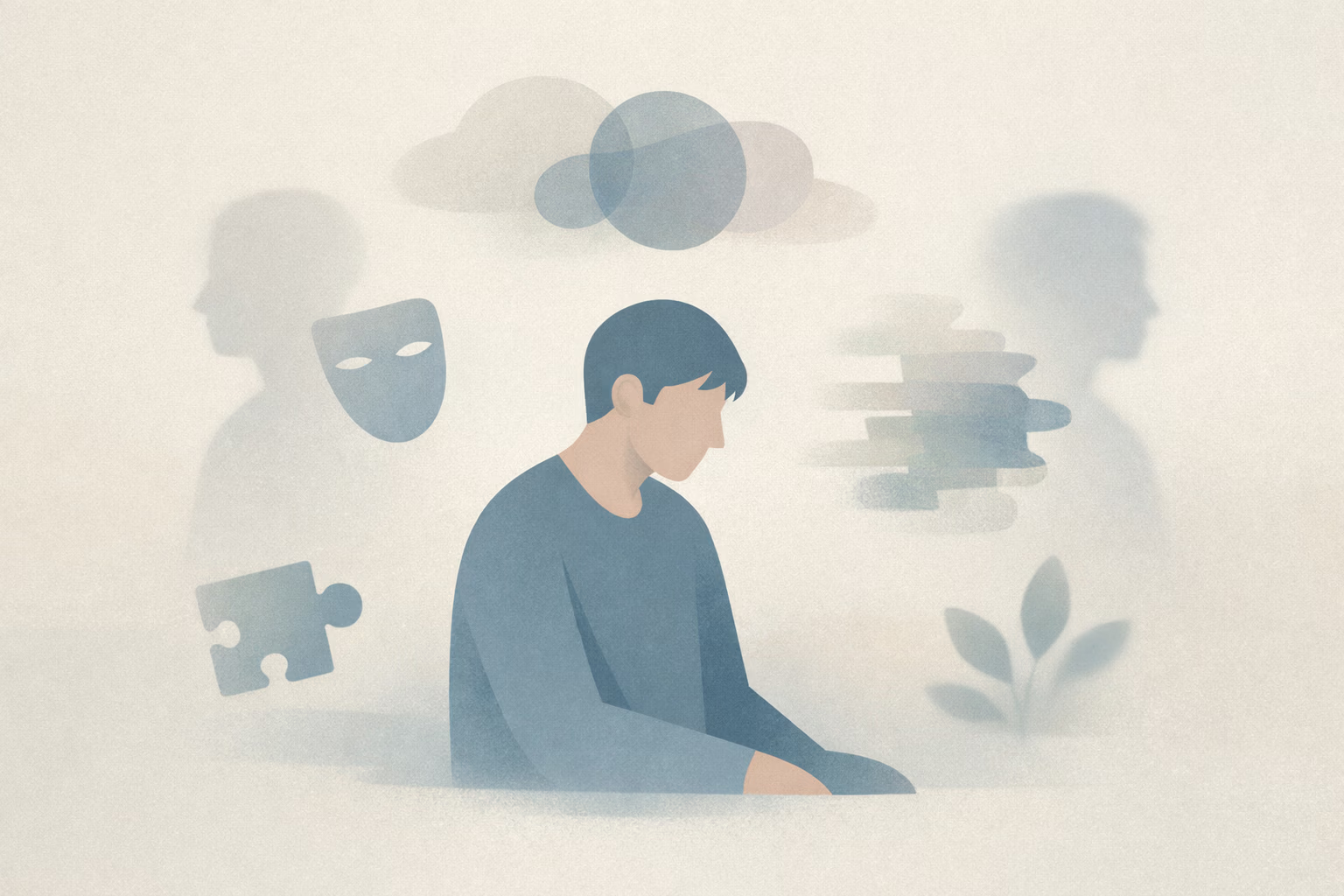
People often describe alignment drift as a subtle internal distance. You can still perform your roles, keep commitments, and appear “fine,” yet there’s a private sense that your reactions are slightly borrowed—like you’re wearing a life that fits but doesn’t warm.
This can come with confusion and quiet grief: not necessarily sadness in the foreground, but a lingering sense of missingness. The system is picking up that something is unintegrated—unfinished loops, unsaid truths, unchosen choices—and it can’t fully stand down. [Ref-1]
It’s not that I don’t have a life. It’s that my life doesn’t feel like it’s coming from me.
Alignment usually isn’t lost in one event. It shifts through micro-compromises: laughing at something you don’t find funny, agreeing to a pace you can’t sustain, staying quiet to keep things smooth, choosing what’s expected over what’s true-to-you.
Each deviation is often understandable in the moment. The issue is accumulation. When the story of your days contains many small “not-quite-me” moves, narrative continuity weakens. Then the brain naturally looks for external cues—metrics, approval, group norms—to replace what used to be an internal reference point. [Ref-2]
Over time, the question changes from “What matters to me?” to “What will keep things stable?”
Humans are built for social living. Our nervous systems track inclusion, status, and conflict because, historically, social rupture carried real survival costs. This is not overthinking—this is biology doing its job.
When social pressure is sustained, the belonging system can become the primary steering mechanism. Values don’t vanish; they simply lose priority when the environment repeatedly signals that safety depends on fitting in. Under that load, “authentic” choices can start to feel risky, complicated, or expensive—even when nothing overt is happening. [Ref-3]
Micro-compromises often function as short-term friction reducers. They bypass an argument, prevent awkwardness, avoid exclusion, keep a group mood stable, or protect your role. In the moment, the body registers relief: fewer social threat cues, less conflict energy to metabolize.
The catch is that relief is not the same as completion. When your system repeatedly chooses the path that reduces immediate social pressure, it may never receive a “done” signal around what you actually meant, needed, or valued. That unclosed material stays active in the background as low-grade tension or internal distance—an experience many people describe as alienation from self. [Ref-4]
There is a particular kind of ease that comes from aligning with what’s already established: the group’s preferences, the workplace tempo, the family script, the dominant worldview. It reduces decision load. It keeps you legible to others. It makes the day run.
But when this becomes the default, identity clarity slowly thins out. You may stop trusting your own signals—not because you’re incapable, but because you’ve trained your system to treat external feedback as the most relevant data. Over time, the internal sense of “I know where I stand” can be replaced by “Tell me what this should be.” [Ref-5]
It can help to think of alignment drift as a loop shaped by conditions. Not a psychological defect—an adaptive pattern. When the environment repeatedly rewards smoothness and punishes friction, the system learns to bypass resistance and mute consequence.
Each time you take the socially safer route, you get an immediate downshift in activation. That downshift is reinforcing. The loop is simple: external comfort replaces inner orientation, and the absence of immediate consequences makes it harder to notice what’s being traded away. Over time, the loop becomes normal, and “normal” becomes the only reference you have. [Ref-6]
Alignment drift doesn’t always look like crisis. Often it looks like functioning with a persistent sense of uncertainty—especially around your own preferences, priorities, and voice.
Some common patterns include:
Research on authenticity and well-being often finds that when self-worth becomes contingent on power, approval, or external standing, inner coherence tends to weaken and well-being can suffer. [Ref-7]
When drift persists, identity can start to feel segmented: one self for work, one for family, one for friends, one for being alone. This isn’t “fake.” It’s what happens when the system can’t reconcile competing demands into one integrated storyline.
Fragmentation increases nervous system load. More context-switching, more monitoring, more “Who am I here?” calculations. Over time, meaning can collapse—not as dramatic emptiness, but as a flatness where things that should matter no longer register as organizing signals. Studies linking authenticity, uniqueness, and well-being support the idea that coherence is protective; when it’s reduced, stability is harder to maintain. [Ref-8]
When everything is for someone else, nothing feels like it’s actually mine.
As internal reference points fade, external influence becomes disproportionately powerful. You may find yourself adopting opinions quickly, mimicking a group’s urgency, or feeling thrown off for hours by a small comment. This isn’t oversensitivity; it’s a system without a stable baseline.
Authenticity research often frames this as a relationship between perceived authenticity and well-being: when you experience yourself as less “self-authored,” regulation becomes harder and life feels less anchored. [Ref-9]
The more the inside goes quiet, the more the outside has to do the steering.
Restoring alignment is not a motivational project. It’s not “understanding yourself better” in the abstract. It’s the gradual return of internal signals once the system has more closure and less conflicting demand.
Often, the first sign is consistency rather than confidence: your yes and no begin to match across contexts; you feel less split when you move between roles. Self-concordant goals—aims that fit your values and identity—tend to be associated with greater well-being, and authenticity is often discussed as part of how that fit becomes sustainable over time. [Ref-10]
Not forced clarity. Not a performance of certainty. More like an inner compass reappearing when the fog lifts.
Humans recalibrate in relationship. Not through interrogation or pressure, but through experiences of being met without needing to contort. When your environment provides safety cues—respect, room to differ, steady connection—your system can afford to stop scanning and start settling.
From a self-determination perspective, autonomy and relatedness are not opposites; they support each other when the social field allows real choice and honest belonging. In those conditions, identity tends to stabilize because you don’t have to abandon yourself to stay connected. [Ref-11]
When I don’t have to prove I belong, I can finally hear myself again.
As coherence returns, people often report a quieter nervous system: less internal debate, less anticipatory monitoring, fewer after-the-fact spirals. The “self” feels more recognizable—not because you discovered a new truth, but because the system has fewer unfinished social loops running in the background.
Sometimes this shift includes realizing how much you were conforming to a norm that wasn’t actually as unanimous as it seemed. Pluralistic ignorance—when many people privately disagree but publicly go along—can make drift feel mandatory even when it isn’t. When that illusion loosens, internal clarity can come back online with less strain. [Ref-12]
When alignment is restored, direction starts to feel less like constant decision-making and more like a steady organizing principle. You still adapt—because humans do—but adaptation stops being the only tool. There’s more choice in the system.
In drift, the question is often “What will keep me safe right now?” In alignment, the question becomes “What kind of person am I being here?” That shift doesn’t require perfection; it reflects a more stable internal reference point. And as pluralistic ignorance research and explanations often note, groups can collectively maintain a pattern simply because each person assumes everyone else endorses it. When internal reference returns, you’re less likely to be pulled by that invisible consensus. [Ref-13]
Inner alignment drift can feel like you “lost yourself,” but it’s often better understood as a reversible state: a nervous system adapting to conditions that rewarded manageability over coherence. When the environment demands constant fitting-in, drifting is not surprising—it’s functional.
And because it’s functional, it can also change when the conditions around meaning shift: when unspoken loops close, when social reality becomes more honest, when your life stops requiring constant self-editing. Sometimes the biggest relief is realizing you were never the only one quietly going along. [Ref-14]
Agency returns most reliably when self-blame leaves the room and orientation becomes possible again.
You don’t have to erase the past to come back into alignment. Those micro-compromises were often intelligent responses to social pressure and limited options. [Ref-15]
What changes the future is not punishing yourself for adapting, but recognizing that you can be authored again. Not as a dramatic reinvention—more as a steady return of coherence, where your life gradually feels like it’s coming from you.
From theory to practice — meaning forms when insight meets action.
Through tiny deviations, not big decisions — the article is precise about this. Alignment usually isn't lost in one event; it shifts through micro-compromises: laughing at something you don't find funny, agreeing to a pace you can't sustain, staying quiet to keep things smooth, choosing what's expected over what's true to you. Each deviation is understandable in the moment. The issue is accumulation. When the story of your days contains many small not-quite-me moves, narrative continuity weakens. The brain then looks for external cues — metrics, approval, group norms — to replace what used to be an internal reference point.
Because belonging systems can override values under sustained pressure. The article connects this to biology: humans are built for social living, and our nervous systems track inclusion, status, and conflict because rupture historically carried real survival costs. When social pressure is sustained, the belonging system becomes the primary steering mechanism. Values don't vanish — they lose priority when the environment repeatedly signals that safety depends on fitting in. Authentic choices start feeling risky, complicated, or expensive even when nothing overt is happening. Conformity reduces decision load and keeps you legible to others. It's not weakness — it's biology under sustained social pressure.
Yes — the article frames it as a loop shaped by conditions rather than a defect. When the environment repeatedly rewards smoothness and punishes friction, the system learns to bypass resistance and mute consequence. Each socially safer route gives an immediate downshift in activation, which is reinforcing. Short-term: less conflict, less scrutiny, fewer ripples. Long-term: less coherence, less self-recognition, fewer Done Signals. External comfort replaces inner orientation, and the absence of immediate consequences makes it harder to notice what's being traded away. Over time the loop becomes normal, and normal becomes the only reference you have.
Consistency before confidence — that's how the article describes restoration. Often the first sign isn't certainty but coherence: your yes and no begin to match across contexts, you feel less split moving between roles. Internal reference reappears not as forced clarity but as a quieter nervous system: less internal debate, less anticipatory monitoring, fewer after-the-fact spirals. Sometimes it includes realizing how much you were conforming to a norm that wasn't as unanimous as it seemed. You don't have to erase the past to come back into alignment — those compromises were intelligent responses to social pressure. What changes the future is recognizing you can be authored again, steadily, as your life feels like it's coming from you.
From Science to Art.
Understanding explains what is happening. Art allows you to feel it—without fixing, judging, or naming. Pause here. Let the images work quietly. Sometimes meaning settles before words do.
One Quiet Window, one insight, one reflection — every Sunday