Internal Resistance: Why You Fight the Good Habits You Want
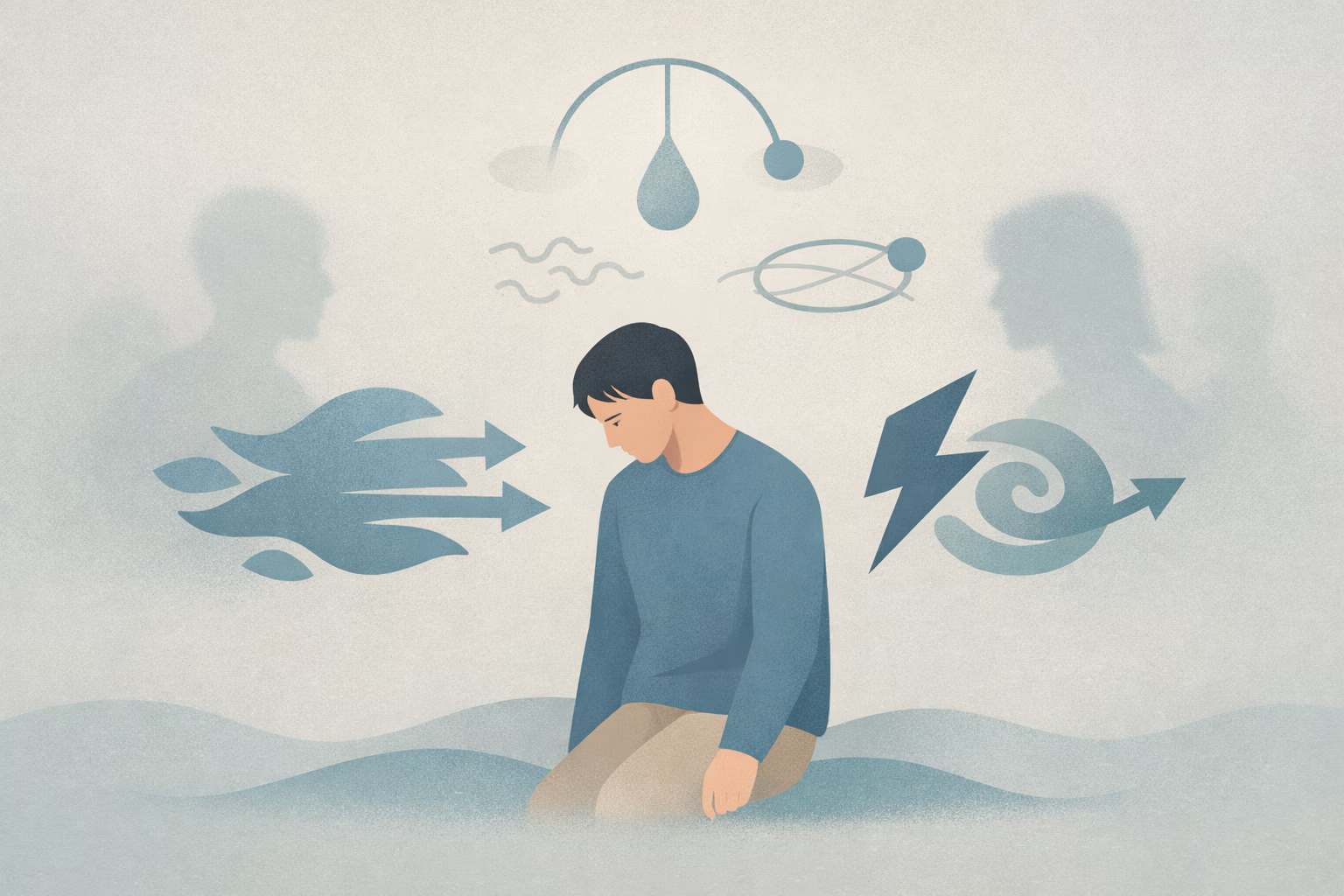
In short: Inner friction is the quiet, expensive tension that happens when competing values, roles, or self-concepts are all trying to be “the real me” at the same time. It can look like indecision, procrastination, second-guessing, or a persistent sense that you’re behind—even when you’re doing plenty.
Inner friction is the quiet, expensive tension that happens when competing values, roles, or self-concepts are all trying to be “the real me” at the same time. It can look like indecision, procrastination, second-guessing, or a persistent sense that you’re behind—even when you’re doing plenty.
What if your exhaustion isn’t laziness or lack of willpower—what if it’s unresolved internal traffic?
From a nervous-system perspective, inner friction is often less about character and more about load. When your system doesn’t receive a clear “done” signal—when identity questions remain unfinished—your attention keeps getting pulled back into monitoring, evaluating, and bracing.
When you’re pulled between an old way of being and an emerging one, the strain often shows up as mental tiredness first: rereading the same sentence, restarting tasks, forgetting why you walked into a room. This isn’t mysterious. Competing inner commitments require constant switching and constant self-checking.
Many people also notice a bodily layer: tight chest, clenched jaw, restless legs, shallow breathing. The body is tracking uncertainty and keeping readiness high, even if you’re “just thinking.” Identity conflict is a known source of internal tension and depletion because it makes everyday choices feel riskier than they objectively are. [Ref-1]
In that state, even small decisions can feel heavy—not because you can’t decide, but because each option quietly activates a different “who am I in this choice?”
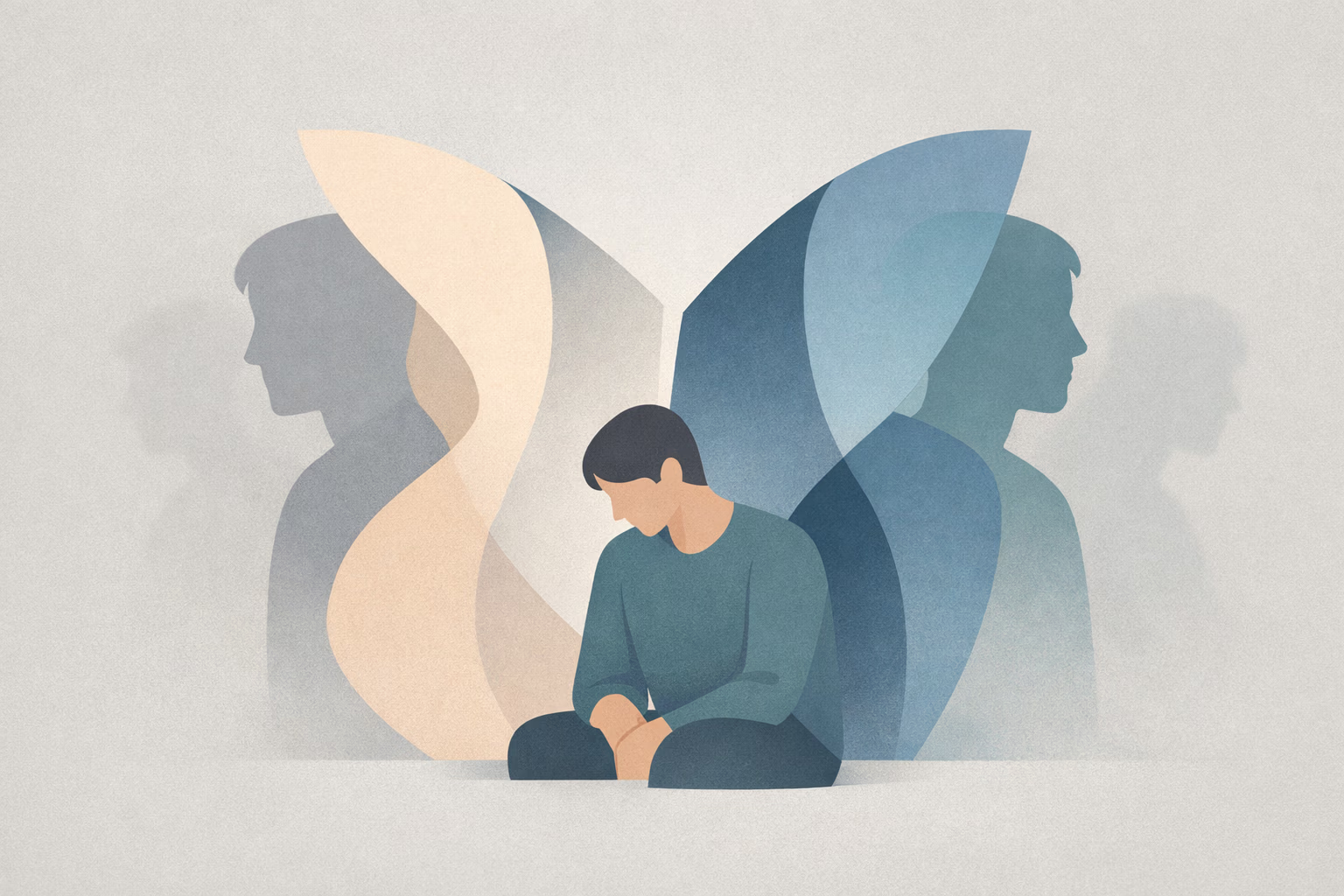
Your brain builds efficiency through stable patterns: “In this situation, I do this.” Identity is part of that patterning. When two self-narratives compete—like “I’m dependable and available” versus “I’m building a life with boundaries”—the brain has to keep both maps online and compare them in real time.
That comparison costs resources. It increases cognitive load, creates more internal monitoring, and can amplify stress physiology. Over time, the system may default to the safest short-term outcome: delay, avoid, or keep options open so no identity narrative “loses.” Research overviews of identity conflict describe how these competing demands can reduce behavioral consistency and increase strain. [Ref-2]
Importantly, this isn’t you being dramatic. It’s a predictable effect of running overlapping, unresolved identity programs at once.
Inner friction hits humans hard because our nervous systems are built for social living. To stay connected and safe, we track how we’re seen, whether we’re predictable, and whether our actions match our roles. A coherent identity isn’t just “self-esteem”—it’s a coordination tool.
That’s why identity conflict can feel urgent. It threatens predictability: to yourself (“What kind of person am I?”) and to others (“What can they expect from me?”). The more change you’re undergoing—new job, parenthood, illness, relocation, spiritual shift—the more likely the old identity and the new identity overlap before they settle. [Ref-3]
In modern life, change arrives faster than completion. So the system spends more time in transition mode—alert, scanning, and not fully landing anywhere.
Holding two identities at once can create a temporary sense of control: you don’t have to disappoint anyone, you don’t have to grieve the old self, and you don’t have to face the consequences of a clear choice yet. It can feel like staying flexible.
Physiologically, ambiguity sometimes reduces immediate threat because nothing is finalized. But the cost is ongoing activation: the brain keeps checking, “Are we safe with this? Are we safe with that?” Models of identity conflict describe how uncertainty can trigger inhibition and vigilance—more pausing, more scanning, less follow-through. [Ref-4]
When nothing is decided, everything stays on the table—and your system keeps paying attention to all of it.
It’s easy to assume that keeping multiple selves alive is the safer route. But unresolved identity isn’t neutral storage; it’s active processing. Each time you revisit the question, your nervous system re-enters evaluation mode, searching for a stable answer that hasn’t been completed yet.
Over time, that can create a specific kind of tired: not “I did too much,” but “I never arrive.” Studies on coping with identity conflict note that how people perceive their self-concept—flexible versus fixed—shapes how draining the conflict becomes. [Ref-5]
Flexibility can be supportive, but only if it eventually consolidates into a lived-through coherence. Otherwise, flexibility becomes permanent holding.
Inner friction often functions like an avoidance loop—not because you’re “afraid of your feelings,” but because the system is receiving mixed identity signals that prevent completion. One signal says “move forward,” another says “maintain the old contract.” The result is a stall.
In that stall, short-term relief comes from not committing. The loop tightens because the non-decision reduces immediate social or internal conflict, even as it prolongs the underlying mismatch. In ethically and socially charged situations, identity conflict can keep professionals in prolonged indecision because each path threatens a different core commitment. [Ref-6]
The loop isn’t irrational. It’s a regulation strategy under conditions of incomplete closure.
Because inner friction is often “about identity,” it can disguise itself as many other problems. People may label it as time management, motivation, or self-discipline, when the real issue is competing self-concepts pulling attention in opposite directions.
Procrastination that appears only around certain tasks (the ones linked to identity stakes)
Repeated self-doubt after decisions, even reasonable ones
Mood shifts that track social feedback, evaluation, or performance contexts
Overpreparing, overexplaining, or “checking” to reduce uncertainty
Difficulty committing, even to wanted changes
Identity conflicts can escalate in relational contexts because belonging, reputation, and roles are involved—not as drama, but as structural social pressures. [Ref-7]
When inner friction persists, the system can start to lose the sense of “why.” Not because meaning is gone, but because meaning requires integration—experiences that complete and settle into identity. Without completion, life can feel like constant rehearsal.
People in prolonged friction often report lower satisfaction and higher stress, with a background sense of inauthenticity: “I’m doing things, but I don’t feel like I’m living from myself.” Narrative identity research links authenticity and well-being to coherent self-storying over time, not perfect consistency in every moment. [Ref-8]
Under chronic load, the nervous system may prioritize immediate stabilization (numbing, scrolling, busyness, control) over long-range coherence. That’s not failure. It’s triage.
Competing self-concepts tend to create “gaps”: between what you do and what you value, between your current role and your preferred identity, between who you are publicly and who you are privately. These gaps aren’t just psychological—they become daily micro-frictions that keep the system alert.
Over time, the person may begin to identify with the stall itself: “I’m someone who can’t choose,” “I’m always behind,” “I start and stop.” But structurally, what’s being reinforced is the loop: mixed signals → delayed closure → temporary relief → more mixed signals next time.
Self-discrepancy frameworks describe how persistent gaps between actual, ideal, and “ought” selves can maintain ongoing distress and self-monitoring. [Ref-9]
Reframing inner friction isn’t about positive thinking or a better mindset. It’s about locating the real phenomenon: an identity system trying to consolidate under conditions that prevent closure. In that light, the question shifts from blame to structure.
What identity is being asked to become real—but hasn’t become lived yet?
Reflection and regulation language can be helpful here, but not because insight equals integration. Insight can name the competing selves; regulation can reduce load enough for signals to return. What resolves friction is completion that the nervous system recognizes—when choices, consequences, and values cohere into a stable “this is me now,” rather than a constantly debated proposal. Self-discrepancy discussions often point to the strain of living between maps, and the relief when the gap narrows through coherent alignment. [Ref-10]
Because identity is partly social, inner friction often softens when your environment provides stable cues: permission, recognition, predictable expectations, or simply fewer mixed messages. Support doesn’t “fix” identity. It reduces the amount of internal negotiation required to stay connected.
Mentorship, accountability, and community can function as external coherence: someone reflects your emerging self back to you consistently, which lowers the system’s need to keep re-evaluating. In self-determination research, relatedness and supportive contexts are repeatedly associated with more stable internalization over time. [Ref-11]
This isn’t about being dependent. It’s about how human nervous systems calibrate identity in relationship.
When inner friction decreases, people often describe a return of usable energy—not as hype, but as fewer internal stoppages. The nervous system stops spending so much on monitoring, justification, and rehearsal. Choices become simpler because they reference a clearer identity.
More follow-through with less internal bargaining
A steadier sense of “enough,” even when life is still busy
Less need to explain yourself to yourself
More consistency across contexts (work, relationships, private life)
In self-determination theory, alignment with autonomy (self-endorsed direction), competence (effective action), and relatedness (secure connection) is associated with greater vitality and well-being. [Ref-12]
Not perfection—just less internal drag.
A unified self-concept doesn’t mean you never feel conflict. It means conflict resolves faster because there’s a clearer organizing center—values that have become embodied enough to guide behavior without constant debate.
When identity coherence strengthens, energy shifts from self-management to living. Attention becomes available for relationships, craft, play, and real-world problem solving. In SDT language, behavior becomes more self-determined—less driven by pressure and more guided by internalized values and stable commitments. [Ref-13]
It’s not that life gets easy. It’s that you stop arguing with yourself about who has to be the one living it.
Inner friction often arrives at the exact moment something meaningful is trying to change shape: a role outgrows you, a value becomes non-negotiable, a boundary wants to become real, a new identity asks for space in your life. The friction is information—evidence of competing contracts inside a system built for coherence.
In modern environments that keep people constantly evaluated and rarely complete, dissonance can become chronic and draining, sometimes tracking with burnout-like patterns. [Ref-14] That doesn’t make you broken. It means your system is asking for fewer open loops and a more livable story.
Agency often returns not through force, but through the quiet stabilization that comes when life becomes more internally consistent—when the nervous system can finally stand down from constant negotiation.
Inner friction is common during transitions because humans are designed to seek consistency between what we believe, what we do, and who we understand ourselves to be. When those elements temporarily diverge, dissonance is a natural byproduct—not a diagnosis. [Ref-15]
Over time, conflicting selves don’t need to fight for dominance. They can reorganize into something more coherent: a self that can hold complexity while still moving in a clear direction. And when that coherence consolidates, it tends to last—less because you “try harder,” and more because your life finally matches the person you’re becoming.
From theory to practice — meaning forms when insight meets action.
Because inner friction is active processing, not neutral storage. When two self-narratives compete — like I'm dependable and available versus I'm building a life with boundaries — the brain has to keep both maps online and compare them in real time. That comparison costs resources, increases internal monitoring, and amplifies stress physiology. Even small decisions feel heavy because each option quietly activates a different who am I in this choice? The exhaustion isn't laziness or lack of willpower; it's unresolved internal traffic. Every revisit re-enters evaluation mode, searching for a stable answer that hasn't been completed yet.
Because mixed identity signals prevent completion. One signal says move forward, another says maintain the old contract. Holding two identities at once creates temporary control: you don't have to disappoint anyone, don't have to grieve the old self, don't have to face consequences yet. Ambiguity reduces immediate threat because nothing is finalized — but the cost is ongoing activation. The Avoidance Loop here isn't fear of feelings; it's the system regulating under incomplete closure. Non-decision reduces immediate conflict while prolonging the underlying mismatch. When nothing is decided, everything stays on the table, and your system keeps paying attention to all of it.
Because inner friction disguises itself. People label it as time management, motivation, or self-discipline, when the real issue is competing self-concepts pulling attention in opposite directions. Procrastination often appears only around tasks linked to identity stakes — those carrying signals of who you'll be afterward. Repeated self-doubt after reasonable decisions, mood shifts that track evaluation contexts, overpreparing to reduce uncertainty, difficulty committing even to wanted changes — these aren't separate problems. They're the same loop showing up wherever the gap between who you've been and who you're becoming has to be navigated.
Not by silencing one side — by completion. The question shifts from what's wrong with me? to what identity is being asked to become real but hasn't become lived yet? Insight names the competing selves; regulation reduces load enough for signals to return; but what resolves friction is completion the nervous system recognizes — when choices, consequences, and values cohere into a stable this is me now. A unified self-concept doesn't mean you never feel conflict; it means conflict resolves faster because there's a clearer organizing center. You stop arguing with yourself about who has to be the one living it.
From Science to Art.
Understanding explains what is happening. Art allows you to feel it—without fixing, judging, or naming. Pause here. Let the images work quietly. Sometimes meaning settles before words do.
One Quiet Window, one insight, one reflection — every Sunday