
Cognitive Overload: When Your Brain Reaches Its Limit
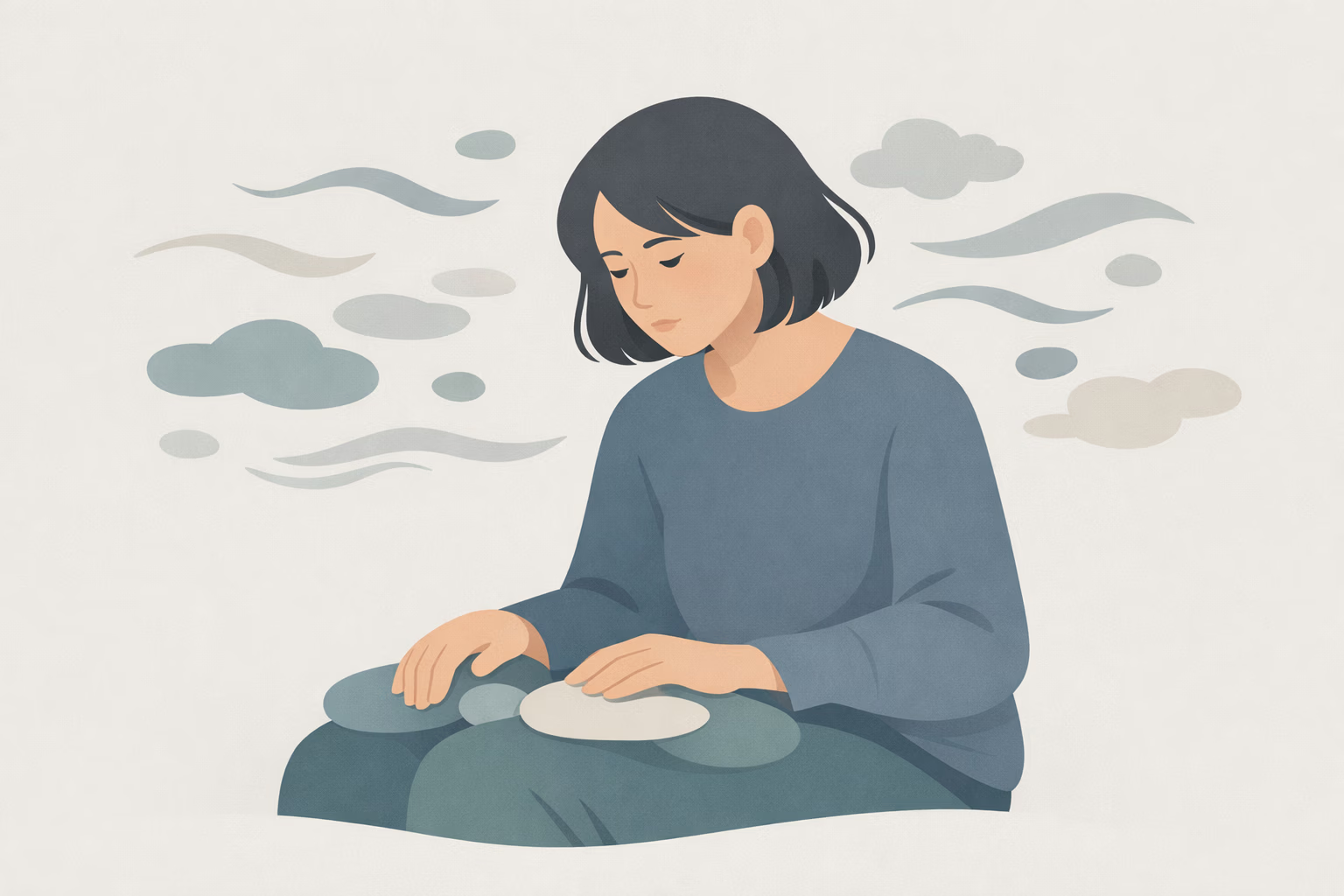
In short: Inner noise can feel like living with a running commentary: reminders, worries, mental rehearsals, post-conversation reviews, and a background sense that something still needs tracking. It isn’t always dramatic. Sometimes it’s just… constant.
Inner noise can feel like living with a running commentary: reminders, worries, mental rehearsals, post-conversation reviews, and a background sense that something still needs tracking. It isn’t always dramatic. Sometimes it’s just… constant.
In the Meaning Density view, this kind of mental clutter is less about a “busy personality” and more about overlapping, unresolved loops competing for limited attention. When life doesn’t offer clear endings, your mind keeps generating activity to hold the pieces together.
What if the nonstop thinking isn’t a character flaw—but your system trying to create closure in an environment that won’t let anything feel finished?
Inner noise often shows up as a mind that won’t fully stand down: a stream of commentary, planning, analyzing, anticipating, re-checking, and keeping mental tabs on multiple “open items.” Even when nothing urgent is happening, there can be a sense of being mentally on-call.
This isn’t just “having thoughts.” It’s a particular texture of cognition—sticky, repetitive, and difficult to end—where the same themes return with new angles. Research on perseverative cognition describes how worry and rumination can extend stress-related activation beyond the moment that triggered it. [Ref-1]
It can feel like your mind is trying to keep you safe by never letting the thread drop—because dropping the thread might mean losing control of something important.
Executive attention is designed to allocate resources: what matters now, what can wait, what’s done. Inner noise tends to rise when that system can’t confidently mark experiences as complete—when concerns, conflicts, or ambiguous outcomes don’t resolve into a clear “closed file.”
In that state, thinking becomes a stand-in for completion. The mind keeps returning to the same material not because you’re choosing it, but because the system never received enough closure to release it. Perseverative cognition has been linked to sustained physiological and behavioral impact, suggesting that mental looping can act like a prolonged stressor rather than a neutral habit. [Ref-2]
Not all mental activity is problem-solving. Sometimes it’s the nervous system staying engaged because it can’t safely disengage.
Humans evolved with attention systems that prioritize scanning: noticing changes, detecting social signals, tracking uncertainty, and preparing for possible threats. When conditions are unclear, the brain’s default is often “keep monitoring.”
Repetitive thought can be understood as one expression of that monitoring function—an internal form of scanning when the environment (or your social world) feels unresolved. Models of perseverative thought describe it as a multi-factor pattern that can persist because it serves an adaptive purpose under uncertainty. [Ref-3]
So inner noise is not evidence that your mind is broken. It can be evidence that your system is operating exactly as designed—just in a world that supplies far more ambiguity, input, and consequence without closure than most nervous systems can comfortably integrate.
When life feels uncertain, ongoing thinking can create a felt sense of doing something. The mind stays active, which can resemble preparedness: reviewing possibilities, predicting outcomes, running social simulations, building contingency plans.
Importantly, this doesn’t require a story like “you’re afraid to feel” or “you’re suppressing emotions.” Structurally, constant cognition can simply be the easiest available way to maintain readiness when consequences feel muted, delayed, or hard to read. In daily-life research, repetitive thought tends to fluctuate with context and can function like a state of ongoing mental engagement rather than a stable trait. [Ref-4]
In other words: the chatter can be a regulatory posture. It can keep the system mobilized in the absence of clear resolution—even when that mobilization is exhausting.
Many people have been taught—implicitly or explicitly—that more thinking equals more responsibility, more insight, or more maturity. So inner noise can feel like proof you’re staying on top of life.
But high mental activity isn’t the same as clarity. Repetitive thought often fragments attention into micro-concerns, keeping the system busy without producing integration. Research that differentiates adaptive reflection from maladaptive repetitive thought notes that certain styles of repetition are more linked to impairment than to useful problem resolution. [Ref-5]
In an avoidance loop, the system finds a way to stay active without reaching an endpoint. Inner noise can serve that function: it keeps cognition moving so the body doesn’t have to fully downshift into stillness, where unfinished material might register as uncertainty, loss, conflict, or unmet needs.
This isn’t about willpower, and it doesn’t require a dramatic hidden fear. It’s more mechanical than moral: when closure is bypassed, the system searches for substitutes. Thinking can become a substitute for completion—an activity that creates the sense of engagement while postponing the “done” signal that would allow the whole organism to stand down.
Work on the brain’s default mode network describes how internal mentation is a normal, active mode of brain function, not an error—yet it can become over-recruited when demands and unresolved content stack up. [Ref-6]
Inner noise has recognizable patterns. Some are obvious (constant worry); others look like productivity, caretaking, or “being responsible.” What they share is an attention system that can’t find a stable resting point.
Neuroscience discussions of the default network note its role in internal mentation—autobiographical thinking, simulation, and sense-making—which can become dominant when external anchors are weak or when the system is overloaded. [Ref-7]
When inner noise is constant, attention becomes expensive. You may still function, but with reduced margin—less spare capacity for complexity, connection, creativity, or recovery. The cost is not just cognitive; it’s regulatory.
Default mode network research describes how subjective experience is supported by multiple component processes (self-referential thinking, memory, simulation). When these processes are continually recruited, they can crowd out other modes of engagement, especially sustained, present-focused attention. [Ref-8]
Over time, the system can start to treat “quiet” as unfamiliar. Not unsafe in a dramatic sense—just under-signaled. Without repeated experiences of completion, the body doesn’t get enough practice receiving quiet as a cue to stand down.
Inner noise often becomes self-feeding. When the mind is busy, it’s harder to register what actually changed, what is concluded, and what belongs to the past. So fewer experiences convert into integrated memory with a clean endpoint.
Instead, experiences remain partially open: “I still need to figure this out,” “I still don’t know what that meant,” “I still might be judged,” “I still might need to respond.” The brain’s default mode network is frequently discussed in relation to self-referential thought and narrative processing—useful capacities that can also keep the self-story running when closure is missing. [Ref-9]
If the mind is always processing, it may never receive the evidence that processing is complete.
It can be relieving to learn that inner noise isn’t primarily a “mindset problem.” Often, the volume drops when the system encounters conditions that allow completion: clearer endings, fewer competing demands, less ambiguity, more trustworthy feedback, more coherent social reality.
This is not the same as insight or reframing. Understanding why you overthink can be helpful, but integration is different: it’s the body-level settling that occurs after an experience is sufficiently completed—internally and externally—so it can become part of identity rather than remain an active alert.
Research on perseverative cognition in daily life suggests that certain relational contexts can either amplify looping or help it unwind, depending on whether the interaction creates containment and resolution versus more activation. [Ref-10]
Humans are not solo processors. Conversation, attunement, and being accurately mirrored can function like external scaffolding for closure—especially when your mind has been carrying too many threads alone.
At the same time, not all talking is settling. Some forms of shared processing can keep the loop spinning (for example, repeatedly revisiting the same uncertainty without any added containment or endpoint). Research on co-rumination highlights how certain interpersonal patterns can be associated with more perseverative cognition rather than relief. [Ref-11]
The difference is not moral. It’s structural: does the interaction reduce ambiguity and restore coherence, or does it multiply angles and keep attention activated?
Internal quiet is often misunderstood as a special state you “achieve.” More commonly, it emerges as a side effect when demand drops and enough loops get completed. The mind becomes less tasked with protection, tracking, and rehearsal.
People describe this kind of quiet not as emptiness, but as more space between thoughts—more signal return. Attention becomes easier to place, and less effort is required to stay with what’s in front of you. Work linking emotion and cognitive load suggests that affective load can meaningfully shape cognitive bandwidth, which helps explain why reducing internal pressure can restore capacity. [Ref-12]
Quiet doesn’t always feel like bliss. Sometimes it just feels like your system is no longer being recruited for five jobs at once.
When inner noise softens, something subtle becomes available: choice. Not forced choice, not “discipline,” but the ability to let attention be guided by what matters rather than by what is unresolved.
In Meaning Density terms, this is where values can become orientation instead of a slogan. Identity becomes less of a performance and more of a lived coherence: what you do aligns more naturally with what you care about because fewer internal alarms are competing for the steering wheel.
Accounts of cognitive load and emotion emphasize that mental capacity is shaped by more than information volume—it’s shaped by the total load the system is carrying. When load decreases, the same life can feel more navigable, and meaning can show up as a stabilizing organizer rather than another demand. [Ref-13]
If your mind won’t stop talking, it may be because attention is still trying to deliver something important: resolution, coherence, an updated sense of safety, a clearer story about what happened and what it means.
Suppressing the noise often fails because it treats the symptom as the problem. A more dignified frame is that the system is working with the materials it has. When closure is scarce and evaluation is constant, thinking becomes a way to keep the self intact.
Research on emotion regulation and cognitive performance supports the broader point that how internal states are managed and resolved can meaningfully affect cognitive capacity—inner noise is not “just thoughts,” it’s load. [Ref-14]
There is nothing shameful about a mind that keeps talking. That mind is often doing protective work in a world that rarely lets anything fully conclude.
As completion becomes possible—through clearer endings, coherent relationships, and fewer open loops—thought no longer needs to serve as constant guard duty. The quiet that follows is not a performance. It’s a natural stand-down response: the nervous system recognizing, at last, that it can stop holding everything up. [Ref-15]
From theory to practice — meaning forms when insight meets action.
Because executive attention can't confidently mark experiences as complete when concerns, conflicts, or ambiguous outcomes don't resolve into a closed file. Thinking becomes a stand-in for completion. The mind keeps returning to the same material not because you're choosing it, but because the system never received enough closure to release it. The looping isn't proof your mind is broken; it can be evidence your system is operating exactly as designed — just in a world that supplies far more ambiguity, input, and consequence without closure than most nervous systems can comfortably integrate. It's protective work, not a flaw.
The article draws this distinction directly. Awareness can be simple and direct. Inner noise is dense, recursive, self-referential. Clarity tends to reduce options into a coherent next reality; noise multiplies possibilities without completion. Many people have been taught implicitly that more thinking equals more responsibility or maturity, so chatter can feel like proof you're staying on top of life. But high mental activity isn't the same as clarity — repetitive thought often fragments attention into micro-concerns, keeping the system busy without producing integration. Some styles of repetition are more linked to impairment than to useful problem resolution.
Often, yes — and the article is careful that this doesn't require a story about hidden fear. Structurally, when closure is bypassed, the system searches for substitutes. Thinking can become a substitute for completion: an activity that creates the sense of engagement while postponing the Done Signal that would let the whole organism stand down. It's more mechanical than moral. The mind stays active so the body doesn't have to fully downshift into stillness, where unfinished material might register as uncertainty, loss, or unmet need. The chatter is a regulatory posture maintaining readiness.
Not by suppression, which treats the symptom as the problem. Volume drops when the system encounters conditions that allow completion — clearer endings, fewer competing demands, less ambiguity, more trustworthy feedback, more coherent social reality. When load decreases and enough loops close, the mind becomes less tasked with protection, tracking, and rehearsal. People describe this kind of quiet not as emptiness but as more space between thoughts, more signal return. Quiet doesn't always feel like bliss; sometimes it just feels like your system is no longer being recruited for five jobs at once. Stillness arrives when protection is no longer required.
From Science to Art.
Understanding explains what is happening. Art allows you to feel it—without fixing, judging, or naming. Pause here. Let the images work quietly. Sometimes meaning settles before words do.
One Quiet Window, one insight, one reflection — every Sunday