Resetting After Emotional Shock: Nervous System Recovery
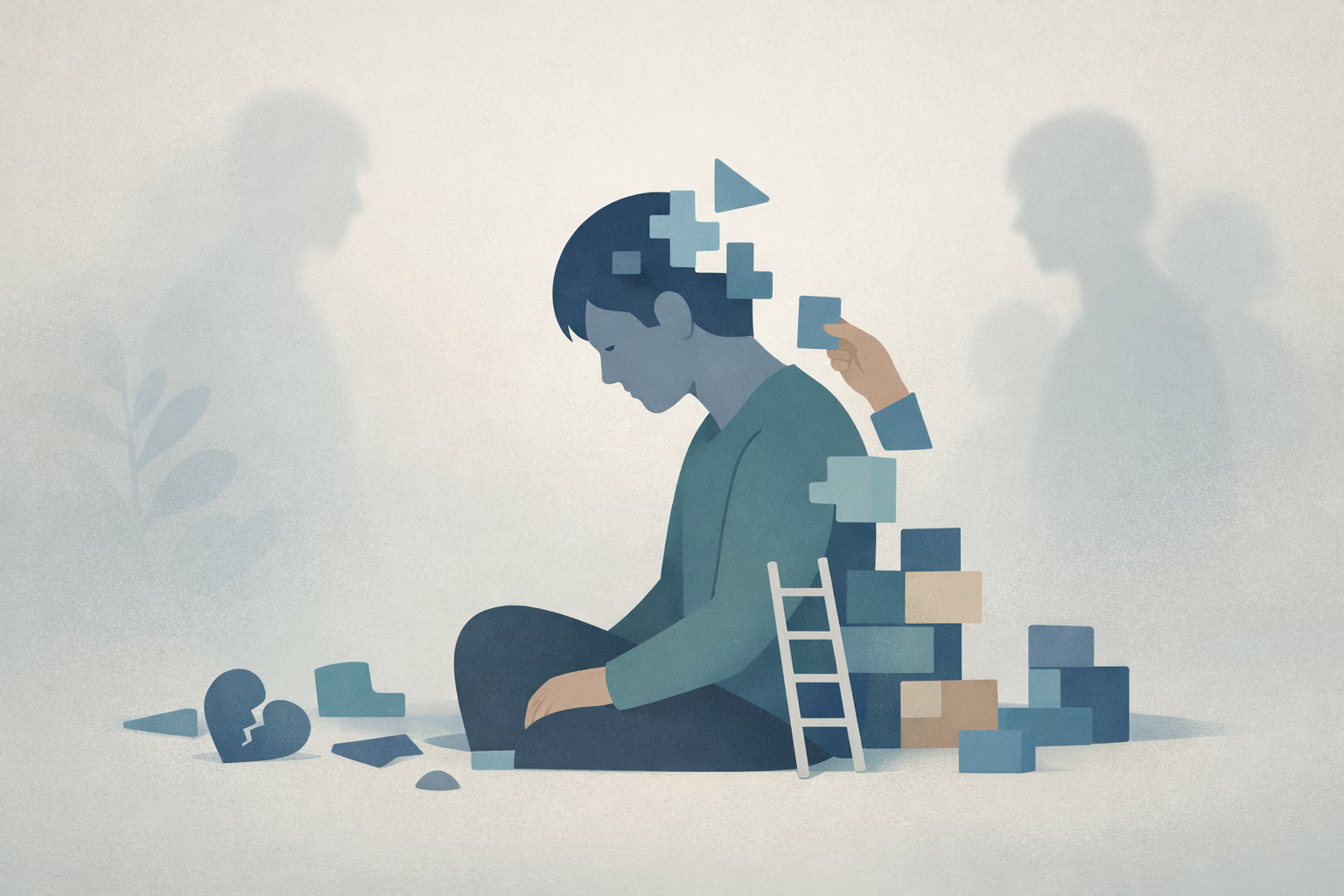
In short: Emotional collapse can feel like more than “having a hard time.” It can feel like the internal structure that used to organize your life—your preferences, priorities, confidence, and sense of direction—has gone offline. What if the emptiness isn’t a personal failure, but a sign that an old identity loop has ended before a new one has formed?
Emotional collapse can feel like more than “having a hard time.” It can feel like the internal structure that used to organize your life—your preferences, priorities, confidence, and sense of direction—has gone offline.
What if the emptiness isn’t a personal failure, but a sign that an old identity loop has ended before a new one has formed?
In a Meaning Density view, human stability comes from coherence: experiences completing, values becoming livable, and identity feeling real in the body—not just understood in the mind. Inner reconstruction is the slow, dignified process where the nervous system stands down from constant scanning and the self becomes workable again.
After a major rupture—loss, betrayal, burnout, illness, a relationship ending, a sudden change—many people report the same strange mix: emptiness, disorientation, and a sense that their usual personality has thinned out. This can be unsettling precisely because it isn’t only sadness or stress; it’s a loss of internal reference points.
In practical terms, identity is a guidance system. It helps you predict what matters, what to do next, and what “counts” as a normal day. When the old structure can’t organize reality anymore, the mind may keep looking for a familiar map and finding none—so everything feels effortful, uncertain, or unreal. That is not a character flaw; it’s a coherence gap. [Ref-1]
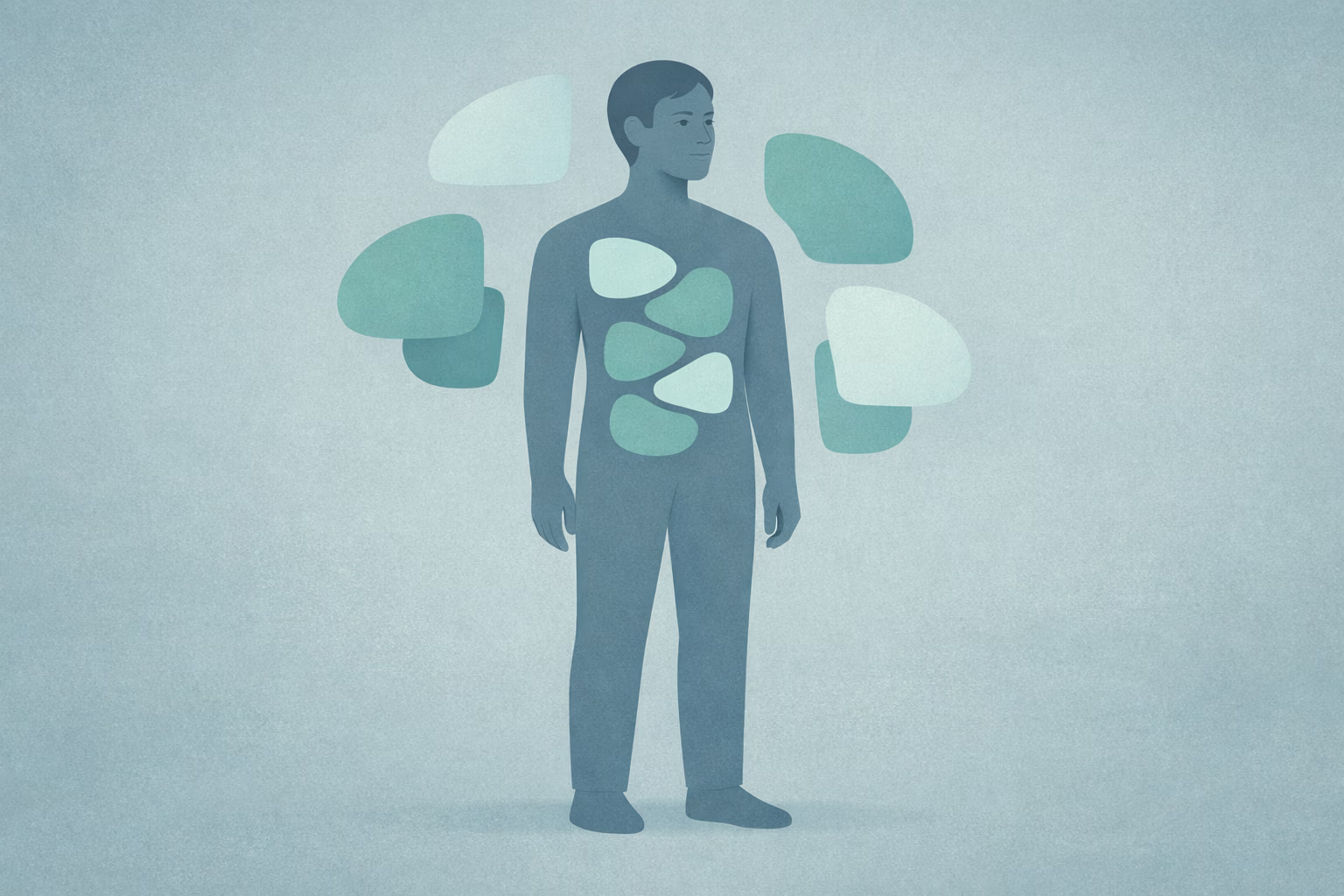
Humans don’t carry identity as a single idea. It’s distributed across memory, attachment expectations, bodily threat detection, and social prediction. When something breaks the assumptions that held your life together, the system can shift into a high-load mode: scanning, bracing, replaying, or shutting down.
This is why collapse can produce “mixed signals” that look contradictory: you may want closeness and also want to disappear; you may crave reassurance and also reject it; you may feel both numb and overwhelmed. These are regulatory responses under strain—your system trying to reduce uncertainty and regain a workable model of reality. [Ref-2]
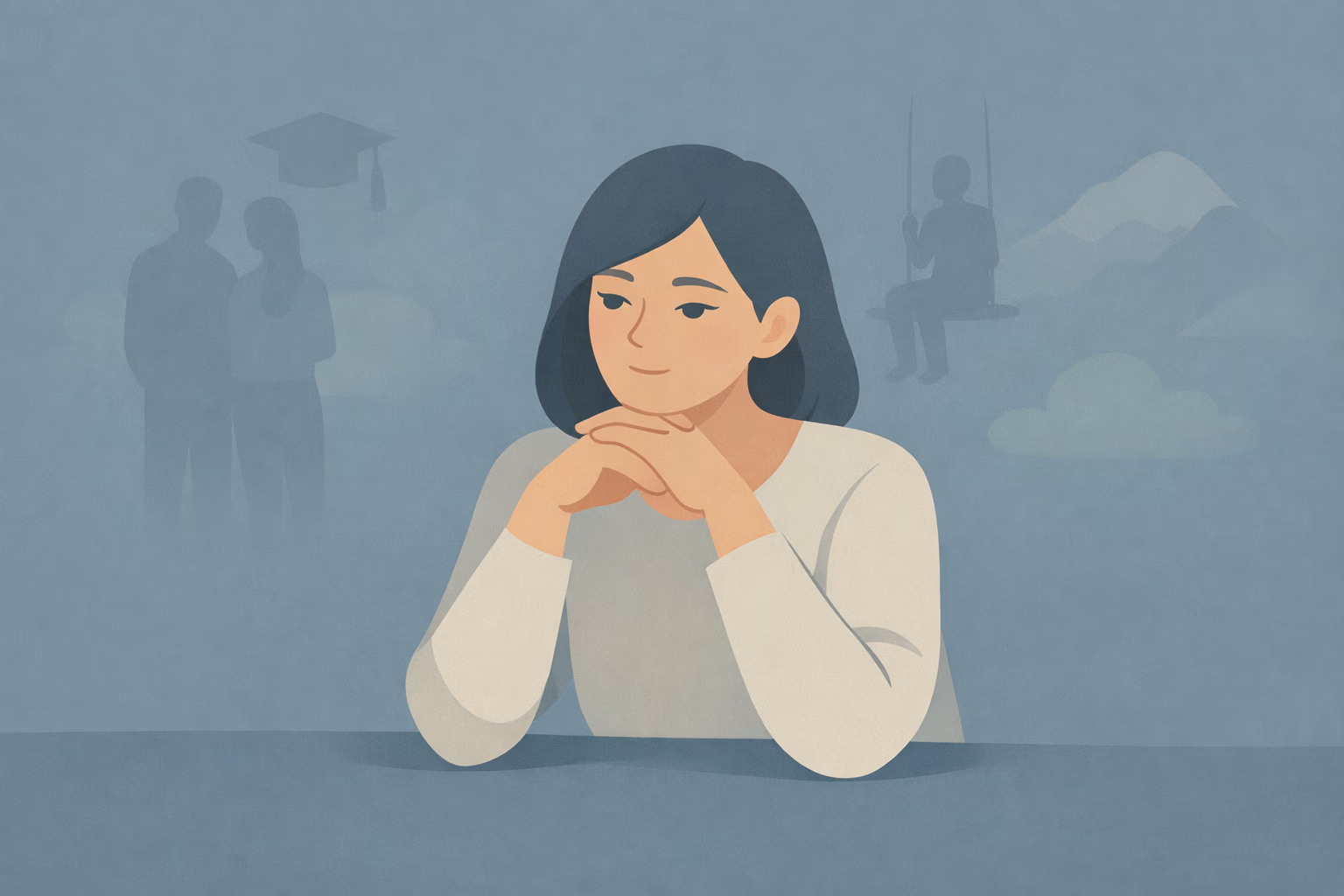
Humans rely on narrative identity: the ongoing story that connects past choices, present roles, and future direction. This isn’t just self-talk—it’s a biological orientation tool that helps the nervous system anticipate what’s safe, what’s expected, and what actions will “make sense.”
When a crisis contradicts the story you were living—“I’m safe,” “I can handle it,” “this relationship is stable,” “my effort leads somewhere”—the narrative can fragment. Without continuity, even simple decisions can feel heavy, because decisions depend on who you believe you are becoming. Narrative approaches in psychology often focus on how people re-author meaning after disruption, because continuity is a stabilizer, not a luxury. [Ref-3]
In the aftermath of collapse, many people experience a quieter, flatter phase: fewer texts answered, less interest in hobbies, reduced initiative, or an impulse to stay small. This is often described as “giving up,” but it can also be the system limiting input when it can’t metabolize more complexity.
When the load is too high, one way the body protects coherence is by lowering intensity—less social exposure, fewer commitments, less stimulation. It’s not necessarily avoidance driven by a single emotion; it can be a structural throttle that reduces competing demands while the system recalibrates.
Sometimes the most honest thing your body can say is: “Not yet. Too much.”
Trauma-related narrative research notes that fragmented experiences can persist without completion, keeping the system activated until there is enough safety and structure for integration to occur. [Ref-4]
Modern culture often frames recovery as a quick return: “You’ll be yourself again soon.” But after emotional collapse, the “old self” may not be available because it was built around assumptions that no longer fit. Reconstruction isn’t about forcing a comeback; it’s about building an identity that can hold what happened.
It’s also why insight alone doesn’t settle the system. You can understand what happened and still feel unmoored, because integration is not a cognitive event—it’s a completion event. The body needs repeated “done” signals: experiences that reach a finish line, roles that become stable again, and meaning that becomes lived rather than analyzed.
Storytelling and narrative coherence are often discussed as pathways to healing because they help experiences become organized and complete enough to stop constantly reactivating. [Ref-5]
After collapse, people often meet a painful paradox: the same internal disorientation that makes life harder also makes reconstruction harder. When identity is unstable, everything requires more effort—work, relationships, self-care, planning, even rest. That extra effort increases load, and higher load reduces coherence.
Over time, this can become a loop: the old identity no longer works, so the system hesitates; hesitation delays completion; lack of completion keeps the system activated; activation makes it harder to form a new stable sense of self. This is not “lack of motivation.” It’s the nervous system stuck without a reliable map.
Many recovery frameworks note that identity reconstruction is a core mechanism of longer-term stabilization—because once identity becomes coherent, behavior requires less force. [Ref-6]
When reconstruction is underway—but not yet complete—the system often expresses a recognizable set of patterns. They can look like personality changes, but they are frequently temporary strategies for managing uncertainty and conserving capacity.
From a narrative standpoint, these patterns can be understood as the mind and body attempting to function without a settled story of self—an understandably unstable situation. [Ref-7]
One of the hardest parts of emotional collapse is the sense that nothing lands. Conversations don’t resolve. Rest doesn’t refresh. Achievements don’t register. This often happens when the system can’t complete experiences into identity—so there’s relief or distraction, but not closure.
Without closure, the nervous system keeps checking: “Are we safe now? Did we handle that? Did we lose something important?” This ongoing checking is exhausting. It can also shrink resilience because capacity is spent on maintaining vigilance rather than rebuilding a stable inner structure.
Narrative medicine and trauma writing frequently emphasize that reconstruction involves forming a self that can contain the experience without constant reactivation—so life can move again without leaving the person behind. [Ref-8]
When a system lacks coherence, it naturally reaches for what used to work: mental replay, problem-solving, control rituals, scrolling, overworking, numbing, self-critique, or constant comparison. These are not “bad habits” in a moral sense; they are attempts to manage the discomfort of unfinished meaning.
But many of these strategies have a structural downside: they reduce contact with completion. Rumination can keep the brain in rehearsal rather than resolution. Avoidance can bypass the moments where new identity would be formed through lived outcomes. Old coping can produce short-term state change—relief, stimulation, sedation—without the “this is now part of me” settling that ends the loop.
Research on self-narrative suggests that meaning construction depends on experiences being organized into a coherent self-understanding; when the loop stays open, the mind keeps returning to it. [Ref-9]
Reconstruction often begins quietly: not as a breakthrough, but as a subtle reduction in internal conflict. The nervous system starts to register that the present is not identical to the collapse. The future becomes thinkable again. The self begins to feel less like a question mark.
What changes is not just your interpretation—it’s your ability to reach completion.
Reflective practices, emotional processing, and nervous-system support are frequently described as helpful in the literature because they can create conditions where the system can finally finish what was interrupted: making sense of events, locating them in time, updating expectations, and allowing a new identity to consolidate. When that consolidation happens, it tends to feel physical: less bracing, fewer spikes, more stable access to values and choice. Post-traumatic growth research highlights that positive personality change can emerge after trauma when meaning is rebuilt in a way that reorganizes the self, not merely the story. [Ref-10]
Humans reconstruct identity socially. Not because you need approval, but because nervous systems use other nervous systems as safety cues. In supportive settings—therapy, steady friendships, groups, mentorship—people often regain coherence faster because their experiences can be witnessed, named, and held without escalation.
This isn’t about being “fixed” by someone else. It’s about having enough relational stability that the system can stop defending every edge and start completing unfinished loops. Accountability relationships can also reduce fragmentation by providing continuity over time: a place where your emerging self is remembered even on days you can’t access it.
Research on post-traumatic growth and trauma recovery commonly notes the role of social support in meaning-making and stabilization, especially when new narratives and identities are forming. [Ref-11]
When reconstruction progresses, people often describe less drama and more traction. Not constant happiness—more reliability. The nervous system spends less time in emergency prediction and more time in ordinary living.
Restoration can show up as:
In post-traumatic growth descriptions, this phase is often marked by a deeper sense of meaning and steadier engagement with life—less because you tried harder, more because the self has reorganized around what is now true. [Ref-12]
Eventually, the center of gravity shifts. The question stops being “How do I get through this day?” and becomes “What kind of life can I honestly live from here?” That shift is not motivational—it’s structural. It reflects an identity that can now carry the past without being constantly pulled back into it.
A renewed identity is not a performance of strength. It’s an internal alignment where values, actions, and lived consequences begin to match again. When the meaning loop closes, agency increases—not as pressure, but as a natural outcome of coherence.
Narrative meaning-making research describes integration as a process where experiences are woven into a coherent life story that supports functioning and well-being; when this happens, people can move forward with less fragmentation and more continuity. [Ref-13]
It’s easy to interpret collapse as proof that you were never solid to begin with. But another interpretation is more humane and often more accurate: something in your life exceeded the capacity of the identity structure you had at the time.
Inner reconstruction is what happens when the system is no longer spending all its energy maintaining a story that doesn’t fit—and begins, gradually, to build one that does. Self-narrative isn’t a vanity project; it’s a way humans coordinate meaning, belonging, and direction. When it’s coherent, behavior becomes less forced and more naturally guided. [Ref-14]
You’re not starting from nothing. You’re starting from what’s true.
There is a particular dignity in rebuilding: not returning to an earlier version of you, but becoming someone who can live with what happened without losing your inner footing. That is not willpower. That is integration—when the body and identity finally receive enough closure to stand down.
Over time, trauma can become part of a coherent life rather than a permanent interruption, and meaning can become something you inhabit rather than chase. In that sense, reconstruction isn’t “moving on.” It’s becoming whole enough to move forward. [Ref-15]
From theory to practice — meaning forms when insight meets action.
Because identity is a guidance system. It helps you predict what matters, what to do next, and what counts as a normal day. After major rupture — loss, betrayal, burnout, a relationship ending — the old structure can no longer organize reality, so the mind keeps looking for a familiar map and finding none. Everything feels effortful, uncertain, or unreal. That's not a character flaw; it's a coherence gap. 'I don't know who I am' is a nervous-system state, not a personality verdict. Identity is distributed across memory, attachment, threat detection, and social prediction — when assumptions break, the system shifts into high-load mode.
Because integration is a completion event, not a cognitive one. You can understand exactly what happened and still feel unmoored. The body needs repeated Done Signals — experiences that reach a finish line, roles that become stable again, meaning that becomes lived rather than analyzed. Modern culture frames recovery as a quick comeback, but after collapse the old self may not be available because it was built around assumptions that no longer fit. Reconstruction isn't forcing a return — it's building an identity that can hold what happened. Storytelling helps because it organizes experience into coherence the system can finally close.
Because internal disorientation makes everything harder, which increases load, which reduces coherence further. The old identity doesn't work, so the system hesitates; hesitation delays completion; lack of completion keeps the system activated; activation makes forming a new stable self harder. This isn't lack of motivation. Old coping patterns — rumination, avoidance, control rituals, numbing — all reduce contact with completion. They produce relief or stimulation without the 'this is now part of me' settling that ends the loop. Without closure, the system keeps checking 'are we safe now,' and that ongoing checking exhausts the very capacity needed to rebuild.
Less drama, more traction. Not constant happiness — reliability. The nervous system spends less time in emergency prediction and more in ordinary living. Clearer preferences return without heavy analysis. Energy stabilizes; fewer extreme swings. Decisions hold — choices feel less reversible and less haunted. Values become reachable, not aspirational. Co-regulation accelerates this: nervous systems use other nervous systems as safety cues, so witnessed and held experiences integrate faster than analyzed ones. Reconstruction isn't moving on; it's becoming whole enough to move forward. You're not starting from nothing — you're starting from what's true.
From Science to Art.
Understanding explains what is happening. Art allows you to feel it—without fixing, judging, or naming. Pause here. Let the images work quietly. Sometimes meaning settles before words do.
One Quiet Window, one insight, one reflection — every Sunday