Fight, Flight, Freeze: Understanding Shutdown Mode
In short: Emotional shock isn’t just “a lot of feelings.” It’s an acute surge of nervous system load that can arrive in seconds and take much longer to settle. Even when the event is finished, the body may still be running a protection program—scanning, bracing, staying ready—because the internal loop that signals done hasn’t completed yet.
Emotional shock isn’t just “a lot of feelings.” It’s an acute surge of nervous system load that can arrive in seconds and take much longer to settle. Even when the event is finished, the body may still be running a protection program—scanning, bracing, staying ready—because the internal loop that signals done hasn’t completed yet.
In that state, common reactions (numbness, urgency, irritability, insomnia, avoidance, overcontrol) aren’t personality traits. They’re regulatory responses: ways the system tries to reduce risk and restore predictability when the world feels suddenly less reliable.
Why does your system act like the emergency is still happening—when you know it’s not?
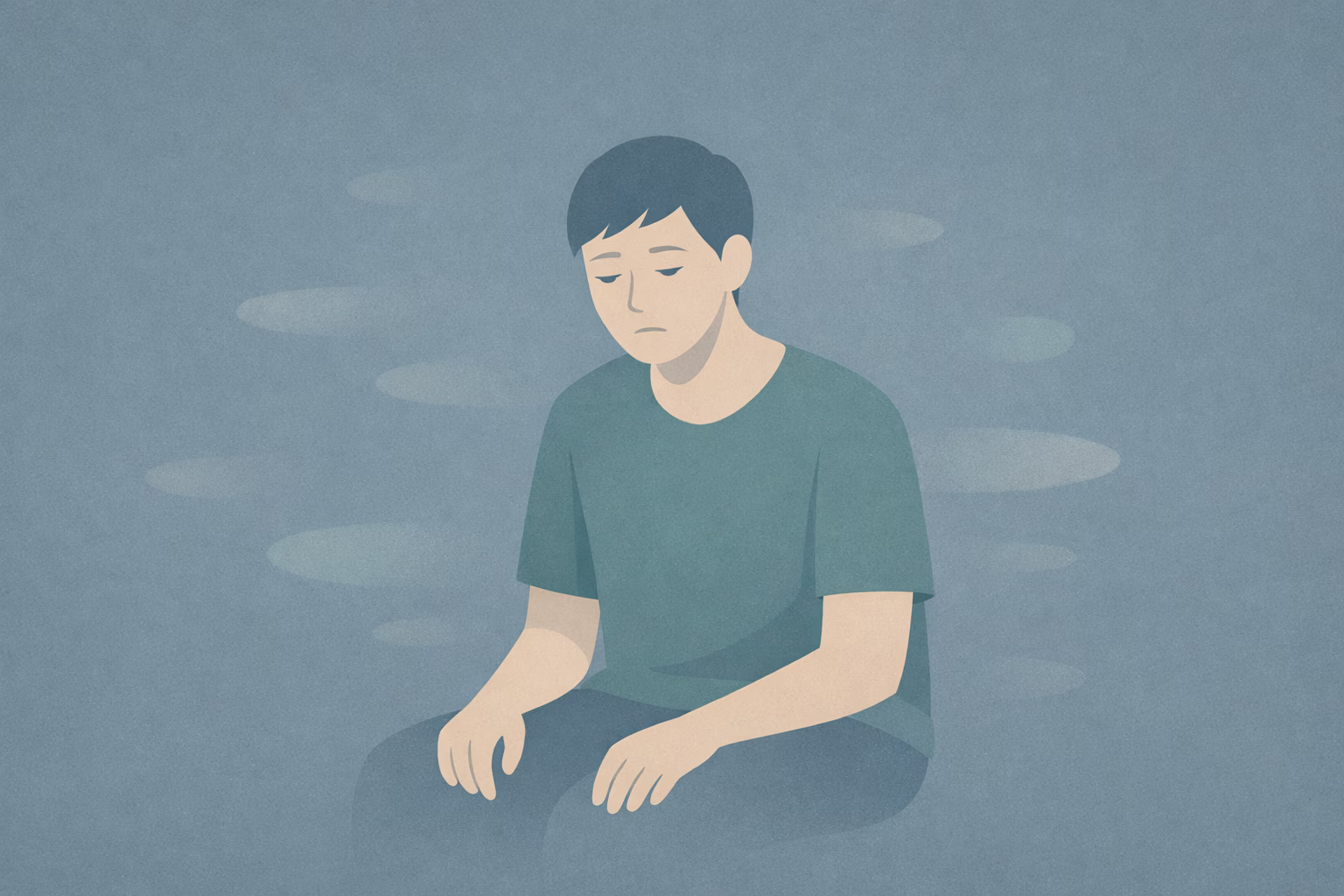
Many people describe the days after emotional shock as strangely unreal: you’re functioning, but not fully oriented. You might replay details, feel jumpy in quiet rooms, or notice that ordinary tasks take more effort than usual. This isn’t “overreacting.” It’s what it can feel like when the nervous system is still carrying a high-activation state after the external moment has passed. [Ref-1]
From the inside, this can look confusing: “Nothing is happening right now—so why can’t I settle?” But the body doesn’t reset on information alone. It resets when it receives enough safety cues and closure signals for threat circuits to stand down.
Shock can leave you living in a body that’s still waiting for the next impact.
Emotional shock often involves a rapid spike in stress chemistry and autonomic activation—heart rate changes, breath shifts, muscle tension, altered digestion, narrowed attention. This is not a “choice,” and it’s not primarily cognitive. It’s an organism-level response designed for speed. [Ref-2]
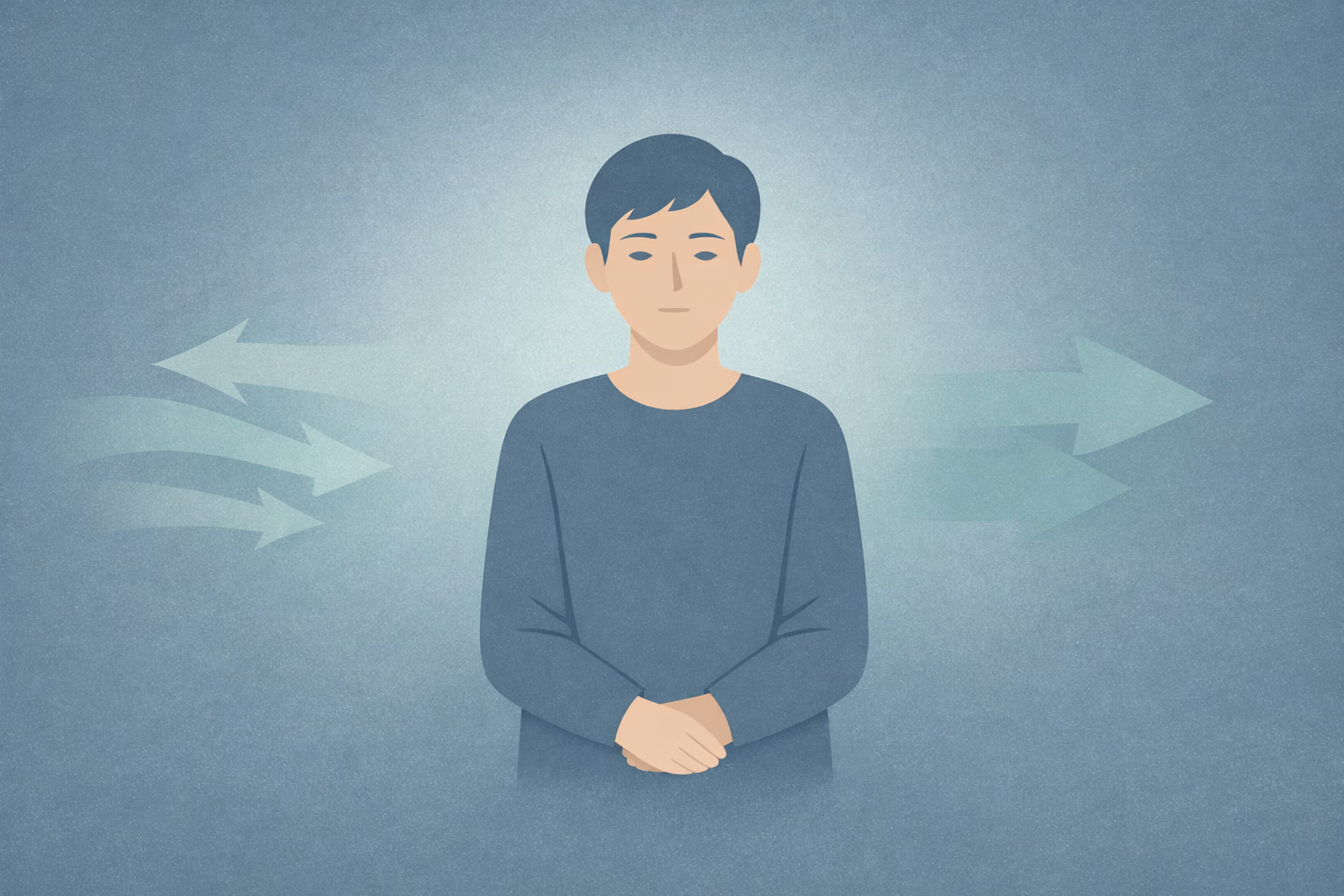
When the surge is intense, the return path to baseline can be delayed. The system may stay partially mobilized (restless, vigilant) or partially shut down (flat, foggy) because both states can reduce exposure to additional demand. Either way, the common thread is load: the nervous system is prioritizing protection over easy access to rest.
In the aftermath, you may notice that cues that used to feel neutral (a notification sound, a particular street, a tone of voice) now carry “edge.” That’s less about meaning-making and more about sensitized detection—your system temporarily treating more inputs as potentially important.
Human stress systems evolved to keep you alive, not to keep you comfortable. When something hits hard—betrayal, sudden loss, a frightening interaction, a medical scare—the body shifts resources toward rapid protection: orienting, mobilizing, withdrawing, or freezing. In that mode, integration is not the priority. Rapid action and risk reduction are. [Ref-3]
This helps explain why emotional shock can feel mentally “unfinished.” It’s not that you haven’t reflected enough. It’s that the nervous system was busy ensuring survival-level stability, and the completion signals that allow the system to close the loop may not have had a chance to land yet.
In the immediate aftermath of shock, ongoing vigilance can be protective. The brain and body may stay primed to detect similar threats, because “predicting the next one” is treated as urgent. Memory and attention can become sticky—replaying, scanning, linking present cues to past danger—because the system is still assembling a coherent map of what happened and what it means for future safety. [Ref-4]
This is one reason people can feel both exhausted and unable to rest. Arousal is expensive, but it can also feel necessary: standing down too soon might be interpreted internally as unsafe. The goal isn’t to stay activated forever; the goal is to avoid being caught off guard again.
What if your hyperalertness isn’t a flaw—just a system delaying the “all clear”?
A common secondary wound after shock is the belief that recovery should be quick, linear, and private. When it isn’t, people often add pressure: “I should be fine,” “Other people handle worse,” “I’m being dramatic.” That pressure increases load—and load prolongs protection states.
Shock can linger because activation lingers. Without sufficient settling, the nervous system doesn’t receive the embodied completion cues that mark an experience as finished. The story may be understood, but the system can still be running a partial threat response. This is why time alone sometimes doesn’t resolve it, especially in environments that keep you stimulated, evaluated, and busy. [Ref-5]
“I know what happened, but my body keeps acting like it’s still happening.”
After shock, avoidance isn’t only about fear or denial. Often it’s structural: the system learns that certain contexts, conversations, places, or internal states increase activation, and it routes around them to prevent overload. In the short run, that bypass can reduce intensity. In the long run, it can also delay closure, because the nervous system doesn’t get enough safe, complete contact to register the experience as fully concluded.
This can create an avoidance loop: lingering activation makes life feel sharper and riskier; life feeling sharper and riskier increases the tendency to reduce exposure; reduced exposure decreases opportunities for completion signals and safety cues; the system remains sensitized. The pattern is coherent from a regulation standpoint—even when it’s frustrating from the outside. [Ref-6]
Importantly, this isn’t a character issue. It’s a state issue. When the system has less capacity, it selects narrower options.
Post-shock reactions often look inconsistent because they’re governed by capacity, not intention. You might do “fine” at work and then unravel at home. Or feel steady all day and then spike at night. These are common signs of a system managing allostatic load—trying to keep the whole organism within tolerable limits. [Ref-7]
Some common patterns include:
These are not separate problems. They’re different regulation strategies a nervous system uses when it hasn’t reached completion.
If emotional shock is repeated—multiple stressors, ongoing conflict, chronic uncertainty—or if recovery space is thin, the nervous system can become more easily activated. This doesn’t mean you’re “getting worse.” It can mean your baseline is carrying more load, leaving less buffer for everyday demands.
Over time, that narrowing can raise vulnerability to anxiety-like states (more scanning, more urgency) or to shutdown states (less energy, less engagement). Social buffering—reliable signals of safety through connection—can reduce physiological stress responses, but modern life often makes those signals inconsistent or scarce. [Ref-8]
In other words: resilience isn’t just grit. It’s the presence of enough regulation resources and enough closure to let the system stand down.
Historically, humans had more built-in endpoints after threat: communal debriefing, physical settling, shared quiet, predictable routines, a sense of being held in a group. Many modern lives lack these “closing ceremonies,” especially after emotionally disruptive events that happen privately (a breakup text, a humiliating meeting, a sudden medical email).
When recovery rituals are absent, stress responses can remain partially open—like a browser tab that keeps using power in the background. That background drain increases sensitivity to future stressors, because the system is already closer to its threshold. Social isolation can amplify this process by removing external safety cues that help the body reorient. [Ref-9]
It can be especially destabilizing when you have to keep performing normalcy while your system is still mobilized. The outward continuity hides the inward incompletion.
Recovery from emotional shock often hinges on a quiet, bodily kind of confirmation: signals that tell the nervous system it can reduce mobilization without increased risk. This isn’t the same as understanding what happened. It’s a gradual downshift in arousal—breath, muscle tone, heart rhythm, attention—until the system can recognize a different state as stable.
From a body–brain perspective, interoceptive signals (internal sensations) help update the brain’s predictions about safety and threat. When internal signals remain tense, fast, or braced, the system tends to keep interpreting the world through a threat-biased lens. When internal signals reliably return toward steadier patterns, the brain has evidence—physiological evidence—that the emergency is no longer the operating context. [Ref-10]
In that way, “resetting” is less like convincing yourself and more like the system completing its own cycle: activation, protection, and then a non-forced stand-down.
Humans regulate in context. A steady, non-demanding relational environment can act as a powerful safety cue: your system receives information that you are not alone, not being evaluated, and not needing to defend your position. This kind of co-regulation isn’t about being “fixed” by someone else; it’s about having enough external steadiness to support internal settling.
When a calm presence is available—someone who stays consistent, attuned, and not escalatory—the body often reduces defensive output. This is part of why practices that cultivate present-moment body awareness and relational safety cues are associated with improved regulation capacity over time. [Ref-11]
Safety isn’t only an idea. It’s a pattern your nervous system can recognize.
As recovery progresses, the change is often less dramatic than people expect. It can look like small returns: more ordinary appetite, fewer spikes, less startle, more reliable sleepiness at night, easier transitions between tasks. The system begins to trust that it can move between activation and rest without getting stuck.
Importantly, this is not about becoming “more emotional.” It’s about becoming more contained—more able to hold signals without immediate escalation or collapse. People often report a quiet restoration of self-trust: not because every memory feels good, but because the body is no longer hijacked by every cue. [Ref-12]
With steadier regulation, the nervous system stops spending so much bandwidth on threat management. That frees attention for ordinary engagement: conversation, creativity, problem-solving, humor, errands—life that isn’t organized around protection. This shift can feel like coming back online.
Sleep often plays a central role here, because ongoing hyperarousal disrupts the body’s ability to downshift at night, and disrupted sleep increases reactivity the next day. When sleep becomes more restorative, the whole system gains more margin. [Ref-13]
Over time, the identity-level effect can be significant: you start to recognize yourself again, not because you forced a new mindset, but because your baseline state is no longer dominated by emergency physiology.
If emotional shock is taking longer than you expected, that doesn’t necessarily mean you’re broken or doing it wrong. It may mean your nervous system is still completing a stress cycle and searching for enough closure to safely stand down. [Ref-14]
From a meaning perspective, this is not just “calming down.” It’s the restoration of coherence: the felt sense that what happened is now in the past, that your body is no longer assigned to constant protection, and that your life can once again be organized by values rather than vigilance.
When recovery is honored as a biological process, shame tends to lose some of its grip. The timeline becomes less about personal adequacy and more about load, safety cues, and completion.
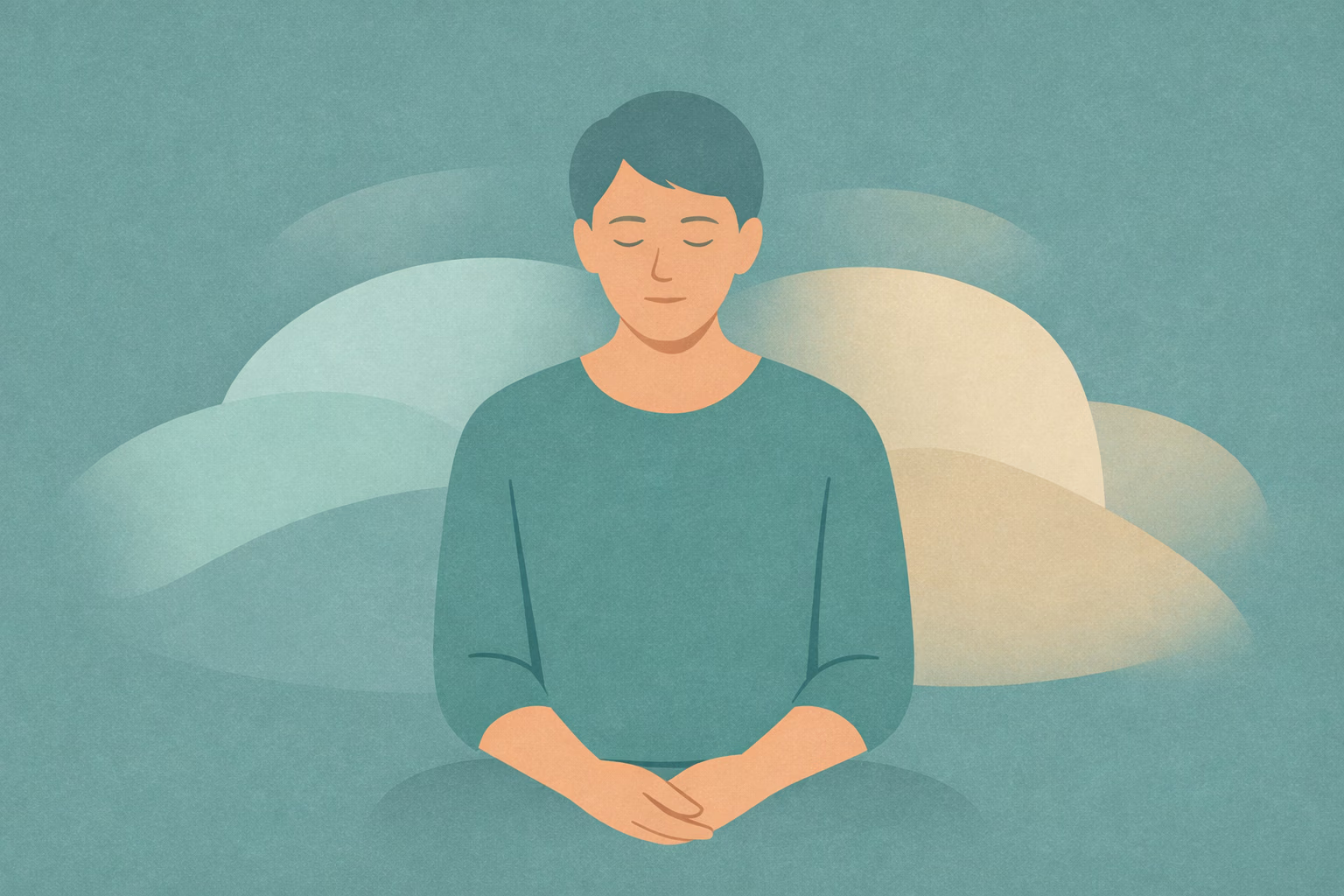
Emotional shock can temporarily rearrange your internal world, not because you’re fragile, but because you’re human. Protection systems do what they’re built to do: keep you oriented to risk until enough safety signals accumulate to permit release.
As that release arrives—often gradually—stability re-emerges in plain ways: steadier mornings, more spacious attention, less bracing, more room for choice. The “all clear” is not a thought you force; it’s a state your system recognizes when safety cues become credible again. [Ref-15]
From theory to practice — meaning forms when insight meets action.
Because the body doesn't reset on information alone. It resets when it receives enough safety cues and closure signals for threat circuits to stand down. Emotional shock involves a rapid spike in stress chemistry and autonomic activation. When the surge is intense, the return path to baseline can be delayed. The system stays partially mobilized (restless, vigilant) or partially shut down (flat, foggy), because both states reduce exposure to additional demand. The event ended; the system didn't. 'I know what happened, but my body keeps acting like it's still happening.'
Because shock can linger because activation lingers. Without sufficient settling, the nervous system doesn't receive the embodied completion cues that mark an experience as finished. The story may be understood, but the system can still be running a partial threat response. Adding pressure ('I should be fine,' 'others handle worse') increases load — and load prolongs protection states. Time alone doesn't always resolve it, especially in environments that keep you stimulated, evaluated, and busy. Recovery isn't weakness; it's completion.
Often structural. The system learns that certain contexts, conversations, places, or internal states increase activation, and routes around them to prevent overload. Short term, the bypass reduces intensity. Long term, it can also delay closure because the nervous system doesn't get enough safe, complete contact to register the experience as fully concluded. The loop becomes self-perpetuating: lingering activation makes life feel sharper; sharper life increases avoidance; reduced exposure decreases completion signals; the system stays sensitized.
Calm relational presence and credible safety cues. A steady, non-demanding environment can act as a powerful safety signal — your system receives information that you're not alone, not being evaluated, not needing to defend. This isn't being 'fixed' by someone else; it's having enough external steadiness to support internal settling. Recovery shows up subtly: more ordinary appetite, fewer spikes, less startle, more reliable sleepiness, easier transitions. The system regains the ability to move between activation and rest without getting stuck.
From Science to Art.
Understanding explains what is happening. Art allows you to feel it—without fixing, judging, or naming. Pause here. Let the images work quietly. Sometimes meaning settles before words do.
One Quiet Window, one insight, one reflection — every Sunday