
Emotional Labor Fatigue: The Hidden Work You Carry

In short: Invisible labor burnout is the particular exhaustion that comes from doing sustained emotional, cognitive, and relational work that is rarely named, counted, or supported. It’s the ongoing effort of anticipating needs, smoothing tension, remembering details, translating feelings, and keeping things from falling apart—often while appearing “fine” on the outside.
Invisible labor burnout is the particular exhaustion that comes from doing sustained emotional, cognitive, and relational work that is rarely named, counted, or supported. It’s the ongoing effort of anticipating needs, smoothing tension, remembering details, translating feelings, and keeping things from falling apart—often while appearing “fine” on the outside.
What if the tiredness isn’t a lack of resilience—but a lack of closure and shared responsibility?
When this kind of work stays unseen, it doesn’t get a natural “done” signal. The body keeps allocating resources to monitoring, buffering, and preparing. Over time, that shapes energy, attention, and even identity: not because someone is broken, but because the system is carrying more load than it can metabolize.
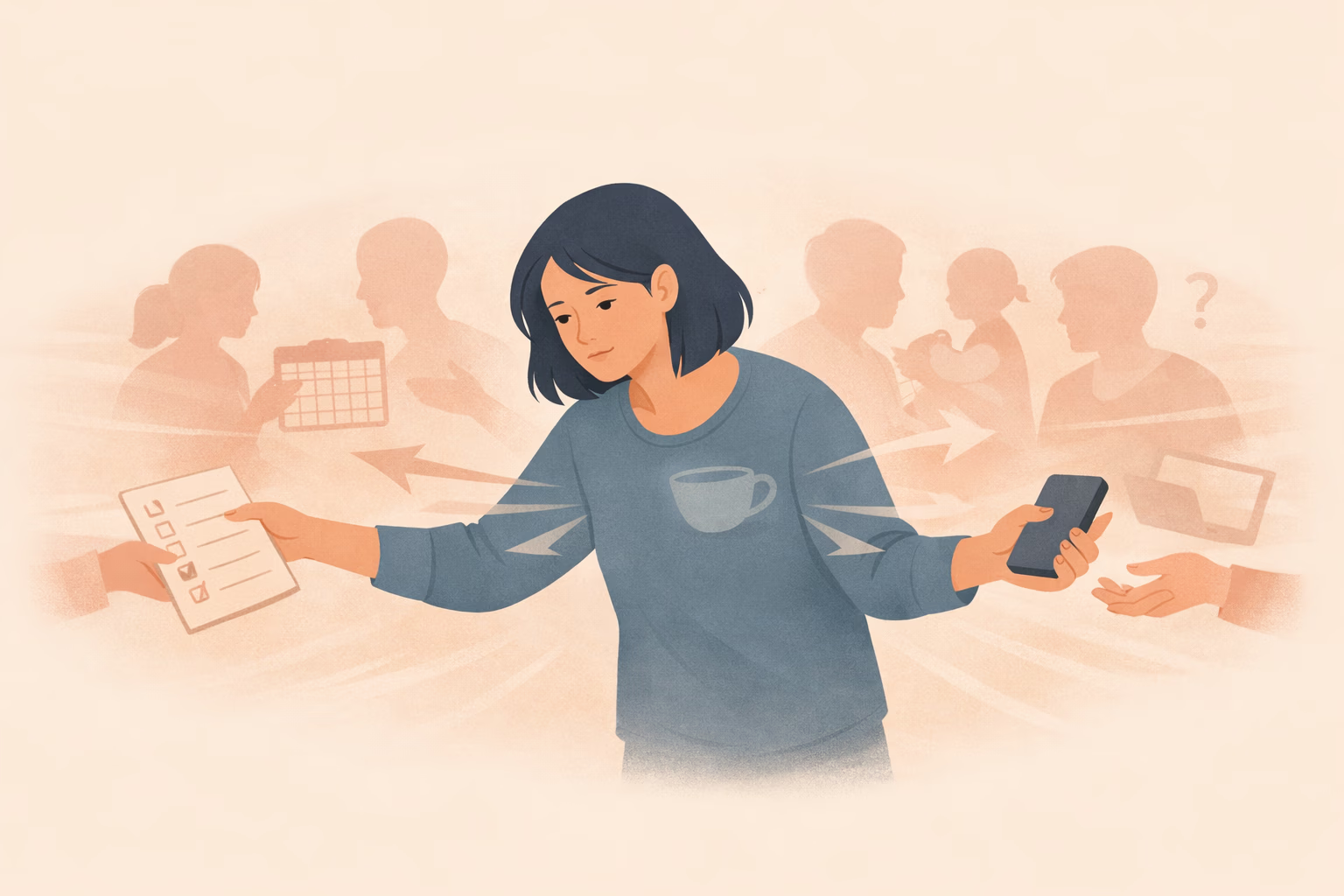
Invisible labor often feels like responsibility without a receipt. You’re not only doing tasks—you’re holding the emotional temperature of a room, the timing of transitions, the unspoken expectations, and the “if I don’t, it won’t happen” layer that never makes it onto a checklist. When it works, it looks like nothing happened. When it fails, it can look like you didn’t do enough.
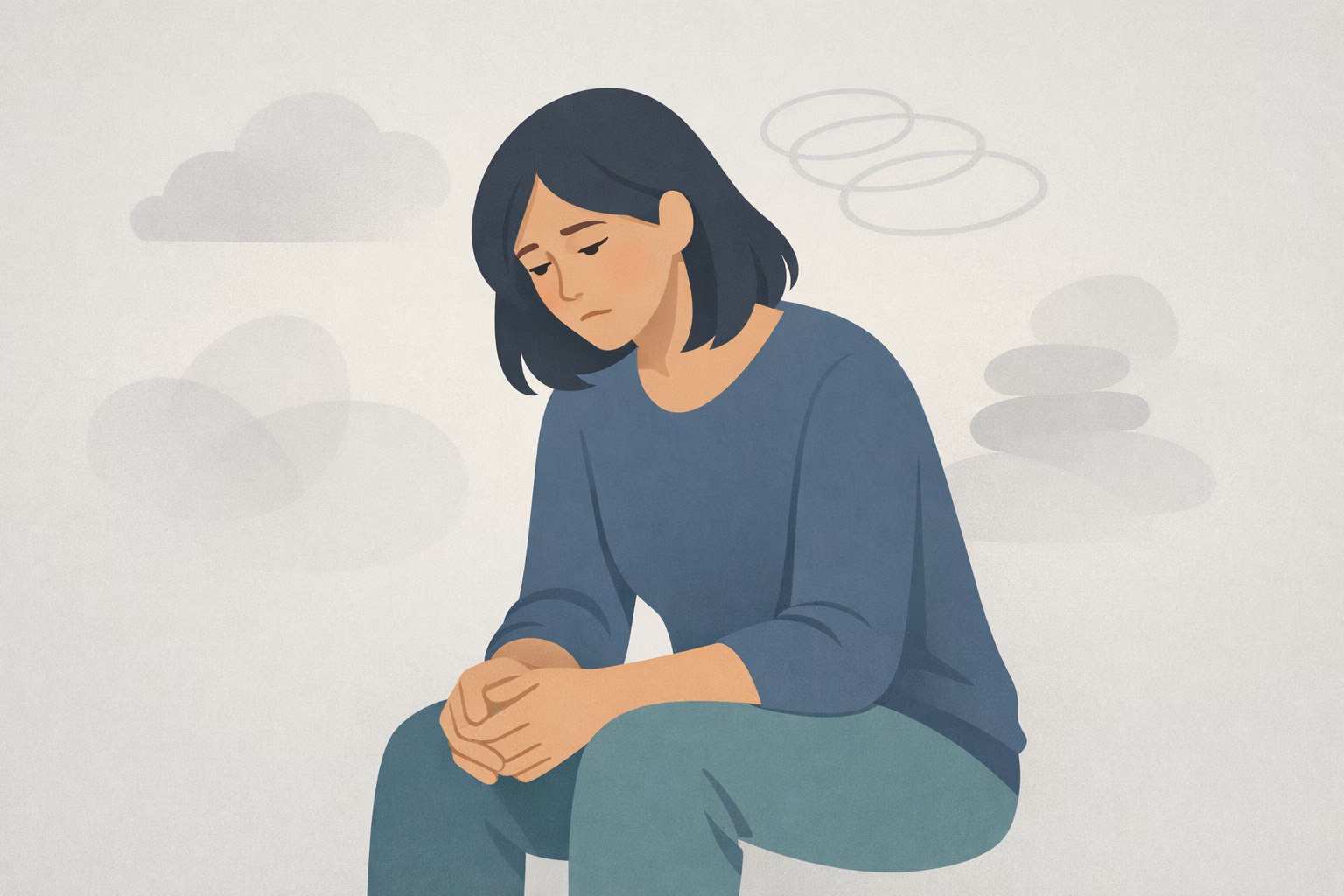
That mismatch—high output, low acknowledgment—creates a specific kind of depletion. Not dramatic, not always obvious, but cumulative. Many people describe a quiet resentment or a flat, far-away tiredness that doesn’t match how their day “should” have felt. That isn’t a character flaw; it’s a predictable response to sustained, unrecognized load. [Ref-1]
To keep the peace, coordinate people, and prevent problems, the nervous system has to stay online. It tracks cues, scans for friction, anticipates needs, and manages expression and tone. This is not merely “being nice.” It’s continuous calibration—micro-adjustments that draw from the same resource pool used for focus, patience, digestion, sleep quality, and mood stability.
When this regulation is constant, baseline energy can drop. Emotional availability narrows, not as a personality change, but as a conservation strategy: the body reduces what it can spare for connection, creativity, and play when too much is already earmarked for vigilance. Research on cognitive household labor highlights how ongoing mental load can contribute to stress and burnout over time. [Ref-2]
Importantly, understanding this doesn’t automatically restore capacity. Capacity tends to return when the system receives real completion signals—when responsibility is shared, demands become measurable, and the body can stand down.
Humans evolved to coordinate. In close groups, emotional attunement and caregiving are survival functions: noticing who is distressed, repairing ruptures, keeping alliances stable, organizing care, maintaining belonging. In supportive conditions, these efforts are reciprocal and recognized. They come with feedback—gratitude, rest, shared duty, visible contribution.
In many modern contexts, the expectations expanded while reciprocity shrank. Emotional labor can become a default requirement—especially in families, caregiving roles, and service-oriented workplaces—without explicit agreements or shared structures. When the coordination system runs without replenishment, it doesn’t feel meaningful; it feels endless. Naming the “emotional labor tax” helps describe the structural nature of this burden. [Ref-3]
Taking on invisible labor can create short-term stability. The room stays calm. Plans run smoothly. Conflict is minimized. Other people stay regulated enough to function. In the moment, over-functioning can act like a stabilizer—an internal promise that “if I track everything, nothing will break.”
This isn’t about being controlling or fearful in a moral sense. It’s about the nervous system preferring predictable load over unpredictable disruption. The body often chooses the known strain of constant managing rather than the uncertainty of what might happen if the managing stops. Over time, though, that trade becomes expensive: harmony outside, depletion inside. [Ref-4]
“It looks like I’m holding it together. It feels like I’m holding my breath.”
Invisible labor often functions like preventative maintenance—except it’s happening inside one person’s body, all day. The logic is understandable: if you anticipate everything, you reduce friction; if you smooth feelings, you avoid blowups; if you remember details, no one is disappointed. The system gets rewarded with immediate quiet.
But quiet isn’t the same as closure. Quiet can mean a problem was deferred rather than completed. When the load is unmeasured, it can expand to fill every available gap: more remembering, more coordinating, more soothing, more monitoring. Over time, the person holding the “hidden load” can lose access to rest that actually restores, because there is no clear point where the work is officially done. [Ref-5]
When does your effort get to count as finished?
An Avoidance Loop isn’t about weakness or denial. It’s a structural pattern where over-functioning prevents disruption, and the lack of disruption becomes the “proof” that over-functioning is necessary. The person doing the invisible work keeps systems running, which means others don’t fully encounter the consequences of not sharing the load.
Because the consequences are muted, roles don’t naturally rebalance. The loop closes like this: you carry more to keep things stable; stability makes the labor less visible; invisibility prevents redistribution; depletion reduces your capacity to renegotiate; so you carry more again. Many accounts of invisible burnout describe this self-reinforcing cycle—especially for women and caregivers—where responsibility accumulates quietly. [Ref-6]
Because this kind of strain is relational and cognitive, it often appears as “life stuff,” not a clearly defined issue. People may keep performing well while feeling internally thinned out. The signs are frequently subtle until they aren’t.
These aren’t personality traits. They’re regulatory outcomes of prolonged load without completion. The “invisible mental load” is often described as exactly this: constant tracking that leaves little room for presence. [Ref-7]
When effort is continuous and unrecognized, meaning can thin out. Not because you stop caring, but because the work stops landing anywhere. Appreciation is one form of closure; shared responsibility is another. Without them, the system may interpret the situation as “ongoing demand without return.” That perception changes how safe it feels to relax.
Relationally, invisible labor can distort balance. One person becomes the default regulator; others become less practiced at noticing, initiating, or repairing. Over time, this can reduce mutuality—the felt sense that you’re in it together. Research discussing cognitive household labor points to unequal mental load and its consequences for wellbeing and relationship dynamics. [Ref-8]
Identity can shift too. You may become “the reliable one,” “the organizer,” “the emotional buffer.” Those labels can sound positive, but when they harden into roles without choice, they can crowd out other parts of self—curiosity, rest, play, spontaneity, even ordinary needs.
A painful feature of invisible labor is that it trains the environment. If you always catch the loose ends, loose ends stop being noticed. If you always smooth tension, others don’t build tolerance for tension. If you always remember, remembering becomes “your thing.” The system adapts around your adaptation.
Meanwhile, depletion reduces leverage. When you’re exhausted, it’s harder to make labor visible, name complexity, or risk the turbulence that comes with change. So the body chooses the path of least immediate disruption: keep going. This is how loops persist—not because someone enjoys them, but because the short-term costs of interruption can feel higher than the long-term costs of endurance. Invisible labor has been linked with cognitive overload and burnout in ways that reinforce this cycle. [Ref-9]
There’s a particular kind of internal stabilization that can occur when invisible work becomes legible—when it’s recognized as real expenditure rather than “just how you are.” This recognition isn’t a pep talk, and it isn’t the same as insight. It’s more like the nervous system receiving an accurate ledger: this has been effort, and effort has a cost.
When responsibility is redistributed or bounded, the body can begin to register completion. Not perfect ease—just the beginning of a “stand-down” signal. The difference is often subtle at first: less bracing, fewer background calculations, more ability to let a moment be a moment. Clinical discussions of invisible emotional labor burnout often emphasize the relief that comes when the load is named and no longer carried alone. [Ref-10]
“It’s not that I needed to be told I’m doing a lot. I needed the world to stop acting like it’s nothing.”
When emotional labor becomes visible, relationships have more room to become reciprocal rather than managed. Reciprocity doesn’t mean perfect symmetry; it means the system isn’t quietly organized around one person’s constant tracking. Shared labor allows shared reality: what’s hard is acknowledged, what’s needed is spoken, what’s owned is distributed.
This can change the texture of connection. Instead of one person continually adjusting to keep things smooth, there’s a larger tolerance for normal friction—misunderstandings, differing needs, logistical mess—because the burden of repair isn’t assigned to a single nervous system. Workplace and cultural discussions increasingly point to how unpaid emotional labor is often expected (especially of women), and how naming it shifts expectations toward fairness. [Ref-11]
What becomes possible when “keeping it together” isn’t your solo job?
When invisible burdens lighten, people often notice capacity returning in practical, body-level ways: more stable energy across the day, a greater ability to tolerate interruptions, a clearer mind, a less brittle patience. This isn’t about “being more positive.” It’s about having fewer background processes running at all times.
Self-respect can also return—not as a mantra, but as a natural consequence of living in a system that reflects your humanity back to you. When your labor is real to others, it becomes real in the environment, not only in your head. Research on cognitive household labor highlights how disparities can affect wellbeing, stress levels, and relationship satisfaction—suggesting that reducing the disparity can reduce the strain. [Ref-12]
In this state, connection tends to be less performative. Presence becomes more available because it isn’t constantly being traded for management.
Restored capacity doesn’t usually arrive as a dramatic breakthrough. It often shows up as a shift from bracing to choosing. When you’re not constantly preventing collapse, you can engage with people and projects with more clarity—because you’re not spending all your resources on keeping the system stable.
This is where meaning can thicken again. Not through understanding alone, but through lived completion: obligations are clearer, roles are less fused, and your effort has edges. Caregiving research and reporting often highlight how hidden responsibilities erode wellbeing—and how visibility and support change what caregivers can sustainably offer. [Ref-13]
In other words: the goal isn’t to stop caring. It’s for care to exist in a structure that allows the body to recover, and the self to remain more than a role.
Invisible labor burnout is not proof that you’re failing at life or relationships. It’s a signal that something important is happening without enough visibility, reciprocity, or closure. When the work stays unmeasured, your nervous system has no reliable way to mark completion—and no reliable way to rest.
There is dignity in recognizing that exhaustion can be structural. The question isn’t “Why can’t I handle this?” but “What has become expected without being named?” Articles describing the emotional labor tax emphasize how naming the load changes what people consider normal and fair. [Ref-14]
Agency often begins as orientation: seeing the pattern clearly enough that it stops feeling like a personal mystery. From there, coherence becomes more possible—because reality is shared, not carried alone.
Care is one of the most human things we do. But when care depends on silent sacrifice, it tends to hollow out the person providing it. What makes care sustainable is not endless endurance—it’s visibility, reciprocity, and a life structure where effort can actually complete.
When the invisible becomes visible, the nervous system can finally receive a different message: you are not a background function. You are a person whose load counts, whose limits are real, and whose meaning is allowed to be more than “holding it together.” Reflections on the invisible mental load frequently return to this point: shared life requires shared responsibility. [Ref-15]
From theory to practice — meaning forms when insight meets action.
Invisible labor often feels like responsibility without a receipt. You're not just doing tasks — you're holding the emotional temperature of a room, the timing of transitions, the unspoken expectations, the 'if I don't, it won't happen' layer that never makes it onto a checklist. When it works, it looks like nothing happened. That mismatch between high output and low acknowledgment creates a specific depletion. The Threat & Safety System stays online, scanning and buffering, because there's no clear Done Signal for work no one else is tracking. The exhaustion isn't proof of weakness — it's the predictable cost of carrying load without closure or shared responsibility.
Short-term, yes — and that's why the pattern persists. The room stays calm. Plans run smoothly. Conflict is minimized. Other people stay regulated enough to function. The nervous system prefers predictable load over unpredictable disruption, so over-functioning gets reinforced. But quiet isn't the same as closure. When labor is unmeasured, it expands to fill every available gap: more remembering, more coordinating, more soothing, more monitoring. There's no clear point where the work is officially done, so rest never actually restores. Harmony outside, depletion inside — that's the trade, and it tends to compound rather than resolve.
When over-functioning prevents disruption, the lack of disruption becomes the proof that over-functioning is necessary. If you always catch the loose ends, loose ends stop being noticed. If you always smooth tension, others don't build tolerance for tension. The environment adapts around your adaptation. This is the structural shape of the Avoidance Loop here: invisibility prevents redistribution; depletion reduces your capacity to renegotiate; so you carry more again. Recognition matters not because you need praise — it matters because the nervous system needs an accurate ledger. Without it, the body has no way to mark completion or rest.
Naming the load is often where it starts — not because awareness alone changes anything, but because the system can finally receive an accurate accounting. When invisible work becomes legible, relationships have more room to become reciprocal rather than managed. Reciprocity doesn't mean perfect symmetry; it means the whole system isn't quietly organized around one person's tracking. The guilt usually softens as the body collects evidence that things don't actually fall apart when you're not silently holding them together — and that other people, given the chance, can be more capable than the role you've been carrying allowed them to demonstrate.
From Science to Art.
Understanding explains what is happening. Art allows you to feel it—without fixing, judging, or naming. Pause here. Let the images work quietly. Sometimes meaning settles before words do.
One Quiet Window, one insight, one reflection — every Sunday