Emotional Labor Fatigue: The Hidden Work You Carry
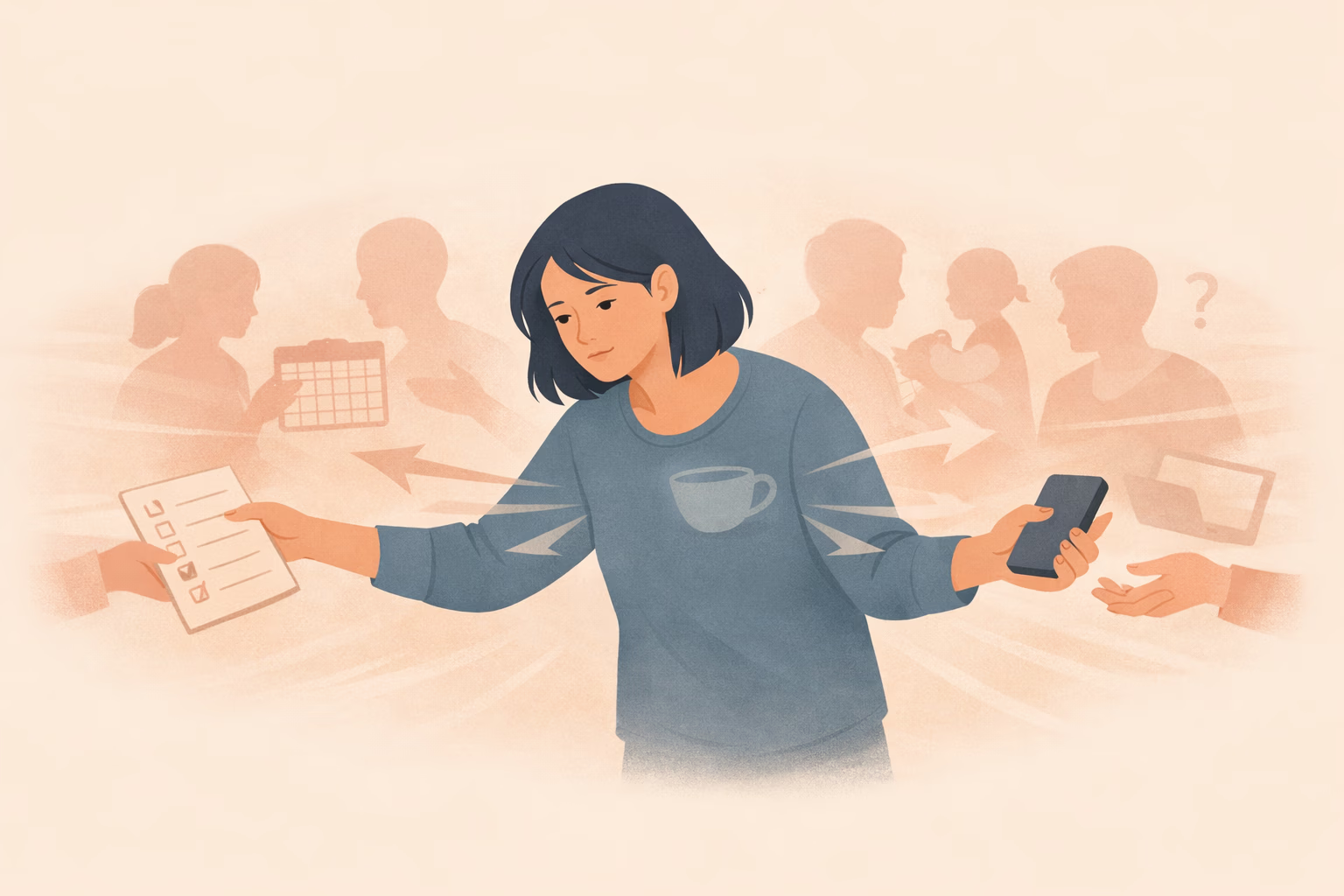
In short: Emotional overfunctioning is what happens when your attention repeatedly moves outward—tracking other people’s needs, moods, and stability—while your own needs quietly go missing. It can look like being reliable, thoughtful, and “good in a crisis.” Inside, it often feels like you’re on call: scanning for what might go wrong, smoothing things over early, and carrying the emotional weight so the relationship stays intact.
Emotional overfunctioning is what happens when your attention repeatedly moves outward—tracking other people’s needs, moods, and stability—while your own needs quietly go missing. It can look like being reliable, thoughtful, and “good in a crisis.” Inside, it often feels like you’re on call: scanning for what might go wrong, smoothing things over early, and carrying the emotional weight so the relationship stays intact.
This pattern isn’t a personality flaw. It’s a regulatory response that makes sense in a world where connection can feel conditional, unpredictable, or easy to lose. When belonging feels even slightly at risk, many nervous systems organize around prevention: keep things stable, keep people okay, keep the bond safe.
What if your habit of holding everything together isn’t who you are—but what your system learned it must do to keep connection steady?
Overfunctioning is tiring in a particular way: it isn’t just “doing a lot.” It’s doing a lot while staying alert to everyone else’s internal weather. You may notice yourself anticipating needs before they’re spoken, taking responsibility for tone, repairing tension quickly, and feeling uneasy when someone is disappointed—even if the disappointment isn’t yours to solve. [Ref-1]
Because this work is often invisible, it can come with a strange kind of loneliness. People may describe you as strong, capable, or easy to rely on, while you feel unseen in the place where support would actually land: the part of you that needs steadiness too.
When you’re the one who always steadies the room, your own signals can start to feel like inconveniences.
Humans are wired for belonging. When a relationship feels uncertain—through distance, conflict, or inconsistent responsiveness—the nervous system tends to increase monitoring and “do more” behaviors. Not because you’re controlling by nature, but because control can function as a substitute for safety cues.
In that state, responsibility becomes a regulation strategy: if you can manage outcomes, you can reduce unpredictability. Hyper-attunement to other people’s signals becomes a way to keep the relational environment readable. Personal needs may not disappear because they’re unimportant; they get crowded out by higher-priority tracking—what will keep the connection stable right now. [Ref-2]
When connection feels fragile, who gets assigned the job of stability?
In social groups, being useful has long been a powerful protection. If you were the dependable one—the helper, the fixer, the caretaker—you were easier to keep close. Overfunctioning can be understood as an adaptive attachment strategy: secure inclusion by becoming indispensable. [Ref-3]
That doesn’t mean you consciously decided to earn love. It means your system learned, through repetition, that helpfulness reliably reduced tension and increased closeness. Over time, usefulness can become the fastest pathway to belonging—especially when direct requests, conflict, or uncertainty felt costly.
Over-responsibility often works—at least in the short term. It can create predictability: fewer arguments, fewer surprises, fewer moments where someone might leave, withdraw, or get upset. It can also produce appreciation and a sense of being needed, which can mimic relational security. [Ref-4]
This is part of why the pattern can persist even when it hurts. The nervous system tends to repeat what reduces immediate risk. If smoothing, fixing, or carrying the load reliably calms the environment, your system receives a “stand down” signal—briefly.
But temporary safety isn’t the same as completion. When stability depends on constant management, the loop never fully closes, so the body stays ready for the next disruption.
Many people are taught—directly or indirectly—that doing more is how relationships stay strong. Emotional overfunctioning can look like commitment: you remember everything, you repair quickly, you track the calendar, you manage the emotional climate. From the outside, it can look like devotion.
But when one person routinely compensates for the whole system, the relationship can quietly tip into imbalance. The overfunctioner becomes the infrastructure; the relationship runs on their effort. Over time, that can produce depletion, resentment, and a sense that care is not truly mutual—even if no one is “doing anything wrong.” [Ref-5]
Sometimes what looks like harmony is actually one person preventing the relationship from having consequences.
In a Power Loop, the body learns a simple equation: control and usefulness bring relief. Each time you prevent a conflict, manage someone’s distress, or handle what others don’t handle, you reduce uncertainty. That reduction is rewarding to the nervous system—even if it costs you later.
The loop becomes self-reinforcing: the more you carry, the more necessary you seem; the more necessary you seem, the harder it is to step back without guilt or fear of relational destabilization. The relationship can start to feel like it runs on your vigilance. [Ref-6]
Importantly, this isn’t about lacking insight. You can fully understand the pattern and still find your body returns to it when safety cues drop. Integration requires something different than awareness: it requires a lived sense of closure where the bond doesn’t depend on your constant management.
Overfunctioning often shows up as a cluster of patterns that make sense under chronic relational load. They’re not identities; they’re adaptations that kept things stable.
When these patterns repeat, it’s often because the system has learned that unshared responsibility prevents rupture. The cost is that your own signals get treated as optional. [Ref-7]
When you repeatedly override your own needs, your system receives a subtle message: “My signals don’t set the agenda.” Over time, that can erode self-trust and self-worth—not as a thought, but as a lived orientation. You may feel less clear on what you want, more doubtful about what you deserve, or strangely numb to your own limits until they break through as exhaustion. [Ref-8]
It can also shrink your capacity to receive care. If you’re used to being the provider of stability, receiving can feel unfamiliar, suspicious, or undeserved. In some relationships, support offered to you may even feel like a disruption to the role the system has assigned you.
None of this means you’re broken. It means your nervous system has been operating without enough closure—too many open loops, too few “done” signals, and too much responsibility concentrated in one place.
Relationships adapt to what is consistently provided. If you routinely regulate the environment—making plans, soothing tension, carrying emotional labor—others may unconsciously lean into that structure. Not always out of malice or entitlement, but because the system teaches them they can. [Ref-9]
This can create a painful feedback loop: you overfunction to keep things stable; others under-participate because stability keeps arriving anyway; your unmet needs deepen the sense that support isn’t freely given, it must be earned through performance.
Over time, “being needed” can become the main way you know you matter. And because need is endless, the loop never closes. The relationship stays running, but not settled.
A different kind of stability becomes possible when worth is no longer tethered to output. This isn’t a motivational shift or a clever reframe. It’s an internal reorganization: your system starts recognizing that belonging can include you as a full person, not only you as a function.
In that shift, needs can become visible without immediately triggering urgency, shame, or the reflex to minimize. Not because you’re forcing vulnerability, but because the body senses more room—more relational bandwidth—for your signals to exist without threatening connection. [Ref-10]
What changes when your presence counts even when you’re not holding everything together?
Relationships tend to rebalance when responsibility is shared and emotional labor is acknowledged as real work. In more mutual systems, repair doesn’t belong to one person, planning doesn’t belong to one person, and the cost of imbalance becomes visible rather than absorbed silently.
This can be disorienting at first because the old setup provided predictability. But shared responsibility creates a different kind of predictability: not “nothing will go wrong,” but “we can meet what happens without one person disappearing into caretaking.” [Ref-11]
Mutuality isn’t a mood. It’s a structure—one that allows both people’s signals to matter, and allows completion to occur after conflict, need, and repair.
As over-responsibility loosens, many people notice a return of internal signals: hunger, fatigue, preferences, limits, and timing. This isn’t an emotional “breakthrough” so much as reduced load—less constant scanning, fewer unfinished loops, more permission for the body to register what it has been carrying. [Ref-12]
Relief can show up as quieter urgency, more spacious attention, and less compulsion to fix. Self-respect often returns in a grounded way: not as confidence theater, but as a steadier sense that your needs belong in the room.
When your system doesn’t have to earn care, it can finally use care.
When emotional overfunctioning is the default, relationships can organize around survival roles: the helper and the helped, the stabilizer and the destabilized, the responsible one and the one who gets a pass. Those roles can keep connection intact, but they often flatten individuality and postpone true fairness.
Restored balance creates room for values to lead. Fairness becomes something you can sense in your body as well as name. Dignity becomes structural: you are not included because you carry the most, but because you are a person with equal standing. In that environment, belonging is less about preventing rupture and more about shared life—where completion, repair, and reciprocity are possible. [Ref-13]
In a relationship built on mutuality, you don’t have to disappear to stay connected.
Emotional overfunctioning is often a belonging strategy—an intelligent adaptation to conditions where relational safety felt uncertain. Many people learned that being easy, useful, or indispensable reduced risk. That learning deserves respect, not shame. [Ref-14]
And it also makes sense if you feel tired of paying for connection with self-neglect. When a relationship relies on one person’s constant management, the system may stay intact, but meaning can thin out: you may feel less like a participant and more like the scaffolding.
Agency grows as coherence returns—when your needs, limits, and values are allowed to matter alongside attachment. Not as a demand, but as a basic condition for a relationship that can settle rather than simply continue.
Healthy connection isn’t proved by who carries the most. It’s proved by whether both people can be real—limited, human, needing support at times—without the bond collapsing. When responsibility is shared and care moves in both directions, the nervous system gets the message it has been waiting for: connection doesn’t require self-erasure.
You don’t have to be indispensable to be loved. Relationships last through seen humanity, not silent overwork. [Ref-15]
From theory to practice — meaning forms when insight meets action.
Emotional overfunctioning is a regulatory response, not a personality flaw. When connection feels conditional, unpredictable, or easy to lose, many nervous systems organize around prevention: keep things stable, keep people okay, keep the bond safe. Hyper-attunement to other people's signals becomes a way to keep the relational environment readable. Personal needs don't disappear because they're unimportant — they get crowded out by higher-priority tracking of what will keep the connection stable right now. When you're the one who always steadies the room, your own signals start to feel like inconveniences. This is the Attachment & Belonging System trying to reduce uncertainty through control.
In a Power Loop, the body learns a simple equation: control and usefulness bring relief. Each time you prevent a conflict, manage someone's distress, or handle what others don't, you reduce uncertainty — and that reduction is rewarding to the nervous system, even if it costs you later. The loop becomes self-reinforcing: the more you carry, the more necessary you seem; the more necessary you seem, the harder it is to step back without guilt. You can fully understand the pattern and still find your body returns to it when safety cues drop. Integration requires more than awareness — it requires lived closure where the bond doesn't depend on your constant management.
Many people are taught that doing more is how relationships stay strong. From the outside, overfunctioning looks like devotion: you remember everything, repair quickly, manage the emotional climate. But when one person routinely compensates for the whole system, the relationship tips into imbalance. The overfunctioner becomes the infrastructure; the relationship runs on their effort. Over time this produces depletion, resentment, and a sense that care is not truly mutual. Sometimes what looks like harmony is actually one person preventing the relationship from having consequences. The cost is that your own signals get treated as optional, and your worth gets quietly tethered to output.
Internal signals return — hunger, fatigue, preferences, limits, timing. Not an emotional breakthrough, just reduced load: less constant scanning, fewer unfinished loops, more permission for the body to register what it has been carrying. Relief shows up as quieter urgency, more spacious attention, less compulsion to fix. Self-respect returns in a grounded way — not confidence theatre, but a steadier sense that your needs belong in the room. When responsibility becomes shared, mutuality stops being a mood and becomes a structure. Both people's signals matter, and completion can occur after conflict, need, and repair. You don't have to disappear to stay connected.
From Science to Art.
Understanding explains what is happening. Art allows you to feel it—without fixing, judging, or naming. Pause here. Let the images work quietly. Sometimes meaning settles before words do.
One Quiet Window, one insight, one reflection — every Sunday