
Lifestyle Inflation: Why More Income Still Feels Not Enough
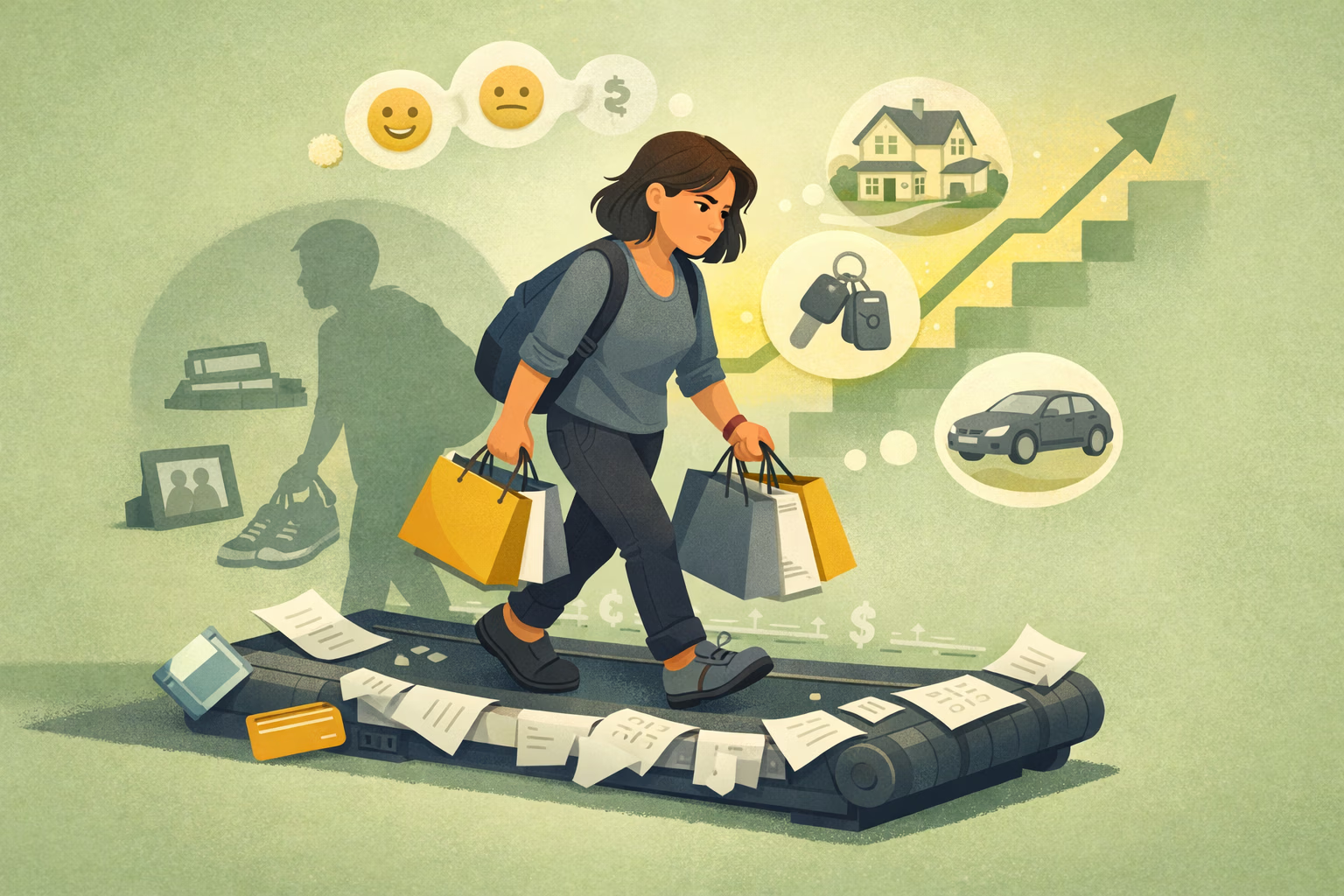
In short: Lifestyle inflation is rarely a dramatic decision. It’s usually a series of small, reasonable upgrades—slightly better groceries, a nicer neighborhood, a more polished wardrobe, a higher monthly payment—until the new “normal” quietly becomes expensive to maintain.
Lifestyle inflation is rarely a dramatic decision. It’s usually a series of small, reasonable upgrades—slightly better groceries, a nicer neighborhood, a more polished wardrobe, a higher monthly payment—until the new “normal” quietly becomes expensive to maintain.
What makes this pattern disorienting is that it can happen alongside real success. More resources arrive, yet the body can feel more keyed up: more monitoring, more comparison, more “keep it together.” This isn’t a character problem. It’s often what happens when relief is repeatedly confused for stability.
Why can “more” feel like it should equal peace, yet your system stays on alert?
Lifestyle inflation (sometimes called lifestyle creep) describes a pattern where increased income or access is followed by increased spending—often in ways that feel sensible in the moment. The difficult part isn’t buying something nicer; it’s how quickly “nicer” becomes baseline, and how fast the baseline starts demanding upkeep. [Ref-1]
Many people notice a particular flavor of restlessness: the sense that life is objectively better, yet internally more tense. Not because something is wrong with you, but because the overall load has changed. Upgrades can add hidden responsibilities—payments, expectations, social visibility, time costs, and the ongoing requirement to maintain a certain standard.
“I thought I was finally arriving. Instead it feels like I’m managing a bigger machine.”
Human systems adapt. A better couch, a faster phone, a more comfortable home—these can genuinely improve daily experience. But the nervous system and the brain’s reward pathways are designed to normalize improvements. What was once exciting becomes ordinary, and the sense of “done” fades faster than expected. [Ref-2]
This is where the mismatch begins: the satisfaction signal drops off, but the maintenance signal stays. The upgrade stops feeling like a gift and starts feeling like a contract. That contract can be financial (fixed costs), social (image management), or internal (the pressure to justify the choice).
In Meaning Density terms, the system keeps collecting “more” without receiving enough closure. The loop doesn’t finish. It simply escalates.
Humans evolved in social environments where rank, belonging, and access mattered. Being seen as competent and resourced wasn’t vanity—it could influence protection, opportunity, and how others treated you. In that context, visible signals of stability served a purpose.
Modern consumer life can plug directly into those ancient circuits. A nicer car, a better address, higher-end brands: these can operate as shorthand for “I’m safe” or “I’m not at risk.” The pull toward upgrading often reflects an underlying attempt to secure position and reduce uncertainty, not a shallow desire for things. [Ref-3]
When the environment is unstable—economically, socially, or informationally—status cues can become even more attractive because they offer quick feedback. The problem is that quick feedback isn’t the same as settled safety.
It’s important to name what’s real: upgrades can feel good. They can increase comfort, reduce friction, and provide a short-lived sense of confidence—like the world is less sharp around the edges. That’s not delusion; it’s state change. [Ref-4]
The nervous system often interprets certain improvements as safety cues: reliable transportation, a quieter home, better healthcare access, fewer daily hassles. These can lower immediate stress load.
But if the upgrade also adds chronic obligations—bigger payments, higher expectations, more visibility—the initial calm can be followed by a longer period of subtle activation. The body registers the new requirement: “Keep this going.”
Lifestyle inflation often feels like a reasonable response to progress: “I work hard, I can afford this, why not?” Yet the pattern can quietly convert flexibility into fixed costs. As the bar rises, peace can become conditional: you feel okay only when you’re keeping up. [Ref-5]
Over time, expectations can inflate faster than satisfaction. The nervous system doesn’t just track what you own; it tracks what you must maintain. When “normal” becomes expensive, the margin for life events—illness, layoffs, caregiving, transitions—shrinks. That shrinking margin is a form of chronic load.
What if the pressure isn’t coming from wanting too much—but from needing the new normal to stay stable?
In a power loop, the system learns that security comes from external markers: the next level, the next upgrade, the next proof. Advancement becomes the regulator. The body relaxes briefly after a “win,” then ramps back up as soon as the win becomes familiar.
This isn’t about greed. It’s about a predictable loop: when internal stability feels unreliable, external expansion can function like scaffolding. The catch is that scaffolding must keep expanding to feel effective.
Because prices rise and needs change, it can be hard to tell what is true inflation and what is lifestyle creep. But in both cases, the nervous system experiences the same thing: higher baseline requirements and less room to breathe. [Ref-6]
Lifestyle inflation isn’t one behavior; it’s a cluster of structural shifts that increase ongoing demand. People often notice it not as “shopping too much,” but as a feeling of being subtly cornered by their own standard.
These are regulatory responses to a system that no longer gets a clear “enough” signal. The loop stays open, so the body keeps scanning. [Ref-7]
As lifestyle demands rise, certain forms of freedom can shrink: the freedom to rest, to pivot, to take a risk that matters, to say no, to recover from a hard month. Even with higher income, the felt sense of options can decrease.
This is how “more” can steal peace without anyone doing anything wrong. The system becomes organized around protection: protect the image, protect the payments, protect the standard. When protection becomes the organizing principle, presence becomes harder—not because you’re failing, but because your resources are allocated to holding the structure up. [Ref-8]
And when capacity is spent on maintenance, there is less left for what creates real coherence: relationships, values, contribution, craft, and the kinds of experiences that actually complete inside you.
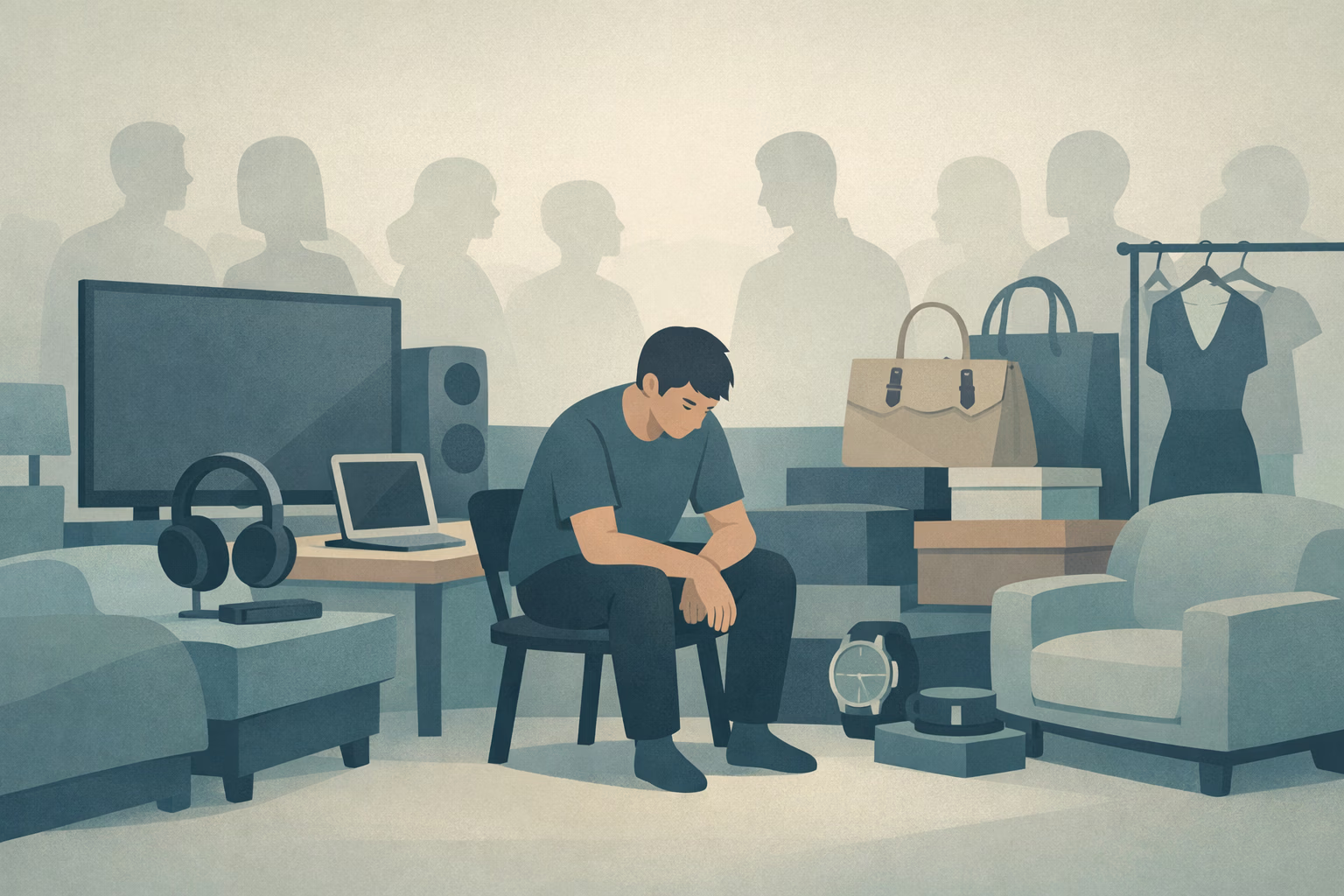
One of the most powerful forces in lifestyle inflation is normalization. Once an upgrade becomes common in your environment—your peers, your neighborhood, your feed—it stops reading as “extra” and starts reading as “standard.” At that point, opting out can feel like social risk, even when no one is explicitly judging.
This is less about insecurity and more about cue exposure. Repeated cues teach the nervous system what is expected for belonging and credibility. When the cue stream is constant, the system can interpret stillness as falling behind.
In this way, comparison doesn’t just create dissatisfaction; it creates pressure. Pressure narrows attention. Narrow attention makes the next upgrade feel necessary. The loop reinforces itself. [Ref-9]
There’s a difference between relief and stability. Relief is a state shift: the momentary exhale after buying, achieving, or upgrading. Stability is what happens when your system receives enough closure to stand down—when life stops feeling like it’s mid-test.
Lifestyle inflation often persists because upgrades deliver reliable relief. They create a quick “I’m okay” signal. But when the deeper need is coherence—when you need your life to feel internally settled and self-consistent—relief alone won’t hold. The system returns to scanning for the next proof. [Ref-10]
Restoring internal stability doesn’t mean rejecting comfort or ambition. It means recognizing which parts of “more” are acting like safety substitutes, and which parts actually reduce load in a lasting way.
Status pressure is heavier when belonging feels conditional. In environments where people are evaluated primarily by visible success, the nervous system learns to stay vigilant. In contrast, values-based relationships—where worth is not constantly renegotiated—can offer a different kind of safety cue: “You’re still in.”
This matters because hedonic adaptation doesn’t only apply to stuff; it applies to social signals too. If approval is tied to ongoing performance, it must be continually earned, and the system stays activated. [Ref-11]
Communities organized around shared values, mutual support, and ordinary humanity can reduce the need for constant external proof. Not by persuasion, but by providing a lived context where “enough” is socially believable.
When the escalation loop slows, people often report a change that’s more physiological than philosophical: less urgency, more space between impulses, fewer background calculations. Enjoyment becomes simpler because it’s no longer competing with the question, “Is this enough?”
Research on income, aspirations, and the hedonic treadmill suggests that well-being is shaped not only by resources, but by the aspiration level those resources are measured against. When aspirations keep rising, the nervous system can remain in a chronic reach state, even as circumstances improve. [Ref-12]
Sufficiency isn’t a mood. It’s a settled signal: the sense that life is not currently demanding another proof of worth to allow you to breathe.
“Nothing dramatic changed. I just stopped feeling chased by my own life.”
As internal stability returns, decisions often reorganize around meaning rather than image management. The question shifts from “What does this say about me?” to “Does this belong in my life?” That shift is subtle—but it changes everything.
Over time, many findings in the economics and psychology of happiness point to a similar tension: rising income can coincide with rising aspirations, and the hoped-for peace doesn’t automatically arrive. Stability tends to be more closely linked to how life is structured, how comparison is regulated by context, and how coherent the narrative feels from the inside. [Ref-13]
Alignment is not austerity. It’s when your life stops fragmenting into separate performances—one for security, one for approval, one for identity—and begins to feel like a single, inhabitable story.
If lifestyle inflation has been part of your story, it doesn’t mean you’re shallow, undisciplined, or ungrateful. It often means your system has been trying to secure safety, dignity, and a stable place in the world—using the tools your environment reliably rewards.
When aspiration levels rise faster than closure, the nervous system keeps reaching. And in a culture that constantly updates what “normal” looks like, reaching can become a default state. Seeing this structurally can reduce shame and restore orientation: the pattern isn’t who you are; it’s what happens when safety is outsourced to visible markers. [Ref-14]
Peace tends to return when “enough” becomes livable again—not as an idea, but as a settled baseline that your life repeatedly confirms.
Upgrades can improve life. But peace usually comes from something quieter: fewer open loops, less performative pressure, and more coherence between what you value and what you maintain. When that coherence grows, the body doesn’t need constant proof.
In a world that trains aspiration to keep moving, choosing a life that can actually complete inside you is not a retreat. It’s a return to stability—where your worth isn’t renegotiated every month, and your nervous system is allowed to stand down. [Ref-15]
From theory to practice — meaning forms when insight meets action.
Lifestyle inflation rarely happens through dramatic decisions — it's a series of small, reasonable upgrades until the new normal becomes expensive to maintain. Many people notice life is objectively better yet internally more tense. Not because something's wrong with you, but because the overall load has changed. Upgrades add hidden responsibilities — payments, expectations, social visibility, time costs, the ongoing requirement to maintain a standard. The nervous system tracks not just what you own but what you must maintain. I thought I was finally arriving; instead it feels like I'm managing a bigger machine. Peace becomes conditional on keeping up.
Human systems adapt. A better couch, a faster phone, a more comfortable home genuinely improve daily experience. But the brain's reward pathways are designed to normalize improvements. What was once exciting becomes ordinary, and the sense of done fades faster than expected. The mismatch begins here: the satisfaction signal drops off, but the maintenance signal stays. The upgrade stops feeling like a gift and starts feeling like a contract — financial (fixed costs), social (image management), or internal (pressure to justify). In Meaning Density terms, the system keeps collecting more without receiving enough closure. The loop doesn't finish; it simply escalates.
In a Power Loop, the system learns that security comes from external markers: the next level, the next upgrade, the next proof. Advancement becomes the regulator. The body relaxes briefly after a win, then ramps back up as soon as the win becomes familiar. From the Status & Control evolutionary root, this isn't about greed — it's that when internal stability feels unreliable, external expansion functions like scaffolding. The catch is scaffolding must keep expanding to feel effective. The pull toward upgrading often reflects an underlying attempt to secure position and reduce uncertainty. Quick feedback isn't the same as settled safety, and protection becomes the organizing principle of life.
More physiological than philosophical: less urgency, more space between impulses, fewer background calculations. Enjoyment becomes simpler because it's no longer competing with the question is this enough? Sufficiency isn't a mood — it's a settled signal: the sense that life is not currently demanding another proof of worth to allow you to breathe. As internal stability returns, decisions reorganize around meaning rather than image management. The question shifts from what does this say about me? to does this belong in my life? Nothing dramatic changed; you just stop feeling chased by your own life. Peace returns when enough becomes livable as a baseline your life repeatedly confirms.
From Science to Art.
Understanding explains what is happening. Art allows you to feel it—without fixing, judging, or naming. Pause here. Let the images work quietly. Sometimes meaning settles before words do.
One Quiet Window, one insight, one reflection — every Sunday