
Dependence on AI for Thinking: The Hidden Cognitive Decline
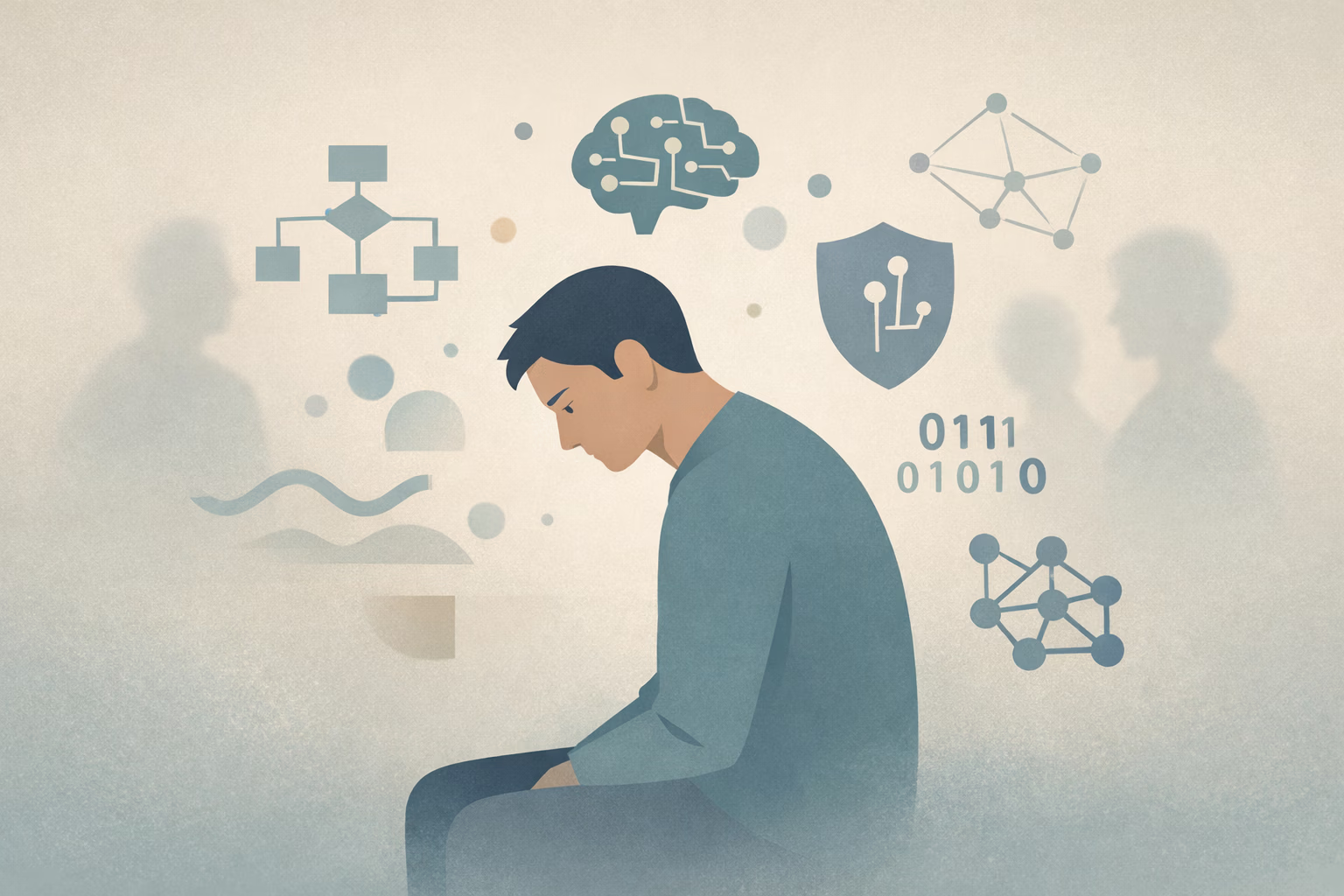
In short: Many people aren’t losing intelligence in the age of AI—they’re losing a quieter kind of orientation. The kind that used to show up as a steady “this one” or “not that” when choosing a meal, a message tone, a career move, or a relationship boundary.
Many people aren’t losing intelligence in the age of AI—they’re losing a quieter kind of orientation. The kind that used to show up as a steady “this one” or “not that” when choosing a meal, a message tone, a career move, or a relationship boundary.
When predictive tools sit beside nearly every decision, the nervous system can start treating external guidance as the default path to safety. Not because you’re dependent or weak, but because modern systems are designed to reduce uncertainty quickly, and uncertainty is biologically expensive.
What if “lost intuition” is less a personal flaw and more a predictable outcome of living in recommendation-first environments?
Loss of intuition often shows up as a specific kind of disconnection: you can still think clearly, but you can’t feel where you stand. You may notice yourself checking ratings, summaries, predictions, or “best of” lists for decisions that used to feel simple. [Ref-1]
It can also feel like doubt has become your baseline. Even after you choose, there’s a lingering sense that you should verify—because a smarter system might know something you missed. Over time, the internal signal that used to say “done” arrives later, or not at all.
Intuition isn’t magic. It’s a compressed form of pattern recognition built from lived experience—your nervous system’s fast synthesis of past outcomes, body states, and context. When you repeatedly hand the synthesis step to an external system, your brain does what brains do: it conserves energy by using the most reinforced route. [Ref-2]
This is not about laziness. It’s about conditioning and load. If the quickest way to reduce uncertainty is a recommendation, your system learns that uncertainty resolves faster through the outside channel than the inside one. The internal pathway gets less “practice,” not as a moral lesson, but as a simple consequence of use patterns.
Over time, it can feel like your own signal is faint and the algorithm’s signal is loud—because the algorithm produces instant clarity, while your internal process needs time, context, and completion.
Humans don’t just make choices; we make sense of choices. Across history, internal narrative helped people coordinate risk, belonging, and identity: “I’m the kind of person who…” This narrative isn’t a self-help story—it’s an organizing system that links experience to meaning and future action.
Predictive technologies shift that organizing system. When the environment constantly offers the “most likely” option, the brain can begin to treat personal uncertainty as an error state—something to eliminate rather than something to metabolize into learning. This is one form of cognitive offloading: moving the work of judgment to an outside scaffold until the inside scaffold weakens. [Ref-3]
When the answer arrives before your experience finishes forming, the system never gets the “completed loop” it needs to stand down.
From a regulation standpoint, uncertainty is stimulating. It increases scanning, comparison, and vigilance. AI tools often reduce that activation by offering immediate structure: ranked lists, predicted outcomes, optimized routes, suggested wording, likely diagnoses, “people also bought.” [Ref-4]
That reduction can feel like relief—especially under stress load. The moment the recommendation appears, your system gets a kind of external “okay, go” signal. Decision time shortens. Social risk feels lower. You’re less exposed to being wrong in public.
So why would your nervous system not lean into a machine that offers quick closure?
AI guidance is often framed as neutral efficiency: fewer mistakes, faster decisions, better outcomes. But human decisions don’t only aim for correctness. They also build identity coherence: the felt sense that your actions belong to you and reflect what matters. [Ref-5]
When choices are consistently shaped by external ranking, two subtle costs can accumulate. First, self-trust thins—not because you “should trust yourself,” but because the system has fewer moments where your judgment completes and lands. Second, creativity narrows, because novelty is riskier than similarity-based prediction.
In other words: efficiency can be real, and still leave you less internally aligned—like your life is running smoothly, but not necessarily running true.
Many modern loops aren’t driven by dramatic distress. They’re driven by small, frequent relief. AI offers a low-friction way out of the micro-discomfort of “not knowing.” That micro-discomfort isn’t fear in the dramatic sense; it’s nervous-system activation without closure.
So the loop forms: uncertainty rises → you consult the tool → activation drops → your system learns that external guidance is the fastest regulator. That’s a pleasure/avoidance loop: pleasure as relief, avoidance as bypassing the internal completion process. [Ref-6]
Importantly, nothing “wrong” is happening here. A system under constant demand will choose the shortest path to a stand-down signal—even if that stand-down is temporary.
When internal signals aren’t getting to complete, certain patterns become more likely. They’re not character traits; they’re predictable regulation strategies under a recommendation-first environment. [Ref-7]
These are less about inner weakness and more about a system repeatedly trained to seek closure from outside itself.
Intuition supports adaptive capacity: the ability to move through ambiguous situations using partial information, bodily cues, and lived learning. When that capacity is underused, it can start to feel like you only function well when there’s a clear metric, a prediction, or a visible consensus.
Over time, this can affect identity development and value alignment. When external feedback is constant, the “who am I in this?” process becomes crowded out by “what performs best?” or “what’s most recommended?” That doesn’t mean you lose values; it can mean your system has fewer quiet moments where values consolidate into lived certainty. [Ref-8]
When every choice is evaluated externally, it’s harder for the self to feel finished internally.
Many AI-driven environments pair recommendations with fast feedback: likes, views, ratings, engagement, “success” metrics, and social proof. That feedback acts like a powerful learning signal. It rewards decisions that match the system and punishes decisions that diverge—sometimes subtly, sometimes loudly.
This is similar to other high-velocity digital loops where rapid reinforcement keeps attention cycling and reduces space for completion. The nervous system learns to chase the next certainty cue because certainty arrives as a quick hit, not as an integrated “done.” [Ref-9]
In this context, intuition can feel unreliable—not because it is, but because it is slower, quieter, and requires a tolerance for unfinishedness that the environment rarely supports.
It can help to reframe intuition not as a mystical authority, and not as a mood. Intuition is often the body-mind’s closure signal: the point where enough experience has consolidated into “this fits” or “this doesn’t.” It’s the end of a loop, not the beginning of an opinion. [Ref-10]
In AI-heavy contexts, the loop can be interrupted. The recommendation arrives before your own process reaches completion, so your system never practices the full arc from uncertainty → exploration → internal settling.
What changes when you treat intuition as a completion process rather than a personality feature?
The pressure to “trust yourself” can soften, because the focus shifts from belief to conditions: Does your life include enough space, consequence, and continuity for inner signals to finish forming?
Interestingly, people often regain internal clarity faster in relational environments than in evaluative ones. Not because someone gives you the answer, but because supportive relationships can reduce nervous system load and restore a sense of safety while you arrive at your own conclusion.
Mentors, peers, and coaches can function as scaffolding that keeps decisions human-sized: you’re not alone with infinite options, and you’re not forced to outsource judgment to a machine for relief. This is different from crowdsourcing. It’s not “what should I do?” so much as “help me stay with my own process long enough for it to complete.”
Cognitive offloading becomes less sticky when the environment includes patient reflection, contextual memory, and a witness to your evolving identity—things algorithms approximate poorly. [Ref-11]
When intuition returns, it often isn’t dramatic. It’s quiet stability. Decisions land more fully. You may still use tools, but you don’t feel erased by them. The internal “yes/no/not yet” becomes easier to detect because you’re no longer forcing constant throughput.
Trust rebuilds through repeated experiences of calibrated reliance: knowing when external input helps and when it overwhelms. Research on trust in AI emphasizes that trust is not simply “more” or “less,” but contextual and shaped by reliability, transparency, and human judgment about when to defer. [Ref-12]
The deeper shift is not “using less AI.” It’s moving from reactive reliance (outsourcing to regulate) to intentional integration (using tools without losing authorship). In human–AI research, reliance improves when people can interpret system outputs and understand when intuition and explanation should be in dialogue rather than in competition. [Ref-13]
When that integration is present, energy changes. There’s less urgency to confirm, fewer mental open tabs, and more capacity to act from values that feel lived rather than argued. Not perfectly. Not constantly. Just more often.
Agency isn’t the absence of help. It’s the felt sense that your life still belongs to you.
In a world designed to predict you, increased reliance is a sensible response. It often signals high load, high stakes, or too many simultaneous choices—conditions where the nervous system will prioritize quick closure. That doesn’t mean you’re losing your humanity; it means your system is adapting to the environment in front of it.
It can also be a meaningful signal: a request for more self-trust, not as an idea, but as an embodied experience of completion. When technology use becomes transparent and choice points become less compressed, reliance can become more selective—guided by context rather than urgency. Research on algorithm appreciation and aversion suggests that how systems are presented (accuracy, transparency) affects reliance, which reinforces that the environment shapes behavior. [Ref-14]
In that light, “lost intuition” is not a verdict. It’s a map of where closure has been outsourced—and where the self may be ready to come back online.
AI can be useful without becoming your inner voice. When intuition is restored, it doesn’t reject external inputs—it contextualizes them. It lets recommendations become one signal among many, instead of the signal that overrules your lived experience.
Personalized systems can shape trust and choice, especially when they feel consistently “right.” [Ref-15] But the most stabilizing form of trust is often the kind that includes yourself: the sense that your decisions can settle, your values can guide, and your identity can remain coherent even in a world full of suggestions.
From theory to practice — meaning forms when insight meets action.
Repeated outsourcing doesn't damage intuition; it under-practices it. Intuition is compressed pattern recognition — your nervous system's fast synthesis of past outcomes, body states, and context. When recommendations resolve uncertainty before your internal process completes, the brain conserves energy by using the most reinforced route, which becomes the external one. The internal pathway gets fewer reps, not as a moral failure but as a predictable consequence of use. Over time, the algorithm's signal feels louder and your own feels faint — because the algorithm produces instant clarity, while your internal Done Signal needs time, context, and completion.
Recommendation-first environments train the nervous system to expect quick closure on every choice. So when you face a decision the tool can't fully answer — what to eat, what to say, what to wear — your system experiences the un-collapsed uncertainty as activation rather than ordinary thinking. Each minor decision arrives without the felt sense of completion. That activation is the Threat & Safety System scanning, not weakness. The weight isn't proof you're indecisive; it's evidence that your environment rarely lets internal signals finish forming. Reduce throughput, and the heaviness usually softens.
Not quite. The article reframes intuition as a completion signal, not a mood or mystical authority. It's the body-mind's quiet 'this fits' or 'this doesn't' that lands when enough lived experience has consolidated. Emotional reactions can fire fast and stay loud; intuition arrives as settling. In AI-heavy contexts, the loop gets interrupted — the recommendation appears before your own arc from uncertainty to exploration to internal landing reaches its end. Treating intuition as closure rather than a personality feature shifts the question from 'should I trust myself?' to 'does my life have enough space for inner signals to finish?'
The shift isn't using less AI — it's moving from reactive reliance to intentional integration. Reactive reliance outsources to regulate: uncertainty rises, you consult the tool, activation drops, and the loop reinforces. Intentional integration treats recommendations as one signal among many, with calibrated awareness of when external input helps and when it overwhelms. Supportive relationships often restore signal integrity faster than evaluative metrics, because co-regulation lets you stay with your own process long enough for it to complete. Agency isn't the absence of help; it's the felt sense that your life still belongs to you.
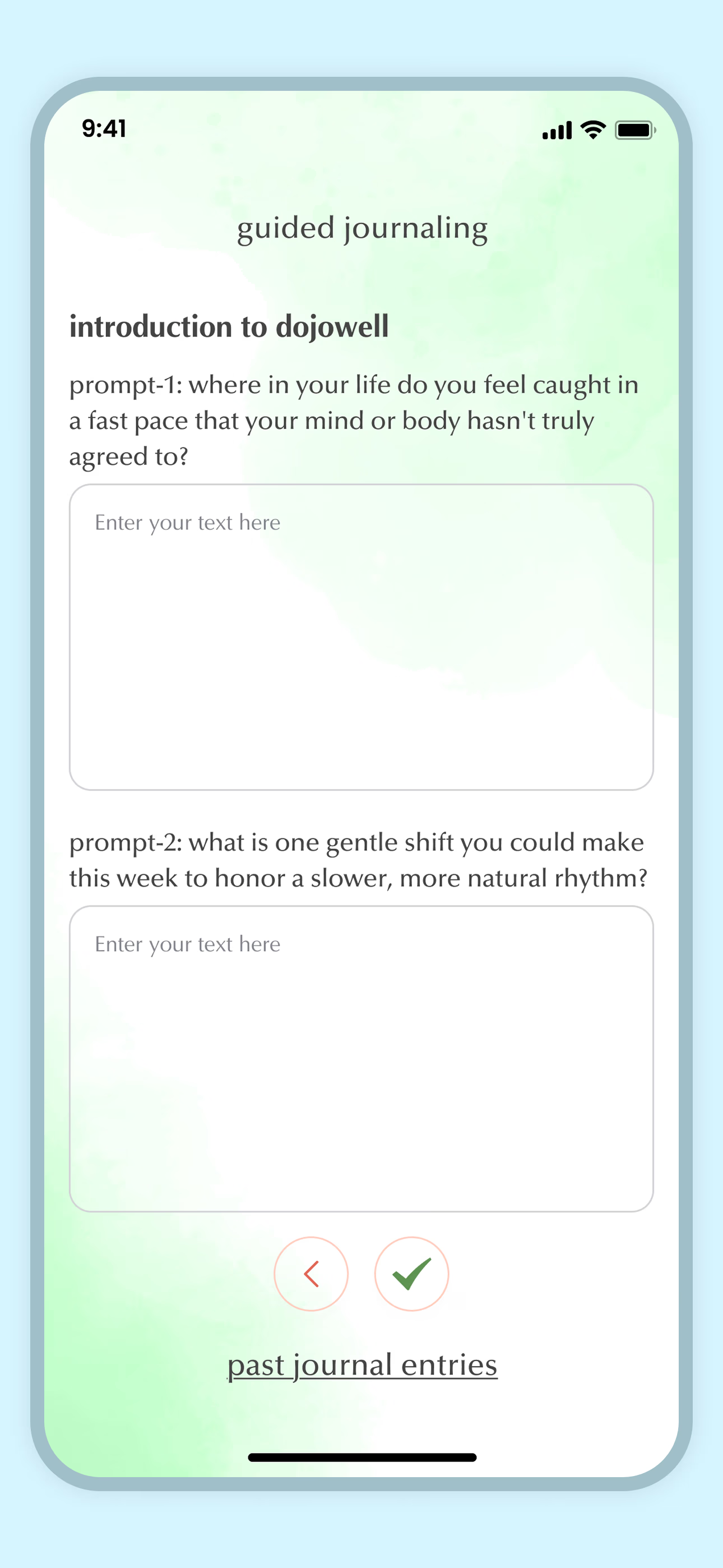
From Science to Art.
Understanding explains what is happening. Art allows you to feel it—without fixing, judging, or naming. Pause here. Let the images work quietly. Sometimes meaning settles before words do.
One Quiet Window, one insight, one reflection — every Sunday