Cognitive Overload: When Your Brain Reaches Its Limit

In short: Less clutter, fewer open loops, and a mind that feels easier to live inside. They can act like a second brain—capturing tasks, organizing notes, summarizing information, and translating overwhelm into a plan.
Mental clarity apps promise something deeply reasonable: less clutter, fewer open loops, and a mind that feels easier to live inside. They can act like a second brain—capturing tasks, organizing notes, summarizing information, and translating overwhelm into a plan.
But “mental fog” is rarely just a filing problem. Often it’s what cognition feels like when the system is carrying too many partial demands at once—too many tabs, too much uncertainty, not enough closure. In that context, an app may create a moment of order without changing the load that keeps rebuilding the fog.
So why can your mind still feel scattered even when your lists look perfect?
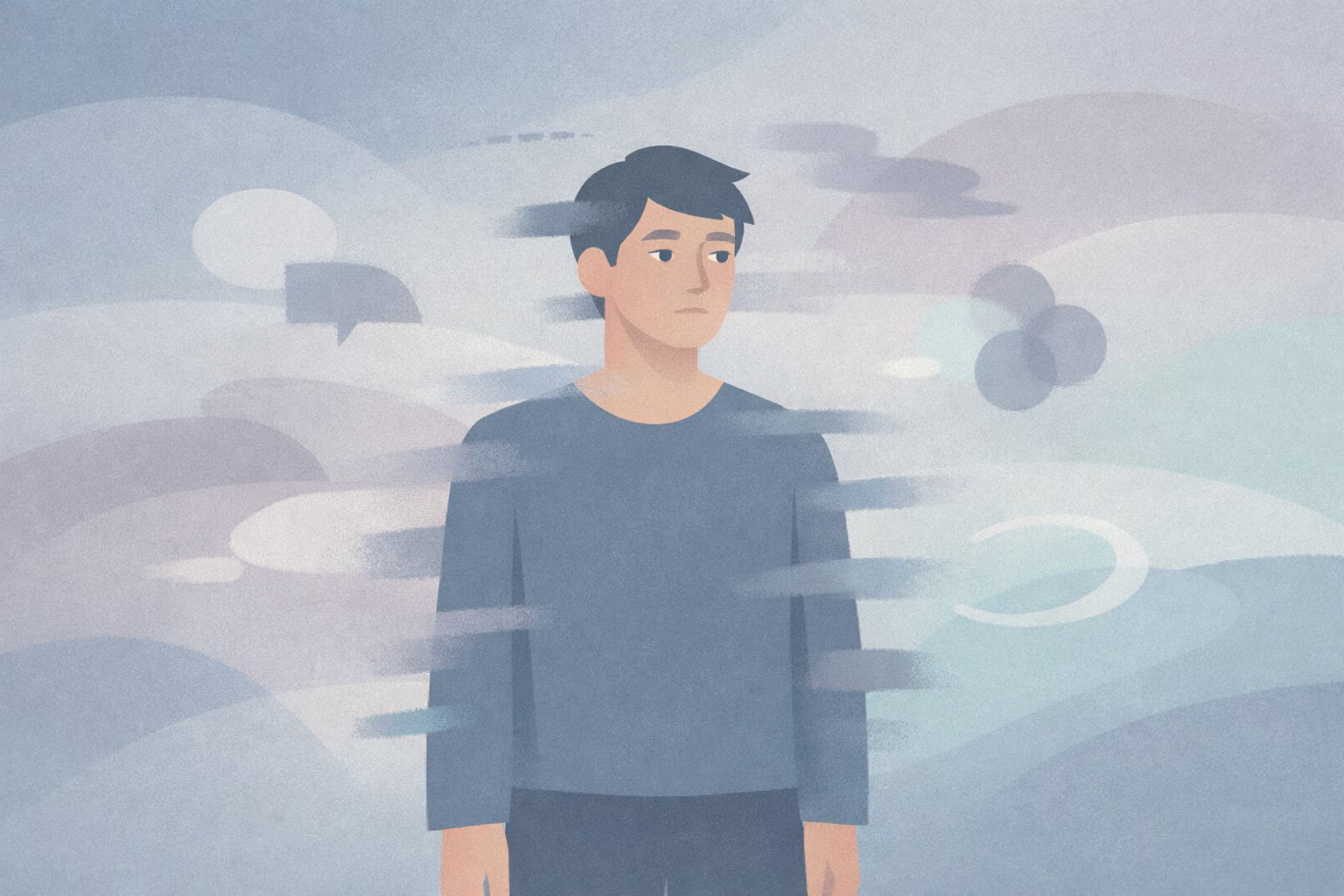
That foggy, scattered feeling—reading the same sentence twice, forgetting why you opened your phone, bouncing between tasks—can be a normal response to high cognitive load. When inputs exceed capacity, attention stops feeling like a steady beam and starts behaving more like a flickering searchlight.
In real life, this can show up even when you’re “doing everything right”: you make lists, color-code, set reminders, and still feel behind. The system isn’t failing. It’s responding to volume, uncertainty, and competing priorities with no clear “done” signal.
In cognitive load terms, the mind becomes a crowded workspace: important items don’t disappear; they stack. Fog is often the subjective experience of that stacking. [Ref-1]
Clarity apps can reduce the effort of holding everything in working memory. Offloading reminders, steps, and schedules can free some mental bandwidth. It can feel like a small exhale: fewer pieces to juggle internally.
But the executive system that uses those tools is sensitive to stress load. Under pressure, the brain’s planning and inhibition capacities can narrow, and attention can become more reactive—pulled toward urgency, novelty, or perceived threat. In that state, even a well-designed app can turn into another demand: another place to check, update, and maintain. [Ref-2]
So the same tool can feel helpful on a lower-load day and oddly “sticky” on a higher-load day—not because you changed as a person, but because the regulatory context changed.
Human attention evolved to make meaning from manageable streams of information—signals that arrived with pauses, endings, and feedback. Modern life delivers something different: constant intake, rapid switching, and decisions that rarely resolve into true completion.
When the executive system is asked to triage endlessly—messages, tabs, updates, ambiguous priorities—fatigue becomes structural. It isn’t just “tiredness”; it’s reduced cognitive control under sustained demand. Burnout and cognitive fatigue are associated with less efficient executive functioning, which can feel like fog even when motivation exists. [Ref-3]
In other words: the problem is often the environment’s pace and fragmentation, not a personal deficit in willpower or organization.
Many clarity apps offer something the nervous system recognizes immediately: containment. A task becomes a checkbox; a vague worry becomes a note; a messy week becomes a calendar view. That shift can reduce perceived chaos and restore a small sense of traction.
When overload is high, even tiny moments of structure can improve planning and reduce the mental thrash of “what am I forgetting?” This is why centralizing tasks and simplifying next steps often feels like relief. [Ref-4]
Notably, the relief comes less from “better thinking” and more from reduced internal juggling. The app doesn’t create meaning by itself—it creates space where meaning might later settle.
It’s possible to be exquisitely organized and still feel mentally crowded. That’s because organization changes how information is stored, but it doesn’t automatically reduce the number of demands, interruptions, or unresolved situations generating that information.
When the underlying load remains high, the mind can keep producing new entries faster than any system can absorb them. The app becomes a treadmill: more sorting, more capturing, more “processing”—with less actual closure.
In this way, “clarity” can become a visual aesthetic (neat lists, clean dashboards) while the nervous system remains activated by fragmentation and uncompleted loops. Reducing cognitive load often requires reducing fragmentation itself, not only building a better container for it. [Ref-5]
Sometimes the relationship with a clarity app quietly shifts. What began as support becomes a requirement: you can’t start a task until it’s entered correctly; you can’t rest until everything is categorized; you can’t think unless the system is open.
This isn’t “avoidance” in the moral sense. It can be a regulatory workaround: when internal capacity is strained, the mind leans on external structure to bypass the strain. The app becomes a way to keep moving without addressing the conditions that keep the system loaded.
Digital minimalism perspectives often point to this paradox: more tools can mean more decisions, more attention switching, and more cognitive residue—especially when screens become the default place where “order” is sought. [Ref-6]
Mental clarity apps can genuinely help, especially for externalizing tasks and reducing immediate overwhelm. At the same time, certain patterns can appear when the app becomes the main route to stability. [Ref-7]
None of these mean the tool is “bad.” They often indicate that the app is carrying more than assistance—it’s carrying regulation.
When an external system becomes the main way you experience steadiness, an understandable belief can form: “My mind can’t hold life without this.” Over time, that can reduce self-trust—not because you’re incapable, but because your nervous system rarely gets the chance to experience internal completion without a tool mediating it.
Some newer tools add AI summarization, predictive planning, and automated prioritization. These features can reduce mental effort in the moment, but they can also keep you in a state of ongoing “management” rather than lived resolution—especially if the environment keeps generating new inputs. [Ref-8]
Sometimes the app isn’t organizing your life as much as it’s organizing your uncertainty.
This is a structural problem: high throughput with low closure trains the system to seek more scaffolding, not more settling.
Many clarity apps are designed to remain in your attention: notifications, badges, streaks, daily summaries, “inbox zero” rewards. Even when the benefits are partial, the system stays compelling because it offers frequent micro-closure—small hits of “done” that don’t necessarily translate into completed life loops.
Task management tools often emphasize centralization and visibility to reduce stress and improve clarity. That can help. But when visibility becomes constant monitoring, it can also keep the nervous system in a continuous evaluation mode—always scanning for what’s missing. [Ref-9]
When does a helpful structure become a source of ongoing activation?
“Mental clarity” is often described as a thinking state, but it behaves more like an alignment state. It stabilizes when what you are doing, what matters, and what counts as finished all point in the same direction.
Apps can support this by holding details so your mind can return to signal: the felt sense of what is relevant now. But stable clarity usually arrives when priorities become livable—not just listable—and when tasks resolve into actual completion (conversations concluded, decisions made, commitments renegotiated, demands reduced). The app may reflect that coherence, but it can’t generate it on its own. [Ref-10]
This is the difference between relief (a temporary state shift) and integration (a physiological stand-down after enough loops truly close).
Attention doesn’t operate in isolation. It tracks cues of safety, urgency, and belonging. A noisy workspace, constant pings, unclear expectations, and social comparison can all increase mental load—even if your task list is immaculate.
Many people adopt clarity tools inside collaborative environments: shared boards, project trackers, team updates. These can reduce confusion by making work visible and coordinated. They can also expand the surface area of demands, because “what exists” becomes “what should be responded to.” [Ref-11]
When fog persists, it often makes sense to consider context: not as something to “optimize,” but as the water your nervous system is swimming in.
When load decreases and enough loops close, attention often becomes more resilient. Thoughts feel less like scattered fragments and more like sequences that can finish. The mind doesn’t become empty; it becomes less interrupted by internal alarms.
In this state, tools can still be useful, but they’re not constantly required for basic orientation. People often describe a quieter baseline: fewer urgent spikes, less compulsive checking, and more capacity to hold a single line of thought long enough for it to resolve.
External structure can be especially supportive for naturally scattered attention styles, but the deeper shift is usually that the nervous system trusts completion again—because it’s actually happening, not just being tracked. [Ref-12]
Mental clarity apps can reduce friction, offload details, and provide helpful scaffolding. They can be genuinely supportive when they amplify meaningful priorities rather than multiplying obligations.
Fog tends to lift more reliably when attention is oriented toward what is truly important and finishable—when “next steps” connect to values and identity, not just to an infinite queue. In that sense, the most clarifying feature isn’t automation; it’s coherence: fewer competing priorities, clearer endings, and less fragmentation between who you are and what you’re being asked to carry. [Ref-13]
The app can be part of that ecosystem. It just can’t be the ecosystem.
It makes sense to reach for structure when your mind feels crowded. That impulse isn’t a character flaw—it’s a stabilizing response to too many open loops and too little closure.
Clarity tools work best when they are in a supporting role: holding information so you can live your life, not holding your life so you can manage information. If a tool leaves you feeling more monitored than oriented, that may be a sign that the need is less “more features” and more conditions that allow completion. [Ref-14]
Agency often returns quietly: when the system feels less hunted by unfinishedness, and more able to recognize what matters, what can wait, and what is already done.
True clarity isn’t a perfectly maintained dashboard. It’s what shows up when the nervous system can stand down, attention can stay with one thing long enough to complete it, and life feels coherent enough to inhabit.
Apps can help reduce cognitive friction. But the deepest relief tends to arrive when meaning, closure, and capacity converge—when your mind no longer has to fight to prove it’s on top of everything, because enough of life is actually settling. [Ref-15]
From theory to practice — meaning forms when insight meets action.
Organization changes how information is stored, but it doesn't reduce the number of demands, interruptions, or unresolved situations generating that information. You can be exquisitely organized and still feel mentally crowded because the underlying load — the actual fragmentation in your day — is unchanged. The app becomes a treadmill: more sorting, more capturing, more 'processing,' with less actual closure. Brain fog is usually a cognitive-load symptom, not a filing problem. A neat dashboard can deliver the visual aesthetic of clarity while the nervous system stays activated by the same unfinished loops it had before.
Both, depending on the role they play. Apps can genuinely scaffold attention by holding details so working memory doesn't have to. That can free real bandwidth on a lower-load day. But the same tool can feel sticky on a higher-load day, when the executive system is already narrowed by stress and another place to check, update, and maintain becomes a demand rather than a relief. The distinction worth watching: is the app holding information so you can live, or holding your life so you can manage information? Useful tools amplify priorities. Stressful ones multiply obligations.
It offers something the nervous system recognizes immediately: containment. A vague worry becomes a note; a messy week becomes a calendar view; a pile of demands becomes a list. That shift reduces perceived chaos and the mental thrash of 'what am I forgetting?' The relief is real — but it comes less from better thinking and more from reduced internal juggling. The app isn't generating meaning; it's creating space where meaning might later settle. That's why the same dump can feel transformative one week and hollow the next, depending on whether anything is actually completing in the life behind the list.
It tends to backfire quietly. When external structure becomes the main route to steadiness, an understandable belief forms: 'my mind can't hold life without this.' Self-trust shrinks while dependence grows — not because you've become incapable, but because your nervous system rarely gets to experience internal completion without a tool mediating it. Stable clarity is more an alignment state than a thinking state. It arrives when priorities become livable instead of just listable, when tasks resolve into actual completion, and when what matters and what's finishable line up. The app can reflect that coherence. It can't generate it.
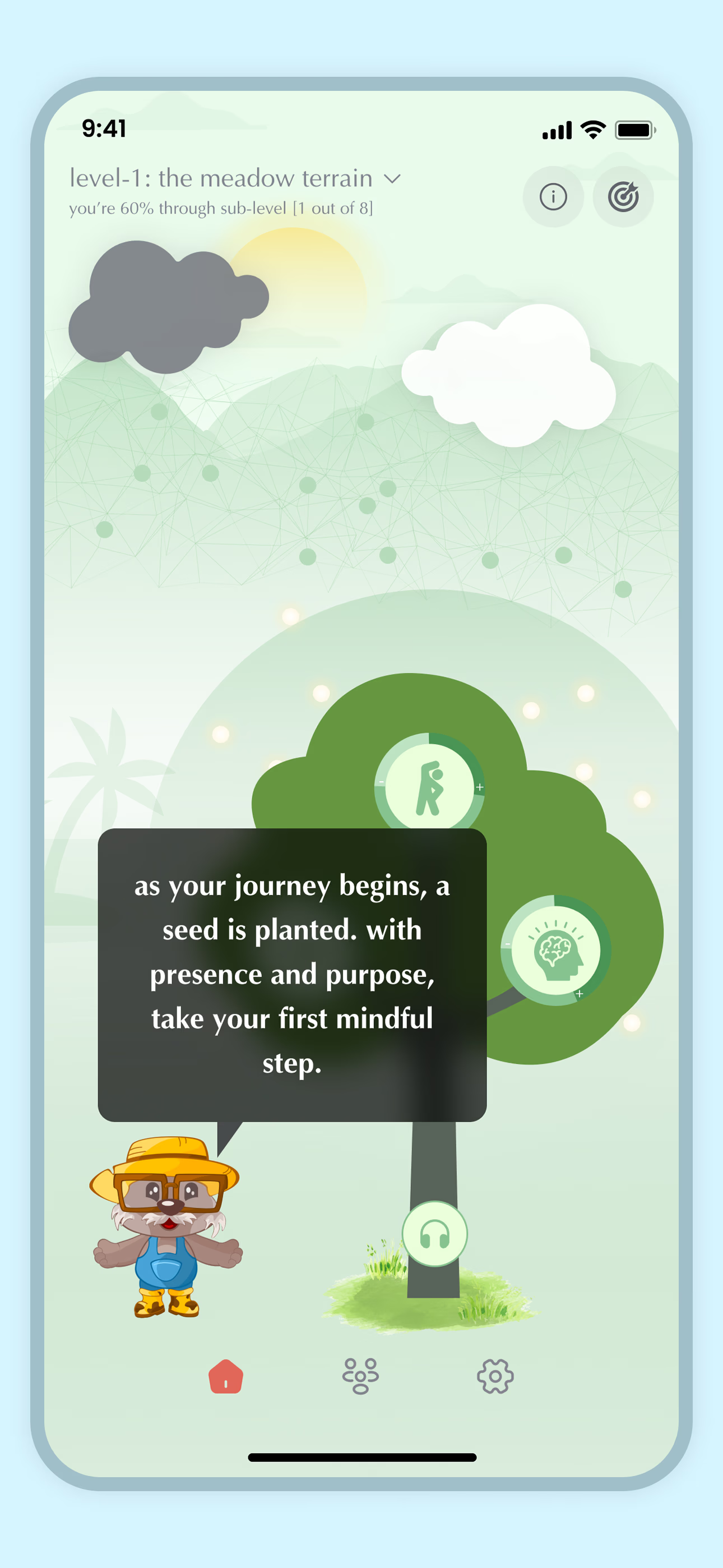
From Science to Art.
Understanding explains what is happening. Art allows you to feel it—without fixing, judging, or naming. Pause here. Let the images work quietly. Sometimes meaning settles before words do.
One Quiet Window, one insight, one reflection — every Sunday