Scarcity Mindset: Why Abundance Still Feels Unsafe
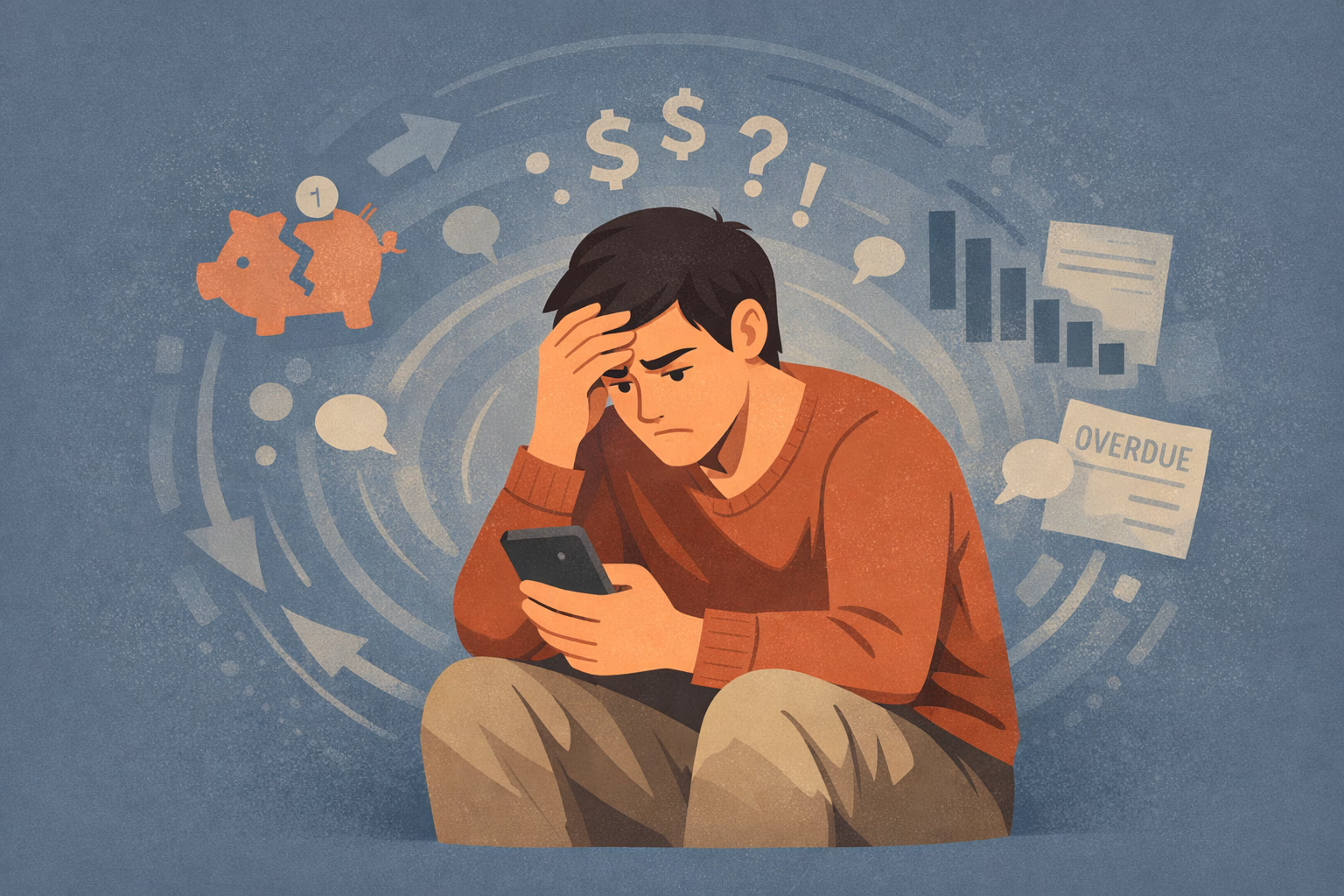
In short: For many people, money isn’t just math. It’s a set of cues that the body reads as safety or danger—often without permission. A bank balance, an unexpected bill, a conversation about budgets, even the sound of a payment notification can land like a threat signal.
For many people, money isn’t just math. It’s a set of cues that the body reads as safety or danger—often without permission. A bank balance, an unexpected bill, a conversation about budgets, even the sound of a payment notification can land like a threat signal.
Money trauma is a useful phrase for this: the lasting imprint of past financial instability on the nervous system, attention, and decision-making. It doesn’t mean you’re broken. It means your system learned patterns that reduced risk in a time when risk felt constant.
What if the parts of you that tense, avoid, or over-control around money are not character flaws—but leftover safety strategies?
Financial stress leaves a specific kind of trace: a readiness to protect against collapse. Even when today’s reality is more stable, the body can behave as if stability is temporary—something that could vanish with one mistake.
This can show up as chronic tension around spending, discomfort with “non-essential” purchases, irritation during money conversations, or a constant scanning for what might go wrong. The mind may tell a story about being “bad with money,” but the deeper pattern is often simpler: a system trained to expect loss and to pre-empt it. [Ref-1]
When your history includes not having enough, “enough” can feel surprisingly hard to recognize.
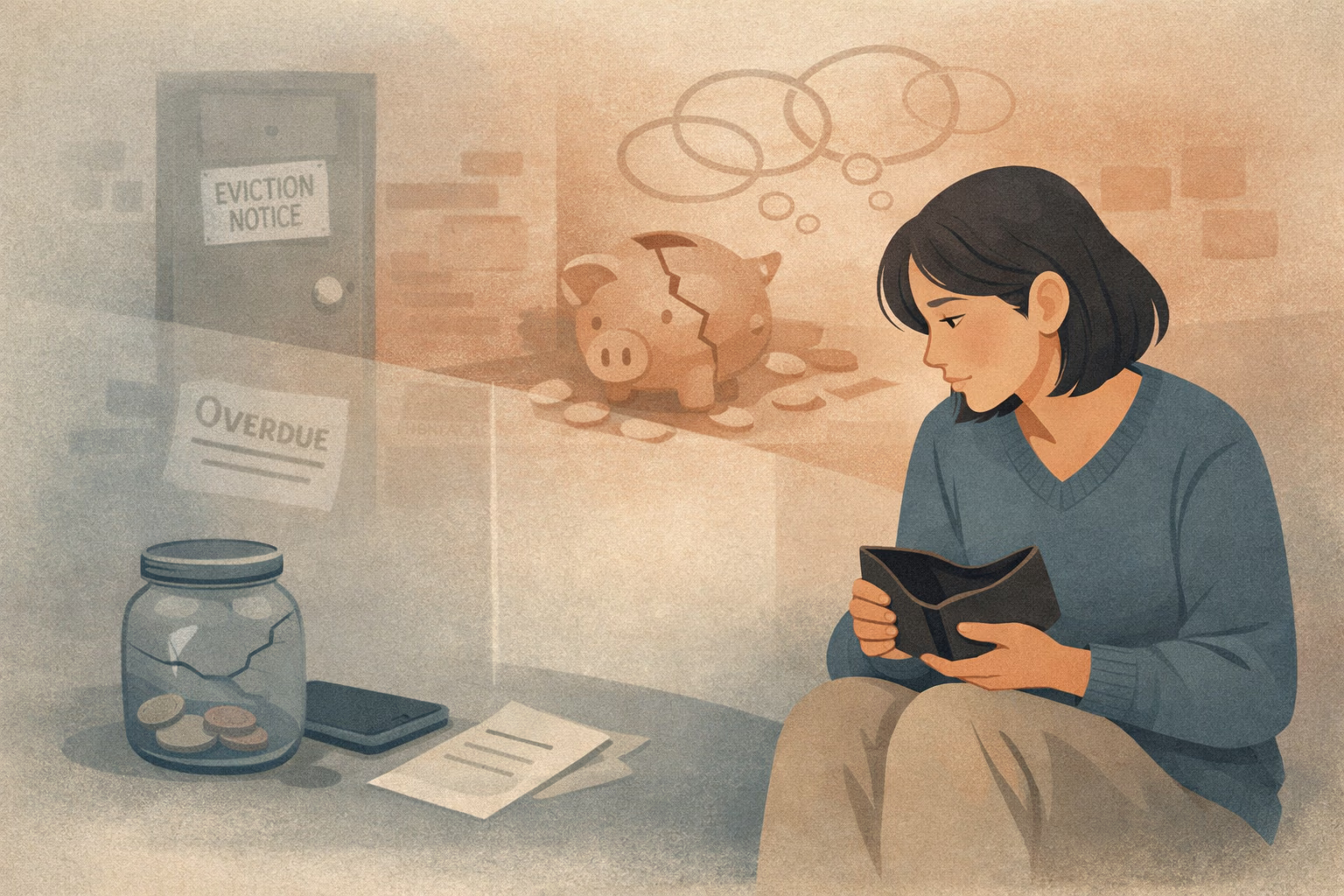
In the nervous system, repeated strain tends to create fast pathways: cue → alarm → protective behavior. If earlier experiences linked money with eviction risk, caregiver stress, conflict, scarcity, or unpredictability, the body can treat money-related inputs like alarms rather than neutral data.
That’s why a routine financial task can produce a disproportionate reaction—tight chest, restless urgency, mental blankness, or a need to escape. The response isn’t “too sensitive.” It’s a learned threat map that prioritizes survival over nuance. [Ref-2]
When your system learned that numbers could change your life overnight, why would it treat them casually?
Money stress rarely lives in isolation. For many people, early financial instability was also an attachment environment: caregivers under strain, fewer dependable buffers, more tension in the home, and less predictable support.
Over time, the nervous system can encode a broad lesson: resources aren’t reliable, and neither is help. That doesn’t have to be a conscious belief to shape behavior. It can show up as difficulty receiving support, discomfort depending on others, or a reflex to handle everything alone—because that once reduced disappointment or chaos. [Ref-3]
When money once felt like the edge of a cliff, certain strategies can create an immediate sense of safety: strict control, rigid rules, or total avoidance. These aren’t “bad habits.” They’re short-term nervous-system solutions that narrow the range of uncertainty.
Hyper-control can produce a brief settling because it creates clear boundaries: no spending, no risks, no surprises. Avoidance can also reduce load by muting incoming cues—no account logins, no bills opened, no conversations started. In the moment, both can feel like stability because they reduce activation. [Ref-4]
These strategies often “work” in one narrow way: they reduce the immediate sense of threat. But they can also quietly shrink flexibility, making life feel smaller and more effortful—like every decision must be defended.
Over time, strict control can turn into constant monitoring and self-interrogation. Avoidance can turn into backlog and delayed consequences that arrive louder later. The goal isn’t to blame the strategy; it’s to name the tradeoff. A nervous system can mistake tightness for safety, even when tightness becomes the new chronic state. [Ref-5]
An Avoidance Loop is a self-reinforcing pattern: discomfort rises, contact with the trigger is reduced, the body gets a short-term drop in activation, and the brain learns “avoidance helped.” The loop isn’t driven by weakness; it’s driven by relief.
With money trauma, the loop often centers on a fear of re-experiencing loss—so the system keeps life constrained. This can look like postponing decisions, refusing uncertainty, or using extremes (all-saving or all-spending) to force a sense of closure. The loop continues because it prevents a new, completed experience of “I can meet money reality and remain okay.” [Ref-6]
Relief changes state. But completion is what tells the body it’s done.
Money trauma can wear many disguises. What looks irrational from the outside is often internally coherent: it is the nervous system trying to reduce exposure to instability cues.
Some common patterns include: [Ref-7]
If your money behavior changes dramatically under stress, that’s often a state shift—not a personality.
When the nervous system treats finances as survival terrain, it can erode trust—both self-trust and relational trust. People may become guarded, private, or quick to interpret questions as judgment. Partners can end up living in parallel realities: one person tracking every detail, the other trying not to touch it at all.
It also compresses time. Planning can become hard, not because you lack ambition, but because the system is oriented to immediate stabilization. When survival is the organizing principle, long-range choices feel abstract, and the future can feel like a place you’re not allowed to count on. [Ref-8]
To update an old survival map, the system needs more than insight. It needs contact with present-day reality that reaches completion—an experience that begins, moves through, and ends with “nothing collapsed.” Avoidance interrupts that arc.
When money tasks are repeatedly delayed or outsourced to panic mode, the body never receives a full, digestible sense of: “This is manageable now.” Instead, the trigger remains linked to unfinished activation. The result is a paradox: avoiding money can keep money feeling dangerous. [Ref-9]
Not because you’re scared, but because the loop never reaches a done signal.
A key shift happens when financial fear is met in a way that changes the body’s timeline. Not through forcing positivity or repeating mantras, but through a quieter recognition: the reaction belongs to a period when the stakes were different.
When that recognition is paired with experiences that actually complete—conversations that end without rupture, bills that get handled without collapse, moments of uncertainty that resolve without catastrophe—the nervous system can begin to reclassify money cues. They become signals to respond to, not emergencies to outrun. [Ref-10]
Stability isn’t an idea you think. It’s a condition your body learns it can return to.
Money trauma often creates loneliness: the sense that you must manage quietly, prove competence, or hide struggle. That secrecy isn’t just emotional—it’s physiological load. It keeps vigilance running because support cues are missing.
When finances are held with more shared clarity—whether in relationships, community, or professional contexts—the system often softens. Not because someone “fixes” it for you, but because support becomes more predictable and conflict becomes less threatening. Over time, this can reduce the need for defensive control or disappearance around money. [Ref-11]
As financial survival memory loses intensity, decisions tend to feel less charged. Not perfect, not effortless—just less like a referendum on your worth or your future. The body can stay online longer, which allows more nuance and fewer extremes.
People often describe more capacity for ordinary tasks: looking at statements without spiraling, tolerating uncertainty without immediate shutdown, and having conversations without the same spike of threat. The hallmark isn’t constant confidence; it’s faster return to baseline after contact with money reality. [Ref-12]
Money is a tool, but under trauma it becomes a shield. Healing doesn’t turn money into something you love; it turns it back into something you can use—without it defining your identity or dominating your attention.
As coherence returns, financial choices can align more naturally with values: care, stability, generosity, learning, rest, community, future-building. The system isn’t constantly trying to prove safety through extremes, so money can take its appropriate place—important, but not all-powerful. [Ref-13]
Not “more motivated”—more oriented.
Money trauma is often the nervous system doing what it had to do in conditions that were too uncertain, too quiet, or too heavy to carry. The patterns that formed—avoidance, control, urgency, numbness—make sense when seen as protection against unfinished risk.
Over time, a new narrative becomes possible: not “I’m bad with money,” but “my system learned money as danger, and it can learn present-day safety too.” That shift isn’t about pushing harder. It’s about creating enough closure, consistency, and support that the body can stand down and let choice return. [Ref-14]
Early financial strain can echo for years, shaping anxiety, loneliness, and the sense of what’s possible. That imprint is real—and also changeable as life provides new, completed experiences of stability and support. [Ref-15]
Past money pain doesn’t have to be the author of your future. When survival memories are gently updated by present-day outcomes, the system gains permission to live with more dignity, coherence, and choice—even in an imperfect world.
From theory to practice — meaning forms when insight meets action.
Because the nervous system isn't reading numbers — it's reading cues. Repeated financial strain creates fast pathways: cue, alarm, protective behavior. If earlier life linked money to eviction risk, caregiver stress, conflict, or scarcity, the body can treat a bill, a bank balance, even a payment notification as a threat signal rather than information. That's why a routine task can produce a tight chest, restless urgency, mental blankness, or an urge to escape. The response isn't oversensitivity. It's a learned threat map prioritizing survival over nuance. When your system once learned that numbers could change your life overnight, it has reasons for not treating them casually.
Both are short-term safety substitutes — and both work, narrowly. Hyper-control reduces uncertainty by tightening rules: no spending, no risks, no surprises. Avoidance reduces uncertainty by reducing contact: no logins, no bills opened, no conversations started. Rigidity reduces uncertainty by preventing choice. In the moment, all three lower activation, which is why they feel like stability. The cost shows up later: tightness becomes the chronic state, backlog becomes louder consequences, and life shrinks until every decision must be defended. The Threat & Safety System can mistake constriction for safety long after the original conditions have changed.
Because the nervous system updates through completion, not insight. To revise an old survival map, the body needs an experience that begins, moves through, and ends with 'nothing collapsed.' Avoidance interrupts that arc. When money tasks are repeatedly delayed or handled only in panic mode, the body never receives a digestible Done Signal — only spikes of activation that cut off before resolution. The trigger stays linked to unfinished arousal. This is the Avoidance Loop in action: relief without closure. Healing requires not forcing positivity, but enough completed contact with present-day money reality that the system can reclassify the cue.
Yes, but the learning is conditional, not declarative. Stability isn't an idea you think; it's a condition your body learns it can return to. Repair happens through repeated, completable experiences: conversations that end without rupture, bills handled without collapse, uncertainty that resolves without catastrophe. As survival memory loosens, decisions feel less charged — not perfect, just less like a referendum on your worth. The hallmark isn't constant confidence. It's faster return to baseline after contact with money reality. Money stops being a shield and becomes a tool again, taking its appropriate place: important, but no longer the organizing principle of your life.
From Science to Art.
Understanding explains what is happening. Art allows you to feel it—without fixing, judging, or naming. Pause here. Let the images work quietly. Sometimes meaning settles before words do.
One Quiet Window, one insight, one reflection — every Sunday