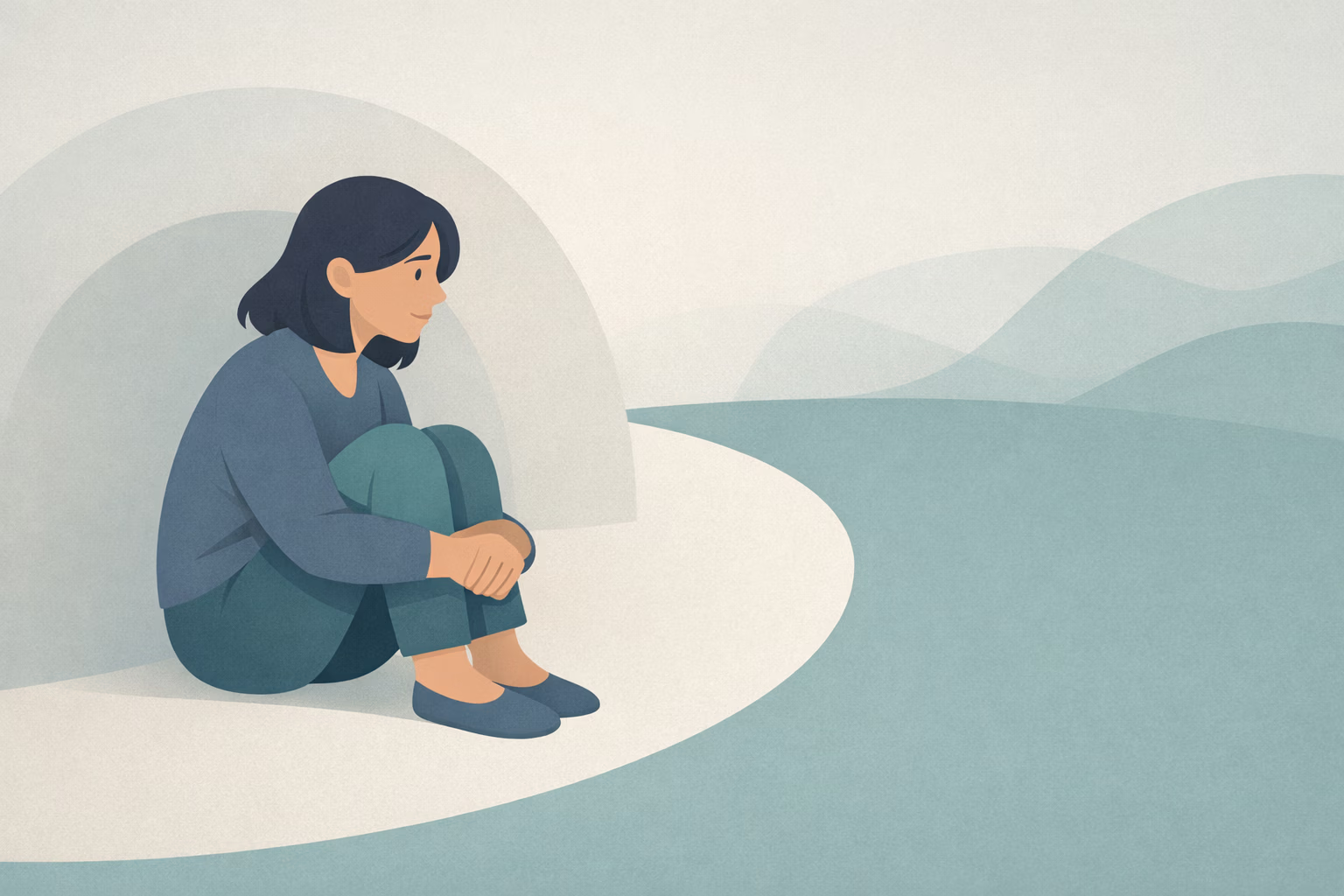
The Tyranny of Perfectionism: Why Nothing Feels Good Enough

In short: Parenting perfectionism often looks like love with its shoulders up: continuous scanning, constant adjusting, and an internal sense that there’s always one more thing to improve. It isn’t a personality flaw.
Parenting perfectionism often looks like love with its shoulders up: continuous scanning, constant adjusting, and an internal sense that there’s always one more thing to improve. It isn’t a personality flaw. It’s what can happen when a caregiving system is carrying too much uncertainty, too much visibility, and too little “done.”
What if the pressure to be everything is less about who you are, and more about what your system is being asked to hold?
In modern parenting, information is endless, standards are elastic, and outcomes feel publicly measurable. Under those conditions, the nervous system tends to reach for control and self-sacrifice because those can create short bursts of certainty. The cost is that parenting can start to feel like managing risk rather than living a relationship.
Many parents living under perfection pressure describe a steady background of anxiety, guilt, or self-criticism: the sense that any choice could be consequential and any miss could mean you “failed.” That experience can be loud even when things look fine from the outside.
Notice how this state behaves: it doesn’t resolve when you do more. It often tightens. It turns ordinary moments—snacks, bedtime, screen time, tone of voice—into decisions that feel like they will echo forever. In that state, your system isn’t evaluating your parenting; it’s trying to secure safety through certainty. [Ref-1]
When everything feels high-stakes, even small decisions can register like moral tests.
Today’s parenting environment combines two destabilizers: constant comparison and constant information. Social feeds show curated “solutions,” parenting content delivers endless cautions, and the future can feel like a moving target you’re personally responsible for predicting.
This combination can activate threat responses (scan, worry, brace) while also recruiting control strategies (monitor, perfect, prove). It’s not irrational; it’s a coherent adaptation to a world that implies you can and should prevent every negative outcome if you just work hard enough. Research on perceived parenting pressure links it with higher burnout and mental health strain, which fits this load-based picture. [Ref-2]
Caregiving isn’t merely a set of tasks; it’s an evolved attachment role. Human infants depend on adults for survival, and the adult nervous system is built to track cues, respond quickly, and stay engaged. In a different era, that vigilance had clear endpoints: the child is fed, sheltered, warm, and near.
Modern culture amplifies that ancient role through visibility and scrutiny. Parenting choices are discussed as identity statements, safety policies, and future determinants. Studies on pressure to be a “perfect mother” show links to burnout, reflecting how intensified standards can strain the caregiving system over time. [Ref-3]
Perfectionism often functions like a short-term stabilizer. When the world feels uncertain, “If I do it perfectly” can offer a momentary sense of control, moral reassurance, and reduced ambiguity. It provides an immediate “I’m doing something” signal to the nervous system.
But this is relief, not closure. The relief wears off quickly because the underlying uncertainty remains, and the standard quietly rises to keep delivering that same reassurance. When goals become unrealistic, the effort required to maintain safety-through-performance can climb until it’s unsustainable. [Ref-4]
What happens when the standard has no natural finish line?
Perfectionism can promise harm prevention: fewer mistakes, fewer regrets, fewer “what ifs.” Yet chronic pressure tends to undermine the very thing children orient to most reliably—felt emotional safety in the relationship.
When a parent’s system is consistently loaded, the household can become organized around tension and monitoring rather than settling. That can show up as irritability, rigidity, or emotional distance—not because the parent doesn’t care, but because the body is operating without enough stand-down signals. Research has found links between parenting perfectionism and harsher or more neglectful patterns under strain, suggesting that pressure can backfire even when intentions are protective. [Ref-5]
Safety isn’t only about outcomes; it’s also about the climate a child’s nervous system lives inside.
Parenting perfectionism often runs as a Power Loop: when uncertainty spikes, control behaviors increase. Control temporarily reduces distress, which teaches the system to reach for more control next time. When the inevitable imperfect moment happens—because life is life—the system often turns inward with self-blame, which keeps the threat signal active and pushes effort even higher.
In this loop, “trying harder” isn’t a virtue or a vice; it’s a regulatory attempt. It’s the body saying: stay on watch, stay ready, don’t let anything slip. Research on perfectionistic parents has also highlighted the cost of maintaining a composed exterior and managing inner strain, which can intensify exhaustion. [Ref-6]
Perfectionism in parenting is often recognizable less by what a parent believes and more by what their system repeatedly has to do to feel momentarily “safe enough.” Common patterns include: [Ref-7]
These patterns are not evidence that you’re broken. They’re evidence that the environment has made “done” hard to reach.
Over time, perfection pressure can lead to parental burnout: a state where energy is depleted, patience shortens, and caring can start to feel mechanical. This isn’t a character change. It’s what chronic load does to capacity—especially when there is little closure and little room for genuine recovery between demands. [Ref-8]
As load accumulates, presence can narrow. You might still be physically there while feeling mentally occupied with tracking, planning, correcting, or evaluating. Joy becomes less accessible not because it disappeared, but because the nervous system is prioritizing threat management over play, curiosity, and connection.
What gets lost when parenting becomes a performance?
Once the loop is running, anxiety often drives over-effort. Over-effort creates a new baseline—more rules, more tracking, more responsibility. That baseline then becomes the “minimum,” which effectively raises standards. Higher standards increase the chance of feeling behind, which increases anxiety. The loop closes, and the system learns that stopping is risky.
Importantly, this is not simply “worry causing behavior.” It’s a structural cycle built from repeated, incomplete completion signals: you do a lot, but you rarely receive a convincing internal sense that it’s enough and finished. Studies connecting parenting pressure to burnout align with this escalating cycle of demand and strain. [Ref-9]
When the nervous system doesn’t get a “done” signal, it keeps reopening the assignment.
There is a particular kind of internal calming that can become possible when self-worth is no longer fused to outcomes. Not “I understand I shouldn’t take it personally,” but a deeper settling where a child’s hard day, a missed patience moment, or an imperfect choice no longer reads as a threat to your goodness.
This shift isn’t about lowering standards through logic. It’s about the system receiving a different signal: that relationship safety is not earned by flawless performance, and that imperfection can exist without escalating into danger. In that state, effort becomes more proportional, and decisions carry less identity weight. [Ref-10]
Children tend to organize around cues of steadiness: a caregiver who can return, repair, and remain emotionally available even when things are messy. When a parent is trapped in performance, the child may sense evaluation in the air—subtle tension, quick corrections, or a parent who seems “away” while doing everything right.
As performance pressure loosens, warmth often becomes easier to access, not as a technique, but as a natural byproduct of reduced threat load. The home climate can feel less like an inspection and more like a shared life. Family-oriented writing on perfectionism commonly highlights how relentless standards can strain connection, while a more humane stance supports closeness. [Ref-11]
How does the room feel when no one is being graded?
When threat pressure subsides, many parents notice something quiet but profound: signals return. Hunger cues, fatigue cues, play cues, affection cues—basic human rhythms that get drowned out by constant vigilance. This isn’t about “getting better at emotions.” It’s about the nervous system having enough bandwidth to register and respond.
With more bandwidth, patience and flexibility are more available because the system is no longer operating at the edge of overload. Confidence becomes less performative and more grounded: not “I can control everything,” but “I can meet what happens and recover.” Popular discussions of parenting burnout often describe how chronic stress narrows tolerance and how relief from pressure can restore steadiness. [Ref-12]
When parenting is guided primarily by fear of failure, the day becomes a series of prevention maneuvers. But when parenting is guided by values—care, respect, responsibility, curiosity, faith, humor, community—the day has a different organizing center. Values provide coherence: a reason that can hold steady even when outcomes vary.
This doesn’t mean outcomes don’t matter. It means they stop being the sole measure of your worth and your child’s future. As unrealistic parental goals intensify, burnout risk rises, suggesting that the system does better with humane standards and meaningful orientation than with constant optimization pressure. [Ref-13]
Meaning in parenting often grows less from getting it right and more from staying connected while it unfolds.
Parenting perfectionism can be understood as deep care searching for safety in a high-demand environment. The impulse to monitor, optimize, and self-sacrifice is often a sign that your system has been asked to carry too much uncertainty alone—not that you are deficient. Research linking perfection pressure with burnout supports the idea that conditions matter. [Ref-14]
When the pressure story loosens, agency tends to feel different: less like forcing yourself to be more, and more like remembering what you are already doing—showing up in a relationship that matters. Coherence grows when your choices can land inside a stable sense of “this is who I am as a parent,” rather than continually reopening the question.
Most children are not looking for flawless execution. They orient to return: a caregiver who can come back to steadiness, offer repair after rupture, and remain real. Pressure to be “perfect” can exhaust parents and ripple outward, which is why it deserves compassion rather than judgment. [Ref-15]
Parenting becomes less crushing when it’s allowed to be a human relationship instead of a proof of worth. Meaning doesn’t arrive through tighter control; it tends to settle in when connection has room to complete—and when “good enough” can finally register as done.
From theory to practice — meaning forms when insight meets action.
Because the modern environment combines two destabilizers: constant comparison and constant information. Social feeds show curated solutions, parenting content delivers endless cautions, and the future feels like a moving target you're personally responsible for predicting. That activates the Threat & Safety System (scan, worry, brace) while also recruiting control strategies (monitor, perfect, prove). It isn't irrational — it's a coherent adaptation to a world that implies you can prevent every negative outcome if you just work hard enough. Comparison creates a normal that never settles, information overload keeps decisions from feeling finished, and the caregiving role becomes a 24/7 assignment without Done Signals.
Because it's a short-term stabilizer. When the world feels uncertain, if I do it perfectly offers a momentary sense of control, moral reassurance, and reduced ambiguity — an immediate I'm doing something signal to the nervous system. But this is relief, not closure. The relief wears off because the underlying uncertainty remains, and the standard quietly rises to keep delivering that same reassurance. This is the Power Loop in caregiving: uncertainty rises, monitoring increases, brief relief pushes standards up, the inevitable imperfect moment triggers self-blame, and the system reaches for more control. Trying harder isn't a virtue or a vice. It's a regulatory attempt with no finish line.
Often the opposite. Perfectionism promises harm prevention, but chronic pressure tends to undermine the very thing children orient to most — felt emotional safety in the relationship. When a parent's system is consistently loaded, the household can become organized around tension and monitoring rather than settling. That can show up as irritability, rigidity, or emotional distance, not because the parent doesn't care, but because the body is operating without enough stand-down signals. Children orient to return: a caregiver who can come back to steadiness, offer repair after rupture, and remain real. Safety isn't only about outcomes; it's about the climate a child's nervous system lives inside.
A particular kind of internal calming becomes possible. Not I understand I shouldn't take it personally, but a deeper settling where a child's hard day, a missed patience moment, or an imperfect choice no longer reads as a threat to your goodness. Effort becomes more proportional, and decisions carry less identity weight. Patience and flexibility are more available because the system isn't operating at the edge of overload. Confidence becomes less performative and more grounded: not I can control everything, but I can meet what happens and recover. Meaning Density grows when parenting can be a human relationship instead of a proof of worth.

From Science to Art.
Understanding explains what is happening. Art allows you to feel it—without fixing, judging, or naming. Pause here. Let the images work quietly. Sometimes meaning settles before words do.
One Quiet Window, one insight, one reflection — every Sunday