Reskilling Pressure: Always Feeling Behind

In short: Reskilling anxiety is what happens when rapid technological change makes your abilities feel fragile—like what you know could stop “counting” at any moment. It often shows up as urgency, mental scanning, and a pressure to keep adding credentials, not because you’re vain or behind, but because your system is trying to protect future security.
Reskilling anxiety is what happens when rapid technological change makes your abilities feel fragile—like what you know could stop “counting” at any moment. It often shows up as urgency, mental scanning, and a pressure to keep adding credentials, not because you’re vain or behind, but because your system is trying to protect future security.
What if the problem isn’t your motivation—what if it’s your nervous system getting no “done” signal?
In the age of AI, many people aren’t just learning new tools. They’re trying to restore safety while standing on moving ground. And when safety is at stake, the body doesn’t optimize; it defends.
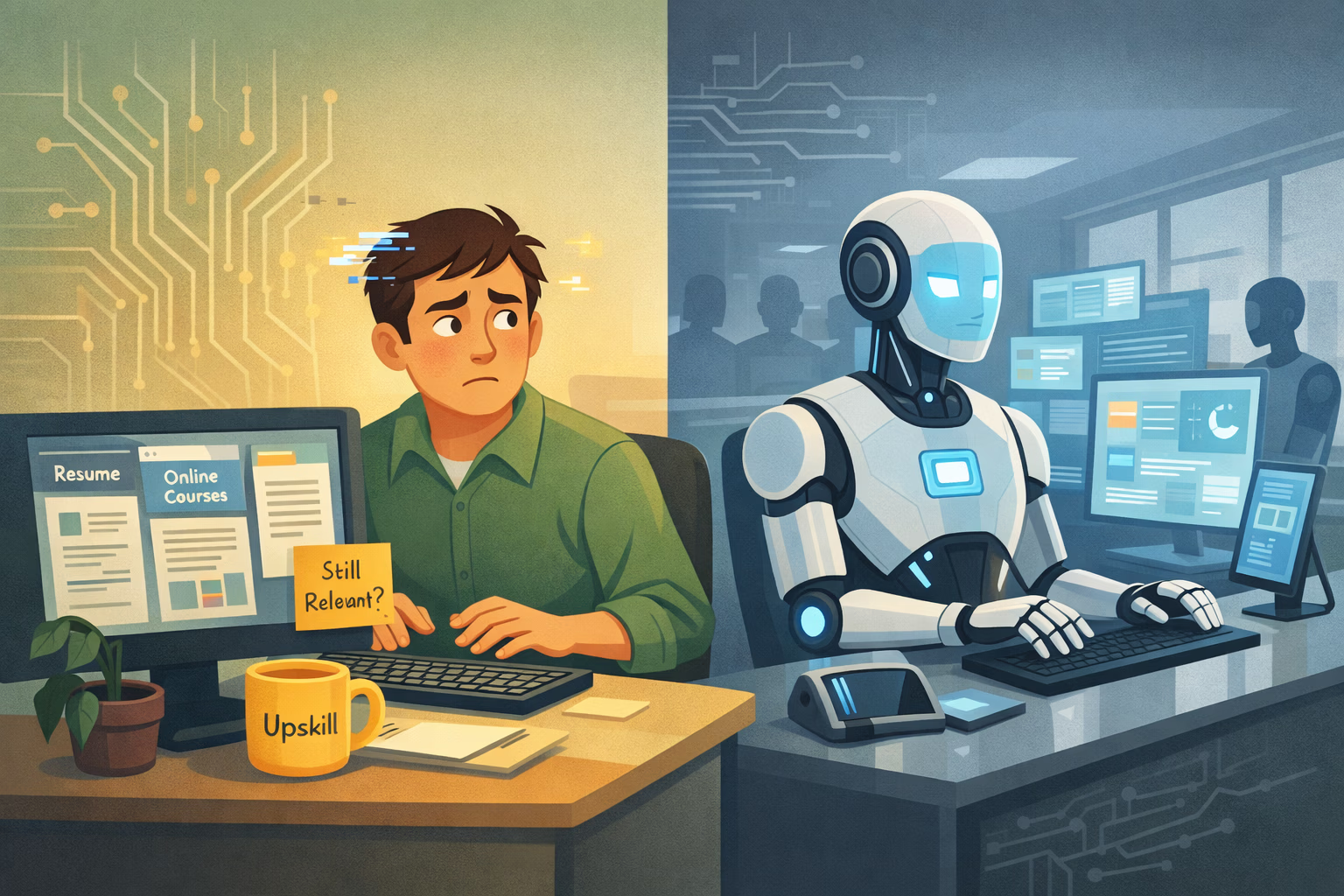
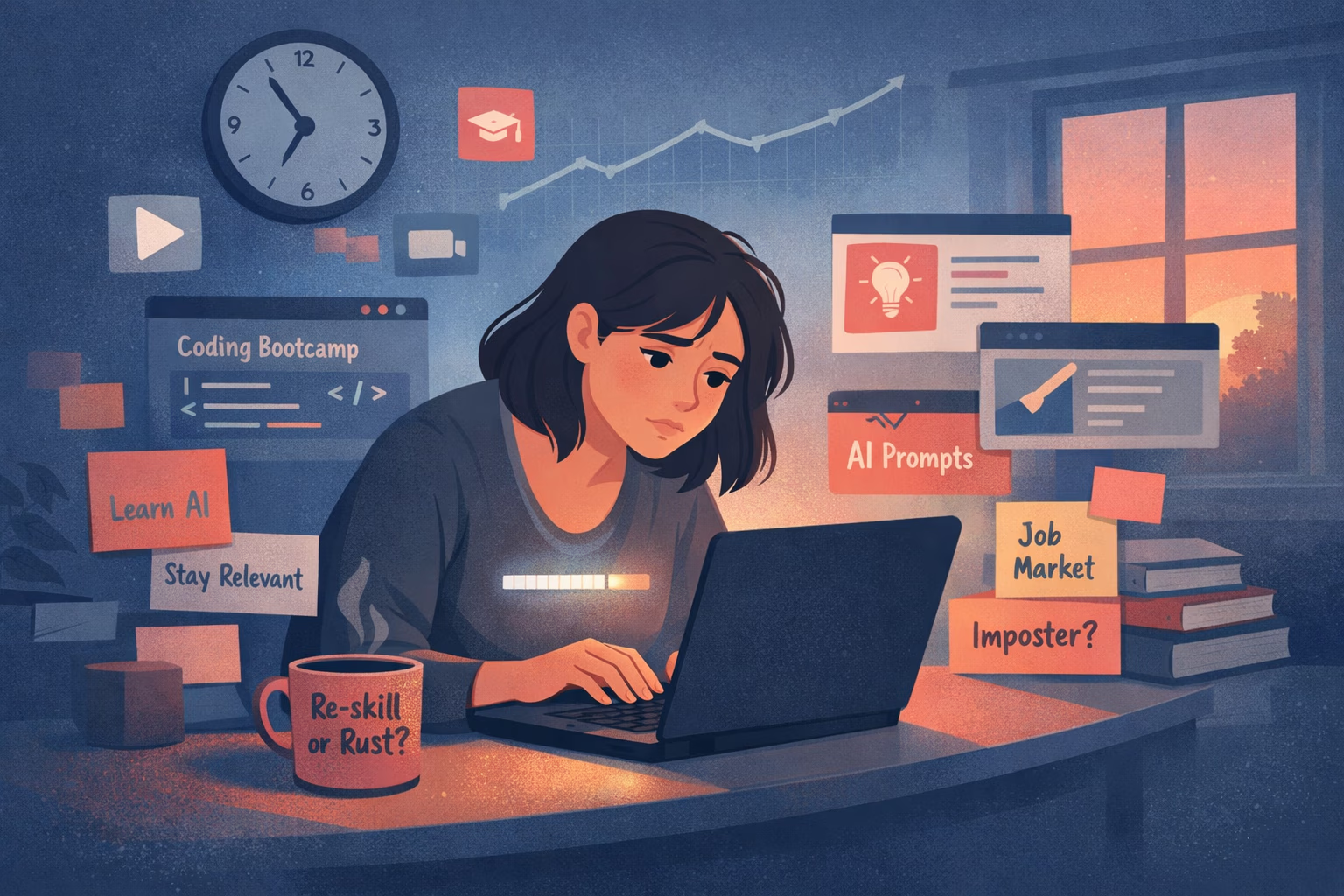
A unique exhaustion comes from never arriving. You finish one training, and another appears. You update one workflow, and the baseline shifts again. The mind starts treating learning as a continuous emergency broadcast: pay attention, or something important will be lost.
This is why reskilling can start to feel less like development and more like a race against disappearance. Reports consistently find high levels of worker fear about automation-related job loss, which can keep the system primed even on quiet days. [Ref-1]
The fatigue isn’t only about time. It’s the ongoing requirement to monitor your relevance—like carrying an invisible performance review in your pocket.
When your skills feel at risk, the body often interprets it as a threat to stability: income, status, belonging, options. That interpretation can activate stress biology—more vigilance, narrower attention, more “must” energy. Under load, learning can become rigid and urgent: memorize, copy, don’t fall behind.
In that state, curiosity doesn’t disappear because you lack character. It gets outcompeted by protection. Research on AI-related anxiety in the workplace suggests it can dampen positive engagement with work, shifting the internal tone from interest to strain. [Ref-2]
When learning is driven by threat, it can feel like you’re studying for an exam that never ends.
Humans evolved to track what keeps us safe: food, shelter, allies, predictable roles. In modern economies, “being employable” can function like a condensed survival signal. It’s not just a career concern; it’s an orientation concern—where do I fit, and will I be able to provide?
AI accelerates this because it changes what counts as valuable labor, sometimes faster than a person can update their sense of contribution. Discussions of job security in the context of AI often highlight how uncertainty itself becomes a stressor, even before any job change occurs. [Ref-3]
So when a tool becomes obsolete, it can land in the body as: maybe I am becoming obsolete. That’s not irrational. It’s the nervous system using available cues to estimate future safety.
Under threat, humans look for immediate ways to reduce activation. Two common regulatory moves show up here: delaying the threat (avoidance) or trying to overpower it (frantic upskilling). Both can briefly lower internal alarm because they change the moment-to-moment signal.
Avoidance can mute consequence: if you don’t open the course portal, you don’t have to meet the evidence that you’re “behind.” Frantic upskilling can restore control: if you enroll, research, and stack resources, you get a quick sense of movement.
Either way, the relief isn’t proof you chose the “right” strategy. It’s proof your system found a short-term state change in a landscape that isn’t offering closure. Job stress discussions around AI often note how uncertainty can increase strain and coping behaviors without resolving the underlying insecurity. [Ref-4]
The modern story says: keep reskilling and you’ll secure your future. But threat-driven learning often doesn’t deliver the feeling it promises, because the goalpost keeps moving. The nervous system doesn’t settle from accumulation; it settles from completion.
When learning is pursued as insurance against replacement, it can quietly erode confidence. Each new requirement becomes evidence that what you had wasn’t enough, which feeds the sense of fragility. Over time, this kind of pressure can contribute to burnout and withdrawal from work. Research on skills obsolescence has linked these dynamics to strain-related outcomes such as burnout and absenteeism. [Ref-5]
The mismatch is subtle: the more you chase safety through constant updating, the more your body learns that safety is always one module away.
An Avoidance Loop isn’t about weakness. It’s a predictable system loop: rising threat pressure reduces capacity; reduced capacity makes learning harder; difficulty then “confirms” the danger; and the system reaches for relief strategies that don’t complete the loop.
In workplaces facing technological change, job insecurity and stress can reinforce each other—pressure narrows bandwidth, and narrowed bandwidth makes adaptation feel even more demanding. [Ref-6]
What keeps the loop going isn’t a lack of insight. It’s that the environment keeps issuing new “not done yet” cues, while the body keeps looking for a stand-down signal that never arrives.
When your system is trying to stay employable and stay regulated at the same time, it will often choose regulation first—even if the method is messy.
Reskilling anxiety often expresses itself through behaviors that make sense structurally: they reduce uncertainty or postpone contact with it. Many people experience these patterns especially when public narratives amplify the idea that most workers are at risk. [Ref-7]
None of these mean you’re incapable. They mean your system is navigating a high-velocity landscape with limited closure points.
Learning needs spare capacity. It needs room for mistakes, play, and consolidation. Under sustained threat, the body prioritizes immediate protection, which can reduce cognitive flexibility and make new information feel harder to hold.
Over time, the cost isn’t only stress—it’s identity instability. When your role feels provisional, it’s harder to build a coherent sense of “this is what I do” and “this is how I contribute.” That instability can show up as burnout, disengagement, or increased absence from work, especially when skills are perceived as eroding. [Ref-8]
This is one reason people can look “unmotivated” from the outside while feeling intensely pressured on the inside: the system is overloaded, not indifferent.
Rapid change introduces uncertainty. Uncertainty increases threat scanning. Threat scanning narrows attention toward immediate risks and social evaluation. And that narrowed attention can make learning feel brittle—harder to prioritize, harder to integrate, easier to abandon.
In sectors experiencing technological change, studies describe how job insecurity and work stress interact, creating conditions where adaptation becomes more difficult precisely when it’s demanded. [Ref-9]
The loop becomes self-reinforcing: you feel behind, so you push harder; the push raises load; under load you absorb less; absorbing less becomes more “proof” that you’re behind. This is not a personal flaw. It’s a predictable output of a nervous system trying to protect continuity without enough closure.
There is a noticeable internal shift that can happen—not as a mindset, but as a settling. The body gets more “room” again. Attention widens. The urge to prove decreases. Learning starts to feel like exploration rather than compulsion.
This shift isn’t created by understanding the problem more clearly. It emerges when threat load drops enough that your system can register safety cues and complete smaller cycles: start, engage, finish, and rest. Research on affective well-being in AI-impacted work contexts points to the emotional tone of work changing under AI pressure, suggesting that conditions can meaningfully shape how work feels from the inside. [Ref-10]
In a regulated state, learning isn’t a referendum on your worth—it’s information you can metabolize.
Threat intensifies in isolation. When you’re alone with uncertainty, the mind fills gaps with worst-case projections. Shared learning environments—mentorship, teams, communities—add reality checks and pacing cues. They also restore a crucial signal: you still belong while you’re learning.
Support can reduce the sense that everything depends on your private effort. It turns “I must keep up or I’m done” into “we’re adapting together.” Many workplace discussions about AI and employment emphasize the balancing role of organizational support and reskilling infrastructure in shaping how threatened people feel. [Ref-11]
Sometimes the most stabilizing thing isn’t a new skill. It’s a new context where your nervous system can stop bracing.
Curiosity is not a personality trait you either have or don’t. It’s a capacity state. When the system isn’t busy defending, it can afford to wonder, experiment, and revise. Patience becomes possible because the body isn’t treating every delay as danger.
In cultural conversations about lifelong learning, the emphasis is often on staying competitive. But from a regulation perspective, the more important point is that sustainable learning tends to ride on a calmer baseline—where the brain can consolidate and where effort doesn’t automatically spike threat. [Ref-12]
When that baseline returns, “learning” stops being a pile of content and starts becoming a sequence of completed experiences that actually stick.
In a more regulated state, people often become more strategic—not because they force it, but because their criteria become clearer. Instead of scanning for what everyone else is doing, you can sense what fits your direction: the work you want to contribute, the environments you want to be in, the kinds of problems you want to help solve.
This is where skill development becomes stabilizing. Not as hoarding. As alignment. And in many contexts, AI doesn’t only remove roles; it reshapes them, creating new combinations of human judgment, domain expertise, and tool fluency. [Ref-13]
Coherence looks like fewer scattered starts, more completions, and a quieter internal narrative: “I know what I’m building toward.”
Reskilling anxiety is often a signal that identity has been over-tethered to tools, platforms, and external validation. In fast-changing environments, that tether becomes painful because tools change faster than a human sense of self can comfortably update.
When you anchor identity in purpose, contribution, and values, the system has somewhere to stand while the landscape shifts. The question becomes less “Will I be replaced?” and more “What kind of work reflects me, and what capacities support that?” Conversations on technological change and mental health often highlight how pace and uncertainty can strain well-being—especially when people feel they have no stable reference point. [Ref-14]
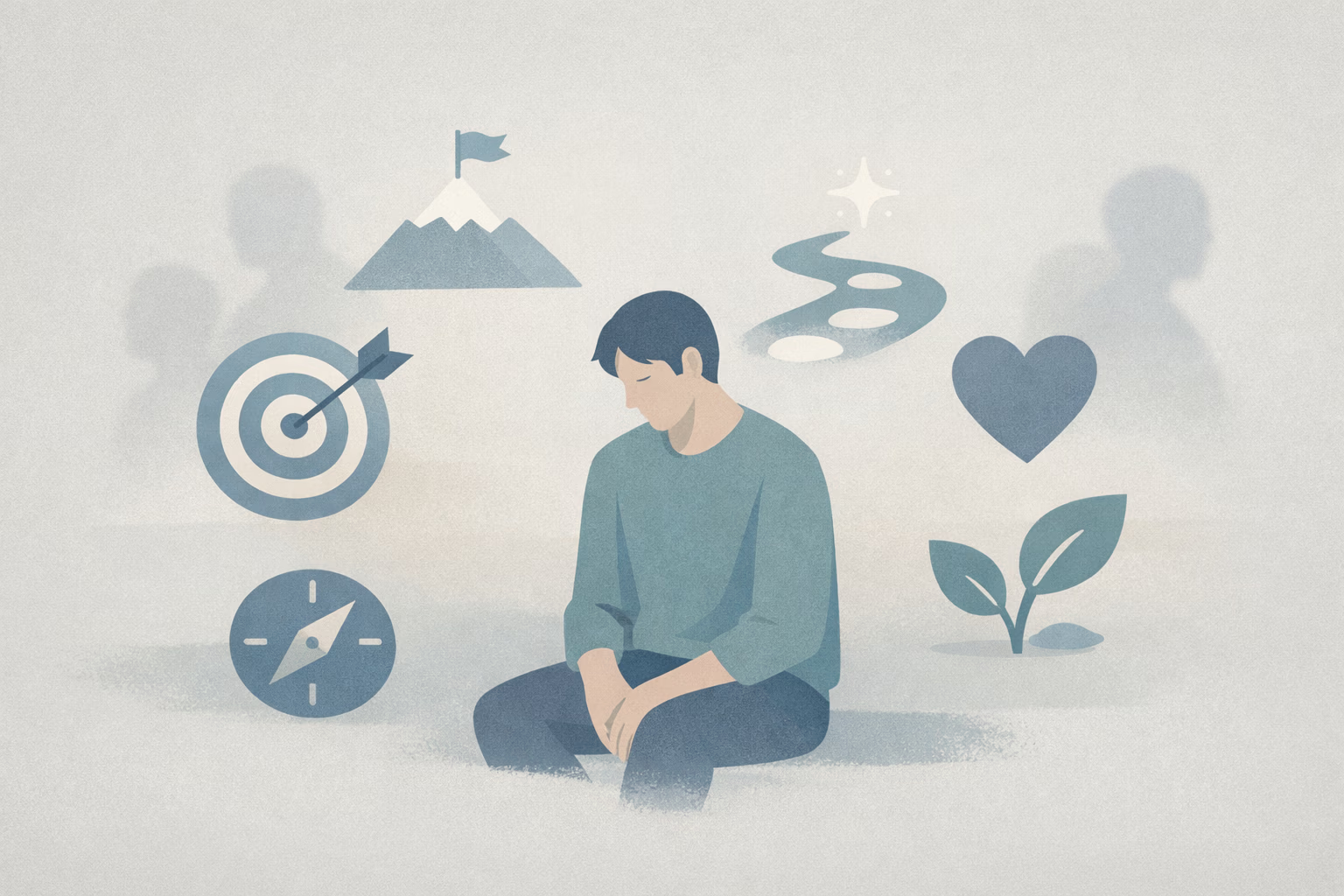
Agency doesn’t require certainty about the future. It often begins as a return of orientation: a felt sense of direction that is bigger than any single software version.
Skills will keep evolving. That’s not a verdict on your adequacy; it’s a feature of the era. What protects you most reliably isn’t endless urgency—it’s the capacity to learn from a steadier place, where completion is possible and identity isn’t constantly on trial.
When learning serves meaning rather than survival panic, it tends to become more durable, more integrated into how you live, and less likely to collapse under pressure. The affective tone of work matters here: when conditions support well-being, people can relate to change with more flexibility and less bracing. [Ref-15]
You don’t have to become a machine to live alongside new machines. A stable sense of self is still the most human form of resilience.
From theory to practice — meaning forms when insight meets action.
Because you never arrive. You finish one training, another appears. You update one workflow, the baseline shifts. The mind starts treating learning as a continuous emergency broadcast: pay attention, or something important will be lost. The fatigue isn't only about time — it's the ongoing requirement to monitor your relevance, like carrying an invisible performance review in your pocket. Reskilling stops feeling like development and starts feeling like a race against disappearance. The Threat & Safety System interprets skill obsolescence as threat to income, status, belonging, options. Under threat the body doesn't optimize — it defends. Curiosity gets outcompeted by protection.
Because the goalpost keeps moving. The nervous system doesn't settle from accumulation; it settles from completion. When learning is pursued as insurance against replacement, each new requirement becomes evidence that what you had wasn't enough — which feeds the sense of fragility. The more you chase safety through constant updating, the more your body learns that safety is always one module away. Frantic upskilling restores a quick sense of movement and control, while avoidance mutes consequence. Both can lower immediate alarm, but neither delivers a Done Signal. The relief is your system finding a state change in a landscape that isn't offering closure.
Rising threat pressure reduces capacity. Reduced capacity makes learning harder. Difficulty 'confirms' the danger. The system reaches for relief strategies — frantic course consumption, decision paralysis, comparison spirals, avoiding learning altogether — that don't complete the loop. The environment keeps issuing 'not done yet' cues while the body looks for a stand-down signal that never arrives. Pressure narrows bandwidth, and narrowed bandwidth makes adaptation feel even more demanding. People can look unmotivated from the outside while feeling intensely pressured on the inside, because the system is overloaded, not indifferent. The loop isn't a personal flaw; it's a predictable nervous-system output.
Learning changes texture. The body gets more room. Attention widens. The urge to prove decreases. Learning starts feeling like exploration rather than compulsion. This isn't a mindset shift — it's a settling that happens when threat load drops enough for the system to register safety cues and complete smaller cycles: start, engage, finish, rest. Curiosity isn't a personality trait you either have or don't; it's a capacity state. When you anchor identity in purpose, contribution, and values rather than tools and platforms, the question shifts from 'will I be replaced?' to 'what kind of work reflects me?' You don't have to become a machine to live alongside new machines.
From Science to Art.
Understanding explains what is happening. Art allows you to feel it—without fixing, judging, or naming. Pause here. Let the images work quietly. Sometimes meaning settles before words do.
One Quiet Window, one insight, one reflection — every Sunday