Reskilling Anxiety in the Age of AI
In short: AI replacement anxiety isn’t just worry about technology. It’s the fear that the future will arrive and quietly erase your usefulness, your economic safety, and the role that helped you feel like a real person in the world.
AI replacement anxiety isn’t just worry about technology. It’s the fear that the future will arrive and quietly erase your usefulness, your economic safety, and the role that helped you feel like a real person in the world.
What if your nervous system isn’t overreacting—what if it’s responding to an environment that keeps removing “done” signals?
When every new model release, headline, or workplace shift feels like a countdown, the mind doesn’t just think about change; it starts organizing life around threat. And once threat becomes the organizing principle, clarity and agency can shrink—not because you lack willpower, but because your system is trying to keep you safe.
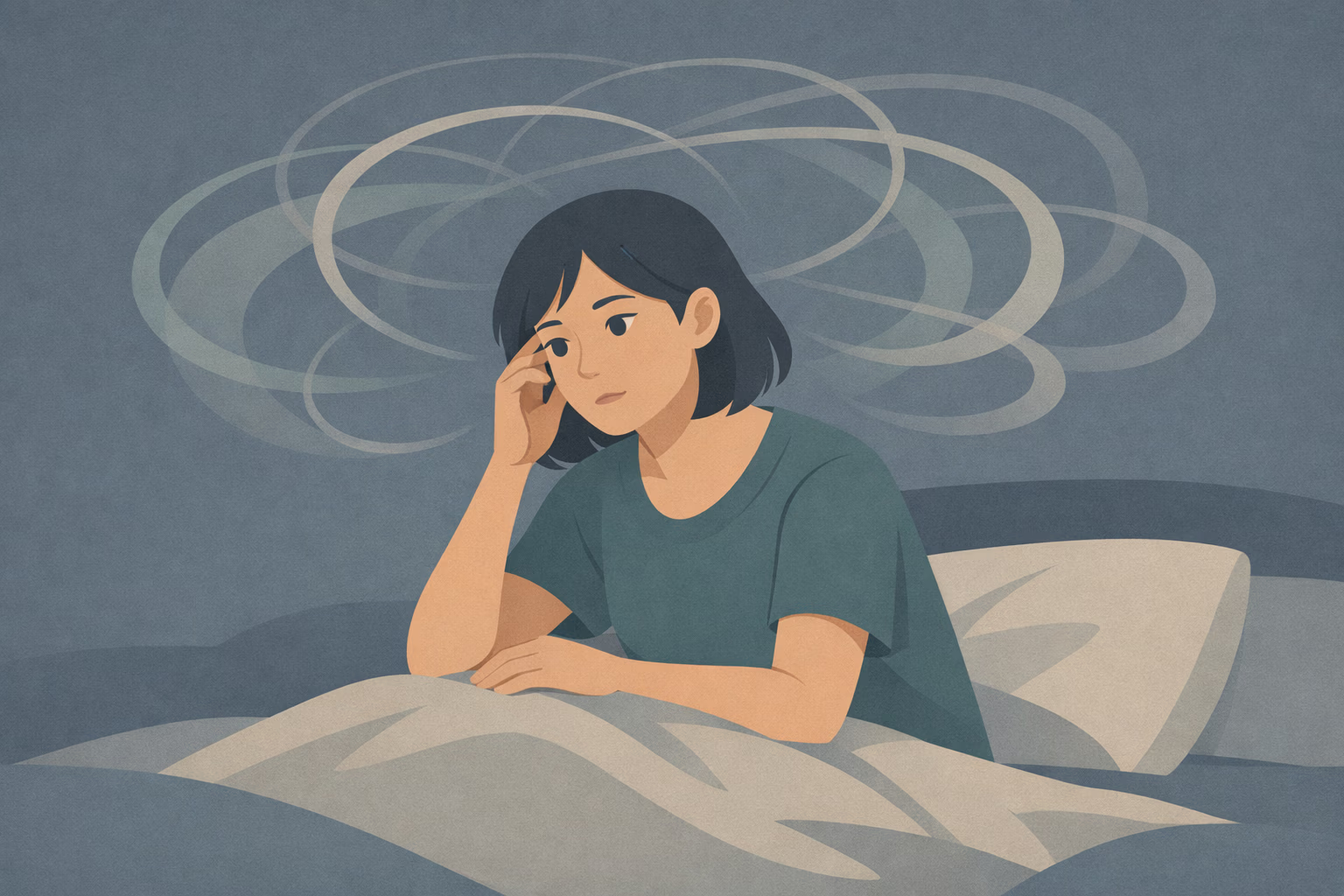
A common texture of AI replacement anxiety is background dread mixed with constant comparison. You see an AI demo and your body reads it less like “interesting tool” and more like “evidence.” Evidence that you’re late, behind, or already losing ground.
This is why it can feel hard to enjoy your own competence. Achievements don’t land. Compliments don’t settle. The goalposts seem to move before your system registers any arrival. In that state, even normal career uncertainty can start to feel like a verdict on your future self. [Ref-1]
It’s not that you think you’re worthless. It’s that the world keeps implying you’ll soon be unnecessary.
When a role feels endangered, the nervous system often shifts into threat physiology: scanning, urgency, and narrowed problem-solving. This isn’t a character flaw—it’s the brain prioritizing immediate safety cues over long-range integration.
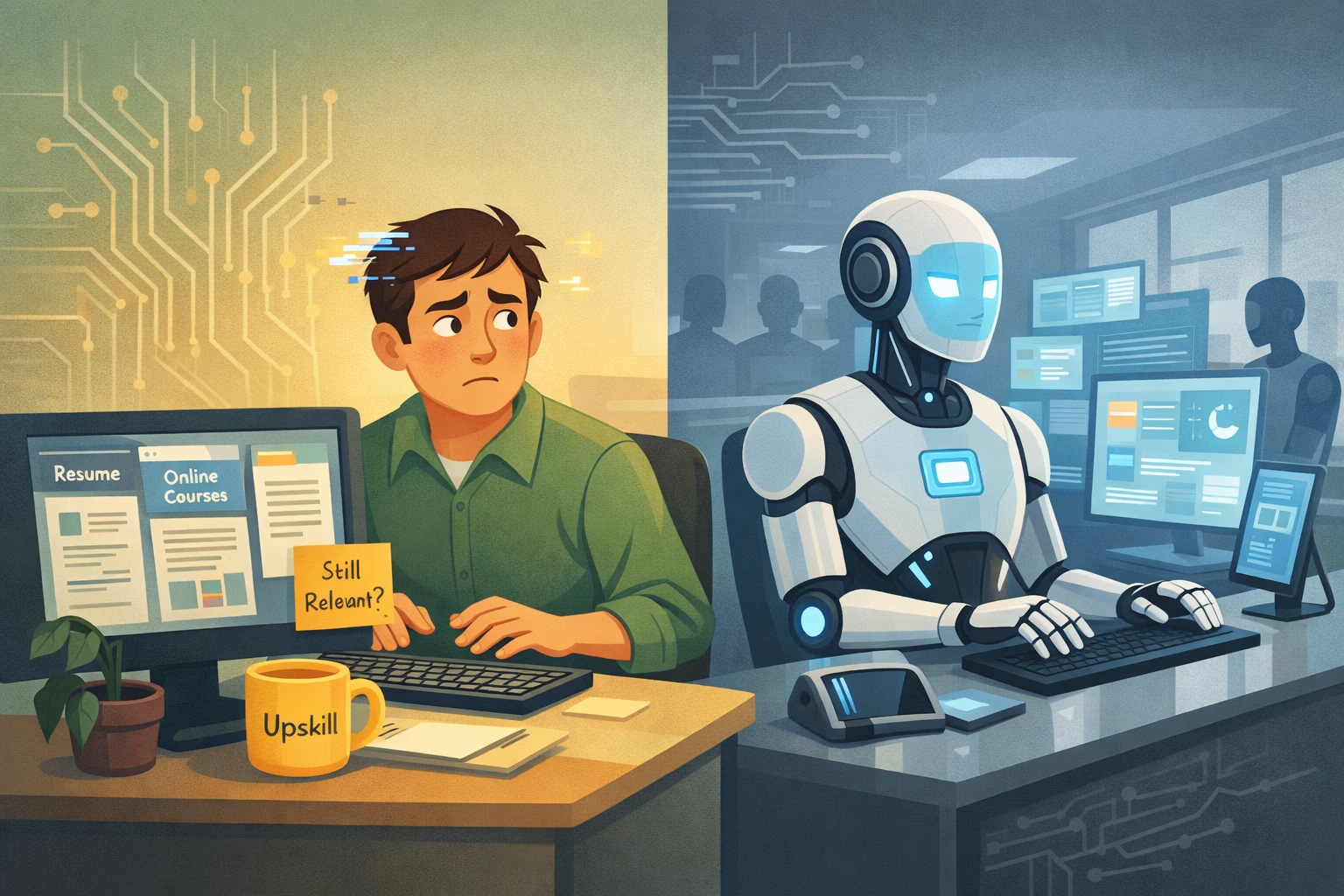
In that state, you may notice freeze-like patterns: difficulty starting, avoidance of applications or projects, or a blank, heavy kind of procrastination. Or you might swing into overactivation: frantic researching, late-night course browsing, compulsive updating of skills and profiles. Both can be expressions of the same load—your system trying to reduce uncertainty and regain a sense of control. [Ref-2]
Why does it get harder to think clearly right when you “need” to?
Because threat orientation reallocates resources. The body prepares for risk management, not for spacious creativity or coherent identity-building.
Humans are social mammals whose safety has long been linked to belonging and contribution. Across most of our history, having a role meant access: to resources, protection, and social standing. Losing a role wasn’t just inconvenient—it could mean exclusion or scarcity.
So when modern work signals “your skillset may not matter soon,” it can land in the nervous system like a primal alarm. Not because the situation is identical to ancestral threats, but because the body uses old templates to interpret new risks.
In that sense, obsolescence fear isn’t irrational. It’s a meaningful signal: “My place in the system might be unstable.” And when change is rapid, that signal can repeat before it ever resolves. [Ref-3]
Under threat, people naturally reach for moves that create immediate relief: distancing from information, minimizing the issue, or intensifying effort. In the short term, each of these can lower discomfort by restoring a sense of agency or by muting exposure to uncertainty.
But relief isn’t the same as closure. Relief changes state; closure lets the system stand down. When the environment keeps re-opening the question—“Will I still matter?”—relief strategies can become the main way the body regulates, even if they don’t produce a lasting “done” signal. [Ref-4]
A modern myth says: if you keep learning fast enough, you’ll be safe. The problem is that fear-driven acceleration rarely creates identity clarity. It can produce more credentials, more tabs open, more “should,” while still leaving the underlying question unanswered.
In a fear posture, learning can become a form of bracing—an attempt to hold off an imagined future. That posture can exhaust attention, strain confidence, and hollow out the sense of a stable self. Instead of “I’m expanding,” it becomes “I’m trying not to disappear.” [Ref-5]
When safety is defined as staying ahead, there’s no place to arrive—only a pace you’re afraid to slow down.
An Avoidance Loop forms when the system repeatedly meets uncertainty without reaching completion. AI replacement anxiety fits this pattern: the threat signal (possible displacement) triggers protective strategies (withdrawing, compulsive learning, overcontrol), which temporarily reduce discomfort but don’t create closure. Then the next headline arrives and reactivates the entire circuit.
Over time, the loop can start shaping identity. You don’t just have a job; you have a running internal audit: “Am I still relevant?” When that audit never ends, the nervous system stays oriented toward proving, preventing, and pre-empting—rather than integrating experience into a settled sense of contribution. [Ref-6]
When threat stays unresolved, the body searches for stabilizers. The result can look like personality change, but it’s often a regulatory shift: the system choosing strategies that reduce uncertainty fastest.
These patterns can be especially intense because the “threat object” is abstract: it isn’t a single event you can complete. It’s a moving horizon, which keeps the loop open. [Ref-7]
When the nervous system stays on alert, it tends to trade depth for speed. That can reduce the very qualities people rely on for meaningful work: nuanced judgment, creative association, relational presence, and the willingness to explore.
Confidence often erodes first—not as a belief problem, but as a capacity problem. Under chronic activation, it’s harder for positive feedback to register as “true enough to rest on.” The system stays prepared for reversal.
Over time, this can narrow the sense of possibility: you may feel less open to new forms of contribution, not because you’re rigid, but because openness requires spare capacity—and threat uses that capacity. [Ref-8]
One reason AI replacement anxiety can feel relentless is the cadence of change. Tools update, workflows shift, companies reorganize, and public narratives oscillate between hype and catastrophe. Each cycle reactivates the question: “Am I safe here?” [Ref-9]
In that atmosphere, relevance can start to look like the only currency that matters. If your system learns “safety depends on staying indispensable,” then any sign of automation becomes a threat cue—even when your real-life job hasn’t changed yet.
And when safety is tied to relevance alone?
The self becomes conditional: valuable only if current, only if faster, only if replace-proof. That conditionality is a heavy load to carry.
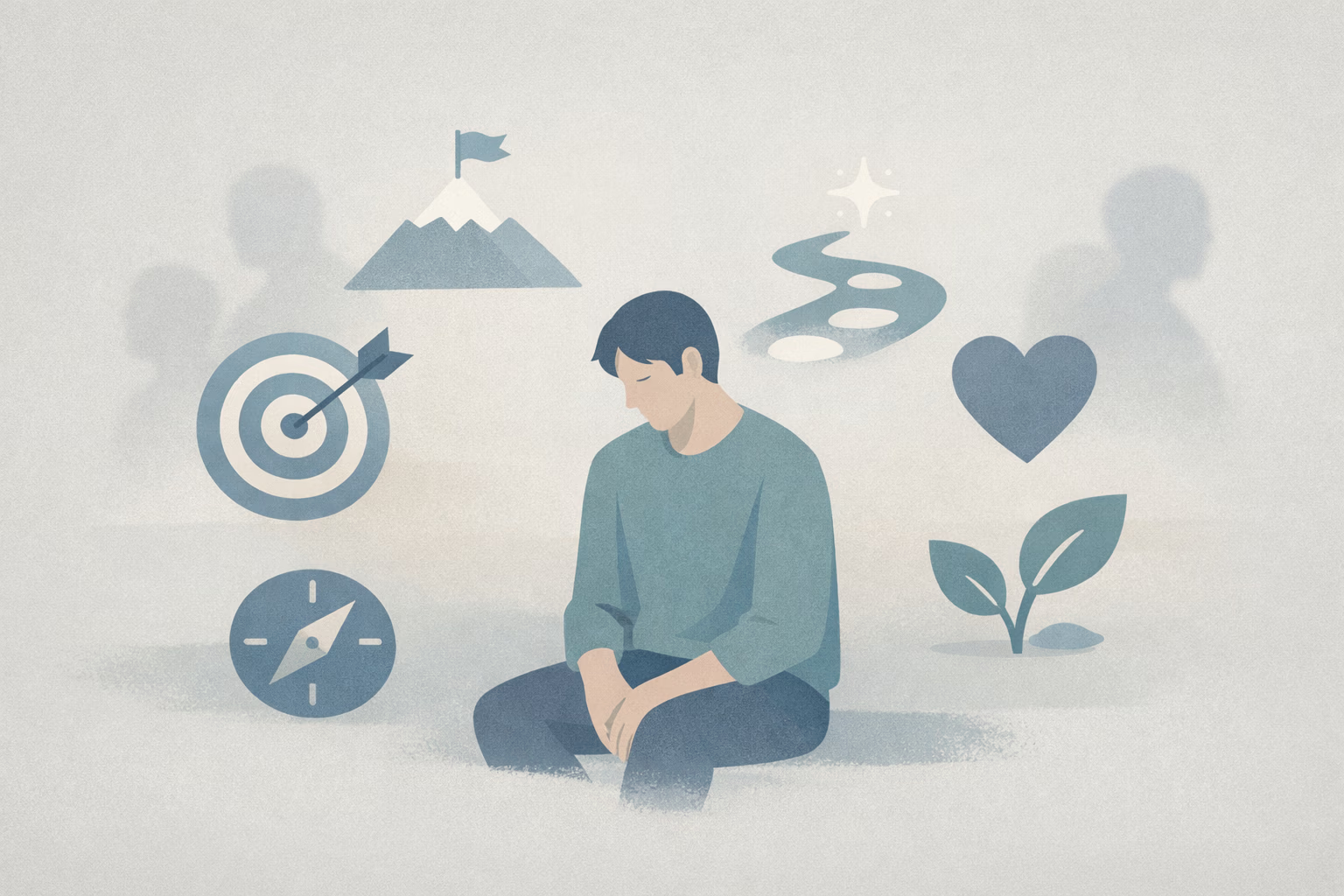
There is a different kind of steadiness that can return when identity is grounded beyond a specific platform, role title, or set of tasks. Not as a motivational slogan, and not as a reframing that tries to “think positive,” but as a deeper orientation: a sense that your worth and contribution are larger than any one interface.
Tools change. Workflows change. Even entire professions evolve. Yet many human forms of value are not tool-bound: reliability, discernment, ethical judgment, context-reading, relationship stewardship, taste, accountability, and the ability to hold complexity without flattening it.
This doesn’t erase uncertainty. It changes what uncertainty is about. The question becomes less “Will I be replaced?” and more “How does my contribution translate as the environment changes?” That shift often reduces internal threat because it restores continuity of self across transitions. [Ref-10]
Threat tends to isolate. It makes people feel like they’re the only one falling behind, the only one who didn’t see it coming, the only one whose work is at risk. Isolation amplifies uncertainty because the nervous system loses social safety cues.
In contrast, shared learning and mutual validation can reduce the sense that you’re in a private survival test. When people exchange what they’re seeing, name what’s hard, and recognize each other’s contributions, the environment becomes more legible—and legibility is calming.
Importantly, this is not about “networking harder.” It’s about the nervous system benefit of not carrying the future alone. Social support is one of the most reliable buffers against workplace stress load, including tech-related anxiety. [Ref-11]
Curiosity is not a personality trait you either have or don’t. It’s a capacity that tends to come online when the system senses enough safety to explore. Under chronic threat, exploration gets deprioritized; the mind goes into prediction and prevention.
As activation subsides, people often notice a quiet return of flexibility: the ability to consider multiple futures, to learn without panic, and to evaluate tools without feeling evaluated by them. Confidence, in this frame, isn’t a hype state—it’s the felt sense that you can meet what’s next without abandoning yourself.
This is also where learning can become coherent again. Not frantic accumulation, but learning that attaches to identity and lived contribution—knowledge that sticks because it’s integrated into how you move through the world. [Ref-12]
When identity is organized around threat, technology feels like a judge: every new capability becomes a comparison point. When identity is more regulated and coherent, technology can return to its actual category: a tool that changes inputs, outputs, and speed—without defining human worth.
In that steadier posture, adaptation becomes less about self-erasure and more about translation: which parts of your contribution remain the same, which parts shift form, and which parts become newly possible. That’s not denial of disruption; it’s a different relationship to it.
And as this settles, many people notice a subtle but important change: the future is still unknown, but it no longer feels like a continuous personal indictment. [Ref-13]
AI replacement anxiety often points to something true: roles are changing. But it doesn’t necessarily mean you are disappearing. It may be your system asking for a more durable basis for safety than “staying ahead of the next update.”
When the fear is met with dignity—when it’s understood as a load response to uncertainty rather than a personal weakness—space can open for a different kind of coherence. Not a fight to preserve an old shape of work at all costs, but a gradual reorganization of contribution that can survive transitions. [Ref-14]
It’s hard to feel like yourself when your life is built around preventing replacement. It’s easier when your identity has room to evolve.
Machines can automate tasks. They can accelerate outputs. They can even mimic parts of language and pattern. But a human life is not a task list—it’s an arc of responsibility, relationship, discernment, and values made real over time.
In a rapidly changing economy, it’s understandable to equate relevance with survival. Yet meaning has a different foundation: coherence between who you are, what you stand for, and how you contribute—across changing tools and titles.
Not because you outcompete machines, but because your humanity was never meant to be measured by machine terms. [Ref-15]
From theory to practice — meaning forms when insight meets action.
Because the Threat & Safety System reads role disruption as a survival cue, not just an industry trend. Humans have long linked usefulness to belonging — having a role meant access to resources and standing. So when a model release implies your skillset may not matter soon, the body interprets it through old templates: instability of place. The reaction isn't irrational. It's a meaningful signal that your contribution feels exposed. The trouble is the cadence — each headline reactivates the question before the system reaches closure, so the alarm keeps firing without ever delivering a Done Signal.
Fear-driven learning rarely produces identity clarity. It produces more credentials, more open tabs, and a posture of bracing — an attempt to outpace an imagined future. In that mode, learning becomes a Power Loop trap: motion that simulates safety without delivering closure. The underlying question — "will I still matter?" — stays open. Genuine learning, by contrast, integrates into how you contribute and rests on a stable sense of self. The difference isn't the activity; it's whether the nervous system can register arrival, or whether it keeps moving the goalposts to stay one step ahead of disappearance.
Regular career worry usually has a closeable shape — apply, interview, decide. AI replacement anxiety is structurally different because the threat object is abstract and moving. There's no single event that completes it. Tools update, workflows shift, narratives oscillate between hype and catastrophe — and each cycle reactivates the same question. That's how it forms an Avoidance Loop: the protective strategy (researching, withdrawing, doomscrolling) lowers activation briefly, but the next headline arrives and reopens the circuit. Without a Done Signal, identity becomes a running internal audit instead of a settled sense of contribution.
Steadiness tends to return when identity is grounded beyond a specific tool, title, or task list. Many human contributions aren't tool-bound — discernment, ethical judgment, context-reading, relationship stewardship, the ability to hold complexity. When safety is no longer defined as "staying ahead," the question shifts from "will I be replaced?" to "how does my contribution translate as the environment changes?" That shift restores continuity of self across transitions. It doesn't erase uncertainty, but it changes what uncertainty is about — and the Threat & Safety System can finally stand down between cycles.
From Science to Art.
Understanding explains what is happening. Art allows you to feel it—without fixing, judging, or naming. Pause here. Let the images work quietly. Sometimes meaning settles before words do.
One Quiet Window, one insight, one reflection — every Sunday