
Scarcity Mindset: Why Abundance Still Feels Unsafe
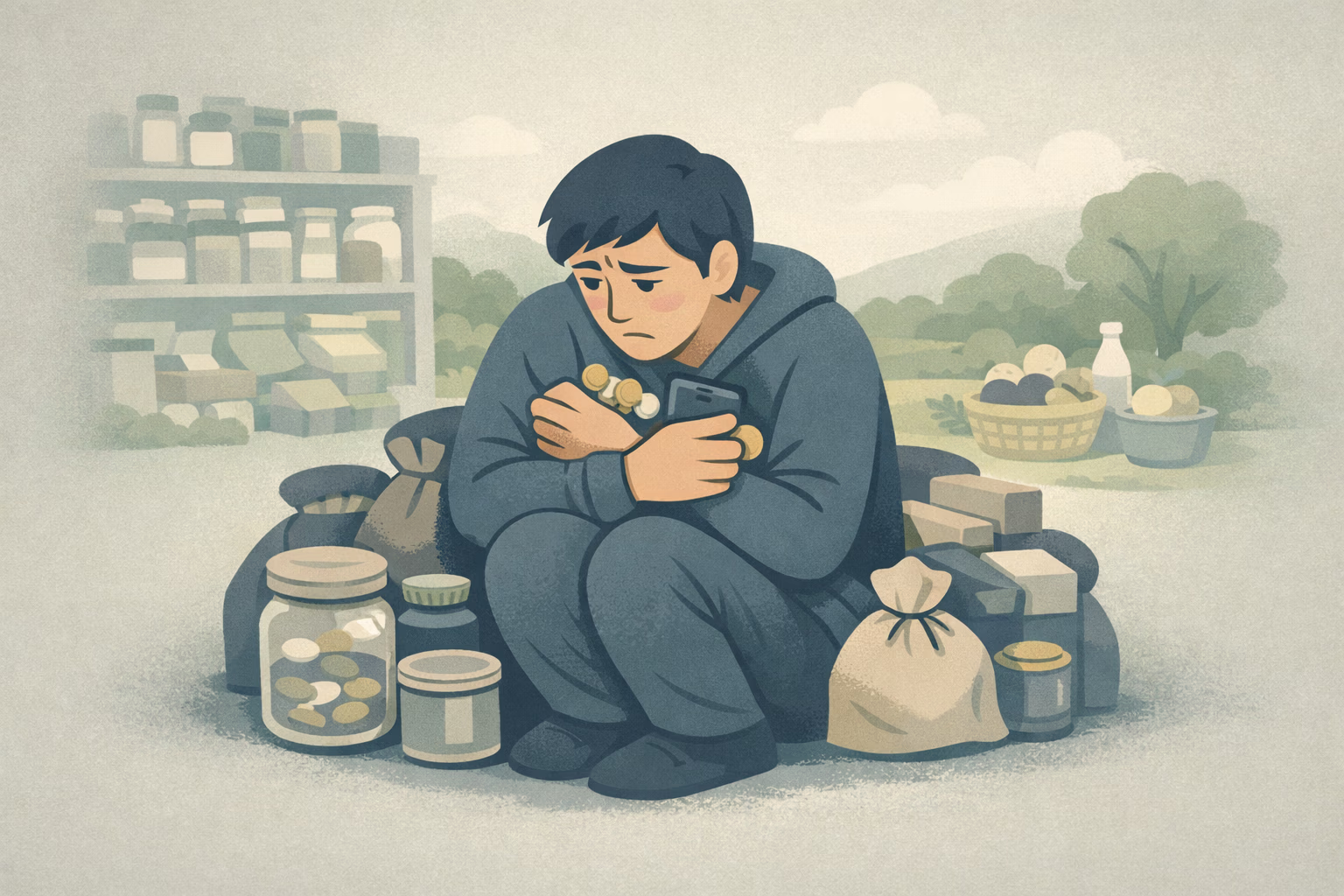
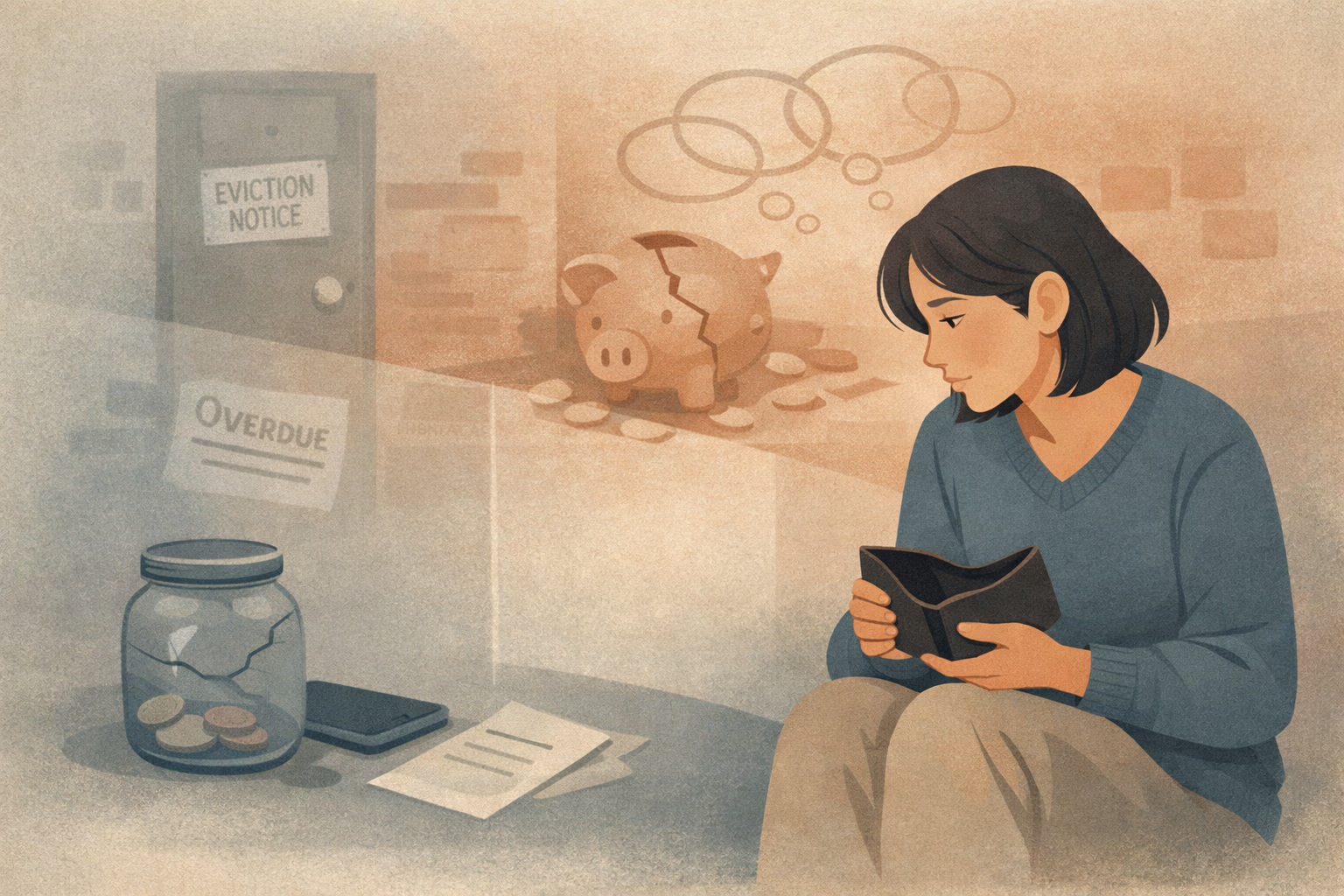
In short: In many modern lives, the basics are technically covered: food is available, bills are mostly handled, and there are choices on shelves and screens. And yet the inner climate can still feel like a shortage—like something is about to run out, slip away, or become unsafe.
In many modern lives, the basics are technically covered: food is available, bills are mostly handled, and there are choices on shelves and screens. And yet the inner climate can still feel like a shortage—like something is about to run out, slip away, or become unsafe.
Why can “enough” exist on paper, while your body stays on alert?
A scarcity mindset isn’t a character flaw or a lack of gratitude. It’s often a persistent threat signal—an ongoing perception of insufficiency that stays active even during stable periods. When that signal doesn’t reach closure, it can keep attention narrowed and life organized around protection rather than presence.
Scarcity mindset often shows up as a background hum: a sense that security is fragile, that a mistake will be costly, that rest is premature. Even when nothing urgent is happening, the system may keep checking—numbers, supplies, plans, backup plans.
This isn’t just “worry.” It can be a full-body readiness: tightness in the chest, sleep that doesn’t refresh, a mind that keeps returning to what could go wrong. The inability to relax can be a clue that the nervous system hasn’t received a convincing “stand down” signal yet. [Ref-1]
When uncertainty rises, human brains tend to prioritize what prevents loss. Attention narrows. Time feels shorter. Small decisions start carrying the emotional weight of big consequences. This is a known effect of scarcity and cognitive load: the mind “tunnels” toward what feels most urgent, even if that urgency is repeating rather than resolving. [Ref-2]
Under sustained threat activation, the body can treat the future like a problem to manage instead of a place to move into. Planning becomes less about direction and more about avoiding being caught off guard. And because uncertainty rarely resolves completely, the system can stay mobilized by default.
In ancestral environments, resource loss was not symbolic—it was survival-relevant. Food shortages, social exclusion, injury, and seasonal instability carried real risk. A nervous system that stayed alert to scarcity had an advantage: it conserved, monitored, prepared, and avoided unnecessary exposure.
That adaptive bias can persist even when modern life offers abundance in quantity. Today, many “threats” are abstract, ongoing, and informational—news cycles, market shifts, status comparisons, and constant measurement. The body may respond as if the old rules still apply: stay vigilant, or you’ll be harmed.
Scarcity thinking can provide a temporary sense of preparedness. If you’re scanning for what might go wrong, it can feel like you’re being responsible. The mental activity itself becomes a kind of shelter—something to do with uncertainty.
But that shelter has a cost. It can reduce psychological freedom by narrowing what feels permissible: spending, resting, changing direction, trusting timing. The system may prefer “guarded and ready” over “open and uncertain,” even when openness would be safe.
Sometimes the mind keeps watch not because danger is present, but because it never received a clear signal that the danger phase ended.
There’s a common illusion inside scarcity: that constant vigilance prevents catastrophe. It can feel like if you stop checking, you’ll miss something and pay for it. Yet research and clinical observation repeatedly show that sustained scarcity load erodes bandwidth—reducing working memory, flexibility, and creative problem-solving. [Ref-5]
In other words, the very stance meant to protect you can shrink the capacities that make life workable: imagination, play, trust, and the ability to perceive options. It can also make stability feel less believable, because the system is oriented around detecting instability.
From the outside, scarcity mindset can look like “being careful.” Structurally, it often functions as an avoidance loop: protective behaviors reduce exposure to uncertainty in the short term, but they also reduce the chances of receiving new safety evidence through lived completion. [Ref-6]
When engagement shrinks—fewer risks, fewer repairs, fewer moments of “we handled it”—the environment starts to look more dangerous. Withdrawal then becomes more justified, and the loop tightens. The mind isn’t avoiding because it’s weak; it’s avoiding because the system is prioritizing safety with the tools it has.
Scarcity mindset isn’t one behavior; it’s a cluster of protective patterns that organize around “don’t lose what you have.” They can vary by personality and life history, but the theme is similar: constant prevention without a satisfying “done” signal. [Ref-7]
These patterns often intensify when life is fast, evaluated, or uncertain—because those conditions amplify the sense that consequences are looming.
Prolonged scarcity perception is exhausting. When the nervous system is repeatedly mobilized, it can produce more rumination, less restorative rest, and a reduced sense of satisfaction—even when goals are met. The mind may register achievements briefly, then return to scanning for the next vulnerability. [Ref-8]
This can also reduce meaningful risk-taking—not reckless risk, but ordinary life risks like starting something, trusting someone, investing time, or changing direction. Scarcity doesn’t only restrict spending; it restricts aliveness by making the cost of uncertainty feel too high.
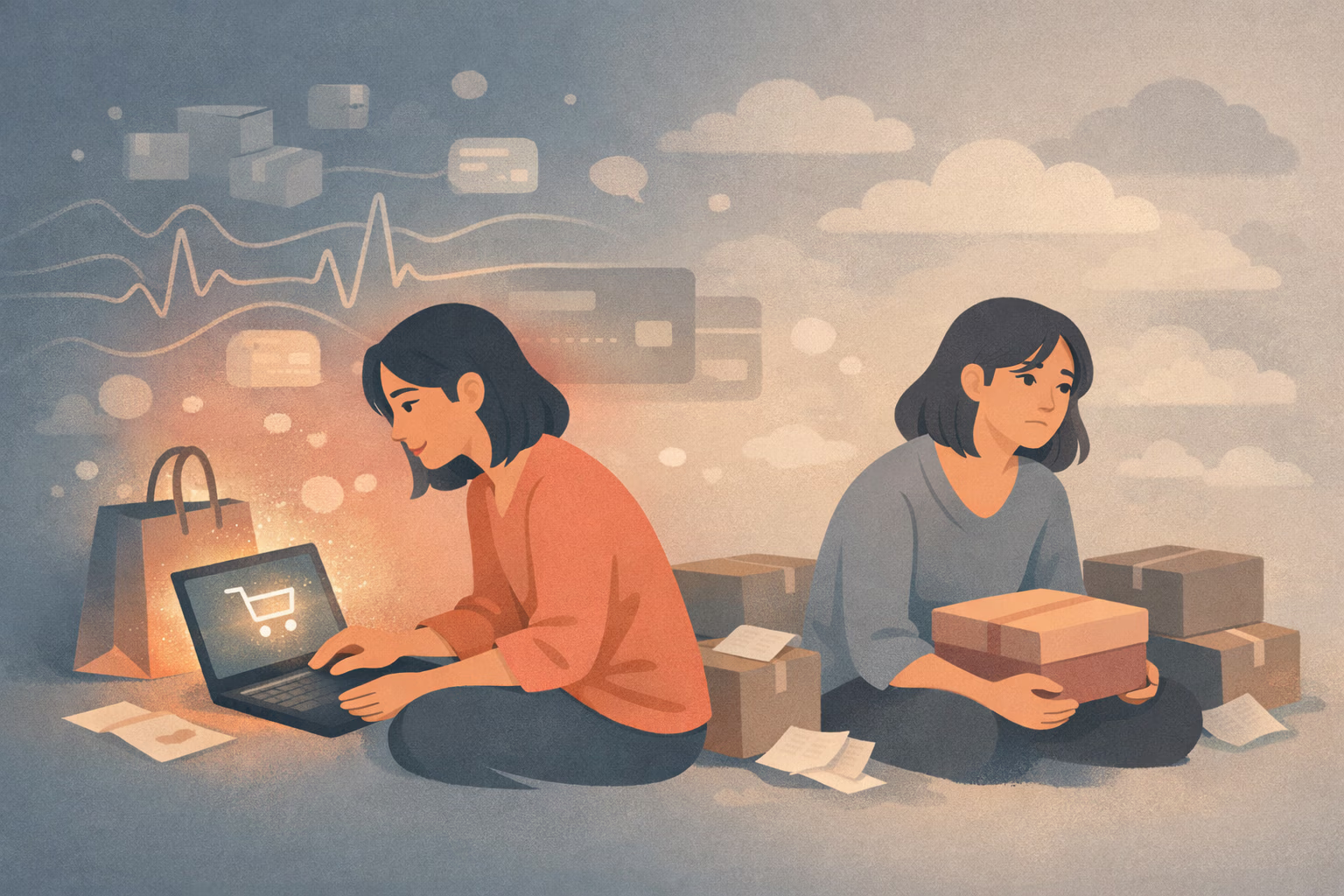
Once threat sensitivity is high, neutral signals can be interpreted as danger. A normal bill feels like a warning. A small market shift feels like a forecast. A delayed message feels like a social loss. The brain starts processing choices through a “protect first” filter, shaping decisions and perception at the same time. [Ref-9]
Over time, this creates a self-reinforcing story: the world is precarious. Not because the person is irrational, but because their attention is continually trained on the narrow channel where precariousness is most visible. What remains unseen is just as important: the countless moments that could have communicated stability, if the system had capacity to register them.
There is a distinct difference between “thinking positively” and a nervous system that has actually received enough safety cues to reduce monitoring. When safety signals return, the inner posture changes first as physiology: less bracing, fewer urgency spikes, less compulsive checking, more flexible attention.
In scarcity research, reduced cognitive load is associated with wider time orientation and less tunneling—more ability to hold context rather than only the immediate threat channel. [Ref-10] This isn’t a motivational upgrade. It’s a capacity return: the system has more bandwidth, and the future stops feeling like a cliff edge.
Importantly, this shift isn’t created by insight alone. It tends to follow completion—moments and seasons where the body learns, through lived experience, that a loop truly closed and the consequences were survivable.
Scarcity often makes relationships feel like a resource landscape: who might take too much, who might leave, who might compete, who might not show up. That lens can subtly reduce warmth and increase calculation—not as a moral failing, but as a protective economy.
When threat is lower, social life often changes in predictable ways: more willingness to collaborate, to share, to assume goodwill, to ask for support without shame. Research suggests scarcity can shift prosocial behavior in different directions depending on context—sometimes increasing helping, sometimes decreasing it—highlighting how sensitive generosity is to perceived safety. [Ref-11]
Trust isn’t a personality trait you force. It’s often what becomes possible when the body no longer expects immediate loss.
As survival alarms quiet, mental space returns. Not as a constant high mood, but as steadiness: the ability to hold more than one thing at once. Work can be work again, not a referendum on security. Rest can be rest, not a guilty pause before the next check.
Many people describe this as “more presence,” but it’s not mystical. It’s what the brain does when it isn’t tunneling: it notices the current moment, keeps perspective, and can access a wider range of choices. [Ref-12]
In this state, satisfaction is more likely to land. Not because life becomes perfect, but because the system can register completion instead of immediately re-activating.
Scarcity organizes life around protection. Safety organizes life around direction. When the system isn’t consumed by preventing loss, attention can move toward contribution, learning, repair, creativity, and long-term relationships with self and others.
This is where meaning becomes stabilizing—not as an idea, but as a lived orientation that helps experiences come to rest inside identity. In high-fragmentation environments, constant comparison and rapid information can intensify threat and divide attention, making coherent direction harder to hold. [Ref-13]
When coherence returns, it often feels quieter than expected. Less dramatic. More like: I know what matters, and my body can stay here while I live it.
Scarcity mindset often reflects a leftover survival signal—an internal forecast shaped by uncertainty, past instability, or ongoing evaluation. Seeing it this way can reduce shame: the system is not “broken,” it’s trying to protect continuity. [Ref-14]
In an age of abundance, “enough” isn’t only about how much you have. It’s also about whether life provides sufficient closure—enough completed cycles, enough reliable support, enough settled evidence that today is not an emergency. When those conditions increase, agency tends to return naturally, because the nervous system has room to choose rather than brace.
Real abundance is not measured only by possession or performance. It’s measured by how often your system can stand down—how often you can inhabit what you’ve built without scanning for its disappearance.
When the fear of loss loosens, life doesn’t become risk-free. It becomes more livable. And that livability—steady, coherent, and human—is its own form of wealth. [Ref-15]
From theory to practice — meaning forms when insight meets action.
This is one of the cleanest examples of Evolutionary Mismatch in daily life. For most of human history, scanning for shortage was adaptive — resources were genuinely limited, and the cost of missing a loss was high. Threat circuits learned to narrow attention toward loss prevention. Modern environments removed the immediate scarcity but didn't remove the wiring. So even when the basics are covered, the inner climate can register shortage: something is about to run out, slip away, or become unsafe. The body is tracking an ancient pattern, not the current shelf.
Scarcity thinking can feel like control because vigilance produces the sensation of doing something. The Threat & Safety System interprets monitoring as protection. The vigilance illusion is that this monitoring isn't actually preventing the thing being feared; it's just keeping the alarm circuit running. Over time, this becomes an Avoidance Loop — protection that reinforces the sense of danger it's trying to manage. Each scan confirms that the situation is one worth scanning, and the loop never closes. Real safety registers in the body as fewer alarms, not more accurate ones.
Yes, but the lever isn't more financial information. The shift comes from the system collecting enough safety signals to stand down. When threat activation decreases, attention widens, satisfaction starts to land, and previously inaccessible states — trust, generosity, settledness — reappear. Mental space and steadiness aren't earned through hard work; they become available when the alarm stops running constantly. Scarcity is a signal, not a verdict on your character or your future. It's the system reporting load. Shift the load, and the narrative starts loosening on its own — no positive thinking required.
Not piles of money or constant gratitude. Abundance, in nervous-system terms, is the capacity to live without the constant background fear of loss. It's the body operating from a baseline where existence isn't a defensive posture. From that baseline, meaning starts organizing life again — choices reflect values rather than panic avoidance, and protection stops being the dominant frame. The same external life can be experienced through scarcity or through abundance depending on whether the Threat System is running the show. The shift is structural, not material: it's about which system gets to be the loudest input.
From Science to Art.
Understanding explains what is happening. Art allows you to feel it—without fixing, judging, or naming. Pause here. Let the images work quietly. Sometimes meaning settles before words do.
One Quiet Window, one insight, one reflection — every Sunday