
Emotional Flexibility: The Skill That Makes Life Feel Lighter

In short: Stress fluidity is the capacity to move up into activation when something needs you, and back down into recovery when it doesn’t. It’s not about eliminating stress. It’s about not getting locked into one stress mode—revved, braced, numb, or overcontrolled—no matter what the moment actually calls for.
Stress fluidity is the capacity to move up into activation when something needs you, and back down into recovery when it doesn’t. It’s not about eliminating stress. It’s about not getting locked into one stress mode—revved, braced, numb, or overcontrolled—no matter what the moment actually calls for.
What if the problem isn’t that you’re “too stressed,” but that your system can’t find the downshift?
In modern life, many of us live with long stretches of partial activation—never fully in danger, never fully done. Over time, that can make the nervous system less responsive to context and more responsive to habit. This isn’t a character flaw. It’s a biological system doing its best under conditions that rarely offer real closure.
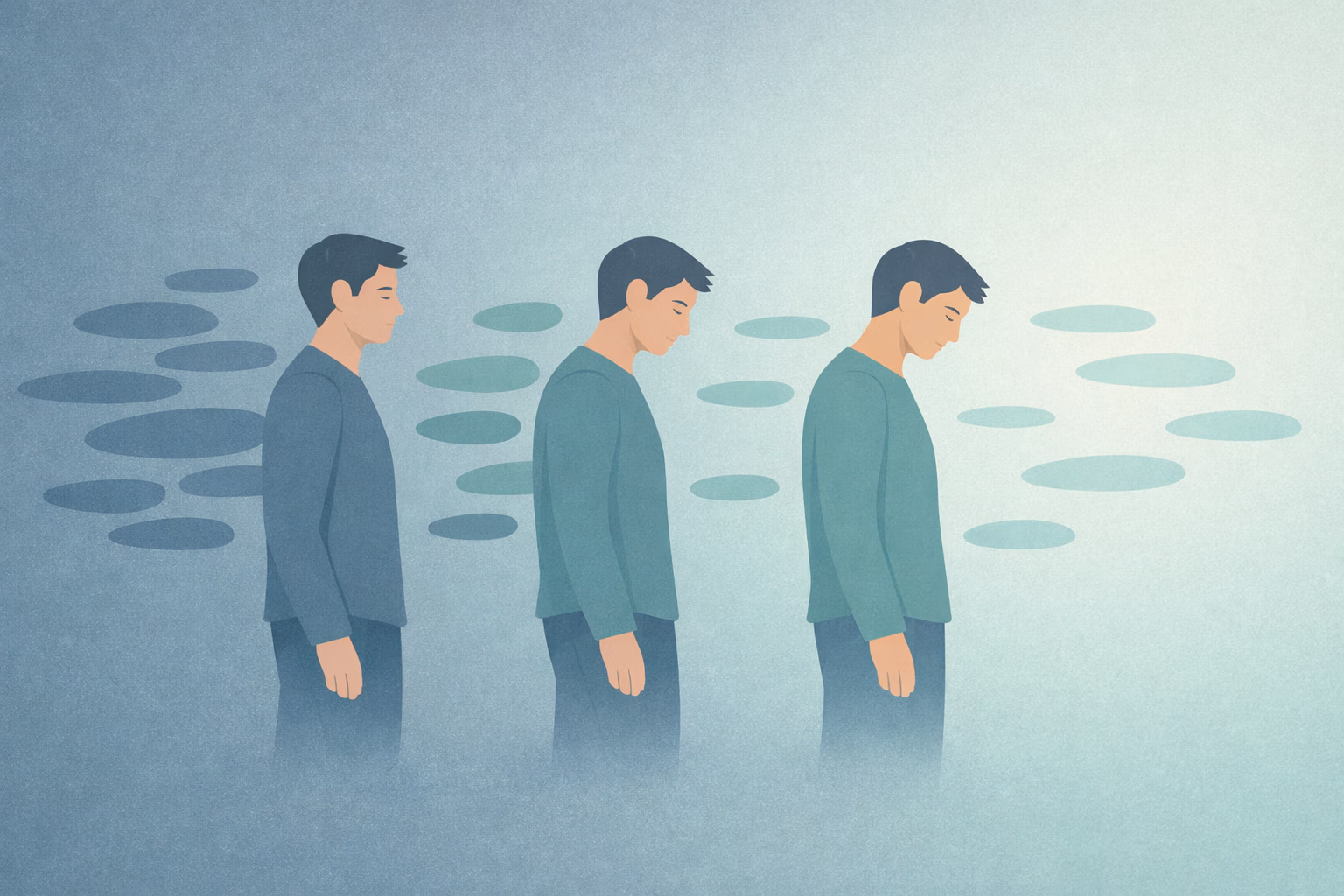
A rigid stress response often feels like a narrow hallway: the same few reactions show up regardless of what’s happening. A small email reads like a threat. A normal decision feels like a cliff. Or the opposite: the body goes quiet, energy drops, and even simple tasks feel out of reach.
This rigidity isn’t “overreacting.” It’s the nervous system simplifying the world under load. When the system carries too much unfinished activation, it defaults to what’s familiar: mobilize harder, clamp down, check out, or keep scanning. That’s a protective economy—less flexibility, fewer variables, faster output. [Ref-1]
Healthy regulation isn’t a constant state of calm. It’s smooth transitioning: up for action, into connection for coordination, down for rest and repair. The autonomic nervous system supports these shifts through networks that change heart rate, breathing, muscle tone, digestion, and attention—often before you consciously “decide” anything. [Ref-2]
When fluidity is available, the body can mobilize without tipping into panic, and recover without needing to collapse. This is why two people can face the same demand and have different internal experiences: one system can complete the stress cycle and stand down; another system stays partially recruited, as if the moment never ended.
Stress is not the enemy. Being unable to exit stress is what exhausts the system.
Human stress biology evolved in environments with variable demands: brief danger, physical problem-solving, social negotiation, then a return to baseline. This design relies on a critical ingredient: completion. After effort, the body expects a “done” signal—movement finishes, conflict resolves, the group regathers, the threat passes.
In modern conditions, we often get the activation without the ending. The brain and body can stay tuned to potential threat—uncertainty, social evaluation, financial ambiguity, constant alerts—without a single moment that clearly says, “You made it; you can stop now.” Over time, that mismatch can tilt the system toward chronic activation or shutdown patterns. [Ref-3]
Under strain, a fixed response is efficient. It reduces uncertainty. If your system always moves into over-control, you don’t have to feel for nuance. If it always shuts down, you don’t have to spend scarce energy deciding what matters. If it always speeds up, you don’t have to tolerate the tension of “not yet.”
From the nervous system’s perspective, rigidity can be a short-term solution: pick a lane, reduce options, conserve decision-making. The cost is that the same solution gets applied to situations where it doesn’t fit, and the body never receives clean feedback that the problem is complete. [Ref-4]
What looks like “personality” is often a repeated state.
Many people learn to treat rigid stress control as a badge of competence: staying composed, pushing through, never needing anything, never falling behind. But the nervous system doesn’t measure strength by how tightly you can clamp down. It measures safety by whether it can move between states without losing coherence.
Resilience is less about suppression and more about adaptability—being able to mobilize, connect, and recover as context changes. Safety cues (internal and external) help the system loosen unnecessary protection. When safety cues are scarce, the system may rely on control or shutdown because those are predictable. [Ref-5]
Stress fluidity isn’t a motivational upgrade. It’s a shift in how the system organizes meaning under pressure. When stress is rigid, the body acts as if the same story is always true: “Everything is urgent,” “Nothing will work,” “I must not slip,” or “I can’t move.” Those aren’t beliefs you chose; they’re state-dependent interpretations.
When fluidity returns, context starts to matter again. Pressure can be read as “important,” not automatically “dangerous.” Rest can be read as “completion,” not “risk.” This is where agency becomes possible—not as forced positivity, but as a widened physiological range that allows choice to re-enter the loop. Measures like heart rate variability are often discussed as markers of autonomic flexibility, reflecting this capacity to shift states. [Ref-6]
Rigidity doesn’t always look dramatic. Often it looks like the same internal setting being applied to every situation, regardless of stakes. This can create confusing contradictions: you can be highly competent and still unable to settle; deeply caring and still oddly detached.
Some common patterns include: [Ref-7]
These are regulatory strategies. They often develop when outcomes feel muted (effort doesn’t lead to completion) or when the body rarely receives a clean “done” signal.
When the system can’t downshift, stress becomes cumulative. The issue isn’t a single hard day; it’s the stacking of incomplete cycles—activation without closure, urgency without resolution, vigilance without clear endpoint. This chronic load is associated with wear-and-tear effects across mind and body. [Ref-11]
Over time, rigidity can look like burnout: reduced capacity, emotional exhaustion, and a shrinking window for engagement. Life becomes about managing the state rather than living the day. Not because you lack willpower, but because the nervous system is spending more energy maintaining protection than supporting repair.
Even practices associated with emotion regulation and body-based stability are often discussed in relation to reducing physiological reactivity and improving regulation capacity—highlighting how embodied this process is.
Neural systems learn by repetition. When the same stress response runs again and again—speeding up, shutting down, clamping control—it becomes the default route. Not because you “chose it,” but because it’s efficient and well-worn.
Habits of attention and arousal can become self-reinforcing: you feel keyed up, so you scan; you scan, so you find more to react to; you react, so the body confirms the world is urgent. This is one reason why approaches like mindfulness-based stress reduction are studied for their relationship to stress physiology and health outcomes: they may interrupt automatic cycles and support different patterns over time. [Ref-9]
Still, it helps to name the difference between noticing and completion. Awareness can map the loop. Completion is what allows the system to stand down.
Restored range doesn’t mean you never get stressed. It means activation becomes more proportionate and more time-limited. You can meet a demand without your whole identity being recruited. You can feel pressure without losing your center of gravity.
This is a meaning bridge: the body begins to register that stress can be a temporary state in service of something, not a permanent atmosphere you live inside. When that registration happens, “calm” stops being a fragile mood and becomes a physiological availability—an option the system can access when a loop is complete.
Range feels like being able to be fully in the moment without having to stay braced for the next one.
Stress fluidity isn’t built in isolation. Nervous systems co-regulate. Tone of voice, facial expression, timing, responsiveness, and the sense of being met all function as safety cues that help the body update its threat calculations.
When feedback is reliable—when needs are acknowledged, roles are clear, repair is possible—the system can spend less energy on monitoring and more on living. When feedback is inconsistent or purely evaluative, the system may stay activated because it can’t predict the social outcome. Chronic stress and allostatic load research repeatedly points to the impact of sustained environmental demand and insufficient recovery on health. [Ref-11]
When regulation becomes more adaptive, the change is often less dramatic than people expect. It can show up as faster recovery, fewer lingering stress aftershocks, and a greater ability to respond to signals without being hijacked by them.
Rather than chasing high calm, the system becomes better at returning. That return is a kind of closure: the body recognizes the moment ended and reorganizes around what’s now true.
Research on social buffering highlights how supportive connection can reduce stress responses and improve recovery, underscoring that flexibility is often relational as much as individual. [Ref-12]
When stress is rigid, life tends to narrow. Not because you don’t care, but because the system learns that caring costs too much. Meaningful challenges start to look like threats to stability, and avoidance can become a structural solution: reduce exposure, reduce activation, reduce uncertainty.
With more fluid regulation, engagement becomes possible again. You can take on something that matters and still return to yourself afterward. You can participate without needing to armor up or disappear. Social connection is a powerful part of this equation: isolation and disconnection can intensify stress load, while supportive relationships can protect health and widen resilience. [Ref-13]
Meaning doesn’t require constant intensity. It requires enough capacity to stay coherent through change.
Stress fluidity is not a promise that life will feel easy. It’s a quieter dignity: the sense that your system can respond to what’s real, then return when the moment is complete.
When pressure stops being your default identity, agency reappears—not as force, but as orientation. Values can matter again because you’re not spending all your resources on bracing. In that space, stress can become information rather than a verdict, and meaning can become lived coherence rather than another performance. Values-based frameworks often describe this as moving with what matters even in the presence of difficulty—without making struggle a measure of who you are. [Ref-14]
You don’t have to prove strength by staying activated. A nervous system that can shift gears is not “less serious” or “less driven.” It’s more resourced, more accurate, and more able to complete what it starts.
Over time, many people find that a kinder internal stance supports this process—not as a slogan, but as reduced self-attack that lowers load and makes recovery more available. Self-compassion research often frames this as an alternative to self-criticism with meaningful links to well-being. [Ref-15]
Stress doesn’t need to dominate your story. With enough closure and enough range, it can become one chapter—useful when needed, quiet when not.
From theory to practice — meaning forms when insight meets action.
Because rigidity is efficient under load. When the system carries too much unfinished activation, it defaults to what's familiar: mobilize harder, clamp down, check out, or keep scanning. That's a protective economy — fewer variables, faster output. The cost is that the same solution gets applied to every situation, and the body never receives clean feedback that the problem is complete. A small email reads like a threat, a normal decision feels like a cliff, or the body goes quiet and even simple tasks feel out of reach. This isn't overreacting; it's the nervous system simplifying the world under load. What looks like personality is often a repeated state.
Composure is useful, but the nervous system measures safety by range, not control. Resilience is less about suppression and more about adaptability — being able to mobilize, connect, and recover as context changes. Healthy regulation isn't constant calm; it's smooth transitioning: up for action, into connection for coordination, down for rest and repair. When fluidity is available, the body can mobilize without tipping into panic and recover without needing to collapse. Control can keep you functioning. Range helps you stay human while functioning. Stress isn't the enemy — being unable to exit stress is what exhausts the system. Fluidity is the window of tolerance widening.
Because awareness can map the loop, but completion is what allows the system to stand down. Neural systems learn by repetition: when the same stress response runs again and again, it becomes the default route — efficient and well-worn. You feel keyed up, so you scan; you scan, so you find more to react to; you react, so the body confirms the world is urgent. This is self-reinforcing and largely automatic. Insight names it; integration changes it. Integration depends on the body actually receiving Done Signals — moments where activation can resolve, the loop closes, and the system reorganizes around what's now true rather than what was once threatening.
Less dramatic than people expect. It shows up as faster recovery, fewer lingering aftershocks, and a greater ability to respond to signals without being hijacked by them. Activation becomes more proportionate and time-limited. You can meet a demand without your whole identity being recruited; you can feel pressure without losing your center of gravity. Rather than chasing high calm, the system gets better at returning. Quicker settling after conflict, more responsive energy, less stuckness in rumination, more social openness without feeling exposed. Range feels like being able to be fully in the moment without staying braced for the next one. Calm becomes a physiological availability, not a fragile mood.
From Science to Art.
Understanding explains what is happening. Art allows you to feel it—without fixing, judging, or naming. Pause here. Let the images work quietly. Sometimes meaning settles before words do.
One Quiet Window, one insight, one reflection — every Sunday