Mental Elasticity: How Flexible Thinking Reduces Anxiety
In short: Emotional flexibility is often described as “handling feelings well,” but that can sound like a character trait you either have or don’t. In real life, it’s closer to a nervous-system capacity: the ability to register what’s happening, adapt your response, and then actually come back down—without getting locked into one state for hours or days.
Emotional flexibility is often described as “handling feelings well,” but that can sound like a character trait you either have or don’t. In real life, it’s closer to a nervous-system capacity: the ability to register what’s happening, adapt your response, and then actually come back down—without getting locked into one state for hours or days.
What if “feeling lighter” isn’t about feeling less, but about getting unstuck?
When emotional flexibility is low, life can start to feel dense and effortful. Not because you’re doing anything wrong, but because too many internal loops are left incomplete—so your system keeps running them in the background, searching for an ending that never quite arrives.
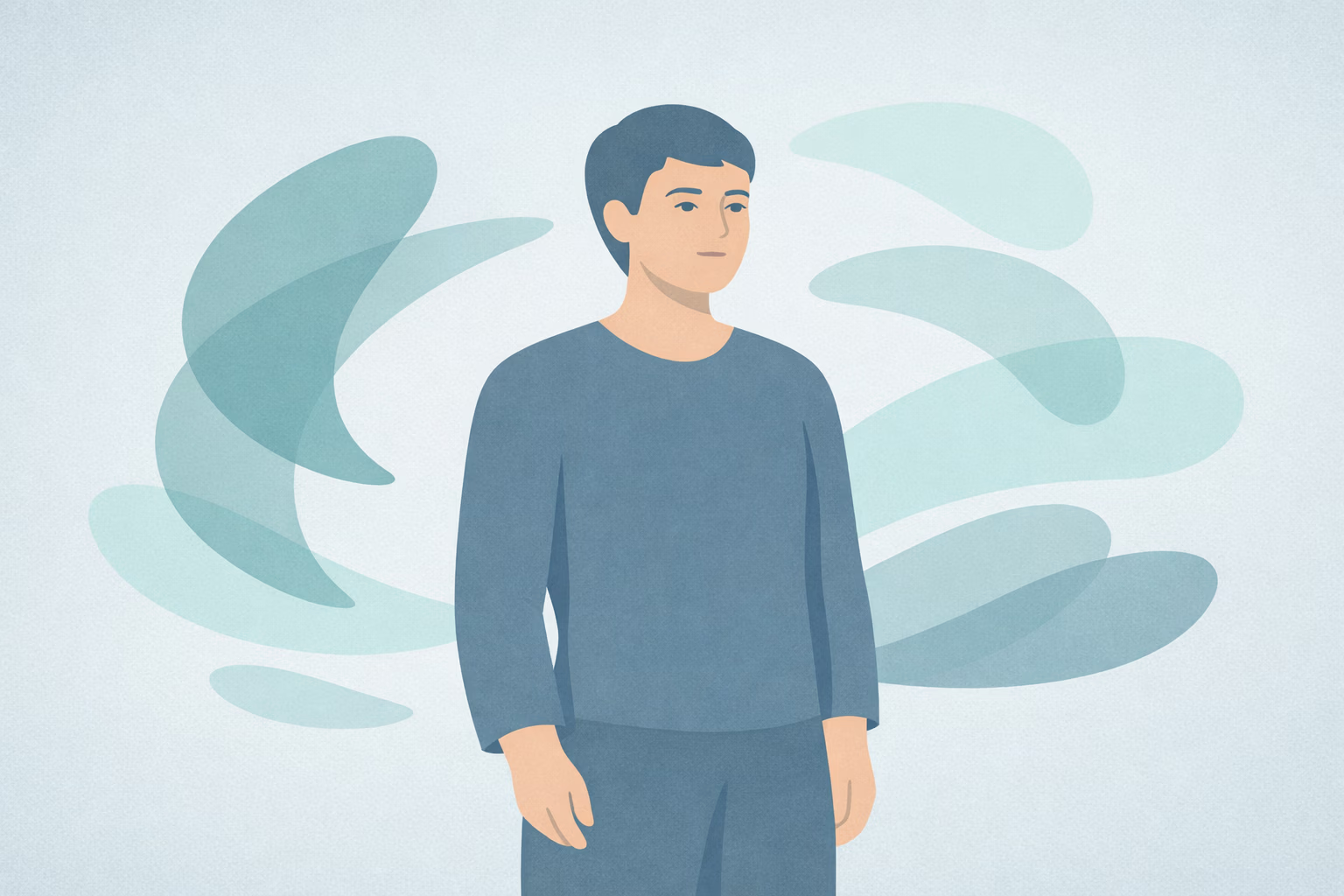
Everyone gets pulled into a mood sometimes. The heavier version is when the mood becomes the atmosphere: it fills the day, narrows the options, and makes even small decisions feel loaded. You’re still functioning, but it’s like moving through thick air.
This “trapped” feeling isn’t a moral failure. It’s often what a human system does when it can’t find a clean completion signal—when something inside hasn’t landed, resolved, or found a coherent next step. Regulation is partly about helping the body and mind return to baseline after activation. When that return doesn’t happen, the state starts to feel like identity. [Ref-1]
Sometimes it’s not that the feeling is too big. It’s that it never gets to be done.
Emotional flexibility is tightly linked to attentional flexibility: the ability for attention to widen, shift, and reorient without force. When attention can move, the nervous system has more routes back to safety cues and context, which lowers load over time.
Another piece is creating distance between a thought and a fact. Not by arguing with thoughts, but by relating to them as events passing through awareness rather than commands that must be followed. This kind of “defusion” is associated with lower entanglement and less emotional rigidity, especially under stress. [Ref-2]
Importantly, this isn’t the same as insight. Understanding why you feel a certain way can be useful, but flexibility shows up as a bodily shift: more options become available, and the system can stand down after the moment passes.
Under perceived threat, human attention naturally tightens. The brain prioritizes detection, prediction, and control. This is not a flaw; it’s an ancient efficiency. The tradeoff is that narrow attention also narrows interpretation and behavior.
When threat systems stay “on,” emotional states can become rigid: the body remains braced, the mind scans for confirmation, and the same storyline repeats because it feels safer than uncertainty. Many difficulties we label as “emotion regulation problems” track with this kind of narrowed, effortful state. [Ref-3]
In other words, rigidity can be a sign of sustained load. The system isn’t being stubborn; it’s conserving resources and trying to prevent surprises.
Trying to control internal experience often begins as a reasonable attempt to stabilize. If a feeling is interfering with work, relationships, or sleep, “get rid of it” can feel like the most direct path back to functioning.
The problem is structural: control strategies can reduce short-term discomfort while keeping the loop open. If the nervous system never receives a completion signal—never gets the “message delivered” or “danger resolved” update—it may continue generating the emotion as a reminder, a guardrail, or a readiness state. Over time, suppression and chronic control can increase physiological reactivity and prolong stress responses. [Ref-4]
This is one reason people can feel worn out even when they’re “holding it together.” The energy cost isn’t only the feeling; it’s the ongoing management.
Emotional stiffness is when your system has one main gear: tense and vigilant, shut down and flat, spinning and urgent, or tightly controlled. Emotional responsiveness is when more gears are available—without needing to manufacture a better mood.
Lightness often arrives as a side effect of adaptability. Not because life becomes easy, but because the internal friction decreases: fewer minutes spent arguing with reality, fewer hours spent stuck in aftershocks, less effort spent maintaining an internal stance.
In many models of change, this capacity is linked to psychological flexibility and reduced reactivity over time. [Ref-5]
Discomfort is a signal. Suffering often emerges when the signal can’t complete. Modern life supplies endless ways to keep loops running: checking, scrolling, rehearsing, optimizing, evaluating. Each offers a brief state change—relief, stimulation, distraction—without necessarily giving the nervous system closure.
This is where the “meaning loop” gets relevant. Humans don’t just want less pain; we want coherence. We want an experience to land into a story we can live from: what happened, what it meant, what I’m doing now. When that sequence stays incomplete, the system returns to it repeatedly, hoping to finish the file.
Values-based orientation is often discussed as a stabilizer because it helps behavior organize around what matters rather than what feels urgent in the moment. But stability still depends on completion—on experiences actually settling into lived identity, not just being named. [Ref-6]
When flexibility is reduced, certain patterns show up again and again. They can look like “bad habits,” but many are regulatory attempts—ways the system tries to reduce uncertainty, regain control, or dampen overload.
Research on experiential avoidance describes how pushing away internal experiences can amplify distress over time, even when it provides short-term relief. [Ref-7]
Meaning isn’t just a belief you adopt. It’s something that emerges when experiences integrate into a coherent sense of self and direction. Under chronic stress, the brain prioritizes survival-relevant processing, and the bandwidth for meaning-making can shrink.
In rigid states, people often report that life feels “flat,” “pointless,” or “all pressure.” That can happen even when life looks fine from the outside. It’s not a character flaw; it’s what it feels like when the system is running too hot (or too shut down) to register subtler signals like satisfaction, connection, or completion.
Physiologically, emotional suppression and sustained bracing can increase stress reactivity and reduce recovery. When recovery is limited, resilience looks smaller—not because you’ve changed as a person, but because capacity is being spent maintaining load. [Ref-8]
Emotions tend to persist when the system treats them as problems to eliminate or treasures to preserve. Resistance sends one kind of message—“this must not be here”—while clinging sends another—“this must stay.” Both can keep attention locked and the loop uncompleted.
This doesn’t mean you should like unpleasant feelings or let them run your life. It means the nervous system responds to relationship and context. When an emotion is met with constant correction, the system can interpret that as ongoing danger, which sustains activation. Studies on suppression versus acceptance suggest that pushing down negative emotion can carry physiological and interpersonal costs. [Ref-9]
Clinging can have a similar effect in a different direction: if a state becomes the only place you feel oriented (even if it’s anger, urgency, or sadness), letting it change can feel like losing structure. The system may hold on because it prefers a known load to an unknown openness.
Emotional flexibility is sometimes talked about using words like awareness, acceptance, and reframing. These can be helpful concepts, but they are not the same as integration. Integration is what it looks like when the body receives enough completion to stop re-issuing the signal—when the experience becomes “done enough” to settle into the background.
Still, certain inner postures tend to create more range and less entanglement. For many people, simply noticing “a thought is happening” instead of “this is the truth of me” reduces rigidity and restores choice in the next moment. This is consistent with research on cognitive defusion and psychological flexibility. [Ref-10]
What changes when a feeling is allowed to be information rather than a verdict?
Often, the system shifts from enforcement to orientation: emotions become data about needs, boundaries, loss, desire, or overload. Not to be obeyed automatically, and not to be erased—just included in the larger picture.
In relationships, rigidity often shows up as speed: quick defensiveness, quick escalation, quick withdrawal, quick certainty. When the nervous system is loaded, it tries to resolve tension fast—sometimes by winning, fixing, explaining, or disappearing.
Flexibility tends to slow the reflex without requiring passivity. It allows more micro-pauses where context can return: “What’s happening here?” “What matters between us?” That shift can reduce conflict and increase empathy because you can register the other person without losing your own orientation.
Research on mindfulness and present-centered attention links these capacities with improved well-being and relational functioning, partly through reduced automatic reactivity. [Ref-11]
When I’m not fighting my own state, I have more room to meet yours.
Lightness isn’t constant happiness. It’s more like reduced drag. People often describe it as quicker recovery after disappointment, less dread about normal stress, and fewer hours lost to inner weather.
It can also look surprisingly ordinary: more neutral moments, more steady attention, more ability to hold mixed signals without needing immediate resolution. Over time, self-kindness can support this by reducing secondary pressure—the extra layer of self-criticism that adds load on top of the original feeling. [Ref-12]
Not because you’ve become tougher, but because fewer internal processes are being run at once.
The deepest relief of emotional flexibility is not comfort—it’s restored choice. When you’re not being pushed around by urgency or locked into one interpretation, you can feel what you feel and still move in a direction that matches your values.
That’s an identity-level shift: “I’m someone who can stay oriented even when my internal weather changes.” This isn’t willpower. It’s coherence—the sense that your actions, meanings, and self-story are in the same lane. Research on emotion differentiation and flexibility in daily life suggests that being able to distinguish and work with emotional signals supports more adaptive responding. [Ref-13]
In that space, emotions become part of guidance rather than the whole driver’s seat. And life often feels lighter because it’s less dominated by constant internal negotiation.
Emotional flexibility isn’t about becoming endlessly calm. It’s about not having to build your entire day around whatever state arrives. When internal states can rise and fall without hijacking identity, you regain a sense of authorship—less because you “controlled your emotions,” and more because your system could complete cycles and return.
Over time, many people notice a quiet restoration of self-trust: the sense that they can listen inward without being pulled off course by every spike or dip. That restoration is less a breakthrough moment and more a gradual reorganization toward coherence. [Ref-14]
Even when emotions remain intense, the relationship to them can become less consuming. And that difference—less consumption, more movement—often reads as lightness.
Emotions are not obstacles to a meaningful life; they are part of how a human system tracks what matters. When they’re allowed to change states and reach enough closure to settle, they stop demanding constant management and start behaving more like signals with a beginning, middle, and end.
And because humans regulate in connection as well as internally, it also makes sense that lightness often grows where safety cues and supportive relationships exist—places your system can finally stand down. [Ref-15]
Life doesn’t become perfectly smooth. It becomes more navigable—because you’re not stuck inside one feeling as if it’s forever.
From theory to practice — meaning forms when insight meets action.
No — the article makes this distinction central. Lightness isn't about reducing emotional content; it's about getting unstuck. Emotional flexibility is the nervous-system capacity to register what's happening, adapt your response, and actually come back down without getting locked into one state for hours or days. When that return doesn't happen, a mood becomes the atmosphere — it fills the day, narrows options, and makes small decisions feel loaded. The heaviness isn't usually 'too big a feeling'; it's a feeling that never gets to be done. Lightness is what arrives when experiences can complete and the system regains range.
Because control strategies can reduce short-term discomfort while keeping the loop open. The article is precise: if the nervous system never receives a completion signal — never gets the 'message delivered' or 'danger resolved' update — it may continue generating the emotion as a reminder or readiness state. Suppression and chronic control can also increase physiological reactivity over time. That's why people can feel worn out while 'holding it together.' The energy cost isn't only the feeling; it's the ongoing management. Resisting an emotion sends a 'this must not be here' signal that keeps the system reading the moment as ongoing danger.
Often as having one main gear. The article describes it as tense and vigilant, shut down and flat, spinning and urgent, or tightly controlled. Threat narrows interpretation and behavior — the body braces, the mind scans for confirmation, and the same storyline repeats because it feels safer than uncertainty. Common forms include rumination, over-identification (the feeling becomes 'who I am'), rapid overwhelm, and overcontrol. None of these are personality defects. They're regulatory attempts to reduce uncertainty, regain control, or dampen overload — signs of sustained load, not stubbornness or weakness.
It changes the timing of reactions. The article describes rigidity as showing up as speed: quick defensiveness, quick escalation, quick withdrawal, quick certainty. When the system is loaded, it tries to resolve tension fast — by winning, fixing, explaining, or disappearing. Flexibility slows the reflex without requiring passivity. It allows micro-pauses where context can return: what's happening here, what matters between us. That shift reduces conflict and increases empathy because you can register the other person without losing your own orientation. When you're not fighting your own state, you have more room to meet someone else's.
From Science to Art.
Understanding explains what is happening. Art allows you to feel it—without fixing, judging, or naming. Pause here. Let the images work quietly. Sometimes meaning settles before words do.
One Quiet Window, one insight, one reflection — every Sunday