The Paradox of Control: When Holding On Makes Life Harder

In short: Control often gets mislabeled as a personality trait: “Type A,” “dominant,” “intense,” “a control freak.” But in many lives, control is less about who someone is and more about what their nervous system has learned will reliably lower the noise of uncertainty. In a fragmented world—too many inputs, too little closure—power can feel like the closest thing to a “done” signal.
Control often gets mislabeled as a personality trait: “Type A,” “dominant,” “intense,” “a control freak.” But in many lives, control is less about who someone is and more about what their nervous system has learned will reliably lower the noise of uncertainty.
In a fragmented world—too many inputs, too little closure—power can feel like the closest thing to a “done” signal. It brings a quick sense of direction, predictability, and leverage. Not because a person is bad or broken, but because the conditions make steadiness hard to come by.
What if the craving for control is not a character flaw, but a signal that your system is searching for safety and completion?
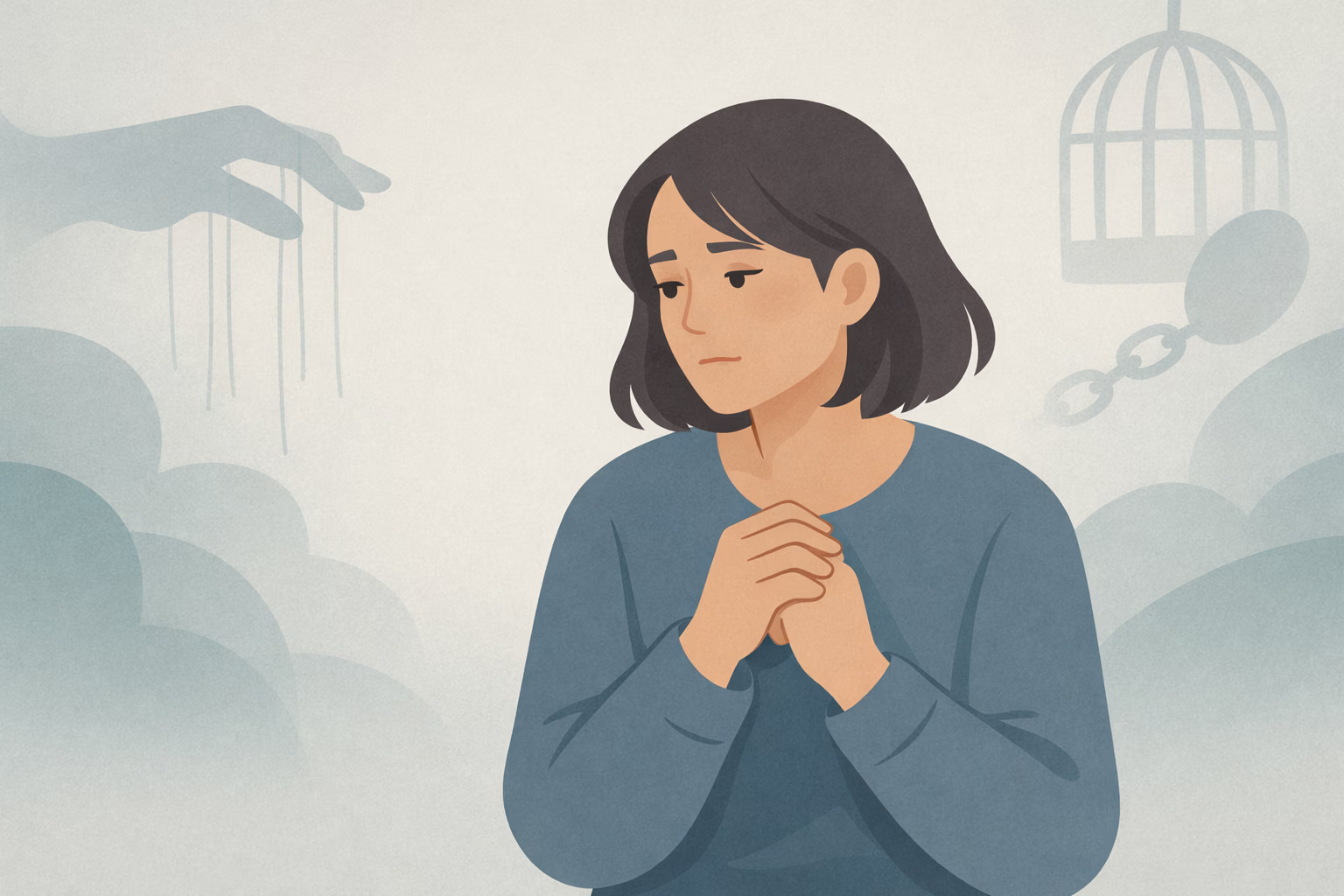
Many people feel a persistent pressure to manage outcomes: to direct conversations, oversee details, anticipate what could go wrong, or keep the emotional temperature of a room within a narrow band. From the inside, it can feel like responsibility. From the nervous system’s perspective, it can function like a stabilizer.
When stress load is high, the body tends to prefer strategies that reduce uncertainty quickly. Control is one of the fastest ways to create predictability: it narrows variables, limits surprise, and produces a sense of “I have this handled.” The more the environment feels unstable, the more compelling that narrowing can become. [Ref-1]
Importantly, this doesn’t require a dramatic backstory. Repeated exposure to fast change, ambiguous expectations, or high consequence can train a system to rely on management as its most dependable path to steadiness.
Control doesn’t always feel like aggression. Often it feels like relief. A plan is made, a decision is locked in, the room is organized, the message is rewritten, the rules are clarified—and the body exhales.
Biologically, predictability is a safety cue. When you increase predictability, you reduce scanning, reduce ambiguity, and reduce the sense that something unseen might ambush you. Control also sends an internal signal of capability: “I can influence what happens next,” which can quiet threat circuits even if the underlying situation is still difficult. [Ref-2]
Sometimes “being in charge” is the fastest way a system can stop bracing.
In evolutionary terms, influence mattered. Access to resources, protection, and social standing shaped survival. A nervous system that could secure leverage—through competence, dominance, alliance-building, or leadership—had a better chance in uncertain conditions.
That history still lives in modern bodies. When circumstances feel unstable, the brain can revert to ancient math: “More control equals more safety.” It’s not a moral impulse; it’s a survival logic that prioritizes reduced vulnerability. [Ref-3]
This is why power can feel “good” even when it strains relationships or drains energy. The reward isn’t necessarily joy; it’s a drop in threat.
Control offers fast closure: decisions get finalized, uncertainty is cut down, and the mind receives a temporary “resolved” signal. The body often experiences this as relief—less tension, fewer spiraling possibilities, a stronger sense of footing.
But the relief can happen even when the control doesn’t meaningfully change the outcome. That’s the tricky part: the nervous system can reward the act of controlling, not just the results. A person may feel better after rechecking, reworking, or reasserting—even if nothing truly became safer. [Ref-4]
Why does this matter?
Because the system learns through consequences. If controlling reliably produces a brief stand-down, it becomes the preferred route—especially under chronic load.
Control can create a feeling of security, but it often requires constant effort. The world keeps changing, people keep being unpredictable, bodies have limits, and life keeps refusing to be fully managed. So the system escalates: more monitoring, more rules, more certainty-seeking.
Over time, this can harden into rigidity. Not because someone is “stubborn,” but because flexibility requires spare capacity. When capacity is low, the nervous system tends to choose the strategy with the quickest payoff—even if it has downstream costs. [Ref-5]
A “power loop” forms when control becomes the main way the body finds safety. The sequence is simple: uncertainty rises → the system tightens → control is exerted → relief arrives → the strategy gets reinforced.
In this loop, trust can start to feel like a gamble. Delegation can feel like exposure. Waiting can feel like danger. It’s not that a person “doesn’t value” cooperation; it’s that their system has learned that cooperation doesn’t reliably produce the closure it needs.
This is why control can intensify during transitions: new roles, new relationships, unstable workplaces, health scares, parenting shifts. The more open loops there are, the more the system reaches for leverage to close them. [Ref-6]
Control-seeking often hides inside socially rewarded behaviors: competence, high standards, leadership, decisiveness. And sometimes it truly is those things. The key difference is the internal cost—how much tension and urgency it takes to maintain.
Common expressions include:
Research on the human need for control suggests it’s a basic psychological drive: predictability and influence are deeply linked with perceived safety and functioning. [Ref-7]
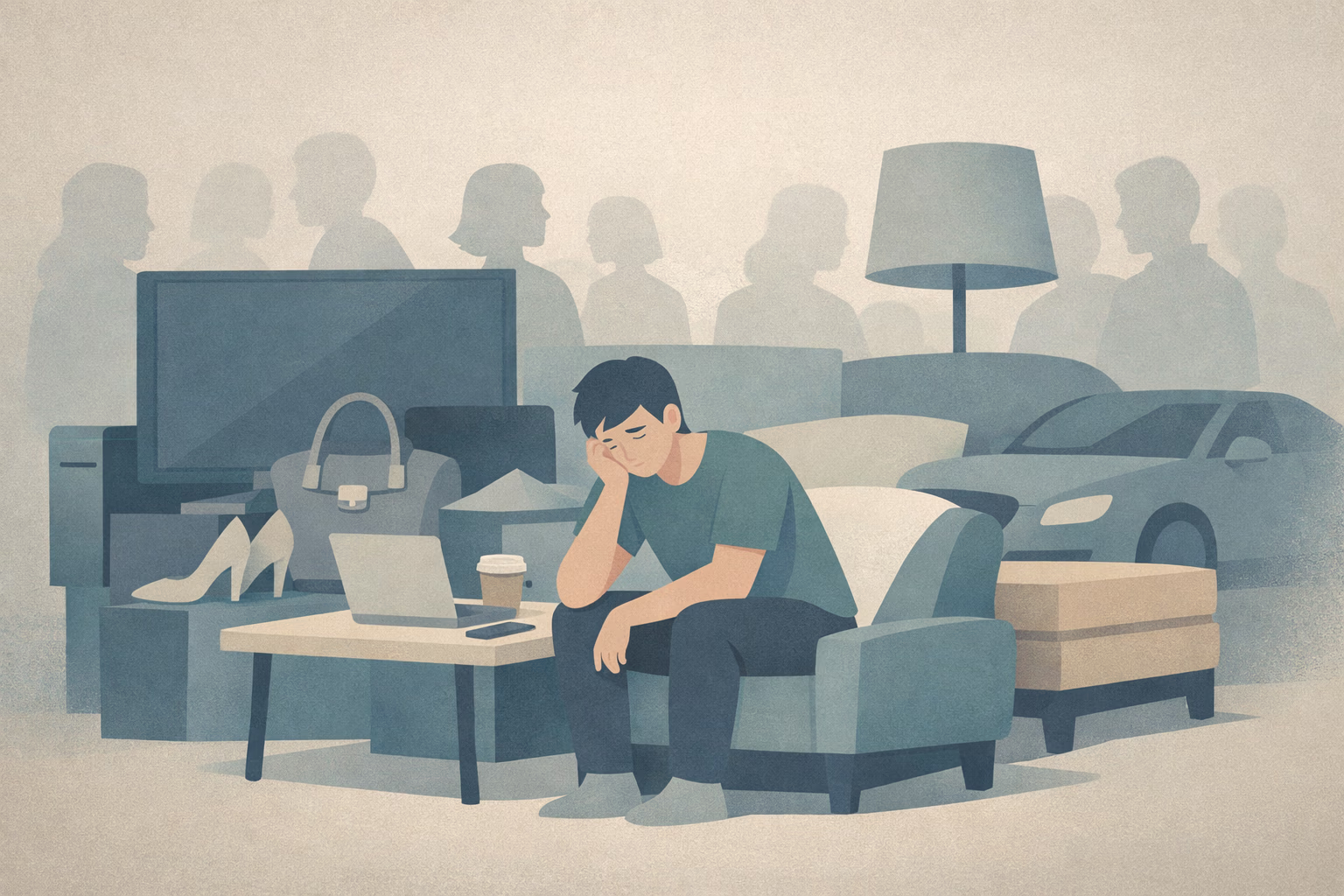
Control changes social ecosystems. Others may adapt by shrinking, hiding, complying, rebelling, or becoming passive. Over time, this can create a strange loneliness: the controller is surrounded by people, yet feels solely responsible for everything working.
Physiologically, sustained control-seeking can keep the body in a semi-activated state—always monitoring, always preventing, always correcting. Even if nothing is “wrong,” the system behaves as if a mistake would be costly.
Studies on perceived control and safety behaviors show how strongly a sense of control can shape compliance, stress responses, and perceived security under threat. [Ref-8]
When your system believes outcomes depend on you, rest can start to feel like negligence.
One hidden cost of the power loop is that it reduces opportunities for a different kind of closure: the kind that comes from discovering “I can stay oriented even when I don’t lock everything down.” That discovery isn’t an idea; it’s a body-level update that tends to require real-world completion of uncertainty without catastrophe.
When control steps in early, the system may never get the evidence it needs that ambiguity can resolve, that people can self-correct, that outcomes can be “good enough,” or that repair is possible. So the need for control remains intact—and often increases.
Research on uncertainty tolerance and the need for cognitive closure describes how discomfort with ambiguity can drive people toward quick conclusions and rigid certainty, especially under stress. [Ref-9]
It can help to separate two experiences that often get blended: state change versus integration. Control is excellent at state change—it can shift someone from overwhelmed to temporarily steadier. But state change is not the same as the deeper settling that happens when life provides genuine completion: when consequences are metabolized, identities update, and the nervous system no longer has to keep a problem “online.”
In modern life, closure is frequently delayed or denied. Work is never done, messages never end, standards constantly move, and social comparison is always available. Under these conditions, the mind can lean on quick certainty as a substitute for completion. Individual differences in the “need for closure” help explain why some systems reach for definitive answers and firm control when ambiguity rises. [Ref-10]
In other words: the pull toward power may be less about wanting to dominate and more about wanting something to finally land.
Power dynamics don’t only live inside one person; they emerge between people. When responsibility, voice, and impact are distributed, the nervous system can start receiving different cues: “I’m not alone in this,” “repair is possible,” “the load is shared.” Those cues can reduce the felt need to clamp down.
This isn’t about becoming passive or never leading. It’s about the difference between leadership that organizes meaning and leadership that tries to eliminate uncertainty. Collaboration can create a different kind of closure—one built from mutual reality-testing, shared commitment, and relational steadiness.
Research linking meaning in life with mental health outcomes suggests that coherence and connection can be protective, shaping how distress is carried and resolved. [Ref-11]
When the system is no longer forced to run on constant leverage, certain shifts often appear—not as a sudden transformation, but as a quieter baseline change. The body doesn’t have to grip as hard to stay organized.
Well-being research consistently finds that lasting stability relates less to intense highs and more to sustainable conditions that support equilibrium over time. [Ref-12]
Coherence feels like you can respond without having to seize the steering wheel every second.
Excessive control often forms when identity is forced to stay on guard: “I must prevent failure,” “I must hold everything together,” “If I’m not in charge, things fall apart.” These are not mere thoughts; they are organizing principles that keep the system braced.
As life becomes more coherent—when experiences complete, roles become workable, relationships stabilize, and consequences are metabolized—direction can begin to come from meaning rather than threat. Values become less like pressure and more like orientation: a steady “this matters” that doesn’t require constant tightening.
Work on uncertainty and the craving for control highlights how ambiguity can amplify control-seeking; conversely, when ambiguity becomes tolerable, the urgency to dominate outcomes often decreases. [Ref-13]
The desire for power is often a signal: not of selfishness, but of a system trying to secure safety in a world that keeps shifting. When your environment doesn’t provide reliable closure, control can become the quickest substitute.
Seen this way, the question isn’t “Why am I like this?” but “What load am I carrying that makes leverage feel necessary?” That shift can restore agency without shame. It honors the intelligence of the adaptation while making room for a different source of stability—one rooted in responsibility, trust, and meaning rather than domination. [Ref-14]
Control feels rewarding because it can quiet threat quickly. That reward is real, and it makes sense. But true steadiness tends to come from something deeper than command: from the capacity to stay oriented when not everything is secured.
When a life offers more completion, more shared reality, and more coherent meaning, power no longer has to do so much work. And what remains isn’t weakness—it’s a quieter form of strength that doesn’t need to grip to be real. [Ref-15]
From theory to practice — meaning forms when insight meets action.
Because control is one of the fastest ways to create predictability — it narrows variables, limits surprise, produces a sense of 'I have this handled.' Biologically, predictability is a safety cue: when you increase it, you reduce scanning, ambiguity, and the sense that something unseen might ambush you. Control also signals capability internally, which can quiet threat circuits even when the underlying situation is still difficult. Sometimes 'being in charge' is the fastest way a system can stop bracing. The reward isn't necessarily joy; it's a drop in threat. The pull to manage isn't vanity — it's a regulation attempt.
Often, but it doesn't require a dramatic backstory. Repeated exposure to fast change, ambiguous expectations, or high consequence can train a system to rely on management as its most dependable path to steadiness. Status & Control circuits run ancient math: 'more control equals more safety.' It's a survival logic that prioritizes reduced vulnerability. Importantly, control rewards the act of controlling, not just the results — a person can feel better after rechecking, reworking, or reasserting, even if nothing actually became safer. The system learns through consequences: if controlling reliably produces a brief stand-down, it becomes the preferred route under chronic load.
The sequence is simple: uncertainty rises, the system tightens, control is exerted, relief arrives, the strategy gets reinforced. Trust starts to feel like a gamble. Delegation feels like exposure. Waiting feels like danger. Control intensifies during transitions — new roles, unstable workplaces, parenting shifts — because more open loops make the system reach harder for leverage. The hidden cost is that the loop blocks safety learning through flexibility: when control steps in early, the system never gets evidence that ambiguity can resolve, that people can self-correct, that outcomes can be 'good enough.' So the need for control remains intact and often increases.
It helps to separate state change from integration. Control is excellent at state change — it shifts you from overwhelmed to temporarily steadier. But state change isn't the deeper settling that happens when life provides genuine completion. Closure is frequently delayed in modern life, so the mind leans on quick certainty as a substitute. Shared agency softens the room: when responsibility, voice, and impact are distributed, the body receives different cues — 'I'm not alone in this,' 'repair is possible,' 'load is shared.' Strength isn't maximum control; it's stable orientation. When life offers more completion and coherent meaning, power no longer has to do so much work.
From Science to Art.
Understanding explains what is happening. Art allows you to feel it—without fixing, judging, or naming. Pause here. Let the images work quietly. Sometimes meaning settles before words do.
One Quiet Window, one insight, one reflection — every Sunday