
Chasing Social Media Likes: Emotional Reward or Escape?
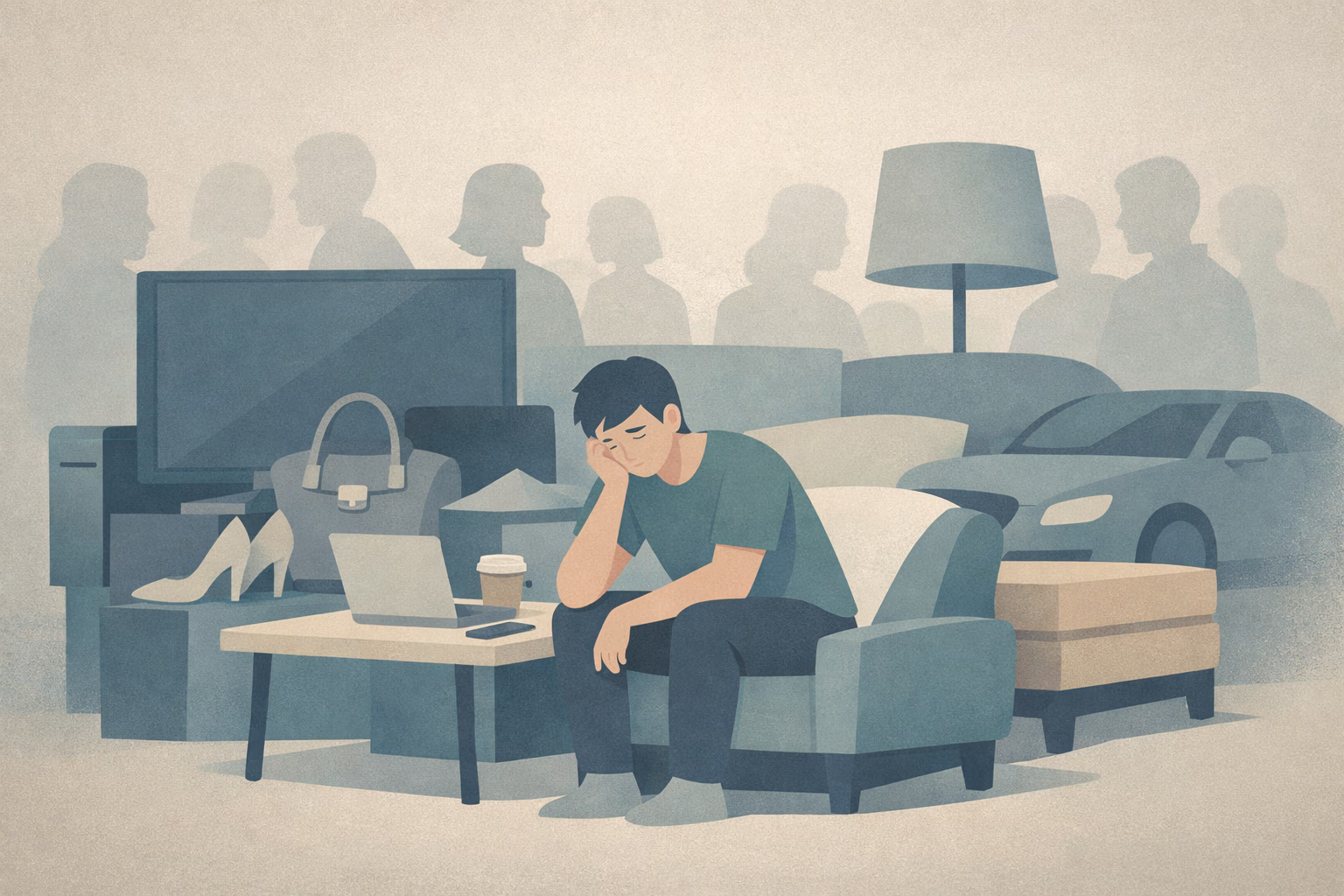
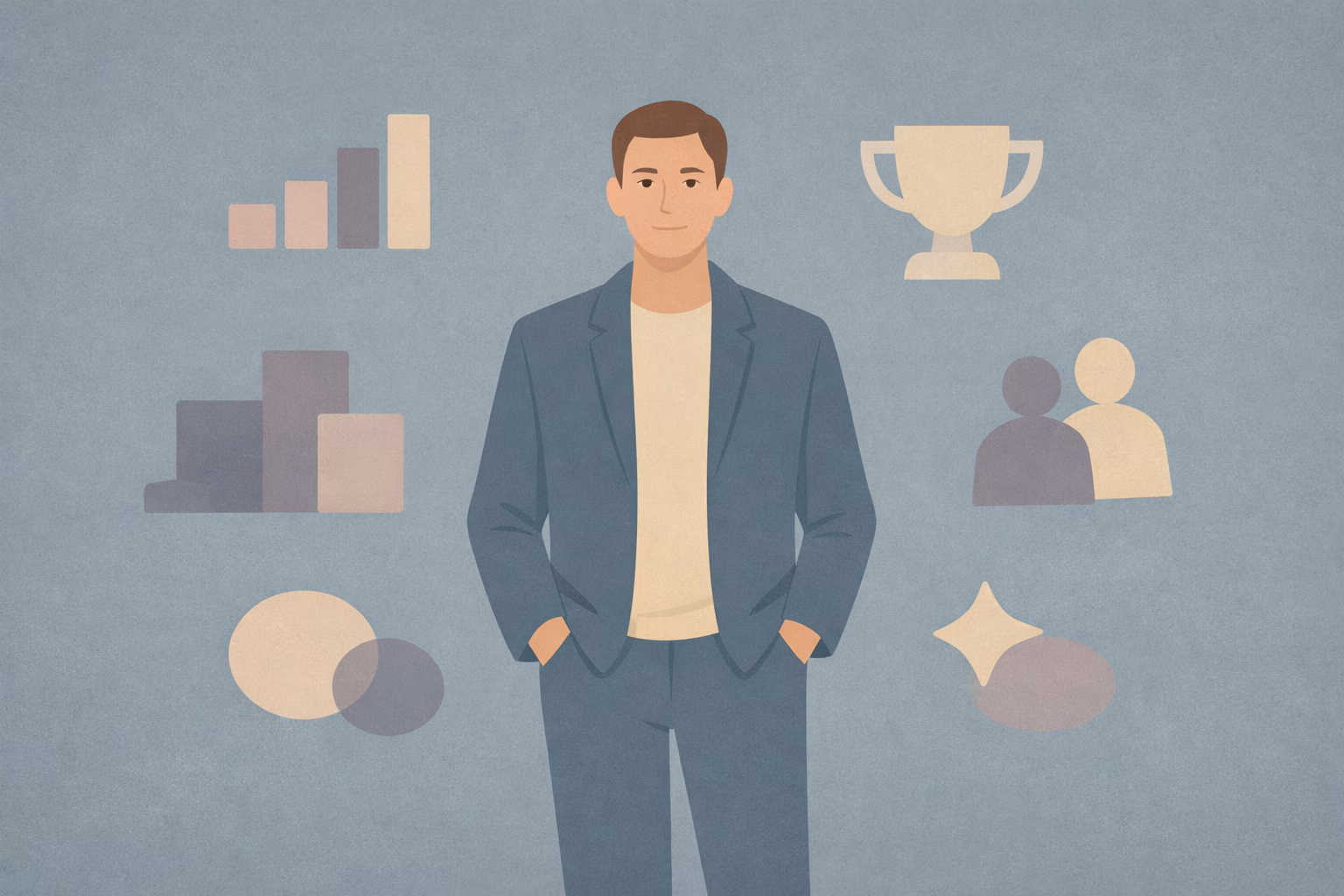
In short: Status anxiety on social media often looks like a personal problem—like you should be more confident, less reactive, more “above it.” But for many people, it’s closer to a predictable nervous system state: chronic self-evaluation under nonstop comparison cues. In a feed built from highlights, milestones, bodies, relationships, and success signals, the mind keeps receiving a question it can’t fully answer: Where do I stand?
Status anxiety on social media often looks like a personal problem—like you should be more confident, less reactive, more “above it.” But for many people, it’s closer to a predictable nervous system state: chronic self-evaluation under nonstop comparison cues.
In a feed built from highlights, milestones, bodies, relationships, and success signals, the mind keeps receiving a question it can’t fully answer: Where do I stand? When that question never resolves, the body doesn’t get a “done” signal. It stays alert, scanning for evidence—good news, bad news, reassurance, threat.
What if the discomfort after scrolling isn’t vanity or weakness, but a system trying to regain orientation?
Many people recognize the same sequence: a few minutes of scrolling and something subtly changes—tightness, urgency, flatness, agitation, or a quiet sense of being behind. This isn’t simply “jealousy.” It’s your body updating its sense of social reality based on the cues it’s receiving.
Social platforms deliver concentrated signals of achievement, attractiveness, belonging, and momentum. When your nervous system takes those signals in quickly, it can register them as evidence that you are less safe, less relevant, or less resourced than you need to be—whether or not that’s objectively true. In research, heavy social networking exposure has been associated with greater anxiety and depressive symptoms, especially when comparison processes are active [Ref-1].
Under that load, it’s common to feel pressure to “perform a life”: to post, improve, prove, or catch up. The drive isn’t moral. It’s regulatory—an attempt to move from uncertainty to a stable position.
Social comparison is uniquely activating because it can trigger two opposing systems simultaneously: threat vigilance (monitoring danger, rejection, or loss of standing) and reward pursuit (seeking signals of approval, status, and inclusion). This mixed activation can feel like restlessness, mood swings, or a compulsive need to check “just one more time.” [Ref-2]
In practical terms, the nervous system begins tracking micro-feedback: views, likes, replies, silence, who is thriving, who is traveling, who is chosen. Even if you don’t consciously care, your body can still interpret these as ranking data—and keep updating your position.
When both threat and reward are online, attention narrows. Self-monitoring increases. Small cues land loudly. It’s not over-sensitivity; it’s an activated comparison environment with no natural stopping point.
Humans evolved in groups where relative position affected access to protection, mates, food, and alliance. “How am I doing compared to others?” wasn’t a superficial question—it was a survival-relevant form of orientation. Modern comparison can feel personal, but its roots are old.
This is one reason social media comparison can have real emotional weight even when you intellectually dismiss it. The brain is built to treat social information as consequential. Studies linking social networking sites with comparison and mental health outcomes reflect how potent these cues can be in modern contexts [Ref-3].
Seen this way, status anxiety is not a character flaw. It’s a sensitive social-ranking system operating in an environment saturated with signals.
Likes, compliments, follower growth, and positive comments can provide a short-lived sense of location: I’m okay. I’m seen. I still belong. In that moment, the nervous system gets a small reduction in uncertainty—an orientation cue that temporarily quiets self-monitoring. [Ref-4]
But the relief often doesn’t last because the underlying question isn’t fully completed. Validation on a platform is rarely a settled “done”; it’s a new data point in an ongoing stream. The system learns that reassurance comes in pulses, and that silence could mean loss of standing.
So the body stays near the channel where reassurance might appear. Not because you’re shallow—because your system is tracking safety through social signals that keep moving.
Comparison can feel like a way to get control: if you gather enough information about how others look, earn, live, and succeed, you’ll know where you stand. But constant comparison tends to increase insecurity rather than resolve it, because there is always someone ahead on some axis, and platforms keep those examples flowing.
Instead of closure, comparison often produces endless partial conclusions: maybe I’m doing fine… except there’s that person; I’m improving… but not fast enough. In studies of Instagram and short-form content, social comparison can intensify the relationship between use and worse mental health indicators [Ref-5].
Emotional exhaustion here isn’t a failure of perspective. It’s the cost of running a ranking process without a finish line.
One way to understand status anxiety is as a loop where internal worth gets continuously negotiated through external cues. The nervous system begins treating fluctuating metrics—attention, engagement, perceived popularity—as if they were the scoreboard for safety and belonging.
When worth is outsourced this way, the system can’t stand down. Even neutral moments become evaluative: “Is this post good?” “Did I say the right thing?” “Why did they get invited?” The mind stays in measurement mode, and the body carries the cost.
Across research, social comparison shows robust associations with anxiety and depression, supporting the idea that persistent ranking pressure can be a significant psychological load [Ref-6].
When your environment keeps asking you to rank yourself, calm can start to feel like falling behind.
Status anxiety doesn’t always feel like panic. Often it shows up as a set of adaptive behaviors aimed at reducing uncertainty and restoring position.
Common patterns include:
These patterns are widely discussed in youth and adult social media research, where social comparison is connected with mental health vulnerability and emotional volatility [Ref-7]. The important reframe is structural: the behavior is a response to an environment that keeps the loop open.
Over time, persistent comparison can erode self-trust—not because you “lack confidence,” but because your inner signals get overridden by external ranking data. Preferences become less reliable. Achievements don’t land. Even rest can feel unjustified.
This is how a person can be objectively capable and still feel unsteady. The nervous system is prioritizing social readouts over internal completion: what matters becomes what is visible, measurable, and approved. Resources like JED describe how social comparison on platforms can distort self-perception and intensify dissatisfaction [Ref-8].
What happens when your life is experienced mainly through how it might look?
Often, the answer is a thinning of lived identity—less sense of “this is me,” more sense of “this is what might be acceptable.” That shift is exhausting because it demands continuous self-editing without true closure.
When a post performs well or someone praises you, the nervous system gets a quick drop in uncertainty. That relief is real. But because it’s tied to external conditions that can change at any moment, the system learns to keep monitoring for the next update.
This creates a predictable cycle: discomfort → checking or posting → brief reassurance → new exposure → renewed discomfort. Over time, the threshold for feeling “okay” rises, because the system adapts to a high-frequency stream of social evaluation.
Public health discussions have highlighted how social media environments can amplify comparison and increase mental health strain, particularly for young people whose identity and belonging systems are still consolidating [Ref-9]. The core mechanism isn’t weakness; it’s repeated activation without completion.
Status cues land hardest when the nervous system is already running hot—when baseline load is high and the body is scanning for proof of position. In that state, a stranger’s highlight reel can register as a real-time threat, and a small dip in engagement can feel like a social drop.
When internal safety is more available, the same cues often carry less force. Not because you’ve talked yourself into confidence, but because the system doesn’t need the feed to answer “Am I okay?” as urgently. Reactivity decreases when the body isn’t relying on external ranking to stay organized.
Research on upward comparison has shown links with forms of anxiety (including appearance anxiety), underscoring that the impact is not merely cognitive—it involves state-based reactivity to what is perceived as “above” [Ref-10]. In a steadier baseline, those comparisons may still register, but they don’t automatically become a verdict on identity.
Status anxiety often masks a more basic human need: secure belonging. Platforms offer “belonging-like” signals (visibility, praise, rapid feedback), but they frequently require performance and constant updating to maintain.
Genuine connection works differently. It tends to reduce ranking because it provides stable cues: being known over time, being included without auditioning, and being valued for more than output. Social rank perspectives in mental health research emphasize how perceived rank and defeat dynamics relate to distress, while safer affiliative contexts can counterbalance those pressures [Ref-11].
Some forms of belonging make you feel quieter inside because you don’t have to keep proving you deserve a place.
In this frame, the opposite of status anxiety isn’t “not caring.” It’s belonging that is coherent enough to let the nervous system stand down.
As ranking pressure decreases, people often describe not a constant high mood, but a return of steadiness: less urgency to check, fewer dramatic spikes after comparison, and more ability to let a moment be unfinished without turning it into a crisis. This is what it can look like when the system regains capacity for signal return after reduced load and more reliable closure.
From a social-rank lens, shame and social anxiety can intensify when the body expects negative evaluation; when that expectation eases, self-acceptance often becomes less of a project and more of a baseline state [Ref-12]. Not perfect, not permanent—just less dominated by measurement.
Crucially, this steadiness isn’t the same as “understanding why you compare.” It’s the physiological settling that comes when your sense of worth isn’t constantly renegotiated by external metrics.
When status anxiety runs the system, attention naturally narrows toward rank: who is ahead, who is rising, who is desirable, who is invited. But when the loop loosens, attention often widens toward contribution—what you want to make, share, protect, learn, or participate in.
This isn’t a motivational speech. It’s a structural shift: agency returns when identity is guided by meaning rather than by constant evaluation. Social rank research helps explain why perceived position can shape social anxiety and self-consciousness—because rank feels consequential to belonging and safety [Ref-13]. When safety is less contingent on rank, participation can become more genuine.
Contribution can be quiet. It can be local. It can be private. The key is that it produces a different kind of completion: a sense that your life is being lived from the inside, not audited from the outside.
Status anxiety is often described as ambition gone wrong. Another interpretation is simpler and more humane: it’s a desire for stable belonging and recognition in an environment that keeps shifting the criteria.
In social rank theory, distress can arise when the system perceives low rank or unstable standing, because rank is implicitly tied to safety and acceptance [Ref-14]. Social media can intensify that perception by turning everyday life into a continuous ranking field.
When you see status anxiety as a regulatory response to ongoing evaluation, shame tends to soften. The question becomes less “What’s wrong with me?” and more “What conditions keep my system in measurement mode?” In that reframe, agency starts to return—not as pressure, but as orientation.
Metrics fluctuate. Trends move. Someone will always appear ahead in a curated stream. If your sense of worth depends on winning that stream, your system can’t get a lasting “done.”
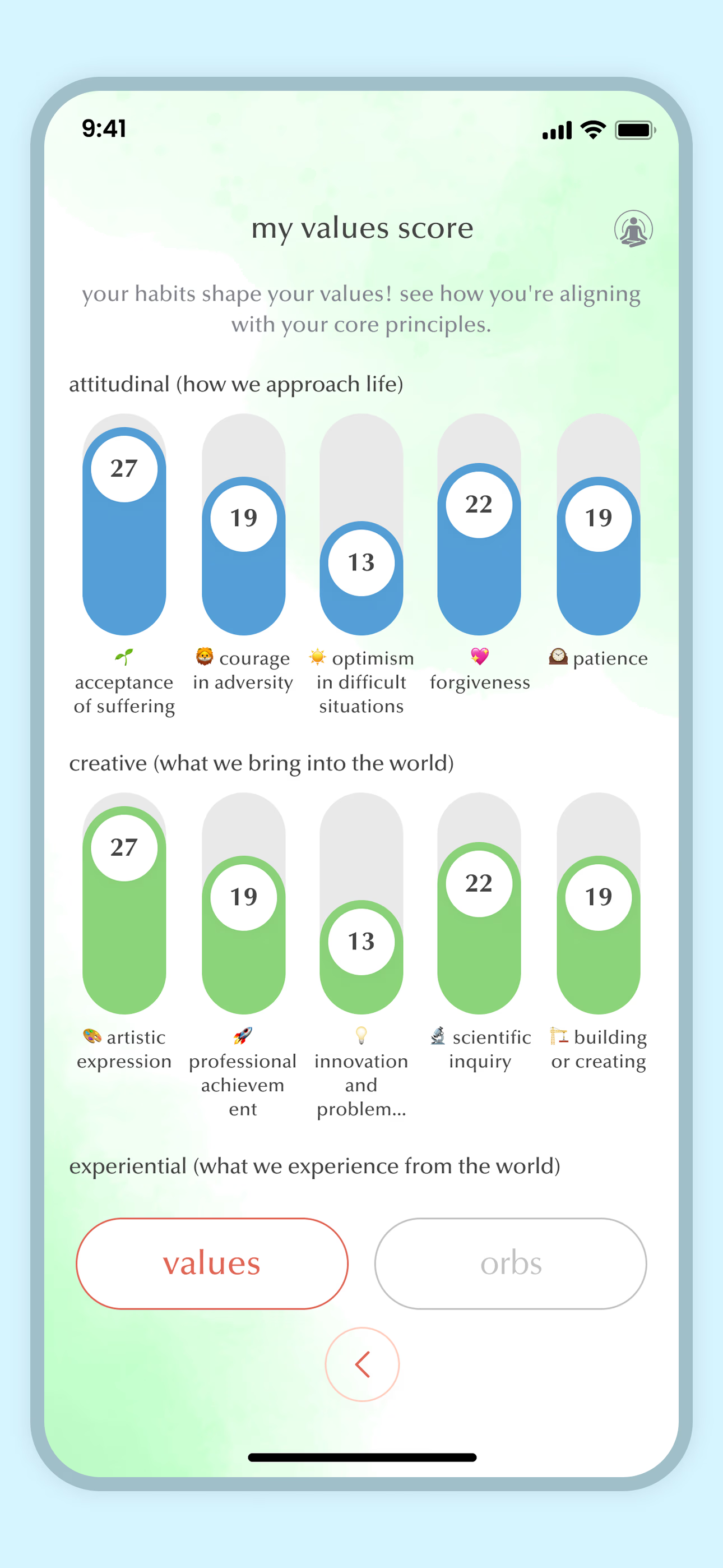
Stability tends to emerge when worth is rooted in something less volatile: values you recognize as yours, roles that feel real in your body, and participation that leaves a residue of completion rather than a craving for more proof. Status may still matter—but it doesn’t have to be the place where your identity lives. [Ref-15]
From theory to practice — meaning forms when insight meets action.
Because your body is updating its sense of social reality based on the cues it's receiving. Social platforms deliver concentrated signals of achievement, attractiveness, belonging, and momentum — and the nervous system absorbs them quickly. It can register them as evidence that you're less safe, less relevant, or less resourced than you need to be, regardless of what's objectively true. The 'behind' feeling isn't imaginary or simply jealousy; it's a state shift. Under that load, the pressure to perform a life — to post, improve, prove, catch up — isn't moral. It's regulatory. Your system is trying to move from uncertainty to a stable position.
Because it pulls threat and reward circuits simultaneously. Threat vigilance monitors danger, rejection, and loss of standing; reward pursuit chases approval and inclusion. Both systems online produces restlessness, mood swings, and a compulsive need to check 'just one more time.' The body tracks micro-feedback — views, likes, replies, silence — as ranking data, even if you don't consciously care. Attention narrows, self-monitoring increases, small cues land loudly. It's not over-sensitivity. It's an activated comparison environment with no natural stopping point. The Power Loop here outsources internal worth to fluctuating external metrics.
Because validation on a platform isn't a settled Done — it's a new data point in an ongoing stream. Likes and positive comments give a brief reduction in uncertainty and quiet self-monitoring temporarily. But the system learns that reassurance comes in pulses and silence could mean loss of standing, so it stays near the channel where the next update might appear. The cycle becomes predictable: discomfort, checking or posting, brief reassurance, new exposure, renewed discomfort. The threshold for feeling 'okay' rises because the system adapts to a high-frequency stream of social evaluation. This isn't shallowness; it's repeated activation without completion.
A return of steadiness, not constant high mood. Less urgency to check, fewer dramatic spikes after comparison, more ability to let a moment be unfinished without turning it into a crisis. The shift isn't 'understanding why you compare' — it's the physiological settling that comes when worth isn't constantly renegotiated by external metrics. Attention often widens from ranking toward contribution: what you want to make, share, protect, learn, participate in. Belonging that doesn't require performance is part of what makes this possible. Some forms of belonging make you feel quieter inside because you don't have to keep proving you deserve a place.
From Science to Art.
Understanding explains what is happening. Art allows you to feel it—without fixing, judging, or naming. Pause here. Let the images work quietly. Sometimes meaning settles before words do.
One Quiet Window, one insight, one reflection — every Sunday