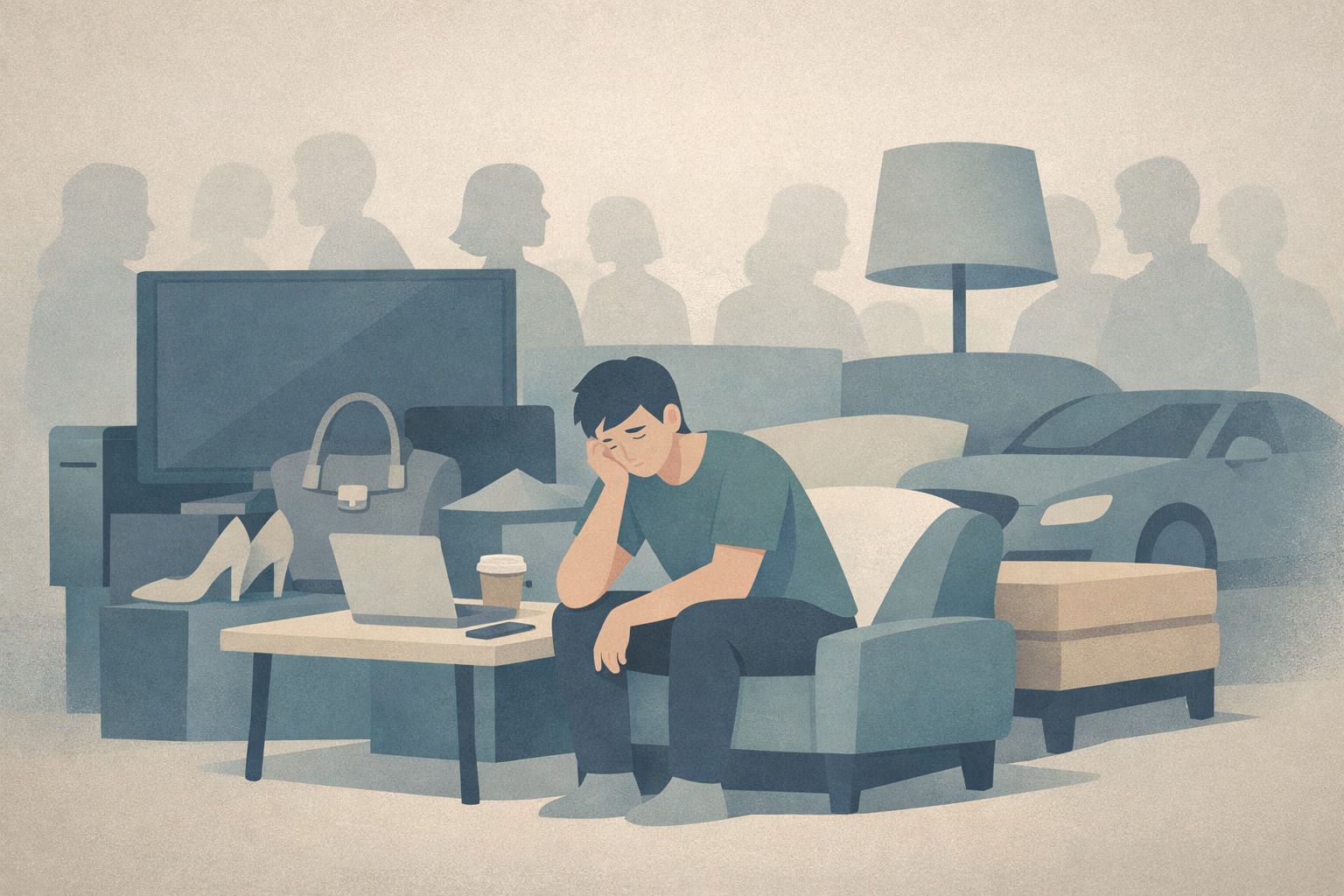
Influencer Envy: The Comparison Loop You Don’t Notice
In short: “Like” chasing is often described as vanity or a lack of confidence. But for many people, it’s more accurate—and more humane—to see it as a regulation strategy: a fast, measurable signal that briefly reduces uncertainty inside the social nervous system.
“Like” chasing is often described as vanity or a lack of confidence. But for many people, it’s more accurate—and more humane—to see it as a regulation strategy: a fast, measurable signal that briefly reduces uncertainty inside the social nervous system.
In a world where attention is fragmented and social standing can feel continuously evaluated, a small burst of approval can function like a momentary “all clear.” Not because you are broken, but because human systems orient toward belonging, safety cues, and closure.
What if the pull toward likes isn’t a personality flaw—what if it’s your system looking for a dependable “done” signal?
Before a post goes up, many people notice a very specific kind of activation: scanning for the right wording, the right photo, the right timing. After it goes up, the body can shift into monitoring mode—checking, refreshing, counting, recalibrating mood based on what comes back. This isn’t random; it’s the social system doing what it evolved to do: track cues of acceptance and risk.
The emotional swings that follow engagement are often less about “being dramatic” and more about how the nervous system treats social feedback as a signal that updates safety and standing. A higher count can create a quick settling. A lower count can create a lingering sense of exposure, like a loop that didn’t close. [Ref-1]
“It’s not that I need everyone to like me. It’s that silence feels like something is unfinished.”
Social platforms compress feedback into bright, immediate signals. When approval lands, reward pathways can light up, and the brain learns: this cue matters. When approval doesn’t land, the system may interpret the absence as ambiguity—an open question that keeps attention deployed.
At the same time, social evaluation carries a stress component. Being seen, ranked, or compared can raise arousal, and uncertainty can keep it elevated. In this context, likes aren’t just “nice”; they can function like a biochemical hinge between tension and temporary release. [Ref-2]
Human nervous systems formed in environments where social standing wasn’t abstract. It influenced access to protection, resources, and connection. Because of that history, the brain treats social cues as more than information; it treats them as orientation—Who’s with me? Am I safe here? Do I belong?
Platforms convert that ancient calibration process into a visible metric. It’s not surprising that the system leans in. A “like” can read like a micro-signal of inclusion; a lack of response can read like social fog. Digital feedback doesn’t only inform the mind—it can shift the body’s state. [Ref-3]
When engagement is high, many people feel a short-lived lift: more confidence, more clarity, more ease. In Meaning Density terms, it can mimic closure—the sense that something landed, that the exposure resolved, that the social question got answered.
This matters, because a nervous system under load often prioritizes quick certainty. A clean number is certainty. A burst of hearts is certainty. That certainty can briefly quiet rumination and reduce the sense of waiting. Especially for younger brains, which are still developing sensitivity to reward and feedback, the impact can be amplified. [Ref-4]
And if the relief is real, why doesn’t it ever feel like enough?
Likes can feel like self-worth, but structurally they function more like a fluctuating external gauge. The body reads the gauge, updates state, then looks again. Over time, this can shift self-evaluation from an internal continuity (“I know who I am”) to an external volatility (“What did today’s number say about me?”).
One reason the loop tightens is comparison. Platforms don’t just show feedback; they show other people’s feedback, too. Upward comparison can quietly reframe “enough” into a moving target, which keeps the nervous system in ongoing appraisal rather than completion. [Ref-5]
In the “Power Loop,” the system tries to reduce vulnerability by increasing control over social outcomes: curating, timing, editing, monitoring. It’s not arrogance. It’s a bid for predictability in an environment that feels rankable and fast.
Status signaling and comparison turn the social world into a shifting ladder. Even subtle cues—who gets boosted, who gets seen, who gets praised—can keep the body oriented toward winning safety through performance. In this loop, likes become less about enjoyment and more about control: controlling uncertainty, controlling perception, controlling where you stand today. [Ref-6]
Checking behavior often looks like a “bad habit,” but it can be understood as a system waiting for the loop to close. The post went out; the system expects a response. Until it arrives, attention stays tethered.
Low engagement doesn’t just disappoint; it can create a muted consequence that never resolves. There’s no clear ending—only ambiguity. And ambiguity is sticky. It can lead to repeated checking, re-posting, deleting, or spiraling into comparison because the nervous system is trying to locate a stable signal. [Ref-7]
When feedback becomes frequent and public, identity can start to feel negotiable. Not in a dramatic way—more like a subtle erosion of continuity. The system learns to treat the self as something that must be validated in real time.
Over time, this can reduce self-trust: not because you “don’t know yourself,” but because the environment keeps interrupting the settling process. Instead of experiences integrating into a stable sense of “this is me,” they remain exposed to constant revision. People often report feeling more anxious, more image-conscious, or oddly numb after scrolling—signs of a system managing load rather than completing meaning. [Ref-8]
“I can’t tell if I actually like what I posted, or if I like that it got liked.”
Reward systems adapt. What once felt satisfying can become the new normal. The same number may stop producing the same relief, and the system seeks a bigger signal to reach the prior level of reassurance.
This can look like posting more, optimizing more, or feeling strangely flat after “good” engagement. Not because you’re ungrateful, but because the body has learned that metrics are the pathway to certainty—and now needs a stronger cue for the same stand-down. When likes dip, self-evaluation can drop sharply, reinforcing the loop. [Ref-9]
The deepest reframe is not “likes don’t matter.” They matter to the nervous system because they resemble social safety cues. The question is what kind of safety is being purchased—and whether it can ever fully complete.
Metrics offer fast state change: a spike of reward, a brief decrease in uncertainty. But integration is different. Integration is what happens when something in life reaches a true “done”—when identity doesn’t need the next signal to remain coherent. Habitual checking can keep the system in rehearsal and evaluation, which makes “done” harder to access, even when nothing is objectively wrong. [Ref-10]
What counts as “real enough” belonging for your body—not just your screen?
Likes are lightweight affiliation: they indicate attention, but they rarely carry the full texture of being known. Genuine connection tends to include specificity—tone, reciprocity, context, repair, continuity. Those features give the nervous system richer evidence of belonging.
This is why someone can receive hundreds of likes and still feel oddly alone afterward. The system got stimulation, but not necessarily completion. Being seen as a person—over time, with nuance—creates a different kind of settling than being rated in a moment. [Ref-11]
“A single message that feels real can land differently than a hundred taps.”
When social comparison is high, self-assessment can become sharp and unstable: “I’m doing great” one day, “I’m nothing” the next. Research links social feedback and comparison processes with shifts in self-esteem and well-being, especially in environments that constantly present curated highlights. [Ref-12]
As the system finds more reliable closure, self-assessment often becomes calmer and less reactive. Not euphoric—just steadier. There’s more room for nuance: a post can do “fine” without redefining you, and another person’s success can exist without automatically becoming evidence of your lack.
Performance is a reasonable response in an environment that measures you. But over time, constant performing can thin meaning: choices become guided by predicted reaction rather than lived values. The self starts to feel like a project under review.
A different orientation emerges when expression is tethered to values—what matters to you, what you want to stand for, what feels aligned with your identity even without immediate applause. This isn’t a mindset trick; it’s a structural shift in what the nervous system uses as its reference point. When values guide expression, feedback becomes information rather than a verdict. [Ref-13]
It’s not irrational to want likes. It’s human to want a clear signal that you’re included. The hard part is that platforms combine visibility, comparison, and constant evaluation in a way that keeps the social system activated—always checking, always updating, rarely arriving. Social comparison in these contexts is strongly associated with shifts in well-being, which helps explain why the same scroll can feel both compelling and draining. [Ref-14]
Agency often returns when self-worth is no longer negotiated moment to moment through public metrics—when the nervous system can treat belonging as something lived and continuous, not something counted. The point isn’t to reject social feedback; it’s to remember that numbers are thin signals for a much richer human need.
If you’ve been using social media as reassurance, that doesn’t mean you’re shallow. It means your system found a fast way to reduce uncertainty in a noisy social world. [Ref-15]
Over time, the most stabilizing belonging tends to come from being recognizable to yourself—consistent, values-linked, and not renegotiated by every refresh. When life offers that kind of coherence, the nervous system doesn’t need as much applause to feel oriented.
From theory to practice — meaning forms when insight meets action.
The article reframes it as a regulation strategy, not a character flaw. Likes are a fast, measurable signal that briefly reduces uncertainty inside the social nervous system. In an environment where attention is fragmented and standing feels continuously evaluated, a small burst of approval functions like a momentary 'all clear.' Your Attachment & Belonging System orients toward inclusion cues, and platforms compress that ancient calibration into a visible metric. Wanting likes isn't shallow — it's human. The real question is whether the metric can ever produce the kind of closure your body is actually asking for.
Because silence is ambiguity, and ambiguity is sticky. The article notes that low engagement creates a muted consequence that never resolves — there's no clear ending, only an open question. The system stays tethered, refreshing, monitoring views, comparing to others. Bad reactions at least close the loop: the signal arrived, even if uncomfortable. No reaction leaves the post hanging in social fog. That's why compulsive checking isn't weakness; it's an unfinished loop. Your nervous system is waiting for a stable signal it can use to update where you stand, and the platform structurally withholds that stand-down.
Because the underlying drive is control over uncertainty rather than enjoyment of reward. The article places like-chasing in the Power Loop: status signaling, curating, timing, editing, and monitoring are bids for predictability in an environment that feels rankable and fast. It's not arrogance — it's the system trying to reduce vulnerability by managing how it's perceived. Likes become less about pleasure and more about controlling where you stand today. The reward is real, but the deeper function is keeping the social ladder readable, which is exhausting because the ladder never stops moving.
Because likes are lightweight affiliation — they signal attention but rarely carry the texture of being known. Genuine connection includes specificity: tone, reciprocity, context, repair, continuity. Those features give the Attachment & Belonging System richer evidence that you belong. The article notes that someone can receive hundreds of likes and still feel oddly alone afterward, because the system got stimulation but not completion. Being seen as a person, over time, with nuance, creates a different kind of settling than being rated in a moment. Coherence satisfies the social system more deeply than applause.
From Science to Art.
Understanding explains what is happening. Art allows you to feel it—without fixing, judging, or naming. Pause here. Let the images work quietly. Sometimes meaning settles before words do.
One Quiet Window, one insight, one reflection — every Sunday