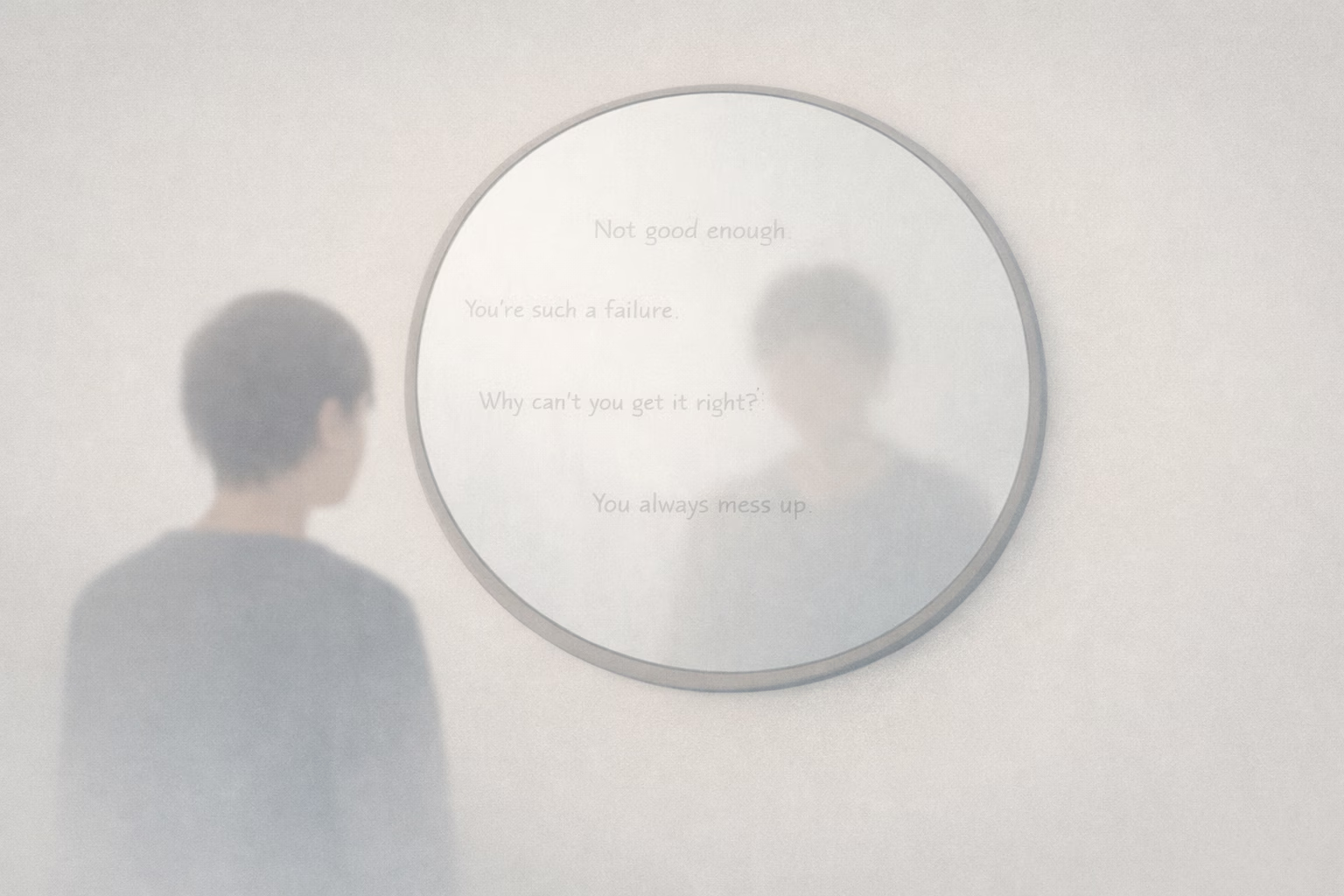
Influencer Lifestyle Comparison: Wanting a Life That Isn’t Yours

In short: A small contraction in the chest, a sudden urge to re-evaluate your choices, a vague sense that your life is behind schedule. And because it arrives in the middle of normal scrolling, it can feel like a personal reaction—when it’s also a predictable nervous-system response to a specific kind of environment.
Influencer envy often isn’t a dramatic emotion you “have.” It can be quieter: a small contraction in the chest, a sudden urge to re-evaluate your choices, a vague sense that your life is behind schedule. And because it arrives in the middle of normal scrolling, it can feel like a personal reaction—when it’s also a predictable nervous-system response to a specific kind of environment.
What if the problem isn’t your mindset—what if it’s the comparison loop you’re being placed inside?
In human terms, comparison is not a flaw. It’s a coordination tool: a way the social brain tracks safety, belonging, and access to resources. But when comparison becomes continuous, unfinishable, and detached from real relationship context, the system can’t complete the loop. It stays activated—seeking resolution that never fully arrives.
One of the most common experiences beneath influencer envy is not hatred or spite. It’s the sensation of being invisible, late, or strangely underqualified—while someone else looks effortlessly ahead. That feeling can show up even when you’re functioning, contributing, and holding a life together.
In the body, “behind” often reads as urgency. The nervous system interprets rank cues as practical information: Am I safe here? Am I valued? Do I have leverage? Do I belong? In a traditional social setting, those questions can get answered through reciprocity, feedback, and actual outcomes. Online, they can remain open-ended. [Ref-1]
When your system can’t locate a clear “I’m okay here” signal, it keeps checking.
Human attention is not neutral. It is biased toward what might affect social standing—especially upward comparisons (people who appear more attractive, successful, connected, or confident). That bias makes evolutionary sense: in small groups, noticing higher-status behavior could help you learn skills, avoid mistakes, and stay included.
But upward comparison also carries a threat-like quality: it implies potential exclusion or diminished value. The result can be a subtle blend of admiration and alarm—an orienting response that narrows attention and increases internal monitoring. This isn’t “overthinking.” It’s a biological prioritization system doing its job. [Ref-2]
When the feed supplies an endless stream of upward targets, the brain’s comparison circuits receive frequent inputs without stable resolution, keeping the system in a semi-activated state.
Envy is often portrayed as purely toxic, but in social species it can function as a positioning signal. It highlights what seems rewarded in your environment and what might increase your access to respect, resources, or belonging. In that sense, envy can be informative—not because it’s “true,” but because it points to what your system believes matters right now. [Ref-3]
In a bounded community, this signal can complete a cycle: you observe, calibrate, adjust, and then you see the results in real time. The loop closes through lived feedback—others respond, opportunities change, your place stabilizes.
Online comparison often removes the closure mechanism. You get the signal without the finishing conditions. The body stays ready, but nowhere to land.
Offline, comparison typically comes with constraints that protect your nervous system: you know the person, you see context, you witness trade-offs, and you eventually return to your own life. Even if envy stings, your system can metabolize it because the environment is finite.
In that bounded setting, envy can sometimes motivate learning, skill-building, or renegotiation of goals—because it’s tethered to achievable steps and real outcomes. When a loop completes, the body receives a “done” signal: attention relaxes, and identity re-stabilizes.
Research on influencer-related envy suggests it’s uniquely intensified by the curated nature of content and the way users compare themselves to idealized presentations. The comparison is real in the nervous system even when the evidence is incomplete. [Ref-4]
Influencer content is not simply “fake.” It’s partial. It is optimized to show outcomes without process: the after-photo without the hours, the confidence without the uncertainty, the revenue without the failures, the relationship moment without the repairs.
That partiality matters because comparison relies on context. When context is missing, the nervous system fills gaps with worst-case interpretations: They did it easily. I’m the only one struggling. I should be further along. Your system isn’t being dramatic—it’s trying to create coherence from incomplete inputs.
Studies on upward social comparison with influencers suggest that comparing to distant, idealized targets can be more strongly linked to lower life satisfaction than comparisons with close peers, partly because the relationship lacks grounding details and mutual reality checks. [Ref-5]
Influencer envy becomes especially sticky when it hooks into a “power loop”: a cycle where status cues trigger monitoring, monitoring triggers self-evaluation, and self-evaluation triggers more exposure to status cues. The platform doesn’t need you to feel bad. It only needs you to stay engaged.
In this loop, comparison is not an occasional reference point—it becomes a background operating system. Because there’s always someone “above,” the brain receives continuous evidence that you should recalibrate upward. The baseline shifts, and satisfaction becomes harder to access.
Research on social networking sites links social comparison and envy to patterns of increased engagement and psychological strain, suggesting a reinforcing cycle: comparison fuels emotion, emotion fuels more checking. [Ref-6]
The loop isn’t “I saw something and felt something.” The loop is “I saw something and my system stayed on.”
Because the loop is physiological and structural, it can express itself through many different behaviors—sometimes even contradictory ones. The nervous system is trying to regain stability, and it will test multiple strategies.
These aren’t personality flaws. They’re regulatory moves: attempts to close a loop that keeps reopening. Appearance management and anxiety-related behaviors can intensify when people feel evaluated through social rank cues, especially in image-driven environments. [Ref-7]
Over time, constant upward comparison can erode the felt sense of “my life is mine.” Not because you lose values, but because values get drowned out by evaluation. When your attention is repeatedly redirected toward external benchmarks, internal orientation has less room to consolidate.
This can look like reduced motivation, not from laziness, but from meaning dilution. Effort without a stable sense of purpose doesn’t integrate into identity; it stays as pressure. And pressure is difficult for the nervous system to sustain.
Research has associated frequent Instagram use and social comparison with higher social anxiety and lower self-esteem in some populations, suggesting that ongoing evaluative exposure can shift self-perception and social safety cues. [Ref-8]
Platforms don’t just show you people. They show you escalations: more polished bodies, more luxurious backdrops, more certainty, more consumption, more “wins.” Even if you intellectually know it’s curated, your nervous system still registers the directionality: up, up, up.
As benchmarks rise, yesterday’s progress can stop registering as progress. This is one reason comparison can feel oddly numbing: the brain keeps updating the target, so completion never arrives. The “done” signal gets postponed.
Studies have explored how upward comparison links with envy and materialistic pull in online contexts, suggesting that repeated exposure can mediate dissatisfaction and drive further engagement with status-related consumption. [Ref-9]
There’s an important distinction between rank cues and worth. Rank cues are external signals—visibility, followers, aesthetics, status markers. Worth is the stabilizing sense that you still belong to yourself, even when you’re not winning the comparison game.
When worth is grounded internally, rank cues don’t disappear; they simply become less commanding. They can be noticed without reorganizing your entire self-story. This is not a mental trick. It’s a shift in what your system treats as primary evidence.
Some research in consumer and social media contexts suggests that stronger internal anchors (such as stable self-evaluations) can reduce susceptibility to comparison-driven dissatisfaction and envy responses. [Ref-10]
Not “I must stop comparing,” but “comparison doesn’t get to define me.”
Human comparison systems evolved in relational contexts: people who could see you, respond to you, and share reality with you. Reciprocal relationships provide corrective information that a feed cannot: nuance, history, trade-offs, and care.
When you’re in contact with real mutuality, status cues often lose some intensity because belonging becomes less theoretical. The nervous system receives steady signals of being counted—signals that help close the vigilance loop.
Research on social comparison and well-being suggests that how people compare—and the relational context around them—matters for outcomes. Comparisons in environments with stronger social support and realistic feedback tend to be less destabilizing than comparisons with distant, idealized targets. [Ref-11]
When the comparison loop loosens, the change is often subtle and physiological before it’s philosophical. There’s less urgency to check. Less snap-judgment about your own life. More capacity to return to what you were doing without the lingering “not enough” aftertaste.
This isn’t about becoming immune to influence. It’s about your system regaining the ability to complete cycles—notice, evaluate, and then stand down. When stand-down is possible, attention becomes less fragmented and more available for lived direction.
Recent work on Instagram use and upward comparison has linked comparison-heavy engagement with shifts in affect and usage patterns, suggesting that repeated upward evaluation can keep people in a reactive cycle, while reduced comparison exposure corresponds with steadier emotional states. [Ref-12]
Coherence isn’t a high. It’s the quiet sense that your life makes sense again.
The deeper shift is not “stop caring what people think.” It’s moving from externally measured status to internally defined progress—where growth is understood as alignment with your values and the life you are actually living.
When progress is defined by your terms, comparison becomes optional data rather than a mandate. The nervous system can treat other people’s wins as information, not as an emergency signal about your place in the world.
Meta-analytic research on upward comparison exposure suggests it can reliably influence self-evaluations and emotions, which helps explain why the shift away from constant ranking often feels like reclaiming mental space rather than “changing your personality.” [Ref-13]
Influencer envy usually isn’t about wanting someone else’s life in full detail. It’s about what their life seems to mean: safety, admiration, freedom, certainty. The comparison loop turns those meanings into a scoreboard—and scoreboards are hard for nervous systems to ignore.
But human stability doesn’t come from winning a feed. It comes from coherent movement: when what you do connects to what you value, and when your experiences have enough closure to become part of a settled identity. Upward comparison on mobile social media has been linked with lower well-being in ways that make sense through this lens: the system is repeatedly activated without completion. [Ref-14]
Agency returns when life is organized around lived direction instead of constant evaluation. Not as a performance—more like a homecoming.
The feed is designed to keep your attention in motion. Your nervous system, however, is designed to settle when something is complete—when it can register “enough for now” and return to the present.
Influencer envy doesn’t prove you’re shallow. It often proves you’re human in a high-velocity comparison environment. And the most durable relief isn’t manufactured through intensity—it arrives when your life becomes more coherent, more reciprocal, and more finishable.
Meaning doesn’t come from outranking strangers. It comes from living in a direction you recognize as yours. [Ref-15]
From theory to practice — meaning forms when insight meets action.
Both, but the algorithm reliably triggers it. Influencer envy isn't a dramatic emotion you 'have.' It's quieter — a small contraction in the chest, a sudden urge to re-evaluate your choices, a vague sense your life is behind schedule. That feeling registers in the body as urgency because the social brain is asking: am I safe here? Am I valued? Do I belong? In a traditional setting those questions get answered through reciprocity and feedback. Online, they remain open-ended. Your system can't locate a clear 'I'm okay here' signal, so it keeps checking. The 'behind' feeling is a signal, not a verdict.
Because human attention is biased toward what might affect social standing — especially upward comparisons. That bias makes evolutionary sense: noticing higher-status behavior could help you learn skills and stay included. But upward comparison also carries a threat-like quality, implying potential exclusion or diminished value. The result is a subtle blend of admiration and alarm. When the feed supplies an endless stream of upward targets, comparison circuits receive frequent inputs without stable resolution, keeping the system in a semi-activated state. This is biology doing its job, not 'overthinking.'
Yes. The article frames it as a cycle where status cues trigger monitoring, monitoring triggers self-evaluation, self-evaluation triggers more exposure to status cues. The platform doesn't need you to feel bad — it only needs you to stay engaged. Comparison stops being an occasional reference point and becomes a background operating system. Because there's always someone 'above,' the brain receives continuous evidence to recalibrate upward. The baseline shifts, satisfaction becomes harder to access, and yesterday's progress stops registering as progress. The Done Signal gets postponed indefinitely.
Distinguishing the two. Rank cues are external — visibility, followers, aesthetics, status markers. Worth is the stabilizing sense that you still belong to yourself, even when you're not winning the comparison game. When worth is grounded internally, rank cues don't disappear; they simply become less commanding. They can be noticed without reorganizing your entire self-story. This isn't a mental trick — it's a shift in what your system treats as primary evidence. Not 'I must stop comparing,' but 'comparison doesn't get to define me.' Stability comes from coherent movement, not winning a feed.
From Science to Art.
Understanding explains what is happening. Art allows you to feel it—without fixing, judging, or naming. Pause here. Let the images work quietly. Sometimes meaning settles before words do.
One Quiet Window, one insight, one reflection — every Sunday