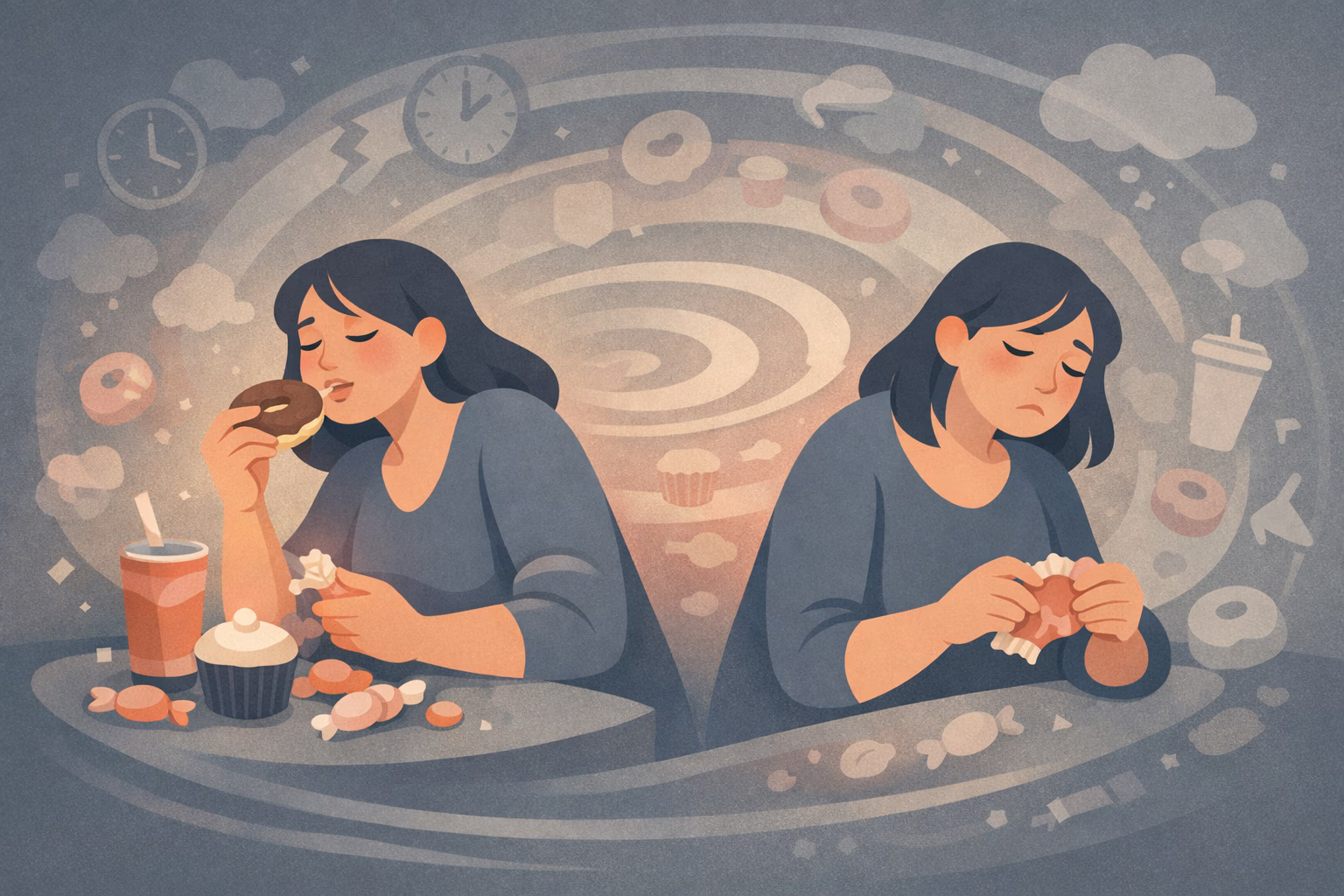
Sugar Addiction: The Stress–Reward Loop
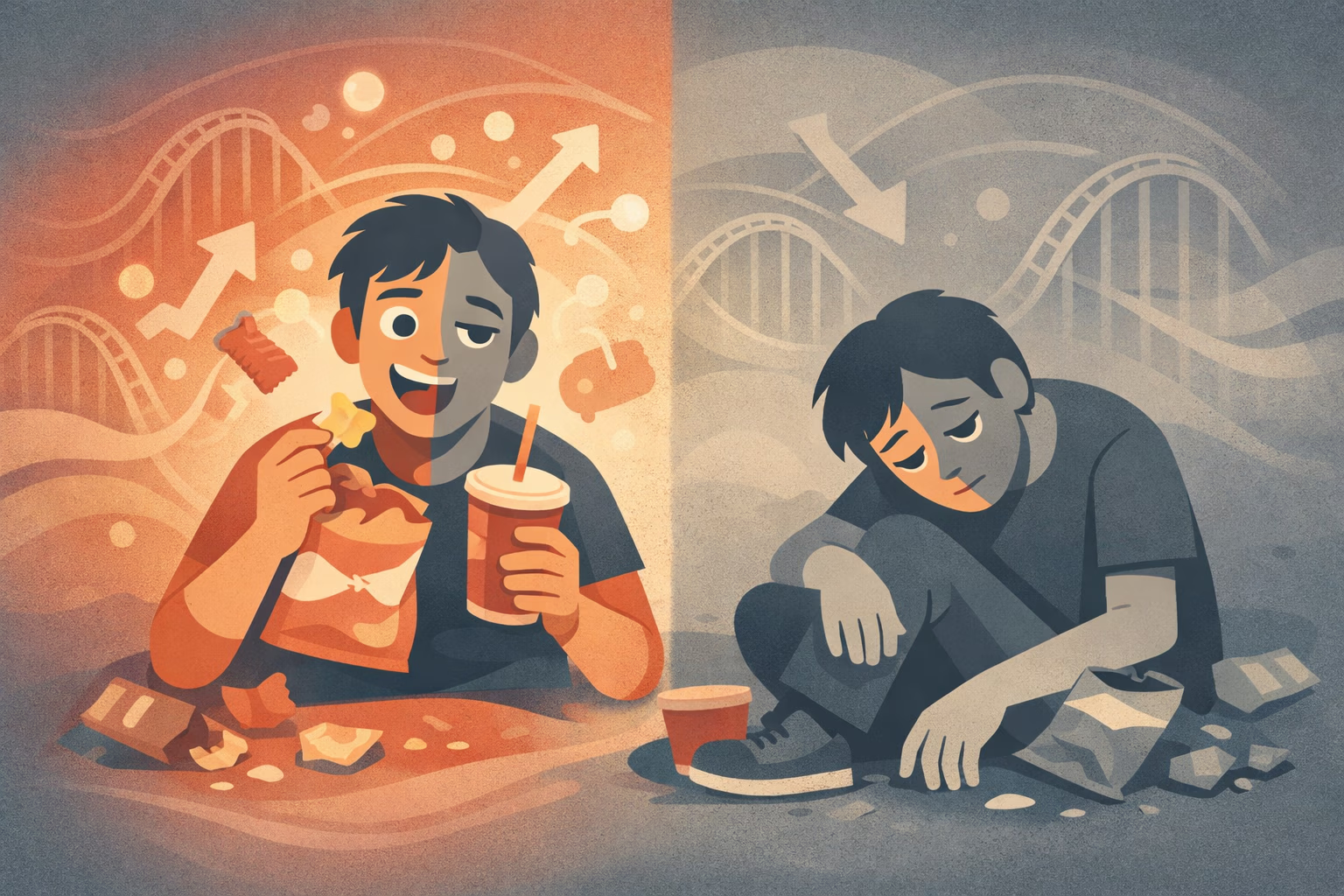
In short: Many people can name the sequence: a strong pull toward a specific snack, a brief sense of comfort or “finally,” and then a slump—fog, irritability, restlessness, or a strange emotional flatness. This pattern is easy to personalize, but it often has less to do with character and more to do with how modern food environments interact with human reward circuitry.
Many people can name the sequence: a strong pull toward a specific snack, a brief sense of comfort or “finally,” and then a slump—fog, irritability, restlessness, or a strange emotional flatness. This pattern is easy to personalize, but it often has less to do with character and more to do with how modern food environments interact with human reward circuitry.
What if the “mood swing” after eating isn’t a moral failure—but a predictable nervous system response to stimulation without closure?
Ultra-processed foods are designed to be fast, intense, and reliably rewarding. That design can temporarily shift state (soothe, energize, distract), yet it doesn’t necessarily provide the kind of steady inputs that help the brain and body stand down. Over time, the gap between “hit” and “settle” can widen—and mood becomes the messenger.
A mood rollercoaster often starts before the first bite. There’s an internal narrowing—attention pulls toward a particular taste, texture, or brand. The body anticipates a change in state, because it has learned that this stimulus reliably delivers one.
Then comes the peak: a short-lived sense of relief, pleasure, or quiet. After that, many people notice a descent—fatigue, emotional thinness, agitation, heaviness, self-critique, or a renewed urge to keep grazing. This isn’t “being dramatic.” It’s a common sequence when reward rises quickly and the system can’t convert it into lasting stability. [Ref-1]
Sometimes it’s not that you wanted food. It’s that your system wanted the shift that food reliably provides.
Ultra-processed foods tend to concentrate sugar, refined starch, fat, salt, and flavor compounds into combinations that deliver rapid sensory impact. The brain’s reward system responds strongly to novelty, intensity, and quick energy availability—especially when the signal arrives fast and repeatedly. [Ref-2]
In simple terms, dopamine is involved in reward learning and “go toward it” signaling. A big spike doesn’t just feel good; it flags the stimulus as important and worth repeating. When the spike is frequent, the after-state can feel comparatively low—less interest, less patience, less buoyancy. The discomfort isn’t proof something is wrong with you; it’s the nervous system registering contrast.
When the reward signal is loud, ordinary life can briefly feel quieter than it “should.”
Humans evolved in food landscapes where calorie-dense rewards were real advantages—and not always available. Sweetness, fat, and salt once signaled survival value. The reward system is not a flaw; it is an ancient orientation tool that helped bodies move toward scarce resources.
Today, the environment is different: dense reward is cheap, constant, and engineered to be easy to consume quickly. That mismatch matters. When high-intensity food is always within reach, the reward system can stay partially activated, scanning for the next reliable “lift,” instead of standing down into baseline steadiness. Research links higher ultra-processed intake with worse mental health outcomes, suggesting this mismatch is not just theoretical. [Ref-3]
In high-load states—poor sleep, social strain, deadline pressure, loneliness, sensory overload—the nervous system often seeks faster pathways to relief. Ultra-processed foods offer rapid sensory comfort and predictable reward. That can feel like a small pocket of safety, especially when other forms of settling are unavailable or take longer to arrive. [Ref-4]
Notice the structural logic: when capacity is low, the system reaches for what reliably changes state. Not because you are “avoiding feelings,” but because the body is trying to reduce friction and regain workable functioning with the tools at hand.
Comfort food is not imaginary comfort. The shift is real: attention changes, the body gets a predictable signal, and the moment can feel softer. The issue is what happens next when the nervous system tries to return to baseline.
Repeated dopamine peaks can deepen volatility: more swings between “up” and “down,” more reliance on the stimulus to feel normal, and more confusion about whether the body can be trusted to self-steady. Over time, this can resemble emotional dependence—not as a personality trait, but as a learned regulatory shortcut that keeps reactivating the loop. Discussions of ultra-processed foods and depression risk often highlight this bidirectional strain between diet quality and mood regulation. [Ref-5]
Relief changes the moment. Restoration changes the baseline.
A “pleasure loop” forms when a stimulus reliably shifts state but doesn’t produce a lasting done-signal. Ultra-processed foods can be especially loop-forming because they deliver strong reward cues while leaving the system without the kind of completion that supports stand-down.
In this loop, the nervous system oscillates: activation (craving, seeking, urgency) → stimulation (eating, reward) → drop (fatigue, irritability, restlessness) → renewed seeking. The cycle isn’t about weak will. It’s about a body learning that the fastest available regulator is also the one that keeps the system cycling. Broad reviews connect ultra-processed intake with mental health patterns in ways consistent with this kind of dysregulation. [Ref-6]
Loops persist when there is no clear “finished” state—only the next hit or the next crash.
Because this is a regulatory pattern, it often shows up as repetition and predictability, not chaos. People describe it as “I didn’t even decide,” or “Once I start, stopping feels oddly hard,” or “I’m hungry again, but not for real food.” These are not confessions; they’re data points about a nervous system trying to stabilize quickly. [Ref-7]
None of these signs prove “addiction” or “lack of control.” They often indicate that the reward system has become a primary regulator in an environment that supplies endless triggers.
When the nervous system is repeatedly pushed into high reward and abrupt contrast, baseline can shift. People may notice less stable mood across the day, less patience, and a reduced ability to tolerate ordinary discomforts without reaching for a quick state change. This can look like “low discipline,” but it’s often reduced regulatory bandwidth.
Over time, chronic reliance on ultra-processed stimulation may also affect metabolic signals (hunger and fullness timing), sleep quality, and inflammation—all of which feed back into mood consistency. Population research and public health reporting increasingly link ultra-processed diets with higher depression risk, suggesting that the cost is not merely cosmetic or cultural. [Ref-8]
When baseline gets noisier, the urge for instant quiet becomes more compelling.
Reward systems adapt. With repeated high-intensity stimulation, the brain can become less responsive to the same dose, or more reactive to cues that predict it. This can make the “pull” feel stronger even when the pleasure feels smaller.
Experimental work shows that repeated sugar intake can repeatedly trigger dopamine release in reward regions, reinforcing cue-driven seeking. [Ref-9] Add modern availability—vending machines, delivery apps, checkout aisles, late-night convenience—and the loop gets many chances to reassert itself before the system has time to settle.
Stress load matters here too: when life is already fragmented, ultra-processed food can become a portable regulator. The loop is not irrational; it’s a consistent response to conditions that keep the body activated and the day unfinished.
There is a distinct difference between being “revved” and being supported. When nourishment aligns with the brain’s need for steadier energy and neurotransmitter precursors, the system can spend less time chasing spikes and more time returning to baseline without drama. [Ref-10]
This isn’t a motivational shift; it’s a physiological quieting that changes what feels urgent. Cravings can become less commanding. Decisions feel less like wrestling. Mood becomes less contingent on the last bite and more continuous across the day.
Stability is not constant pleasure. It’s the capacity to return.
In a spike-and-drop loop, eating often becomes private, fast, or charged—followed by mental accounting and social self-consciousness. It can be hard to share meals without feeling watched by your own inner narrator.
As the loop loosens, many people describe a different quality around food: more room for shared meals, less urgency, and fewer aftershocks of guilt or bargaining. Eating becomes less of a strategy and more of a normal human rhythm—one source of pleasure among others, not the primary tool for emotional control. [Ref-11]
When the body expects steadiness, food doesn’t have to carry the job of rescue.
One of the most disorienting parts of the rollercoaster is losing faith in your own signals. Am I tired or crashing? Hungry or cue-triggered? Calm or numbed? When spikes and drops dominate, the body’s messaging can feel unreliable.
With fewer extreme swings, people often notice a slow reappearance of clearer patterns: steadier energy, fewer abrupt mood turns, and more predictable hunger and satiety cues. The nervous system’s “return signal” becomes easier to find. Popular wellness summaries often describe improved mood and energy stability when ultra-processed intake is reduced, which aligns with a broader understanding of load and baseline regulation. [Ref-12]
Trust grows when your signals stop changing every hour.
When ultra-processed food becomes a frequent regulator, it can quietly reorganize a day: planning, hiding, bargaining, recovering, repeating. That reorganization is a meaning shift—life starts to orbit the lever that changes state fastest.
As nourishment becomes steadier and the loop loses intensity, attention can reorient outward again. Ordinary activities regain some color. Choices feel less coerced by urgency and more connected to identity—what matters, what you’re building, who you are in relationship with others. Research linking ultra-processed consumption with depressive symptoms highlights how dietary patterns may track with broader shifts in well-being and agency. [Ref-13]
Coherence feels like living from your center, not from your next spike.
If ultra-processed foods have become a frequent anchor, it doesn’t mean you’re broken. It often means you’ve been carrying more load than your system can metabolize, in an environment designed to offer quick relief without lasting completion.
Seen through that lens, reliance is information: the body is asking for steadiness, safety cues, and nourishment that actually supports return-to-baseline. Public health research increasingly connects ultra-processed diets to mental health strain, reinforcing the idea that this is not merely “personal choice” but a context-and-biology interaction. [Ref-14]
Agency here isn’t about force. It’s about restoring conditions where the nervous system can settle—and where food can resume its rightful role as support, not management.
Ultra-processed food is persuasive by design. When it becomes a mood tool, that’s a sign your system is doing its best to stay workable in a high-stimulation world.
There is dignity in noticing the pattern without making it an identity. And there is hope in remembering what food is for: to sustain life, steadiness, and participation—so meaning can accumulate in real days, not in engineered peaks. Concerns about depression risk with high ultra-processed intake underline why this matters beyond willpower. [Ref-15]
From theory to practice — meaning forms when insight meets action.
Because ultra-processed foods concentrate sugar, refined starch, fat, salt, and flavor compounds into combinations that deliver rapid sensory impact. The brain's reward system responds strongly to that intensity, producing a sharp dopamine peak — and a sharper contrast afterward. Dopamine isn't pleasure juice; it flags the stimulus as worth repeating. When the spike is frequent, the after-state feels comparatively low: less interest, less patience, less buoyancy. The discomfort isn't proof something is wrong with you; it's the nervous system registering contrast. When the reward signal is loud, ordinary life can briefly feel quieter than it should. The arc runs: craving, relief, drop.
Because in high-load states — poor sleep, social strain, deadline pressure, loneliness, sensory overload — the nervous system seeks faster pathways to relief. Ultra-processed foods offer rapid sensory comfort and predictable reward, which feels like a small pocket of safety when other forms of settling are unavailable. The structural logic: when capacity is low, the system reaches for what reliably changes state. This isn't avoiding feelings; it's trying to reduce friction with the tools at hand. High load narrows options, fast reward becomes more salient, and the immediate shift temporarily mutes the sense of unfinishedness. Stimulation substitutes for regulation when regulation feels too slow.
Because reward systems adapt. With repeated high-intensity stimulation, the brain becomes less responsive to the same dose, or more reactive to cues that predict it. The pull feels stronger even when the pleasure feels smaller. This is the Pleasure Loop: activation (craving), stimulation (eating, reward), drop (fatigue, irritability), renewed seeking. The cycle isn't about weak will — it's about a body learning that the fastest available regulator is also the one that keeps the system cycling. Add modern availability — vending machines, delivery apps, late-night convenience — and the loop gets many chances to reassert itself before the system has time to settle into baseline.
Body trust returns gradually. One disorienting part of the rollercoaster is losing faith in your signals — am I tired or crashing? Hungry or cue-triggered? Calm or numbed? With fewer extreme swings, clearer patterns reappear: steadier energy, fewer abrupt mood turns, more predictable hunger and satiety cues. The nervous system's return signal becomes easier to find. Eating becomes less of a strategy and more of a normal human rhythm — one source of pleasure among others, not the primary tool for emotional control. Stability is not constant pleasure; it's the capacity to return. Coherence feels like living from your center, not from your next spike.
From Science to Art.
Understanding explains what is happening. Art allows you to feel it—without fixing, judging, or naming. Pause here. Let the images work quietly. Sometimes meaning settles before words do.
One Quiet Window, one insight, one reflection — every Sunday