The Instant Gratification Reflex: Why Waiting Feels Impossible Now
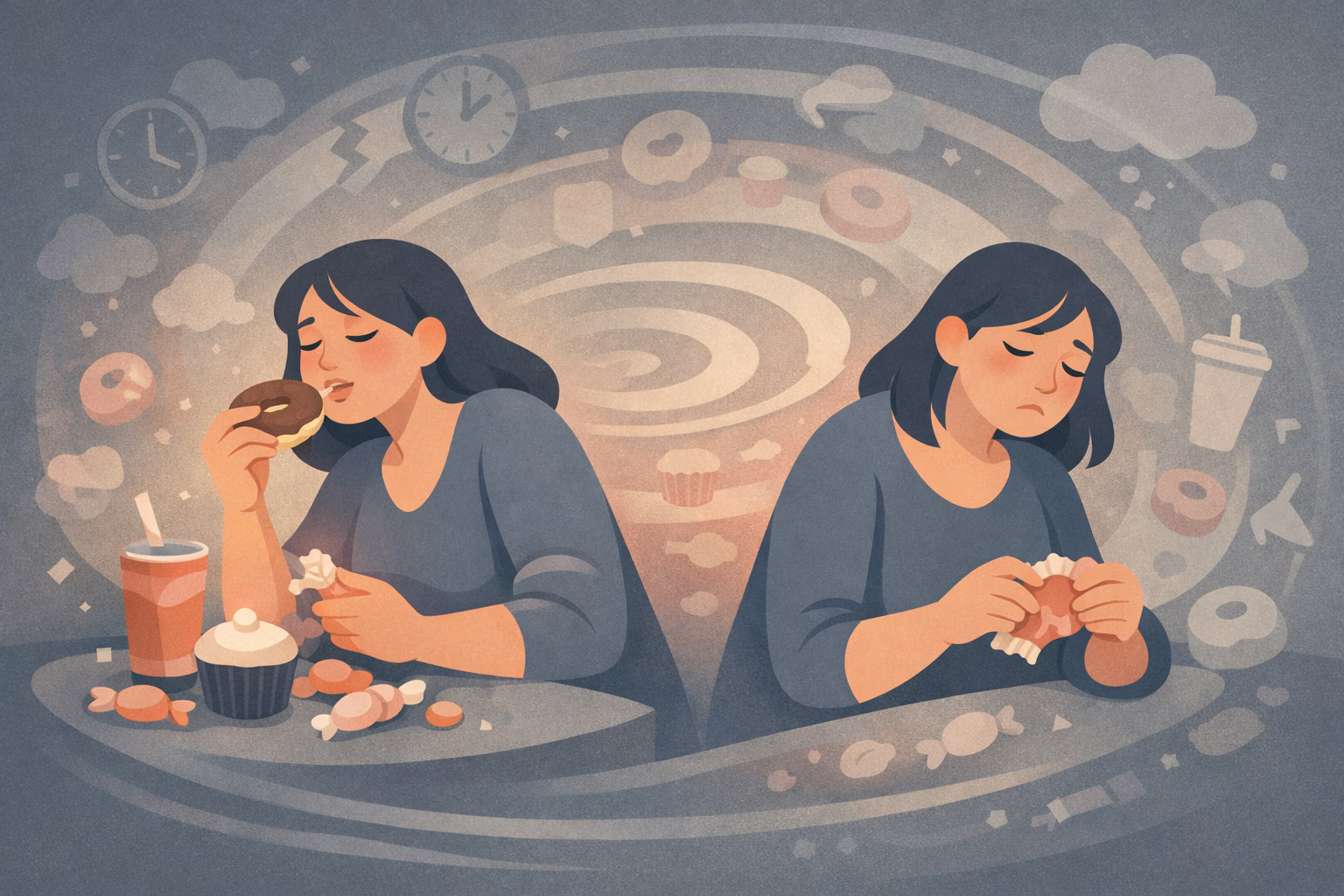
In short: Many people don’t reach for sugar because they “love sweets.” They reach for it because their system is carrying more pressure than it can smoothly process—deadlines, relational strain, sleep debt, decision fatigue, constant input. In that state, sugar functions less like a treat and more like a rapid, accessible regulator.
Many people don’t reach for sugar because they “love sweets.” They reach for it because their system is carrying more pressure than it can smoothly process—deadlines, relational strain, sleep debt, decision fatigue, constant input. In that state, sugar functions less like a treat and more like a rapid, accessible regulator.
What if the craving isn’t a character flaw—what if it’s your nervous system trying to close a loop?
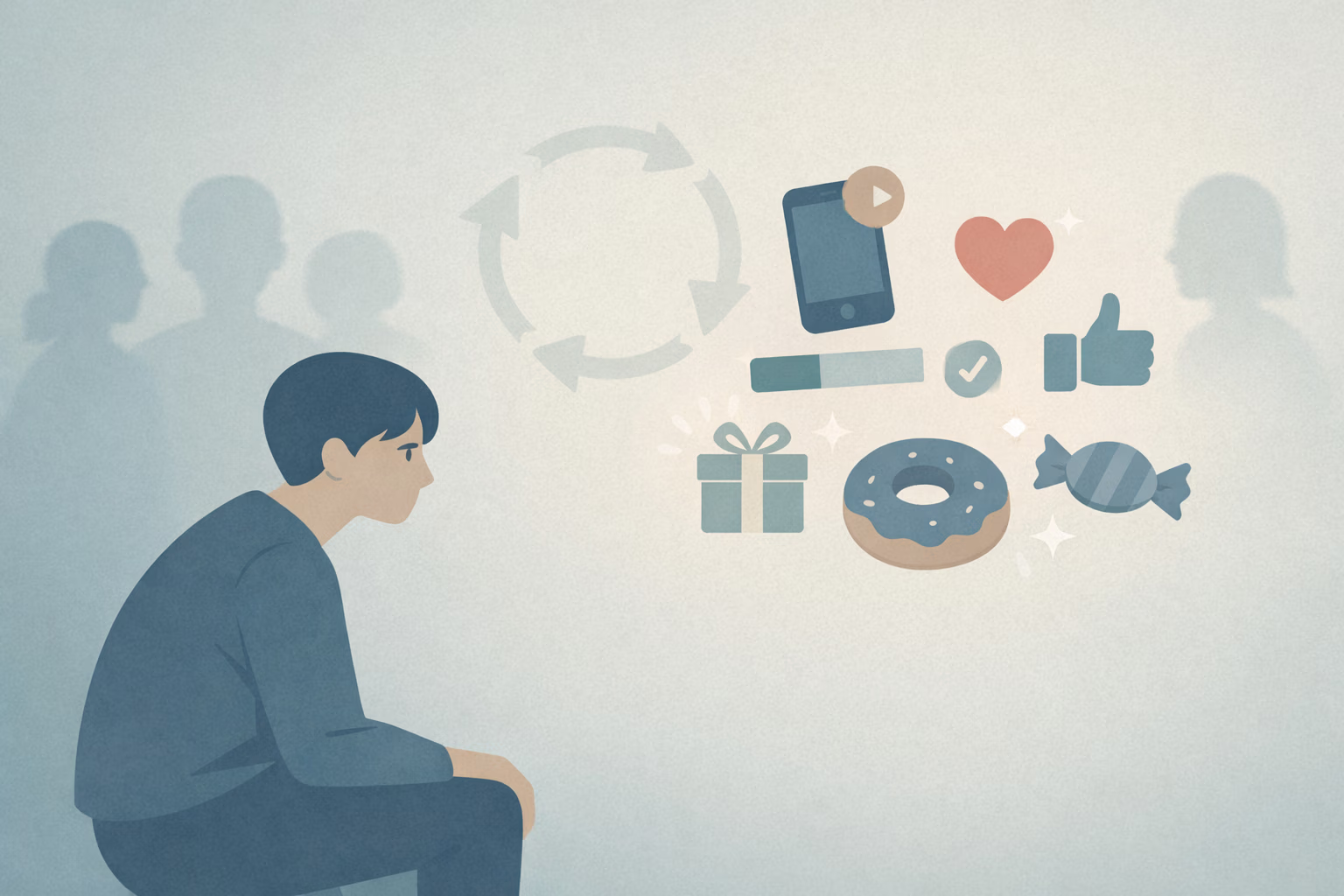
In a modern environment that keeps things unfinished (notifications, worries, work that never truly ends), the body learns to rely on quick reward signals to create a temporary “done.” This article describes sugar craving as a stress–reward cycle: brief relief, then a drop, then a renewed urge to restore steadiness—often in private, often with shame that doesn’t match what’s actually happening.
A sugar urge often arrives in specific moments: late afternoon fatigue, after a tense interaction, when the house finally goes quiet, or when you’re trying to switch from “doing” to “being.” The body is still activated, but there’s no clear completion signal—no real finish line. Sugar can provide a fast shift in state that resembles closure.
What follows is frequently predictable: a short window of soothing or mental quiet, then a crash—energy dips, mood thins, irritability rises, or the mind starts scanning again for the next stabilizer. The cycle can carry its own aftertaste: self-judgment, secrecy, or the feeling of having “messed up,” even when the behavior was a coherent response to load. [Ref-1]
Sometimes sugar isn’t about hunger. It’s about getting your system to stop ringing for a minute.
Sugar is potent because it is fast. Sweet taste and rapid carbohydrate absorption can elevate reward signaling and comfort chemistry, shifting attention and perception toward relief. In a taxed state, that quick, reliable shift matters: it changes internal conditions without requiring time, safety, or completion.
But repeated spikes can teach the brain a narrow rule: “relief arrives through intensity.” Over time, reward circuits can become less responsive to ordinary signals (a meal, rest, connection, a small achievement), while the body becomes more sensitive to dips. That doesn’t mean someone is broken; it means the system is adapting to a repeated pattern of high-contrast inputs. [Ref-2]
This is one reason sugar can feel both comforting and destabilizing: it offers short-term regulation while contributing to longer-term volatility when used as the primary way to change state.
Human bodies evolved to notice sweetness and pursue it. In ancestral environments, concentrated sugar was rare and often signaled safe calories—fruit in season, honey when you could find it. The drive toward sweet wasn’t indulgence; it was an elegant survival program.
Modern conditions changed the landscape: refined sugar is constant, inexpensive, engineered for speed, and often paired with stress that doesn’t resolve. A survival-based seeking system is now surrounded by cues that continuously promise quick energy and fast reward. When an ancient program meets a high-velocity environment, the result isn’t weakness—it’s mismatch. [Ref-3]
When regulation capacity is depleted, the system looks for the most immediate lever. Sugar can temporarily soften sharpness—tension, agitation, mental noise, the feeling of being “too on.” It can also provide a simple focus point: taste, texture, the ritual of opening a package, a small contained moment.
Importantly, this doesn’t require a story about hidden emotions or psychological avoidance. Often it’s purely structural: too much input, too little recovery, too few natural endpoints. In that setting, sugar becomes a fast-downshift tool—especially when the day doesn’t include real closure. [Ref-4]
Sugar’s relief is not imaginary. It can genuinely change state. The problem is that state-change and resolution are different biological events. Relief can arrive while the underlying load remains active—so the system returns to pressure quickly, sometimes with less steadiness than before.
Repeatedly using a rapid reward spike to manage stress can also amplify mood swings and energy instability. The body learns a rhythm of up/down rather than settle/stand-down. Over time, this can correlate with lower baseline mood and more fragile emotional weather, not because someone is failing, but because the nervous system is being asked to regulate with a tool designed for immediacy. [Ref-5]
When the environment doesn’t provide “done,” the body recruits “sweet” as a substitute finish line.
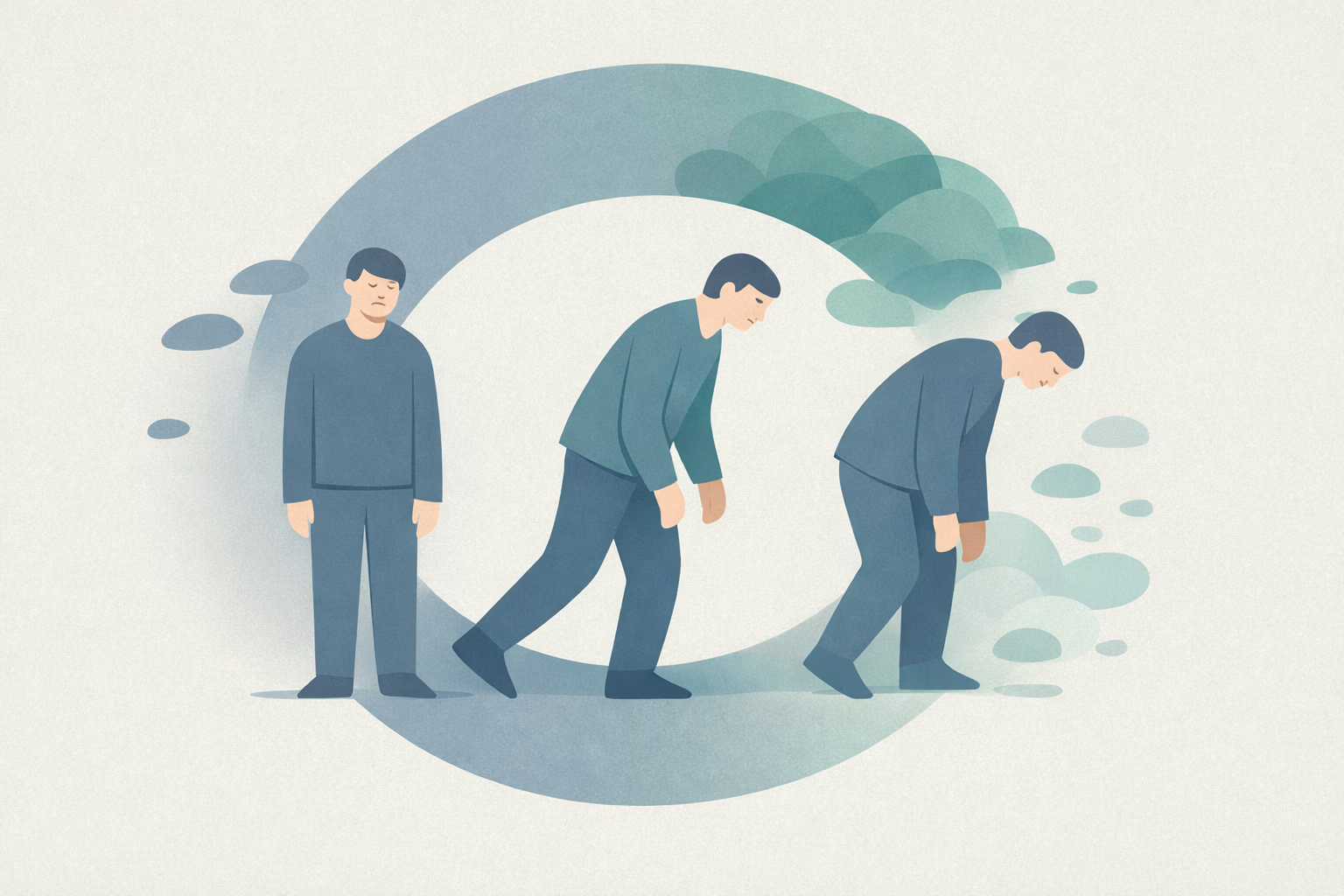
In a Pleasure Loop, the sequence is self-reinforcing: stress raises internal noise; sugar lowers it quickly; the drop that follows increases vulnerability; vulnerability increases stress; stress calls for the quickest regulator again. Each turn of the loop narrows the range of what feels soothing.
This is why “just moderate” can feel like a mismatch to the situation. The issue often isn’t knowledge or willpower—it’s that the body is using sugar as a primary regulator because other pathways are slower, less accessible, or repeatedly interrupted. The loop is not a moral problem; it’s a conditioning-and-capacity problem. [Ref-6]
When life stays unfinished, the nervous system starts bargaining for shortcuts.
Sugar dependence often looks less like constant eating and more like predictable regulation moments—specific times, moods, or contexts where the system expects a quick shift. People may feel “fine” until a certain threshold, then experience a sharp pull toward sweets that feels urgent and oddly specific.
Some recognizable patterns include: [Ref-7]
These patterns are not identities. They’re signs that the system has learned a reliable regulation route—and that the surrounding conditions keep that route necessary.
When sugar becomes a frequent regulator, the cost is often paid in the baseline. Instead of returning to a stable middle, the body spends more time in swings—wired then tired, soothed then edgy, motivated then flat. This can subtly erode self-trust: not “Can I do hard things?” but “Can I predict myself?”
Over time, frequent high-sugar intake can contribute to broader instability in mood and anxiety symptoms for some people, alongside metabolic and energy regulation strain. [Ref-8] The important frame is coherence: when the body can’t reliably return to baseline, life feels harder to inhabit—even if nothing “dramatic” is happening.
Many people interpret that instability as personal failure. More often, it’s the physiology of repeated state-shifts without completion.
Stress changes the internal math. Under load, the brain prioritizes quick resources: immediate calories, immediate reward, immediate quieting. Sugar fits that requirement with remarkable efficiency, which is why stress-driven eating is so common across modern life. [Ref-9]
Then the downstream effects arrive: blood sugar variability, reward contrast, and the psychological noise of “I shouldn’t have.” The crash is not just physical; it’s a vulnerability state—lower energy, lower patience, lower tolerance for friction. In that state, ordinary demands feel sharper, and the system becomes more likely to reach again for the fastest regulator.
This is how the loop locks in place without needing any dramatic cause. A body under chronic activation will keep selecting whatever offers the quickest stand-down—even if the stand-down doesn’t last.
There is a form of calm that doesn’t feel like a “hit.” It’s quieter and less performative: fewer internal alarms, less bargaining, more ability to let a sensation rise and fall without urgent repair. This steadiness isn’t created by insight alone; it tends to appear when the body has had enough consistent completion to trust that relief will arrive without intensity.
When sugar stops being the main bridge back to okay, the nervous system can begin to recognize other safety cues—time, rhythm, warmth, predictability, real nourishment. The internal experience often shifts from “I need something now” to “I can return to baseline.” That return is the signature of restored capacity, not stricter control. [Ref-10]
Stability feels like fewer emergencies inside the same life.
Many people manage sugar cravings privately. Not because they’re deceptive, but because regulation has become solitary: a quick, contained fix that doesn’t require negotiating needs with anyone else. Over time, secrecy can become another layer of load—another unfinished loop carried alone.
When stress is no longer primarily handled through sweets, food can rejoin the social world. Meals can become meals again, not strategies. And relationships can feel less like they’re competing with a craving for relief. People often notice more openness in everyday connection—not as a forced vulnerability, but as a natural byproduct of reduced internal urgency. [Ref-11]
As regulation capacity rebuilds, cravings often change texture. They may become less sharp, less time-critical, less tied to a single solution. Energy can feel more continuous—fewer peaks and troughs—and mood less dependent on quick rewards. This doesn’t mean life becomes easy; it means the body can carry normal stress without immediately reaching for a chemical shortcut.
Research links higher sugar consumption with increased risk markers for depression and anxiety in some populations, suggesting that lowering reliance on sugar may be associated with improved emotional steadiness over time. [Ref-12] The lived experience is often simple: more “room” between a trigger and a response, and more chances for the system to settle instead of spike.
Not perfect control—more reliable return.
The deepest shift isn’t just reduced sugar; it’s restored coherence. When comfort begins to match long-term well-being, the system receives a clear message: “I am safe enough to choose what actually supports me.” That alignment creates a different kind of closure—identity-level settling rather than momentary relief.
Over time, people often find that soothing can come from rhythms that have continuity: nourishment, rest, sensory ease, connection, environments that signal “done,” and small rituals that don’t require a spike to work. These aren’t hacks; they’re forms of completion that let the pleasure system stand down instead of staying on-call. [Ref-13]
Relief that costs you tomorrow never fully lands as safety.
If sugar has become a primary regulator, it often means something understandable: the system has been asked to carry too much activation with too few finishing signals. In that context, craving is not a personal defect. It’s information about load, access to soothing, and how reliably your days provide closure.
Seeing the loop structurally can reduce shame. Shame adds pressure, and pressure strengthens the need for quick relief. When the pattern is understood as a stress–reward cycle, it becomes easier to hold it with dignity: a nervous system doing its best with the tools available. [Ref-14]
Agency doesn’t begin with forcing a different behavior. It begins when life makes sense again—when the body can recognize that stability is possible, and that nourishment is allowed to be both comforting and real.
Sugar can deliver relief quickly, and that’s why the loop is persuasive. But lasting calm is usually built differently: through conditions that let the body complete what it starts, stand down after stress, and return to baseline without needing a spike.
When that capacity returns, the story often changes on its own. Not because you fought harder—but because your system no longer has to bargain for peace in the fastest aisle. [Ref-15]
From theory to practice — meaning forms when insight meets action.
Because sugar functions less like a treat and more like a rapid, accessible regulator when capacity is depleted. The body is still activated but there's no clear completion signal, and sugar provides a fast shift in state that resembles closure. Sweet taste and rapid carbohydrate absorption elevate reward signaling and comfort chemistry, which changes internal conditions without requiring time, safety, or actual completion. That's why cravings spike in specific moments — late afternoon fatigue, after tense interactions, when the house finally goes quiet. The body is using sugar to manufacture a Done Signal the day didn't supply. The pull isn't moral; it's structural.
Through a self-reinforcing sequence: stress raises internal noise, sugar lowers it quickly, the drop that follows increases vulnerability, vulnerability increases stress, stress calls for the quickest regulator again. Each turn of the Pleasure Loop narrows the range of what feels soothing. Repeated spikes can teach the brain a narrow rule — relief arrives through intensity — while reward circuits become less responsive to ordinary signals like a meal, rest, or connection. The issue isn't knowledge or willpower; it's that the body is using sugar as a primary regulator because other pathways are slower, less accessible, or repeatedly interrupted. It's a conditioning-and-capacity problem, not a moral one.
Real — but not the same as resolution. Sugar genuinely changes state, and that's why the loop is persuasive. The problem is that state-change and resolution are different biological events. Relief can arrive while the underlying load remains active, so the system returns to pressure quickly, sometimes with less steadiness than before. Repeatedly using a rapid reward spike to manage stress amplifies mood swings and energy instability — the body learns a rhythm of up/down rather than settle/stand-down. Over time, baseline can erode: instead of returning to a stable middle, you spend more time in swings. Wired then tired, soothed then edgy, motivated then flat.
There's a quieter form of calm that doesn't feel like a hit. Fewer internal alarms, less bargaining, more ability to let a sensation rise and fall without urgent repair. This steadiness tends to appear when the body has had enough consistent completion to trust that relief will arrive without intensity. When sugar stops being the main bridge back to okay, the nervous system can recognize other safety cues — time, rhythm, warmth, predictability, real nourishment. The internal experience shifts from I need something now to I can return to baseline. Stability feels like fewer emergencies inside the same life. Relief that costs you tomorrow never fully lands as safety.
From Science to Art.
Understanding explains what is happening. Art allows you to feel it—without fixing, judging, or naming. Pause here. Let the images work quietly. Sometimes meaning settles before words do.
One Quiet Window, one insight, one reflection — every Sunday