Emotional Exhaustion: When Your Tank Is Empty but Life Keeps Going
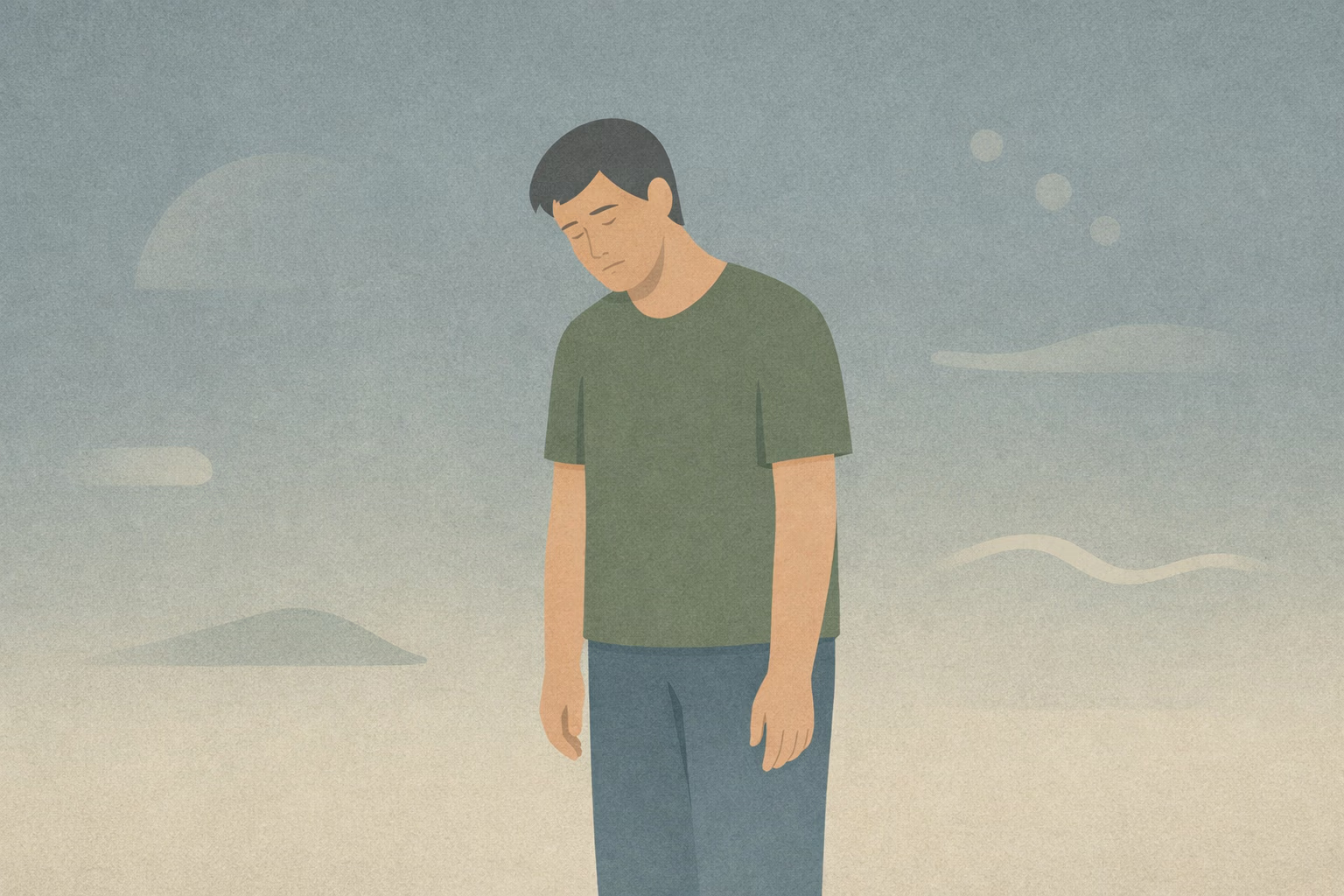
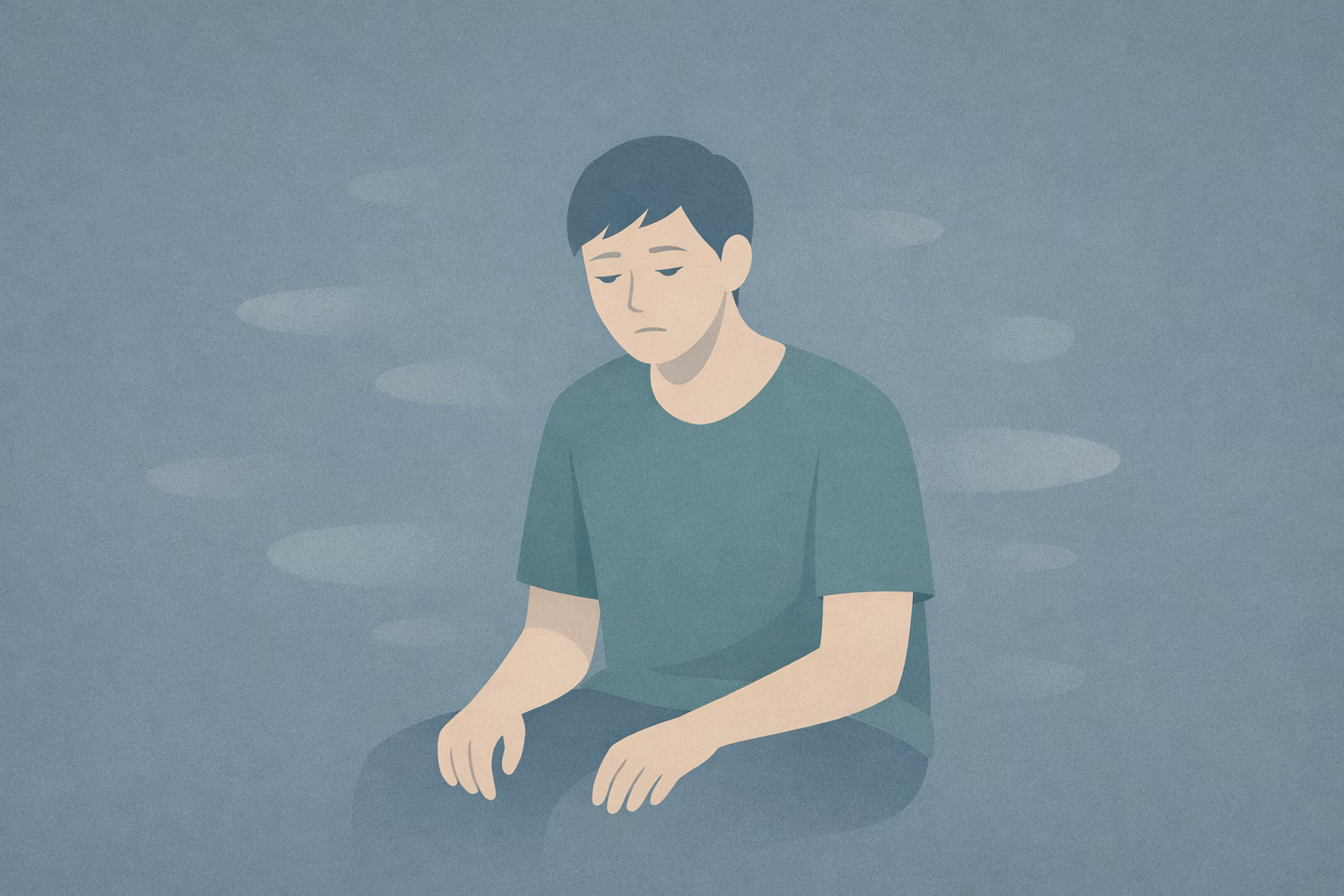
In short: Many people describe a particular kind of exhaustion that doesn’t match the amount of sleep they get. It can feel like mental heaviness, low drive, and a strange sense that everything is “too much” and “not enough” at the same time—too much input, not enough internal fuel.
Many people describe a particular kind of exhaustion that doesn’t match the amount of sleep they get. It can feel like mental heaviness, low drive, and a strange sense that everything is “too much” and “not enough” at the same time—too much input, not enough internal fuel.
What if “drained” isn’t laziness or lack of discipline—but a nervous system stuck without a clear “done” signal?
In modern life, stimulation is everywhere: novelty, scrolling, constant evaluation, and quick rewards. Over time, the brain can adapt to that intensity. When it does, the ordinary pace of life may stop registering as rewarding, even when it’s meaningful. This article explains that pattern in a grounded, non-shaming way: not as a personal defect, but as a predictable response to sustained load, fragmented attention, and incomplete closure.
Not all fatigue is simply physical depletion. There’s also a form of tiredness that feels like reduced capacity: attention won’t settle, tasks feel heavier than they “should,” and starting anything carries an outsized friction cost. Sometimes the body is still, but the system doesn’t feel restored.
This can come with a quiet loss of momentum—less curiosity, less “pull” toward everyday activities, and a sense of being emotionally flat or mentally foggy. Importantly, this isn’t a moral issue. It often reflects how the brain’s reward and effort systems are calibrating under chronic demand and repeated high-intensity input. [Ref-1]
“I’m not exactly sad. I’m just… not landing anywhere.”
Dopamine is often described as a “pleasure chemical,” but it’s more accurate to think of it as a signal involved in motivation, learning, and the energy to pursue outcomes. When stimulation is frequent and intense—high novelty, fast feedback, constant switching—the brain can respond by dialing down sensitivity to protect balance. That adaptation can make the baseline feel dull, even when life is objectively fine. [Ref-2]
This is one reason modern fatigue can feel paradoxical: you can be saturated with input and still feel under-fueled. The system has learned to expect big peaks. Smaller, slower rewards may not create enough signal to move you into action easily—so “getting started” becomes the hard part.
From an evolutionary perspective, reward signaling evolved in environments where novelty and high-reward events were relatively rare. Effort was costly, and the brain needed to allocate energy strategically. In that context, motivation worked like a guidance system—helping a person persist toward food, safety, tools, shelter, and social belonging.
In modern environments, the motivational system meets something unprecedented: abundant novelty without the natural endpoints of completion. The brain can be asked to update, anticipate, and respond all day long. Over time, this can contribute to mental fatigue and reduced reward responsiveness—not because a person is weak, but because the system is doing what it does under sustained cognitive load. [Ref-3]
It makes sense that high-intensity input can feel like relief. When you’re bored, depleted, or carrying unfinished mental loops, stimulation can temporarily create lift: more urgency, more interest, more momentum. It can also mute the discomfort of indecision by replacing it with clear, immediate cues—new content, new messages, new micro-decisions.
This doesn’t mean anyone is “addicted” in a casual sense, and it doesn’t mean there’s a hidden emotional problem to excavate. It means the nervous system is finding a state change that works quickly. The catch is that state change is not the same as completion, and it doesn’t reliably produce the body’s stand-down signal. [Ref-4]
Stimulation can increase activation, but activation is not vitality. A person can feel “wired but tired,” or temporarily energized while also becoming less able to take satisfaction from ordinary life. This is where people start using words like “meh,” “flat,” or “numb”—not as an emotional confession, but as a description of reduced reward contrast. [Ref-5]
When baseline reward is muted, everyday tasks can feel disproportionately effortful. Not because the tasks are objectively harder, but because the internal “this is worth doing” signal is quieter. That’s a coherence problem as much as a chemistry problem: fewer experiences reach a settled endpoint, so the system keeps scanning for the next hit of clarity.
Modern fatigue often stabilizes through a loop that’s more structural than psychological. When exhaustion rises, the system searches for fast relief. Stimulation provides quick engagement and reduces the friction of starting. But because the engagement is high-intensity and often fragmenting, the baseline afterward can drop further—making the next period of exhaustion arrive sooner. [Ref-6]
This loop doesn’t require fear or suppression to operate. It can run on simple mechanics:
The result is a life that feels busy but not finishing—stimulated but not satisfied.
When dopamine-linked reward sensitivity is downshifted, the signs can look subtle at first: less interest, less initiation, more reliance on novelty to get moving. This isn’t a personality change. It’s a predictable pattern when the brain is repeatedly trained on high-intensity reinforcement. [Ref-7]
Common experiences include:
Notice how many of these are about input and momentum, not about emotion. The system is trying to regain a workable signal.
If the loop continues for long enough, the world can start to feel less rewarding overall. Some people describe a generalized dullness, a thinner sense of enjoyment, or reduced resilience to normal stressors. Others notice that even “fun” becomes work—because it requires constant intensity to register.
At the nervous-system level, this can look like chronic load with fewer recovery endpoints. The brain keeps expecting a new cue, and the body doesn’t receive consistent closure signals—so energy doesn’t rebuild in the way people expect. Articles about “dopamine detox” sometimes capture the intuition (less intensity can help), even if the concept is often oversimplified online. [Ref-8]
When baseline motivation drops, the brain doesn’t interpret it as “I need less.” It often interprets it as “I need more signal.” So the system may reach for stronger stimulation to create enough reward contrast to feel engaged again. That makes perfect sense from a learning perspective: the brain pursues what has reliably changed state in the past.
Over time, this can tighten the loop: less natural interest leads to more searching; more searching further trains the brain on quick reinforcement; quick reinforcement makes ordinary rewards feel quieter. Even activities that are genuinely nourishing can feel inaccessible because they start slowly and require sustained attention before reward returns. [Ref-9]
It can help to separate two ideas that often get tangled: relief versus integration. Relief is a state change—an upshift or a numbing. Integration is what happens when experiences reach completion in a way the nervous system recognizes as “done,” and the self can carry it as settled identity rather than ongoing demand.
When intensity decreases, the brain’s reward system often has room to recalibrate. Not through willpower, and not by forcing positivity, but because the signal-to-noise ratio improves: fewer spikes competing for attention means smaller rewards have a chance to register again. This is less about “being mindful” and more about the body getting a fair opportunity to close loops and stand down. [Ref-10]
What starts to change when life becomes less spiky?
Often it’s not a sudden burst of motivation. It’s a gradual return of responsiveness—the sense that ordinary cues can move you again without constant external forcing.
Not all rewards behave like digital rewards. Many natural rewards are slower, layered, and stabilizing—especially those involving safe social connection. When interaction is mutual and grounded, it tends to create completion signals: you show up, you’re seen, there’s a beginning and an end. That structure can be regulating in a way that endless feeds are not.
Meaningful engagement also carries identity coherence: “This is who I am with people,” “This is where I belong,” “This mattered.” Those are not affirmations; they are nervous-system-compatible conclusions that reduce the need for constant seeking. In clinical discussions of dopamine burnout, social nourishment is often highlighted as a different kind of reward—less spiky, more restoring. [Ref-11]
“After talking with someone I trust, I don’t need to keep reaching for something else.”
When reward sensitivity begins to return, it’s often quiet. People may notice small signs: music feels a bit more dimensional, conversation feels less effortful, a simple task creates a slight sense of completion. The point isn’t that life becomes constantly exciting; it’s that life becomes legible again.
This is an important distinction: restoration doesn’t necessarily mean more intensity. It can mean more capacity for signal return—your system responds to smaller cues because it’s no longer drowning in larger ones. Discussions about receptor recovery often emphasize that this is gradual and shaped by the overall environment, not a quick internal “hack.” [Ref-12]
In Meaning Density terms, this is where coherence becomes palpable: moments start adding up into a lived narrative instead of evaporating into the next swipe.
Modern fatigue can trick people into thinking they need a bigger push—more stimulation, more urgency, more novelty. But energy is often less like a fire that needs gasoline and more like a system that needs completion. When experiences finish, the body gets the stand-down signal. When meaning consolidates, identity feels oriented. Those conditions tend to stabilize behavior without constant forcing.
This is why pacing matters at a conceptual level—not as a self-improvement project, but as a biological requirement for recovery of baseline reward. A life that allows endings, quieter reward, and values-based continuity gives the nervous system fewer open loops to carry. Some popular “reset” narratives point in this direction, even if they can sound overly simplistic. [Ref-13]
When the chase softens, what becomes possible to want again?
If you’ve been feeling drained, it may help to consider that your system is responding to conditions: sustained stimulation, constant evaluation, and fewer natural endpoints. That’s not a personal failure. It’s a nervous system doing its best with the inputs it’s been given.
In that light, fatigue can be meaningful information: a signal that baseline reward is being asked to compete with too many spikes, and that closure has been interrupted too often. When reward circuits are under strain, the body may keep searching for something that finally feels settling. Research on dopamine receptor regulation underscores that these signals are not just “mindset”—they reflect real, adaptive neurobiology. [Ref-14]
Agency often returns not as a heroic surge, but as a steadier sense of “I can move from here,” because life begins to offer more coherent endings and fewer unfinished demands.
There’s a particular dignity in recognizing that your tiredness might be a coherence problem, not a motivation problem. When a system has been trained on intensity, the ordinary can feel too quiet—until it isn’t.
Natural rewards tend to be slower and more integrating: they don’t just change your state; they help your system arrive somewhere. Over time, that kind of reward can support a more stable sensitivity—one that doesn’t require constant escalation to feel real. [Ref-15]
And sometimes the most hopeful question isn’t “How do I push harder?” but “What would happen if the signal got simpler—so my system could finally register ‘done’?”
From theory to practice — meaning forms when insight meets action.
Because not all fatigue is physical depletion. There's a kind of tiredness that shows up as reduced capacity: attention won't settle, ordinary tasks feel heavier than they should, and starting anything carries outsized friction. Often this reflects a nervous system stuck without a clear Done Signal rather than a sleep deficit. Modern life trains the brain on high-intensity input, frequent state changes, and fragmented attention, which keeps background activation running. The body is still, but the system isn't restored. Once you see fatigue as a coherence problem instead of a willpower problem, the question shifts from 'how do I push harder?' to 'where can my system finally close a loop?'
Both, in sequence. Stimulation can briefly feel like energy because it creates rapid state changes that override the discomfort of indecision and depletion. New content, new messages, new micro-decisions all give the brain something to track. But this is the Avoidance Loop in motion: high input creates upshifts, upshifts reduce the chance of natural closure, and reduced closure maintains background activation. That activation is later experienced as heaviness, fog, or depleted drive. Stimulation changes your state without producing the body's stand-down signal, so the next wave of exhaustion arrives sooner and the baseline keeps drifting down.
Yes, gradually, when intensity eases. The brain's reward system adapts to repeated spikes by dialing down sensitivity to protect balance — that's why a saturated life can still feel under-fueled. When the signal-to-noise ratio improves, smaller rewards have room to register again. Recovery often looks quiet: music feels slightly more dimensional, conversation feels less effortful, a simple task creates a small sense of completion. This isn't a willpower hack; it's the system getting a fair opportunity to close loops and stand down. Natural rewards — especially safe social contact — tend to be slower and more integrating, which is why they restore responsiveness without the crash that high-intensity input creates.
Because mutual, grounded interaction tends to create completion signals: you show up, you're seen, there's a beginning and an end. That structure is regulating in a way endless feeds are not. Meaningful engagement also carries identity coherence — 'this is who I am with people,' 'this mattered' — which reduces the need for constant seeking. In Meaning Density terms, those moments add up into a lived narrative instead of evaporating into the next swipe. Feeds, by contrast, deliver high-frequency state changes without endpoints, so the nervous system never receives the cue that something is finished. One restores; the other just activates.
From Science to Art.
Understanding explains what is happening. Art allows you to feel it—without fixing, judging, or naming. Pause here. Let the images work quietly. Sometimes meaning settles before words do.
One Quiet Window, one insight, one reflection — every Sunday