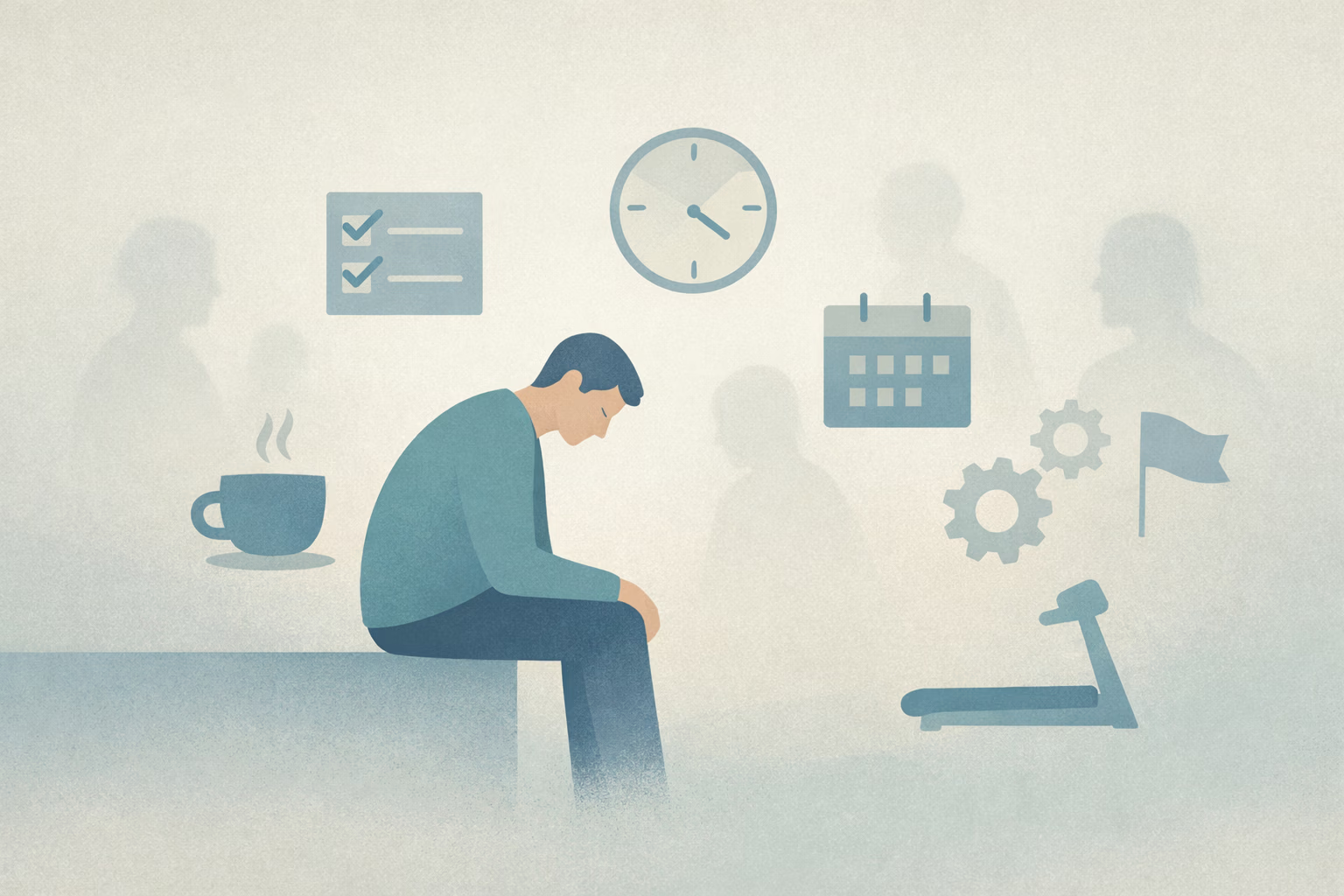
Workaholism & the Illusion of Success

In short: The Deceptive Nature of Success: When Achievement Isn’t Enough There’s a particular kind of disorientation that can show up after you get what you worked for. The promotion lands. The grade posts. The business hits the number.
There’s a particular kind of disorientation that can show up after you get what you worked for. The promotion lands. The grade posts. The business hits the number. People congratulate you. And yet, inside, there’s not the steady exhale you expected—more like a brief lift followed by a quiet pressure to keep explaining, proving, or repeating the win.
Why can success feel like it disappears the moment you touch it?
This isn’t a personal flaw or a sign that you’re “ungrateful.” It often reflects how modern achievement interacts with a nervous system built for closure, belonging, and coherent identity. When accomplishment delivers stimulation and approval but doesn’t complete deeper loops of meaning, the system stays on—still scanning for the next signal that says, “Now it’s safe. Now it’s done.”
People can be visibly accomplished and still carry a low-grade dissatisfaction—an edge of anxiety, a thin irritability, or a sense that life is oddly flat right after a big moment. It can feel confusing because the story says the milestone should deliver relief. But the body’s signals say otherwise. [Ref-1]
This “not done” sensation often shows up as heightened mental reviewing (replaying what could have gone better), a quick return to planning, or a subtle dread that the achievement will be taken away or forgotten. None of this means the achievement was meaningless. It can mean the system didn’t receive the kind of completion that allows it to stand down.
Sometimes the hardest part isn’t failing—it’s succeeding and realizing your system still won’t rest.
Accomplishment is designed to feel good in the short term. The brain’s reward circuitry responds to progress, recognition, and novelty with a burst of energy and focus—useful for effort and persistence. But that same burst is often temporary, especially when the win is mainly tracked through external markers (numbers, titles, applause). [Ref-2]
When success is metabolized primarily as “reward,” it behaves more like a spark than a hearth. It changes state—more alert, more charged, more driven—without necessarily creating the deeper settling that comes from lived coherence. That’s why the satisfaction can fade quickly, leaving behind an urge to re-stimulate the system with the next target.
Humans are social mammals. For most of our history, being valued by the group increased safety, access, and protection. Attention to rank, approval, and reputation wasn’t optional—it was part of survival. So it makes sense that recognition still lands strongly in the nervous system, like a cue that things are stabilizing. [Ref-3]
The mismatch is that modern status signals are frequent, abstract, and endlessly renewable. A “like,” a metric, a competitive peer set, a performance review—these can keep the status system activated without delivering the slower, more embodied evidence of belonging: reliable relationships, contribution that feels complete, and an identity that holds across contexts.
Success can temporarily boost perceived control—more options, more competence, more social credibility. It can also bolster self-esteem through visible proof: “I did it.” Those are real effects, and they can be protective. [Ref-4]
But control and esteem don’t automatically translate into an integrated sense of self. If the achievement primarily answers external evaluation—rather than completing an internal cycle of values, effort, consequence, and closure—the system may treat it as a momentary shield, not a lasting foundation. The result can be an odd combination: high functioning with low internal quiet.
What if the discomfort isn’t ingratitude, but a missing “completion signal”?
Fulfillment is not just pleasure. It’s the felt sense that your life is coherent—that what you do connects to what matters, and that your effort resolves into something you can inhabit. When success comes without that anchoring, the identity remains unmoored: you have the outcome, but not the settled “this is mine.” [Ref-5]
This gap can create internal dissatisfaction even while everything looks impressive on paper. It’s not that you need to want less. It’s that external success can be fast, while meaning is slow. Meaning often requires experiences to complete: to have consequence, to land in relationship, to become part of a stable narrative rather than a temporary headline.
In the power loop, achievement becomes a primary regulator. It supplies bursts of relief, direction, and social safety cues. But because the relief is short-lived, the nervous system learns to reach for the next win as a way to restore steadiness. Over time, the loop can tighten: more output is required for the same internal effect. [Ref-6]
This isn’t “addiction to success” as a personality trait. It’s a predictable adaptation to an environment where evaluation is constant and closure is scarce. When the system can’t reliably complete and integrate experiences, it uses what’s available—metrics, milestones, performance—to manufacture temporary stabilization.
When the loop is running, behavior can look like ambition, diligence, or high standards from the outside—while feeling like pressure, restlessness, or brittle urgency from the inside. These patterns often serve regulation: they keep the system organized, even if the organization is exhausting.
Notice what’s missing here: not “fear” as a moral weakness, but incomplete closure and muted “done” signals. Under load, the system favors what is measurable and fast. [Ref-7]
When achievement is repeatedly used as a regulator, other sources of stability can get quieter—not because they’re gone, but because they don’t compete with the speed of external reward. Over time, this can reduce resilience (the ability to return to baseline), blur purpose clarity, and weaken internal identity anchoring. [Ref-8]
The person may still be capable, skilled, and admired—yet feel increasingly dependent on “proof” to feel real. The system learns: without a signal of success, there is no stand-down. This can make rest feel oddly unsafe, not emotionally, but physiologically—like a loss of structure.
Modern life offers constant mini-rewards: inbox zero, streaks, metrics, likes, quick praise, small wins. Each can provide a brief organizing effect—an instant story of competence. But because they are frequent and externally referenced, they often don’t consolidate into durable meaning. [Ref-9]
Social reinforcement intensifies this. Comparison provides a moving target, so the “enough” line keeps shifting. Research on social comparison links habitual upward comparison with lower life satisfaction, especially in environments saturated with curated performance.
When “enough” is defined by a moving crowd, the nervous system never receives a stable endpoint.
There is a difference between understanding what matters and living in a way that produces a settled sense of alignment. Insight can be clean and articulate—while the body still feels on call. The bridge is not more analysis; it’s the gradual return of completion signals when actions, relationships, and values consistently match over time.
Some people use language like “values audits,” reflective writing, or deliberate slow-downs to create space where accomplishments can be evaluated by more than urgency and applause. [Ref-10] The point isn’t self-improvement as a project. It’s re-establishing a stable internal reference: a way of knowing what counts that doesn’t depend on constant external scoring.
What if the real question is not “How do I achieve more?” but “What kind of life do these achievements belong to?”
Meaning doesn’t form in isolation. Humans regulate through connection and shared reality. Mentorship, accountability, and values-based peer relationships can provide a different kind of reinforcement—one that reflects character, contribution, and congruence rather than constant comparison. [Ref-11]
When the social field rewards coherence (steadiness, integrity, care, follow-through) instead of only outcomes, the nervous system receives new safety cues. Over time, that can reduce dependence on performance spikes as the primary way to feel anchored.
When achievement, identity, and purpose begin to align, the change is often subtle. It can look like reduced background anxiety, clearer prioritization without strain, and a greater ability to let a completed effort actually register as complete. The system becomes better at returning to baseline because it trusts that meaning isn’t evaporating between milestones. [Ref-12]
This isn’t a constant high. It’s more like a steadier internal weather pattern: less whiplash between drive and emptiness, fewer urgency spikes, and more reliable “enough” signals when something has been finished.
As coherence returns, energy often shifts. Goals can still matter, but they stop functioning as emergency regulators. They become expressions of a life direction rather than proof of worth. In practical terms, there’s often less compulsive checking, less comparison-driven acceleration, and more tolerance for slow, unglamorous progress.
In a culture shaped by constant feedback-seeking and social comparison—especially online—this shift can feel almost radical: choosing objectives because they fit, not because they win. [Ref-13]
Achievement can be a chapter. Coherence is the book it belongs to.
If achievement isn’t enough, it doesn’t mean you’re broken, shallow, or impossible to please. It can mean your system is asking for a different kind of stability—one built from closure, values, and identity that holds even when no one is watching.
In a comparison-heavy environment, dissatisfaction can also be an honest cue that external scoring has gotten louder than internal reference points. That cue can be respected without being dramatized: not as a crisis, but as information about where meaning has been thinned out. [Ref-14]
There is dignity in recognizing that the drive to achieve has likely helped you survive, belong, or stay safe. And there is agency in noticing when that strategy no longer produces the settling it once did.
Success can be real and still not be anchoring. Lasting fulfillment tends to come less from the height of the moment and more from the coherence that accumulates when life repeatedly resolves into “this is who I am” rather than “this is what I proved.”
When values—not visibility—become the main reference, achievement can take its rightful place: not as a substitute for identity, but as one way a coherent identity expresses itself. In a world that constantly invites comparison, that kind of internal anchoring is a form of steadiness that doesn’t need to be announced. [Ref-15]
From theory to practice — meaning forms when insight meets action.
Because the body's signals don't match the story. Accomplishment delivers a burst of reward — energy, focus, social safety cues — but that burst is often temporary, especially when the win is mainly tracked through external markers like numbers, titles, or applause. Reward says 'that worked.' Meaning says 'that belongs to who I am.' Closure says 'this loop is complete.' When success is metabolized primarily as reward, it's a spark, not a hearth. It changes state without creating the deeper settling that comes from lived coherence. The hardest part isn't failing — it's succeeding and realizing your system still won't rest.
No — it's often a missing completion signal. Status-seeking isn't vanity; it's an ancient safety strategy. For most of history, being valued by the group increased safety, access, and protection. Modern status signals are frequent, abstract, and endlessly renewable — likes, metrics, performance reviews — so they keep the status system activated without delivering slower embodied evidence of belonging. Control and esteem don't automatically translate into integrated identity. If achievement primarily answers external evaluation rather than completing an internal cycle of values, effort, consequence, and closure, the system treats it as a momentary shield, not a foundation. Discomfort is information, not ingratitude.
When achievement becomes a primary regulator. It supplies bursts of relief, direction, and social safety cues — but the relief is short-lived, so the system reaches for the next win to restore steadiness. The loop tightens: more output is required for the same internal effect. This isn't 'addiction to success' as a personality trait; it's predictable adaptation to an environment where evaluation is constant and closure is scarce. Common patterns: compulsive goal-chasing, comparison scanning, perfectionist tightening, difficulty savoring, overcontrol. When 'enough' is defined by a moving crowd, the nervous system never receives a stable endpoint.
The bridge isn't more analysis; it's the gradual return of completion signals when actions, relationships, and values consistently match over time. Fulfillment isn't pleasure — it's the felt sense that life is coherent: what you do connects to what matters, and effort resolves into something you can inhabit. Supportive relationships shift the center of gravity when the social field rewards coherence (steadiness, integrity, follow-through) instead of only outcomes. The real question shifts from 'how do I achieve more?' to 'what kind of life do these achievements belong to?' Achievement can be a chapter; coherence is the book it belongs to. Milestones are events; meaning is what remains.
From Science to Art.
Understanding explains what is happening. Art allows you to feel it—without fixing, judging, or naming. Pause here. Let the images work quietly. Sometimes meaning settles before words do.
One Quiet Window, one insight, one reflection — every Sunday