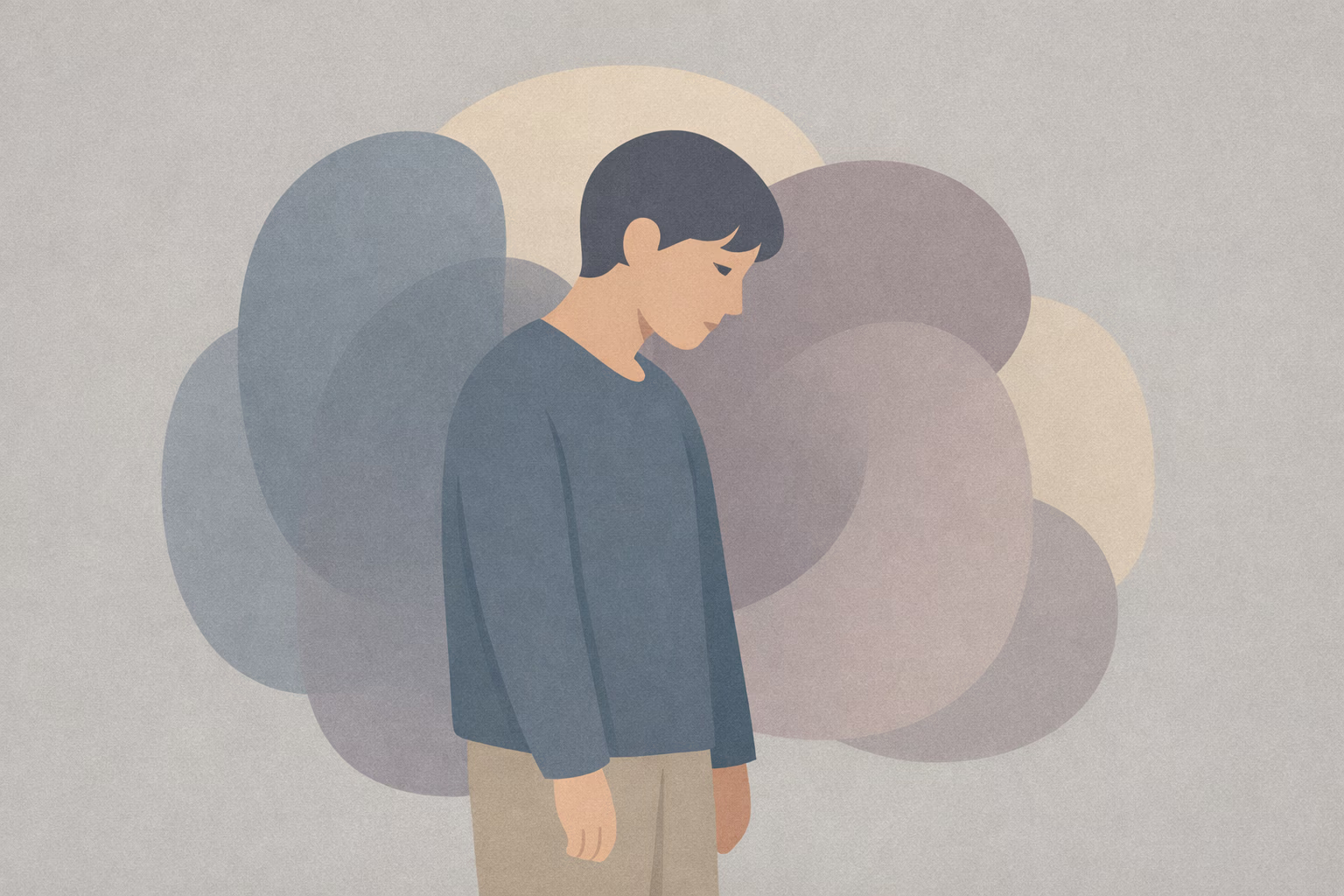
The Inner Critic: How It Shapes Your Identity & Behavior

In short: Workplace imposter syndrome is often described as a persistent sense that your competence is accidental, temporary, or about to be disproven—despite evidence of skill, effort, or results. It can look like “waiting to be found out,” but underneath, it often functions more like a body-level vigilance response to evaluation and rank.
Workplace imposter syndrome is often described as a persistent sense that your competence is accidental, temporary, or about to be disproven—despite evidence of skill, effort, or results. It can look like “waiting to be found out,” but underneath, it often functions more like a body-level vigilance response to evaluation and rank.
Why can success feel less like safety—and more like exposure?
In many modern workplaces, achievement doesn’t always create a clear “done” signal. Instead, it can increase scrutiny, widen your audience, and raise the stakes. When that happens, self-doubt isn’t a personality flaw; it can be a predictable regulatory pattern when social pressure outpaces internal closure.
For many people, success is supposed to settle the question of competence. But in high-evaluation environments, success can do the opposite: it increases expectations, increases visibility, and reduces the margin for ordinary learning curves. The nervous system can interpret that shift as “more risk,” even when the mind can list the achievements.
That’s why a promotion, a high-profile project, or public recognition can bring a strange split: externally, things are going well; internally, the system ramps up. This isn’t irrationality so much as a mismatch between performance signals (“I did well”) and safety cues (“I am still allowed here even if I’m imperfect”). [Ref-1]
In the workplace, comparison and evaluation are often ambient: metrics, performance reviews, peer feedback, visible wins, org charts, and subtle social cues about who is listened to. These cues can activate threat circuitry and vigilance—especially when outcomes feel uncertain or reputational costs feel high. [Ref-2]
When vigilance is online, the brain tends to prioritize error-detection over confidence. Attention narrows toward what could be missing, what could be criticized, and what might be “not enough.” In that state, even genuine competence can feel like a fragile arrangement that must be constantly defended.
What if confidence isn’t a belief problem—but a safety-cue problem?
Humans are social mammals, and our nervous systems evolved inside groups where rank and inclusion influenced access to protection, resources, and support. In that context, being evaluated by others wasn’t just uncomfortable—it shaped survival odds.
So when a modern workplace makes rank feel ambiguous, shifting, or constantly assessed, the body can respond as if belonging is at stake. “Do I deserve this seat?” can be a modern translation of a much older question: “Am I still safe in the group?” [Ref-3]
Self-doubt can create immediate structure: it pushes more checking, more preparing, more scanning for mistakes, more deference to authority. For a nervous system tracking social risk, these behaviors can temporarily reduce uncertainty—because they increase the sense of control and decrease the chance of visible error.
In that way, imposter feelings can become part of a regulatory loop. The doubt ramps up, the person compensates, the situation holds together, and the nervous system learns: “That worked; keep doing that.” The relief is real, but it’s often relief from pressure—not the deeper settling that comes from closure. [Ref-4]
It’s common to assume the feeling will disappear after the next milestone: the next promotion, certification, compliment, or successful launch. But comparison-based environments recalibrate the threat signal continuously. As you rise, the reference group changes, expectations shift, and the stakes can feel higher.
So the mind may look for a final piece of proof while the nervous system keeps receiving fresh cues that the game is still on. When completion never lands, the system doesn’t get a stable “I’m done here” message—only new reasons to stay alert. [Ref-5]
In a Power Loop, external rank awareness and validation cues repeatedly override internal assessment. The person’s sense of “am I okay?” becomes tethered to signals that are inherently unstable: feedback cycles, shifting standards, leadership preferences, team politics, and visible performance comparisons.
Even positive feedback can fail to integrate when it arrives inside a context the body reads as conditional. Praise becomes another data point to manage rather than a completion signal to absorb. The system stays oriented toward maintaining status, not settling into earned competence. [Ref-6]
“If I relax, I’ll miss something—and that’s when it will all fall apart.”
Imposter syndrome is often less about what you think and more about what your system repeatedly has to do to stay socially safe. These patterns are understandable responses when consequence feels high and closure feels unavailable.
None of these patterns mean you’re “not confident.” They often mean your nervous system is doing ongoing reputation management under load. [Ref-7]
Over time, sustained vigilance has a cost. When the system is repeatedly mobilized for threat monitoring, there’s less bandwidth for creative exploration, learning-by-doing, and the relaxed social presence that supports leadership and collaboration. Work can start to feel like constant defense rather than contribution.
Social comparison processes can intensify this narrowing, because the mind keeps receiving cues about who is ahead, who is praised, and what “counts.” That can erode wellbeing and make the workplace feel like a perpetual ranking event rather than a shared mission. [Ref-8]
One reason imposter feelings persist after success is structural: success often increases visibility. You may be watched more closely, invited into higher-stakes rooms, given work that travels farther, or evaluated by people who haven’t seen your process—only your outcomes.
Visibility is not inherently bad, but it changes the nervous system’s math. More eyes can equal more potential consequence, so the system increases vigilance. In daily life, comparison and evaluation cues are linked with heightened social anxiety and monitoring—especially when uncertainty is high. [Ref-9]
The loop can look like: increased success → increased exposure → increased vigilance → increased self-doubt → increased compensating behaviors. It’s coherent, even if it’s exhausting.
There is a different internal experience that can emerge when self-worth is not being constantly negotiated through performance and comparison. It’s not a pep talk and it’s not a perfect self-image. It’s a quieter baseline where competence can register without immediately being converted into “what could go wrong.”
In that state, the system is less dominated by rank-tracking and more able to rely on internal signals: lived skills, repeated completions, realistic self-evaluation, and stable belonging cues. Research on social comparison and social anxiety suggests that how people evaluate their own social competence can shape the impact of comparison on threat responses. [Ref-10]
What changes when your nervous system can accept completion as real?
Imposter feelings often soften in environments where feedback is honest, expectations are clear, and mistakes are treated as part of learning rather than proof of unworthiness. Psychological safety isn’t about constant reassurance; it’s about predictable social consequence—knowing the cost of imperfection is not exile.
When teams normalize learning curves and speak concretely about standards, the system receives steadier cues. Social comparison becomes less consuming when the environment is less ambiguous about belonging and less punitive about normal human variance. [Ref-11]
As threat load reduces, people often notice a shift that is more physiological than philosophical: attention widens, decision-making feels less brittle, and skills feel more available in real time. Confidence, in this sense, is not a mood—it’s the capacity to access what you know without constant interference.
In safer contexts, feedback can land more cleanly. It can become information rather than a verdict. That’s when self-trust tends to increase—not as bravado, but as a stable orientation: “I can meet reality and respond.” [Ref-12]
When identity is less organized around avoiding social consequence, work can reorganize around contribution. The question shifts from “Will I be exposed?” to “What am I here to build, improve, or serve?” That shift is not forced; it tends to happen when completion signals are allowed to register and the system is no longer stuck in continuous defense.
In that orientation, mastery becomes cumulative rather than constantly reset. Visibility may still bring nerves, but it doesn’t automatically translate into global self-doubt. People often feel more consistent across settings: similar clarity in meetings, in writing, and in leadership moments—because their internal stability is less dependent on rank. [Ref-13]
Feeling unqualified despite success is often your nervous system reporting on social uncertainty, not your identity revealing a hidden truth. The sensation of “fraud” can be the body’s way of staying prepared in an environment where evaluation feels constant and closure feels rare.
When you view imposter feelings as a misfiring survival signal—rather than evidence—you gain dignity. The goal isn’t to argue yourself into confidence; it’s to understand why your system is staying on duty, and how meaning and belonging cues can matter as much as performance cues in helping the system stand down. Psychological safety and normalization are part of why some workplaces intensify these feelings and others soften them. [Ref-14]
Hierarchy can measure outcomes, roles, and visibility. It can’t measure the full reality of a person—learning history, adaptation, integrity, care, or the quiet continuity of showing up. When status becomes the main mirror, identity gets unstable because the mirror keeps moving.
Meaning stabilizes differently. It forms when lived contributions settle into who you are, not just what you produced this quarter. And when that settling is allowed to happen, success stops feeling like a trap door—because your belonging is no longer entirely negotiated through rank. [Ref-15]
From theory to practice — meaning forms when insight meets action.
Because success often increases scrutiny rather than settling the question of competence. In high-evaluation environments, achievement increases expectations and visibility while reducing the margin for ordinary learning curves. The nervous system interprets that shift as 'more risk,' even when the mind can list the wins. There's a strange split: externally things look good, internally the system ramps up. That isn't irrationality — it's a mismatch between performance signals ('I did well') and safety cues ('I'm still allowed here even if I'm imperfect'). Confidence isn't just a belief problem; it's a safety-cue problem.
Often it's more about ambient evaluation than personal flaws. Hierarchy sensitivity is an old Status & Control survival function — humans evolved in groups where rank and inclusion influenced access to protection and resources. When a workplace makes rank feel ambiguous, shifting, or constantly assessed, the body responds as if belonging is at stake. 'Do I deserve this seat?' is a modern translation of 'Am I still safe in the group?' Self-doubt can even function as a short-term risk reducer — it pushes more checking, preparing, scanning, deference, which temporarily decreases the chance of visible error. The relief is real but it's relief from pressure, not closure.
Because comparison-based environments recalibrate the threat signal continuously. As you rise, the reference group changes, expectations shift, stakes feel higher. The mind looks for a final piece of proof while the nervous system keeps receiving fresh cues that the game is still on. Even positive feedback fails to integrate when it arrives inside a context the body reads as conditional — praise becomes another data point to manage rather than a completion signal to absorb. That's a Power Loop: external rank awareness and validation cues repeatedly override internal assessment. The system stays oriented toward maintaining status, not settling into earned competence.
Imposter feelings often soften in environments where feedback is honest, expectations are clear, and mistakes are treated as part of learning rather than proof of unworthiness. Psychological safety isn't constant reassurance — it's predictable social consequence: knowing the cost of imperfection isn't exile. As threat load reduces, attention widens, decision-making feels less brittle, and skills feel more available in real time. Confidence becomes the capacity to access what you know without constant interference. Imposter feelings are a signal, not a verdict. Worth isn't granted by hierarchy — meaning forms when lived contributions settle into who you are, not just what you produced this quarter.
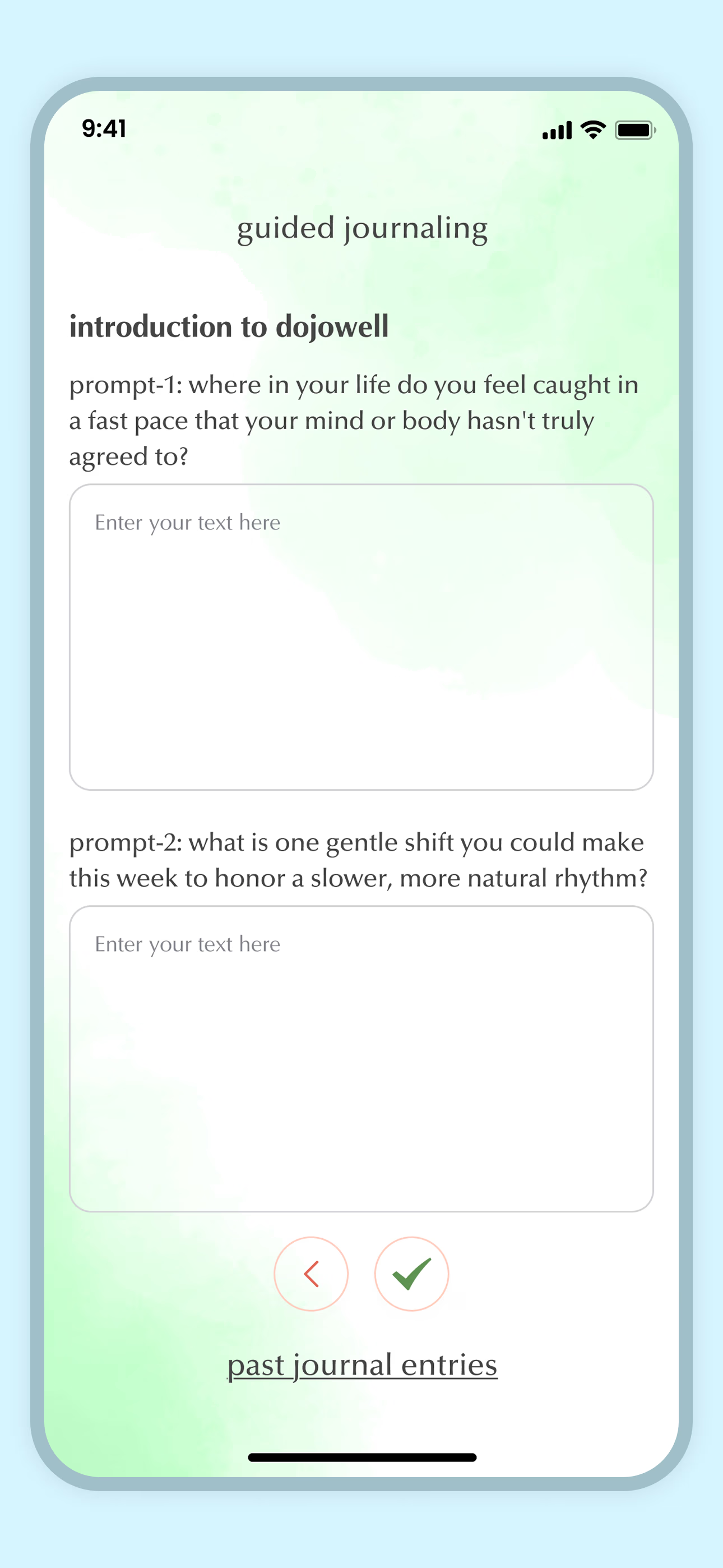
From Science to Art.
Understanding explains what is happening. Art allows you to feel it—without fixing, judging, or naming. Pause here. Let the images work quietly. Sometimes meaning settles before words do.
One Quiet Window, one insight, one reflection — every Sunday