

The Science of DojoWell
A plain-English map of the research DojoWell is built on — and what we explicitly do not claim
Evidence & intent (DojoWell standard)
This page is educational and non-clinical. It maps DojoWell's models — the Matrix of Loops, Meaning Density, the Done Signal, the Threat & Safety and Reward & Stimulation systems, the seven-level journey — to established research in behavioral science, nervous-system regulation, and meaning psychology. Every claim is cited. Where DojoWell introduces original concepts, they are labeled as such, not presented as medical findings.
Document status
The Science of DojoWell — Integrative explainer (v1.0)
First published: May 2026
Scope: Educational. Maps DojoWell's behavioral and regulatory models to published research. Not medical advice, not a diagnostic instrument, and not a substitute for clinical care.
1 I. What DojoWell Actually Is
DojoWell is a meaning-led wellness system for people who feel pulled apart by modern life. It is not a meditation app, not a habit tracker, and not a therapy substitute.
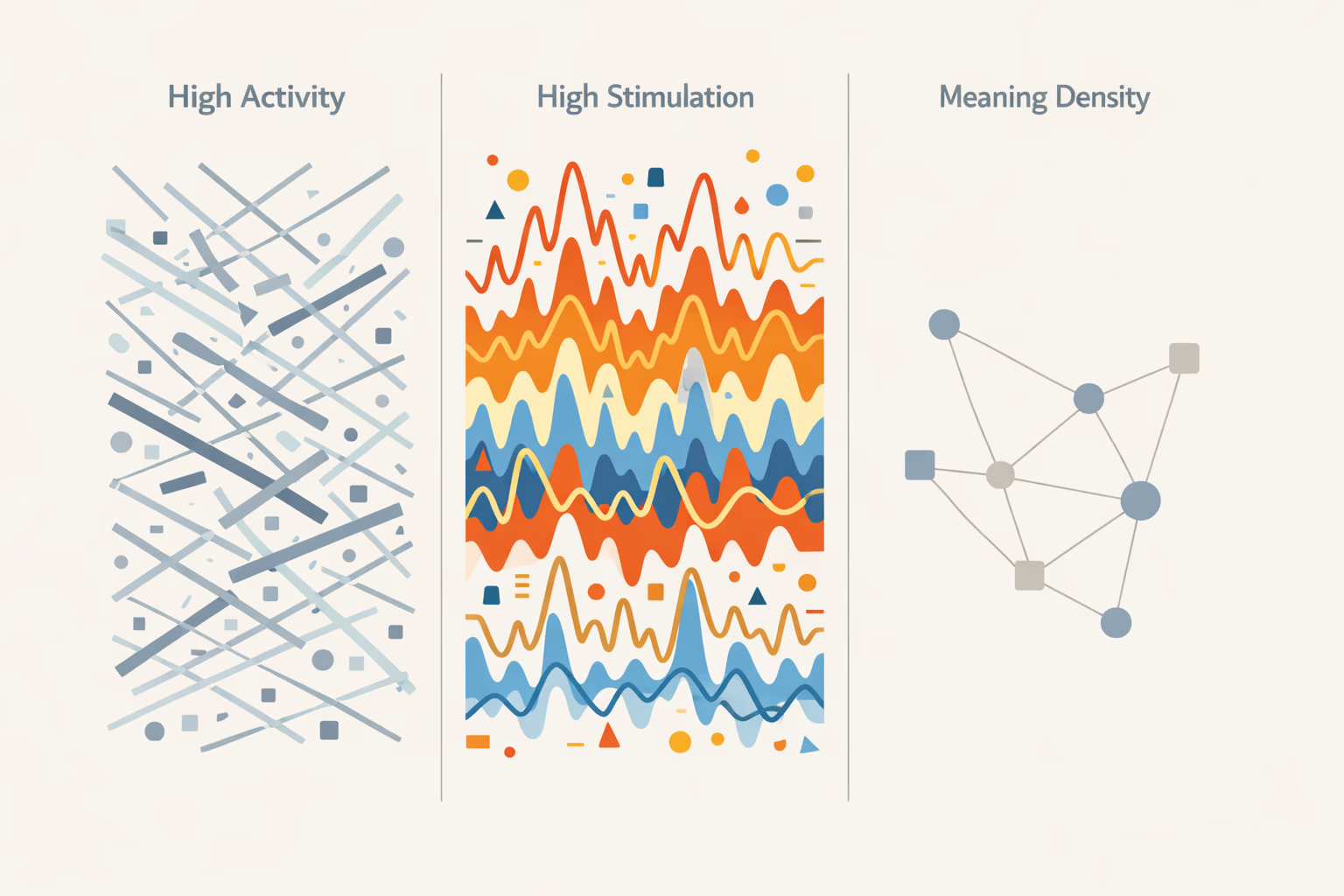
The app draws on logotherapy, behavioral science, and nervous-system regulation research to do one thing: help fragmented experiences finish, so they can integrate into a coherent life. It uses guided audio, gentle reflection, values discovery, and a slow seven-level progression. Where most wellness platforms add stimulation — streaks, scores, daily pushes — DojoWell removes pressure so the underlying systems can settle.
DojoWell treats nervous-system practice as a secular curriculum, not a spiritual tradition. The work draws on polyvagal theory (Porges), dopamine prediction error (Schultz), and Frankl’s logotherapy — three evidence-grounded frames that explain why a brief practice shifts state, without asking the user to adopt any worldview. The seven-level structure exists for the same reason a curriculum exists in any other discipline: integration takes sequence.
DojoWell is also not a CBT tool and does not present itself as one. CBT works at the level of distorted thoughts; DojoWell works one layer beneath that — at the loops the thoughts are running on. If you are mid-course in CBT, DojoWell is a complement that addresses the nervous-system context the cognitive work is happening inside.
This page explains the science those design choices are built on — clearly, with references, and with explicit limits on what we do and don’t claim.
2 II. The Problem We’re Solving: Evolutionary Mismatch
Human nervous systems were shaped over hundreds of thousands of years to survive in small, embodied, slow-changing environments.
Threat was specific and brief. Reward arrived after real effort. Social feedback came from a small circle of people whose faces you could read. Modern environments invert all three: threats are abstract and unending (news, finances, the climate), rewards arrive on demand from a screen, and social feedback comes from thousands of strangers via metrics like likes and view counts (Cosmides & Tooby, 1997; Lieberman, 2013).
This gap between ancient biology and engineered environment is called evolutionary mismatch. It is increasingly cited as a contributor to rising rates of depression, anxiety, attention problems, and chronic stress in industrialised societies (Hidaka, 2012). The mismatch is not a moral failing — your wiring is doing exactly what it evolved to do. The wiring just isn’t a good match for the environment.
DojoWell’s design starts from this premise. Most modern dysfunction is not pathology; it is a calibrated nervous system responding to a miscalibrated world. The work isn’t to fix the user; it is to restore the conditions — pacing, completion, meaning — under which the system can settle. That reframe is what makes DojoWell structurally different from apps that treat users as problems to optimise.
3 III. The Three Loops: Pleasure, Power, Avoidance
DojoWell organises behaviour into three loops, each grounded in established psychology.
1. The Pleasure Loop
The Pleasure Loop maps to dopamine-driven reward learning. The brain releases dopamine not when reward arrives but when a prediction is updated — the expectation of reward is what drives behaviour (Schultz, 1998). Modern environments — infinite scroll, push notifications, slot-machine-style content feeds — engineer constant prediction errors, locking the loop open. Berridge and Robinson (1998) further showed that wanting (incentive salience) and liking (hedonic enjoyment) are separable systems: people can wantingly chase things they no longer enjoy. The Pleasure Loop describes this exactly — relief without closure, repeated.
2. The Power Loop
The Power Loop maps to control-seeking under uncertainty. Higgins’s regulatory focus theory (1997) distinguishes promotion focus (pursuing gains) from prevention focus (avoiding losses); under chronic threat, prevention-focus thinking dominates, producing the optimisation, monitoring, and control-tightening behaviours we call the Power Loop. It feels productive because vigilance is doing something, but it does not deliver actual safety — only the sensation of it. The loop runs until exhaustion or until the user notices the structure.
3. The Avoidance Loop
The Avoidance Loop maps to Mowrer’s two-factor theory of avoidance learning (Mowrer, 1947): an organism learns to escape an aversive cue, then learns to avoid the cue entirely. Each avoidance is reinforced by short-term relief, which makes the original fear more durable. In modern life this looks like procrastination, ghosting, numbing, scrolling-instead-of-engaging — any pattern where short-term comfort is bought with longer-term reinforcement of the underlying threat signal.
DojoWell does not try to suppress these loops. The goal is loop literacy: noticing which loop is running, learning what each loop is asking for at a deeper level, and supplying that need through completion rather than repetition. Each loop has its own treatment path in the app — not a generic “stop doing this” but a structural intervention specific to the loop.
4 IV. Meaning Density and the Done Signal
The Zeigarnik effect (Zeigarnik, 1927) — that incomplete tasks remain mentally active and unfinished situations create persistent cognitive load — is one of the most replicated findings in psychology.
DojoWell takes this seriously as a daily-life mechanism, not just a lab curiosity. Modern life produces an unprecedented density of open loops: messages, tabs, decisions, conversations, plans, identities. Each one stays slightly active in the background. The result is a nervous system that never gets a Done Signal — the felt sense of closure that allows it to stand down (Sapolsky, 2004).
Without Done Signals, life feels increasingly fragmented even when external achievements stack up. We call the accumulated felt-sense of coherence meaning density. It is not a metric and not something you score; it is the experience of life settling — actions, emotions, and identity coordinating rather than competing.
The research grounding here is logotherapy (Frankl, 1946) and the modern eudaimonic-wellbeing tradition (Ryan & Deci, 2001; Ryff, 1989). These traditions distinguish hedonic wellbeing (feeling good) from eudaimonic wellbeing (living a coherent, meaningful life), and consistently find that the latter is more durable across stress, ageing, and loss. Many wellness products optimise hedonic outcomes: calmer, happier, more productive. DojoWell optimises eudaimonic outcomes: more coherent, more integrated, less fragmented.
The practical implication is design-level. DojoWell deliberately avoids streaks, daily pressure, and infinite content libraries, because each of these would create new open loops rather than close existing ones. The app’s small completions — finishing a reflection, ending a session, sitting through a quiet window — are designed as Done Signals the nervous system can register.
5 V. Two Regulatory Systems: Threat & Safety + Reward & Stimulation
DojoWell treats the human nervous system as having (among others) two regulatory systems that interact constantly.
1. The Threat & Safety System
The Threat & Safety System is grounded in polyvagal theory (Porges, 1995, 2011) and broader autonomic-regulation research. It scans the environment for cues of safety or danger, and shifts the body between social engagement, mobilisation (fight/flight), and shutdown (freeze/collapse) depending on what it reads. McEwen’s allostatic load framework (1998) describes how repeated activation without recovery damages tissue and function over time. Modern environments tend to keep this system in low-grade chronic activation — the abstract, never-resolving threats of finances, news, comparison, and time pressure.
2. The Reward & Stimulation System
The Reward & Stimulation System is the mesolimbic dopaminergic circuitry described in § III (Schultz, 1998; Berridge & Robinson, 1998). It seeks novelty, prediction errors, and reinforcement. In modern environments engineered for engagement, this system is over-stimulated and under-satisfied — high wanting, low liking.
Most wellness tools target one system. Meditation apps mostly calm the Threat & Safety system. Habit and productivity apps mostly leverage the Reward & Stimulation system. DojoWell maps practices to both, and to the relationship between them: a person stuck in chronic threat activation cannot benefit from reward-based goal-setting until the threat system has been calmed; a person stuck in stimulation-seeking cannot use quiet practices until their reward system has been gently re-anchored. The seven-level journey sequences these in an order the underlying biology can absorb.
6 VI. The Seven-Level Journey: Why Progression
The seven-level structure draws on three research traditions.
First, the stages-of-change model (Prochaska & DiClemente, 1983) shows that behaviour change moves through distinct phases — pre-contemplation, contemplation, preparation, action, maintenance — and that interventions targeted at the wrong phase typically fail.
Second, narrative identity research (McAdams, 2001; McAdams & McLean, 2013) shows that lasting change happens when new behaviours are integrated into a coherent life story, not when they are stacked as isolated skills.
Third, habit-formation timing research (Lally et al., 2010) found a median of about 66 days for a behaviour to become automatic, with substantial individual variation — making forced “30-day challenge” structures inappropriate for most users.
DojoWell’s progression is therefore identity-integration paced. Each level is a chapter of the user’s developing story, not a level of a game. There are no time limits, no expirations, and no catch-up pressure. Users do not “fall behind” because there is nothing to fall behind on.
7 VII. What DojoWell Does NOT Claim
We are explicit about the limits of this work.
- DojoWell is not therapy. It does not diagnose or treat any medical or psychiatric condition. If you are in crisis, distress, or active mental-health treatment, DojoWell is a complement to clinical care, not a substitute.
- DojoWell does not “balance dopamine,” “rewire your brain,” or “reset your neurotransmitters.” These are popular marketing phrases. Real neurochemistry is more complicated than any consumer app can directly affect. Where we use names like Neuro-Orbs, we mean visual metaphors for the four regulatory systems above, not literal brain-state monitors.
- DojoWell is not a medical device. It does not measure, monitor, or guide any physiological parameter for clinical use.
- DojoWell’s scope of claim is limited to: supporting behaviour change, emotional regulation, completion of daily experiences, integration of meaning, and gentle habit formation. We do not claim psychiatric, neurological, or medical outcomes.
We believe naming these limits openly is what real science-informed wellness looks like — not the absence of claims, but transparent ones.
8 VIII. How DojoWell Features Map to the Science
Every visible part of DojoWell maps to one or more of the research traditions above.
| App element | Grounded in | Plain claim |
|---|---|---|
| Matrix of Loops | Reward learning, avoidance conditioning, regulatory focus (§ III) | A behavioural map of the three loops that organise most modern dysfunction. |
| Wellness Tree | Narrative identity, habit formation timing (§ VI) | A slow, story-shaped visualisation of where you are in the journey. Not a brain-state monitor. |
| Neuro-Orbs | Polyvagal theory + reward circuitry (§ V) | A visual metaphor for the regulatory systems. Not a literal measure of any neurotransmitter. |
| Audio sessions | Threat & Safety regulation + Reward integration (§ V) | Guided practices for calming threat activation and re-anchoring reward to meaningful experience. |
| Values discovery | Logotherapy (§ IV) | A structured way to identify what makes effort feel worth it, drawn from Frankl’s framework. |
| Reflection prompts | Narrative identity (§ VI) | Slow integration of experience into a coherent self-story. Not a journal app. |
| Quiet windows | Allostatic load + nervous-system recovery (§ V) | Low-stimulus repair states the system can use to genuinely recover, as opposed to mid-stimulation pseudo-rest. |
| Done Signals | Zeigarnik effect, completion gestalt (§ IV) | Small, deliberate completions that let the nervous system register this is finished. |
| Seven-level journey | Stages of change + narrative identity (§ VI) | A paced progression matched to how identity actually integrates, not how skills stack. |
The thread running through all of this is structural rather than motivational. DojoWell does not try to make you want change more; it tries to change the conditions under which change can land.
9 IX. References
- Berridge, K. C., & Robinson, T. E. (1998). What is the role of dopamine in reward: hedonic impact, reward learning, or incentive salience? Brain Research Reviews, 28(3), 309–369. PubMed
- Cosmides, L., & Tooby, J. (1997). Evolutionary psychology: A primer. Center for Evolutionary Psychology, UC Santa Barbara.
- Frankl, V. E. (1946). Man’s Search for Meaning. Beacon Press. Publisher
- Hidaka, B. H. (2012). Depression as a disease of modernity: explanations for increasing prevalence. Journal of Affective Disorders, 140(3), 205–214. PubMed
- Higgins, E. T. (1997). Beyond pleasure and pain. American Psychologist, 52(12), 1280–1300. PubMed
- Lally, P., van Jaarsveld, C. H., Potts, H. W., & Wardle, J. (2010). How are habits formed: modelling habit formation in the real world. European Journal of Social Psychology, 40(6), 998–1009. DOI
- Lieberman, D. E. (2013). The Story of the Human Body: Evolution, Health, and Disease. Pantheon.
- McAdams, D. P. (2001). The psychology of life stories. Review of General Psychology, 5(2), 100–122. DOI
- McAdams, D. P., & McLean, K. C. (2013). Narrative identity. Current Directions in Psychological Science, 22(3), 233–238.
- McEwen, B. S. (1998). Stress, adaptation, and disease: allostasis and allostatic load. Annals of the New York Academy of Sciences, 840(1), 33–44. PubMed
- Mowrer, O. H. (1947). On the dual nature of learning — a re-interpretation of “conditioning” and “problem-solving.” Harvard Educational Review, 17, 102–148.
- Porges, S. W. (1995). Orienting in a defensive world: mammalian modifications of our evolutionary heritage. A polyvagal theory. Psychophysiology, 32(4), 301–318. PubMed
- Porges, S. W. (2011). The Polyvagal Theory: Neurophysiological Foundations of Emotions, Attachment, Communication, and Self-Regulation. W. W. Norton.
- Prochaska, J. O., & DiClemente, C. C. (1983). Stages and processes of self-change of smoking: toward an integrative model of change. Journal of Consulting and Clinical Psychology, 51(3), 390–395. PubMed
- Ryan, R. M., & Deci, E. L. (2001). On happiness and human potentials: a review of research on hedonic and eudaimonic well-being. Annual Review of Psychology, 52, 141–166. PubMed
- Ryff, C. D. (1989). Happiness is everything, or is it? Explorations on the meaning of psychological well-being. Journal of Personality and Social Psychology, 57(6), 1069–1081.
- Sapolsky, R. M. (2004). Why Zebras Don’t Get Ulcers (3rd ed.). Henry Holt.
- Schultz, W. (1998). Predictive reward signal of dopamine neurons. Journal of Neurophysiology, 80(1), 1–27. PubMed
- Zeigarnik, B. (1927). Das Behalten erledigter und unerledigter Handlungen. Psychologische Forschung, 9, 1–85.
DojoWell is not affiliated with the cited researchers, journals, or institutions. References are provided for verification of claims made on this page. Outbound research links use rel="nofollow".