
Ghosting as Avoidance: The New Emotional Freeze Response
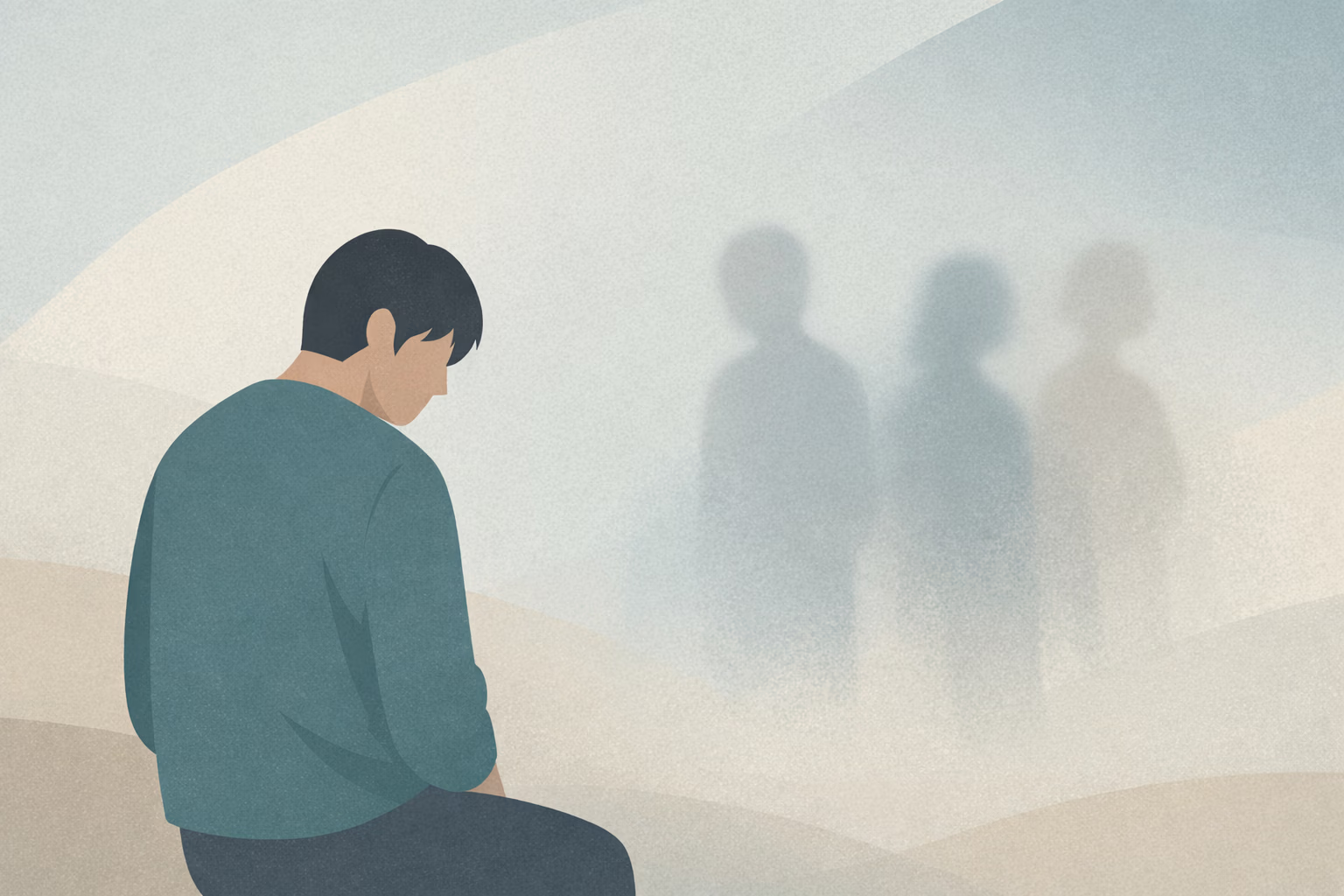
In short: Ghosting can look like a character flaw from the outside: one person disappears, the other is left holding unanswered questions. But many distancing patterns aren’t powered by cruelty or indifference—they’re powered by load.
Ghosting can look like a character flaw from the outside: one person disappears, the other is left holding unanswered questions. But many distancing patterns aren’t powered by cruelty or indifference—they’re powered by load. When the social nervous system reads “too much, too fast, too exposed,” it can downshift into withdrawal because withdrawal is a quick way to reduce stimulation.
What if disappearing isn’t a statement about your worth—or theirs—but a nervous system trying to get a “done” signal?
In a world where connection is constant, visible, and evaluative, silence becomes an oddly efficient tool: it ends the immediate pressure without requiring a complex conversation. The cost is that it also interrupts closure—leaving both people in an unfinished loop.
When someone vanishes without explanation, the hurt often comes with a specific kind of mental friction: replaying texts, scanning for signals, checking timestamps, trying to locate the moment things changed. This isn’t “overthinking” as a personality trait. It’s the brain looking for completion.
Humans regulate through social predictability. When a bond is forming (or established) and then abruptly goes quiet, the system doesn’t get the normal end-markers—repair, agreement, farewell, or even clear conflict. Without those markers, attention stays recruited, and the body can remain on alert for updates that never arrive. Relationship satisfaction and stability are closely tied to how couples handle withdrawal and conflict—patterns of disengagement can amplify distress for both sides. [Ref-1]
Silence doesn’t just remove a person. It removes the ending.
When closeness, expectation, or conflict rises, some nervous systems don’t mobilize into “talk it out.” They conserve. Engagement drops, messages feel hard to answer, and the body leans toward shutdown or minimal contact. This is less about a lack of care and more about a system prioritizing safety through reduced activation.
In avoidant-leaning attachment patterns, distancing can function like an internal brake: fewer cues, fewer demands, fewer chances to be pulled into an intense exchange. Digital spaces make this especially easy—one tap can remove a stream of stimuli. Research on relational dynamics consistently shows that patterns of withdrawal and reduced engagement are tightly linked to stress in romantic bonds, especially when one partner seeks contact while the other retreats. [Ref-2]
Not every silence is a strategy—sometimes it’s a capacity limit.
Attachment isn’t mainly a story about romance; it’s a survival system shaped by the realities of belonging. Throughout human history, social rejection carried real costs—access to protection, food, shared labor, and community standing. So the body learned to treat certain interpersonal situations as high-stakes.
When relational signals are ambiguous—mixed messages, unclear expectations, unpredictable reactions—the system can lean toward risk management. For some people, the “safer” move is to keep distance rather than gamble on a potentially exposing conversation. This isn’t an identity (“I am avoidant”); it’s a regulatory style that can become more prominent under strain, uncertainty, or repeated experiences of relational mismatch. Attachment research links avoidance with strategies that deactivate closeness when it feels unsafe or costly. [Ref-3]
Distancing works quickly. It reduces immediate social input: no tone to interpret, no facial expression to track, no conflict to navigate, no vulnerability to manage in real time. In that sense, ghosting can function like an emergency exit from a crowded room—effective at lowering arousal fast.
This is why it can happen even when someone had good intentions. The body experiences the situation as “too activated,” and withdrawal becomes the fastest route back to baseline. Different avoidant patterns can show up here—some people pull away when things get emotionally close; others pull away when they anticipate conflict or disappointment. The common factor is that disengagement creates instant relief by interrupting the relational demand. [Ref-4]
Relief for one nervous system can become destabilization for another. When communication stops without a clear ending, the relationship turns into an open loop. The receiving system can’t tell whether to grieve, wait, repair, or move on. That ambiguity is not neutral—biologically, uncertain social status is taxing.
Even when the connection was casual, ghosting can shift a person’s sense of safety in future bonds. Trust is partly built from consistency and repair. Without repair, the mind learns that closeness may be followed by sudden disappearance, and it compensates with vigilance or guardedness.
Modern dating culture can normalize “quiet exits,” but normalization doesn’t erase the nervous system’s need for closure and coherent endings. [Ref-5]
Avoidant distancing often becomes self-reinforcing because it works in the short term. The moment someone stops replying, their body feels less pressure. That state change is memorable. The nervous system learns: silence equals relief.
Over time, this can build a loop: relational intensity rises → discomfort rises → withdrawal reduces discomfort → withdrawal becomes the default response the next time intensity rises. The cost is gradual: fewer experiences of repair, fewer “we made it through” moments, fewer internal cues that closeness can be tolerable and safe.
This loop is frequently described in discussions of ghosting: immediate comfort now, longer-term disconnection later. [Ref-6]
Ghosting is the most visible form, but distancing can be subtler and still disruptive. It often looks like reduced availability precisely when a relationship needs coordination, reassurance, or repair. [Ref-7]
These aren’t moral failings. They’re patterns that lower immediate stimulation by shrinking contact—especially in moments where the relational “stakes” feel high.
Intimacy grows through small cycles of contact, rupture, and repair. When repair is consistently bypassed, the relationship doesn’t get the settling that comes after completion. Both people may become less flexible: one side escalates pursuit to regain contact; the other side escalates distance to regain quiet.
Over time, avoidance can erode the shared sense of “we can handle this.” Conflict begins to signal danger rather than negotiation. Emotional closeness can feel less like warmth and more like a doorway to obligation, disappointment, or scrutiny. In this way, avoidance doesn’t only reduce pain; it can reduce the relationship’s capacity to metabolize normal human friction. [Ref-8]
When repair doesn’t happen, even small issues start to carry the weight of everything that never got finished.
From the inside, ghosting can feel like finally being able to breathe. That matters. But if the only reliable route to calm is cutting contact, the nervous system starts to associate engagement with overload and disengagement with safety.
This is one reason distancing can appear “out of nowhere.” The person may have been carrying rising activation for a while—tracking expectations, anticipating a difficult conversation, feeling behind on replies—until one more cue tips the system into shutdown. After that, returning can feel harder than leaving, because returning reopens the loop and reintroduces consequence.
Many descriptions of avoidant “done” signals highlight exactly this shift: the body decides it’s safer to exit than to navigate ambiguity. [Ref-9]
It can help to separate two different processes that often get confused. One is understanding: “I see why I did that.” The other is capacity: the body’s ability to stay present long enough for a relational moment to complete. Understanding can be immediate; capacity is slower and shows up as a real decrease in urgency to flee.
When nervous-system load is high, even kind people can go offline. In those moments, silence is not a thoughtful choice; it’s a reduction in signal. The bridge back isn’t self-criticism or perfect explanations. It’s the gradual return of tolerance for contact—enough room in the system to remain engaged without feeling flooded or trapped.
In discussions of ghosting, this distinction matters: “knowing your triggers” is not the same as having the physiological space to respond differently under pressure. [Ref-10]
Relational safety is built less from intensity and more from steadiness. People tend to stay engaged when the relationship offers clear cues: what’s happening, what’s expected, what a mismatch means, and how repair occurs. When those cues are present, the nervous system doesn’t have to guess as much.
Silent treatment and prolonged non-response weaken this safety because they remove orientation. The other person can’t locate themselves in the bond, and the withdrawing person doesn’t get the stabilizing effect of completion. Over time, both lose confidence in repair. Many relationship educators describe how attuned presence—being trackable, consistent, and clear—reduces the conditions that provoke distancing. [Ref-11]
Coherence isn’t a “deep talk.” It’s an ending the body can recognize.
As relational capacity returns, people often notice changes that are quieter than dramatic breakthroughs. There may be less internal sprinting away from conversations, fewer spikes of dread around replying, and more ability to let a moment finish rather than cutting it off midstream.
Closeness can start to feel less like an engulfing force and more like a choice. Conflict can become more navigable because it no longer automatically signals danger. Importantly, this isn’t about “being more emotional.” It’s about having enough nervous-system bandwidth to stay oriented—so the relationship can move toward completion instead of suspension.
Many accounts of shifting away from ghosting describe this as increased comfort with straightforward communication and reduced impulse to vanish when pressure rises. [Ref-12]
The deepest shift isn’t performed; it settles. When avoidance is no longer the main regulator, people can relate from a clearer internal stance: “This is the kind of partner/friend I intend to be.” Values become more usable because the system isn’t spending all its energy managing threat.
At that point, connection isn’t driven by chasing reassurance or escaping discomfort. It’s driven by meaning: respect, honesty, care, mutual dignity. And endings—when they’re needed—can become part of coherence rather than a rupture that haunts both sides.
In this frame, the opposite of ghosting isn’t constant availability. It’s trackability: being someone whose presence and absence make sense. [Ref-13]
Avoidant distancing is often a survival strategy that became portable—easy to deploy in modern life, especially through screens. Naming it this way doesn’t excuse harm, and it doesn’t erase the pain of being left without closure. It simply restores a truthful context: humans withdraw when systems are overloaded, when consequence feels too sharp, or when endings feel too complex to complete.
Meaning returns when loops complete—when relationships have coherent arcs rather than sudden blanks. Curiosity can coexist with boundaries. Compassion can coexist with accountability. And for many people, the most stabilizing experience is not intensity, but a clean, human ending that lets the body stand down.
When silence has been the only available “safe move,” it makes sense that it gets used. And it also makes sense that something in you still wants a more coherent way to be connected. [Ref-14]
Ghosting is often described as disappearance, but underneath it is a nervous system reaching for relief. When relational safety increases and completion becomes possible, disappearing is less necessary.
Over time, intimacy tends to grow not from pressure or perfect communication, but from experiences that resolve—moments that land, repair that finishes, and departures that are clear. That kind of coherence doesn’t just change a relationship; it changes what the body expects from connection. [Ref-15]
From theory to practice — meaning forms when insight meets action.
Most distancing isn't powered by cruelty or indifference — it's powered by load. When the social nervous system reads too much, too fast, too exposed, it can downshift into withdrawal because withdrawal rapidly reduces stimulation. The Threat & Safety System treats certain interpersonal moments as high-stakes, and disappearing becomes a quick way to get a Done Signal without a complex conversation. This doesn't excuse the harm done to the receiving side, but it reframes the behaviour. Silence is often a capacity limit, not a strategy — an autonomic stand-down rather than a deliberate verdict on the other person's worth.
Confusion after ghosting is a biological response to missing closure. Humans regulate through social predictability, and when a bond goes quiet without repair, agreement, or clear conflict, the brain doesn't get the normal end-markers it needs. So attention stays recruited — replaying texts, scanning timestamps, looking for the moment things changed. This isn't overthinking as a personality trait; it's the Attachment & Belonging System looking for completion. Silence doesn't just remove a person, it removes the ending. Without that ending, the body stays mildly on alert for an update that never comes, which is genuinely taxing.
Avoidant distancing is sticky because it works in the short term. The moment someone stops replying, their body feels less pressure — and that state change is memorable. The nervous system learns silence equals relief, building an Avoidance Loop: relational intensity rises, discomfort rises, withdrawal reduces discomfort, withdrawal becomes the default the next time intensity rises. The cost is gradual: fewer experiences of repair, fewer we-made-it-through moments, fewer internal cues that closeness can be tolerable. Over time, even small frictions feel dangerous because the body has lost its training data on relational completion and successful co-regulation.
The shift isn't insight, it's capacity — the body's ability to stay present long enough for a relational moment to complete. Knowing your triggers is not the same as having physiological space to respond differently under pressure. Relational safety is built less from intensity and more from steadiness: predictability, attunement, and clean repair. When those cues are present, the system doesn't have to guess. The opposite of ghosting isn't constant availability; it's trackability — being someone whose presence and absence make sense. As capacity returns, conflict stops automatically signalling danger and endings can be coherent rather than sudden blanks.
From Science to Art.
Understanding explains what is happening. Art allows you to feel it—without fixing, judging, or naming. Pause here. Let the images work quietly. Sometimes meaning settles before words do.
One Quiet Window, one insight, one reflection — every Sunday