Fear of Being Left Behind (FOMO Version 2.0)
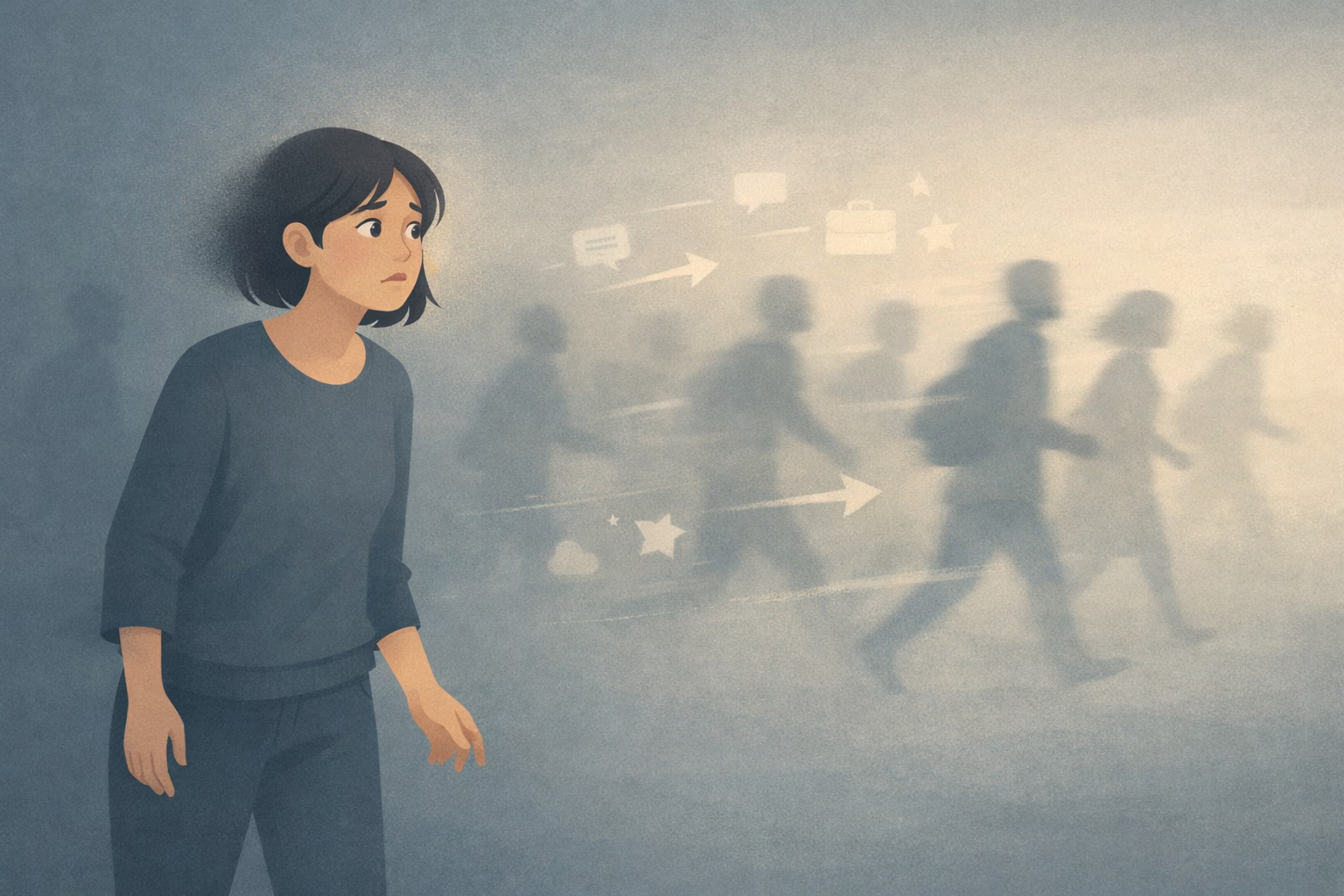
In short: Career FOMO often looks like a simple thought: “They’re moving faster than me.” But inside the body it can feel like a pulse of urgency—restlessness, scanning, and a tightening sense that you have to do something now. Not because you’re shallow or ungrateful, but because social timelines can register as safety signals in modern work culture.
Career FOMO often looks like a simple thought: “They’re moving faster than me.” But inside the body it can feel like a pulse of urgency—restlessness, scanning, and a tightening sense that you have to do something now. Not because you’re shallow or ungrateful, but because social timelines can register as safety signals in modern work culture.
What if the pressure to keep up isn’t a character flaw, but a system reacting to incomplete closure?
When progress is public and constant, the nervous system can treat career movement as a live scoreboard. That can pull attention away from your actual life—your learning curve, your context, your capacity—and toward a single question: “Am I falling behind?”
Career FOMO rarely arrives as one clean emotion. It’s more like a mixed state: a restless drive to “fix” your position, paired with self-doubt and mental replay. The mind starts tracking other people’s promotions, titles, and milestones as if they are updates about your own standing.
It can show up as background pressure even on good days—an inability to fully land in your current role, a sense that your work is never quite “done,” or a nagging suspicion that you’re missing a crucial move. Sometimes it’s not even about the job itself; it’s about the constant load of monitoring and measuring.
In many workplaces, there’s also invisible labor: keeping relationships smooth, staying responsive, managing expectations, carrying the emotional tone of a team. When that effort isn’t recognized as “progress,” the system can feel both overworked and behind at the same time. [Ref-1]
Social comparison doesn’t just create thoughts; it changes state. When someone else’s career progress becomes highly salient, the nervous system can interpret it like a signal about rank, stability, and future access. Attention narrows. Vigilance increases. The body searches for control points: more credentials, more networking, more output.
In that narrowed state, nuance collapses. Context disappears. Your timeline stops feeling like a timeline and starts feeling like a verdict. This is why career FOMO can feel urgent even when your job is objectively fine: the system is responding to perceived hierarchy movement, not to a rational spreadsheet of facts. [Ref-2]
When the environment keeps broadcasting “upward” movement, your system may stay on standby—waiting for proof that you still belong.
Humans evolved in groups where status and belonging affected access to resources, protection, and partnership. Tracking rank wasn’t vanity; it was information. The body learned to pay attention to cues that suggested inclusion or exclusion, because those cues carried real consequences.
Modern careers can mimic that ancient setup: visibility, evaluation, and limited opportunities. So when someone else advances, your system may treat it less like “their good news” and more like “a shift in the landscape.” That doesn’t mean you’re competitive by nature; it means your nervous system is doing what it was built to do—tracking position in a social field. [Ref-3]
Comparison can create a short-term sense of direction. It offers a clear target and a simple narrative: “I need to catch up.” For a moment, that can feel clarifying—like you’ve found the reason you’re uneasy, and the solution is speed.
This is part of why career FOMO is sticky. The urgency can produce action, and action can produce temporary relief. If you update your resume, apply to roles, or work late, the system gets a brief sense of regained control—even if nothing actually resolves underneath. [Ref-4]
But what happens when urgency becomes the only way to feel oriented?
The nervous system loves a simple equation: keep pace = stay safe. In career culture, “pace” often means titles, pay, visibility, and public milestones. The problem is that the finish line keeps moving, and the comparison set keeps expanding.
Over time, the chase can erode self-trust. Instead of using your own experience—energy, fit, learning, stability—as a compass, your system starts outsourcing sufficiency to external signals. Even genuine accomplishments may not register as “done,” because the body is still waiting for the environment to stop shifting. [Ref-5]
Career FOMO often becomes a Power Loop: an external hierarchy drives internal regulation. The system keeps scanning for proof of standing, and each new data point (someone else’s promotion, a hot industry trend, an impressive announcement) reactivates the loop.
In that loop, external benchmarks don’t simply inform decisions—they start substituting for meaning. Instead of “What kind of work fits my life?” the question becomes “What move will look like progress right now?” Under career insecurity, this pattern can intensify, because the environment feels less predictable and the body seeks stronger control signals. [Ref-6]
The result isn’t just stress; it’s fragmentation. Your attention gets pulled into monitoring, and your identity gets pulled into performance—making it harder to feel settled anywhere.
Career FOMO doesn’t have to be dramatic to be powerful. Often it shows up as small, repeated behaviors that keep the system activated. These aren’t “bad habits.” They’re attempts to regain coherence in an environment that withholds closure.
Research on social networking and comparison suggests that ability-comparison and FoMO-like dynamics can mediate compulsive platform use and reduced well-being. [Ref-7]
When comparison becomes continuous, the nervous system doesn’t get a stand-down signal. The body stays mobilized: monitoring, anticipating, and preparing to respond. Over time, this can look like burnout—not just tiredness, but reduced capacity to recover, reduced satisfaction, and reduced access to creative problem-solving.
Career decisions can become thinner under chronic activation. Moves get made for speed, optics, or relief. The system may accept a “louder” job over a better-fitting one because loudness provides temporary certainty. Associations have been observed between heavy professional social networking use and emotional distress, which can amplify this pressured decision-making environment. [Ref-8]
Sometimes the problem isn’t that you’re unmotivated. It’s that your system hasn’t been allowed to feel “complete” anywhere.
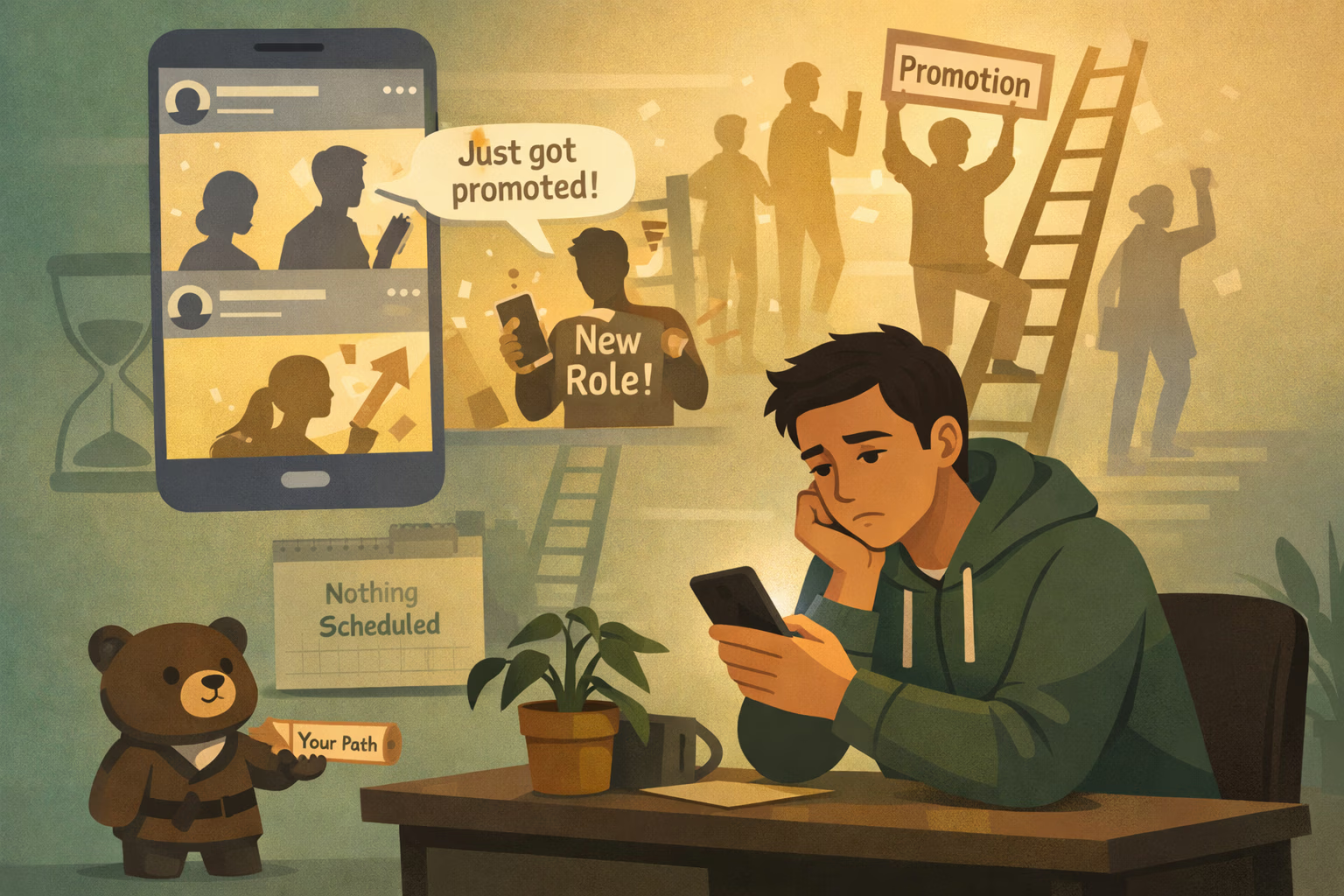
Professional platforms and workplace visibility tools turn career movement into a feed: promotions, new roles, awards, conferences, “excited to announce.” This creates an artificial density of milestones—more career signals in one afternoon than earlier generations might see in months.
Algorithms amplify what is attention-grabbing and status-coded, which can make advancement feel constant and universal, even when it’s not. This isn’t just “social media causing anxiety”; it’s a structural mismatch between nervous systems that need closure and environments that keep reopening the same comparison loop. Studies and academic work on LinkedIn comparison have linked these dynamics to increased job-search anxiety and shifts in career self-efficacy. [Ref-9]
There’s a difference between understanding your values and being organized by them. Values don’t stabilize behavior as ideas; they stabilize when they become a lived orientation that the body recognizes as coherent—when your choices reliably connect to what matters, and experiences are allowed to complete.
In career FOMO, the system often seeks “enough” through metrics: titles, salary bands, prestige signals. But sufficiency is also a physiological state—one that emerges when attention returns from constant monitoring, and the body gets consistent cues that your path is not an emergency.
Professional platforms can intensify metric anxiety by design, keeping comparison close at hand and making identity feel publicly measurable. [Ref-10]
Human nervous systems regulate through co-regulation: safety cues from trusted people, predictable interactions, and spaces where you aren’t being ranked. In a competitive culture, relationships that are not organized around comparison can quietly restore range—more room to think, more room to breathe, more room to be a person rather than a profile.
These relationships don’t erase ambition. They reduce the sense that belonging is conditional on speed. When someone can witness your timeline without evaluating it, the system receives a different message: “I am still connected even when I’m not performing.” Professional anxiety linked to platforms can soften when identity is not continuously exposed to public scoring. [Ref-11]
When comparison pressure eases, it often doesn’t feel like constant confidence. It feels like signal return: your own preferences become easier to detect, your work feels more legible, and decisions stop needing to be justified by urgency.
The mind still notices other people’s success, but it doesn’t automatically translate it into a threat. Regret spirals and self-judgment quiet—not because you forced positive thinking, but because the system is no longer trying to close an endlessly reopened loop. Social comparison can be linked to distress and lowered self-esteem, which makes this softening feel significant in day-to-day life. [Ref-12]
Clarity isn’t always a breakthrough. Sometimes it’s what arrives when the noise stops demanding a response.
As coherence returns, career decisions can start to organize around fit: the kind of problems you can stay with, the environments where your attention works well, the tradeoffs that your life can actually hold. Status may still matter—humans don’t become immune to hierarchy—but it stops being the only stabilizer.
This shift is not about “lowering standards.” It’s about regaining authorship. The question becomes less “How do I look from the outside?” and more “What kind of work can I stand inside of?” Societal expectations can intensify pressure and narrow self-definition; meaning-based orientation widens it again. [Ref-13]
A meaningful career isn’t always the fastest route. It’s the route that your nervous system can inhabit without constant negotiation.
Career FOMO makes sense in a world where advancement is broadcast and evaluated in public. Social comparison is a human function, not a personal failing—and it becomes harsher when the environment provides endless, high-contrast benchmarks without closure. [Ref-14]
Over time, many people find that real stability comes less from “keeping up” and more from a lived sense of alignment: a direction that fits your values, your context, and your capacity. When the system isn’t forced to prove itself every day, agency returns in quieter, steadier ways.
It’s easy to confuse visibility with value, and speed with security. But a career is not only a ladder; it’s a long-form relationship between your skills, your environment, and what you want your life to mean.
When your path becomes coherent—when it can complete and settle rather than constantly re-open—you don’t have to win the timeline to belong to your own life. Direction can be a deeper measure than position. [Ref-15]
From theory to practice — meaning forms when insight meets action.
Because your nervous system reads career movement as a live signal about rank and belonging, not just news. Humans evolved in groups where status affected access to resources, protection, and partnership — so the body learned to track hierarchy cues automatically. When someone else advances on your feed, the system doesn't experience it as 'their good news'; it experiences it as 'a shift in the landscape.' Attention narrows, vigilance rises, and the body searches for control points: more credentials, more output, more visibility. That urgency isn't shallow — it's the Threat & Safety System reading social rank in modern dress.
It becomes a Power Loop when external hierarchy starts driving internal regulation. The system keeps scanning for proof of standing, and each new data point — someone's promotion, a hot trend, an excited-to-announce post — reactivates the loop. External benchmarks stop merely informing decisions and start substituting for meaning. The question shifts from 'What kind of work fits my life?' to 'What move will look like progress right now?' Fragmentation follows: attention gets pulled into monitoring, identity gets pulled into performance. The finish line keeps moving, the comparison set keeps expanding, and even genuine wins fail to deliver a Done Signal.
It's an Evolutionary Mismatch. Professional platforms turn career movement into a feed: promotions, awards, conferences, role changes — more advancement signals in one afternoon than earlier generations would see in months. Algorithms amplify what's attention-grabbing and status-coded, making upward motion feel constant and universal even when it isn't. This isn't simply 'social media causes anxiety'; it's a structural mismatch between nervous systems that need closure and environments that keep reopening the same comparison loop. The body stays mobilized — monitoring, anticipating, preparing — and never receives the stand-down signal it actually needs.
It doesn't feel like constant confidence; it feels like signal return. Your own preferences become easier to detect, your work feels more legible, and decisions stop needing to be justified by urgency. Other people's success still gets noticed, but the body no longer translates it automatically into threat. Decisions reorganize around fit — the kind of problems you can stay with, the environments where your attention works well, the tradeoffs your life can hold. This isn't lowering standards; it's regaining authorship. A meaningful career isn't always the fastest route — it's the one your nervous system can inhabit without constant negotiation.
From Science to Art.
Understanding explains what is happening. Art allows you to feel it—without fixing, judging, or naming. Pause here. Let the images work quietly. Sometimes meaning settles before words do.
One Quiet Window, one insight, one reflection — every Sunday