
The Fear of Silence: Why Stillness Feels Uncomfortable

In short: Dopamine minimalism isn’t a punishment, a purity trend, or a test of self-control. It’s a way of describing what happens when high-intensity stimulation becomes so constant that ordinary life stops registering as rewarding—like your system can’t detect “enough” anymore.
Dopamine minimalism isn’t a punishment, a purity trend, or a test of self-control. It’s a way of describing what happens when high-intensity stimulation becomes so constant that ordinary life stops registering as rewarding—like your system can’t detect “enough” anymore.
In that state, people often blame themselves: Why can’t I focus? Why do I keep checking? Why does everything feel flat unless it’s intense? But much of this is structural. A nervous system under constant novelty and evaluation adapts by narrowing attention, chasing stronger signals, and staying “on.”
What if the problem isn’t your motivation—what if your reward system is overloaded with noise?
Overstimulation can feel like restlessness with no clear target: the urge to click, scroll, snack, refresh, switch tabs, or add something—anything—just to shift state. It can also show up as mental static: difficulty settling into one task, irritability at small delays, or a sense that silence is oddly uncomfortable. [Ref-1]
These patterns are frequently interpreted as “lack of discipline,” but they often reflect a nervous system managing continuous input. When the environment keeps offering sharp peaks of reward, your system adapts by expecting peaks. Neutral moments start to feel like absence, even when nothing is actually wrong.
When stimulation is constant, “calm” can register as a missing signal rather than a safe one.
Reward circuitry is tightly linked to attention. The faster the novelty comes, the more your attention is pulled into short cycles: anticipation, hit, drop, repeat. In modern digital spaces, that cycle can happen dozens or hundreds of times a day, often without a clear endpoint. [Ref-2]
Fragmented attention doesn’t just make you “distracted.” It changes how experiences land in the body. When an experience ends abruptly—swipe, skip, next—there’s less opportunity for completion signals. Without completion, the system stays slightly mobilized, scanning for the next input that might finally make things feel resolved.
Human reward systems evolved in environments where high-value rewards were real but relatively rare: seasonal food, social approval that required effort, novelty that involved exploration, play that had natural limits. Today, many rewards are abundant, portable, and engineered for immediate delivery. That mismatch matters. [Ref-3]
When rewards become constant, the system doesn’t conclude, “Great, we’re safe now.” It adjusts its expectations. What used to be a meaningful spike becomes baseline, and baseline starts to feel dull. This isn’t a moral failing; it’s a predictable adaptation to an environment that rarely lets the loop complete.
High-intensity inputs—fast entertainment, endless feeds, gambling-like apps, hyper-palatable food, porn, shopping—often work because they rapidly change state. They can temporarily sharpen focus, lift mood, mute uncertainty, or replace an undefined “something’s missing” with a concrete signal. [Ref-4]
This is not about people “trying to avoid feelings” in a simplistic way. More often, it’s a structural workaround: stimulation provides a quick end to ambiguity. It supplies a momentary sense of coherence—an artificial “done”—even if it doesn’t hold.
Relief is real. The question is whether it settles, or whether it keeps the system needing the next hit.
Stimulation is intensity. Fulfillment is integration. Stimulation can be high and immediate; fulfillment is often slower and comes with a sense of sufficiency—like something completed and became part of you. When life is dominated by peaks, it can get harder to detect the quieter signal of “this mattered.” [Ref-5]
That’s one reason people can have a full day of content and still feel oddly empty. The day contained plenty of reward, but little closure. Lots of activation, little settling. Meaning tends to thicken when experiences resolve and connect to identity: This is who I am. This is what I do. This is what counts.
Under sustained high stimulation, many people find themselves in a repeating loop. Not because they are broken, but because the system is trying to regulate itself with the tools available. [Ref-6]
The sequence often looks like this:
Importantly, this loop can run even when things are “fine.” It doesn’t require a dramatic problem. It only requires enough repetition that the nervous system starts treating high intensity as normal.
People often notice the shift indirectly. Not as one obvious symptom, but as a collection of small changes that make life feel narrower. [Ref-7]
These are not “traits.” They’re signals of a system adapting to frequent spikes and frequent interruption—where the baseline starts to feel like deprivation even when it’s simply neutral.
Patience is not just a virtue; it’s a physiological capacity to stay with low-intensity input without the system escalating. When stimulation is frequent, that capacity can shrink—not because someone chose it, but because the environment trained the nervous system to expect immediate payoff. [Ref-8]
Over time, this can affect intrinsic motivation. Tasks that require ramp-up—reading, skill-building, deep conversation, creative work—may feel strangely inaccessible. Not impossible, just costly. The body learns: “This doesn’t pay fast enough.” And when fewer experiences reach completion, meaning-making weakens too, because meaning is built from finished loops that actually land.
When nothing gets to “done,” identity can start to feel thin.
When high stimulation decreases, many people experience a rebound: restlessness, irritability, emptiness, or a strong pull back to the old inputs. That discomfort can be misread as proof that something is wrong—when it may simply be the nervous system registering a changed signal environment. [Ref-9]
This is how the loop protects itself. The moment you reduce peaks, the contrast makes baseline feel extra flat. The body wants to restore the familiar intensity, not because it’s “weak,” but because familiarity is a form of predicted safety.
In other words: the return-urge isn’t a personal failure. It’s the nervous system attempting to close the gap between what it expects and what it’s getting.
“Dopamine minimalism” points to a simple principle: when reward peaks are less extreme and less constant, the nervous system can recalibrate what counts as rewarding. This isn’t about understanding the concept or forcing a new mindset. It’s about the body’s ability to re-detect low-intensity cues—subtle satisfaction, steady interest, natural appetite for a task—once the noise floor drops. [Ref-10]
In this framing, reducing stimulation isn’t the point. The point is restoring a usable baseline where ordinary experiences can again create completion signals. The shift is less “I should be better” and more “My system can finally register what’s already here.”
When the signal-to-noise ratio improves, coherence becomes easier to feel.
Humans regulate in connection. Shared attention, predictable conversation, mutual recognition, and ordinary companionship provide safety cues that don’t require intensity. In many evolutionary terms, social stability was one of the most reliable signs that life was workable. [Ref-11]
Digital rewards can imitate social signals (likes, replies, views) while removing the natural endpoints that real interaction provides. Real-world connection tends to have built-in completion: a greeting, a talk, a goodbye; a shared meal; a task done together. Those endings matter. They tell the nervous system, “This loop closed.”
Some of the most nourishing rewards are not exciting—they’re settling.
As stimulation decreases and closure increases, many people describe a gradual return of capacity: the ability to stay with one thing longer, to notice small pleasures, to recover from stress without needing a spike to reset. The inner environment feels less jagged. Attention becomes less hunted. [Ref-12]
This is not a dramatic makeover. It’s often quiet: fewer internal alarms, less compulsive switching, more tolerance for the in-between. Importantly, the change isn’t only psychological. It can feel physiological—like your system has more room to downshift when it’s safe to downshift.
Dopamine minimalism is often misunderstood as “living without pleasure.” A more accurate framing is: living without constant escalation. It’s the difference between choosing fewer, clearer rewards and being pulled by endless, fragmented ones. In evolutionary mismatch terms, it’s less about rejecting modern life and more about reducing conditions that keep the system perpetually activated. [Ref-13]
When life is less saturated with peaks, meaning has space to form through completion. Identity thickens through what you consistently return to and finish—not through what you consume. Sufficiency becomes a real signal again: not “I must want less,” but “I can finally tell what is enough.”
In a high-stimulation culture, it’s easy to assume that wanting more intensity means something is wrong with you. But it can be a predictable response to an environment that rarely provides closure. Dopamine minimalism, at its best, is not a rule set. It’s a dignity-preserving explanation: when the noise is constant, the nervous system adapts; when the noise softens, sensitivity can return.
Freedom here doesn’t mean never enjoying strong rewards. It means not being owned by the loop. And meaning doesn’t come from pressure or perfect habits—it emerges when experiences complete and settle into a coherent sense of life: This counts. This is mine. This is enough. [Ref-14]
When stimulation is less frantic, attention can gather. When attention gathers, ordinary experiences have a chance to land. And when experiences land and complete, motivation becomes less of a struggle—because it’s supported by coherence rather than urgency.
The aim isn’t a smaller life. It’s a more legible one: where presence carries reward, where effort can finish, and where the nervous system isn’t constantly negotiating with the next hit to feel alive. [Ref-15]
From theory to practice — meaning forms when insight meets action.
Dopamine minimalism isn't a punishment, a purity trend, or a self-control test. It describes what happens when high-intensity stimulation becomes so constant that ordinary life stops registering as rewarding — the system can't detect enough anymore. People often blame themselves for restlessness, compulsive checking, or flatness, but much of this is structural. Under continuous novelty, the Reward & Stimulation System narrows attention and chases stronger signals. The point isn't living without pleasure; it's living without constant escalation. When reward peaks soften, the body can re-detect low-intensity cues — subtle satisfaction, steady interest, natural appetite for a task — once the noise floor drops.
Human reward systems evolved in environments where high-value rewards were real but relatively rare — seasonal food, social approval that required effort, novelty that involved exploration. Today many rewards are abundant, portable, and engineered for immediate delivery. That's an Evolutionary Mismatch. When rewards become constant, the system doesn't conclude great, we're safe now — it adjusts expectations. What used to be a meaningful spike becomes baseline, and baseline starts to feel dull. This isn't a moral failing; it's a predictable adaptation to an environment that rarely lets the loop complete. Neutral moments start to feel like absence, even when nothing is wrong.
Under sustained high stimulation, many people end up in a Pleasure Loop: craving (urgency, restlessness, I need something), stimulation (a quick high-signal input that changes state), numbness or flatness (a drop in sensitivity, ordinary life feels muted), then return to craving. The next hit is needed to get the signal back. This loop runs even when things are fine — it doesn't require a dramatic problem, only enough repetition that the nervous system treats high intensity as normal. Stimulation isn't fulfilment. Stimulation is intensity; fulfilment is integration. Lots of activation, little settling. Meaning Density thins when nothing reaches a Done Signal.
When high stimulation decreases, many people experience a rebound — restlessness, irritability, emptiness, or a strong pull back to old inputs. That discomfort is often misread as proof something's wrong, when it's the nervous system registering a changed signal environment. The moment you reduce peaks, the contrast makes baseline feel extra flat. The body wants to restore familiar intensity not because it's weak but because familiarity is a form of predicted safety. The return-urge isn't a personal failure; it's the system trying to close the gap between what it expects and what it's getting. Sensitivity returns as the noise floor drops.
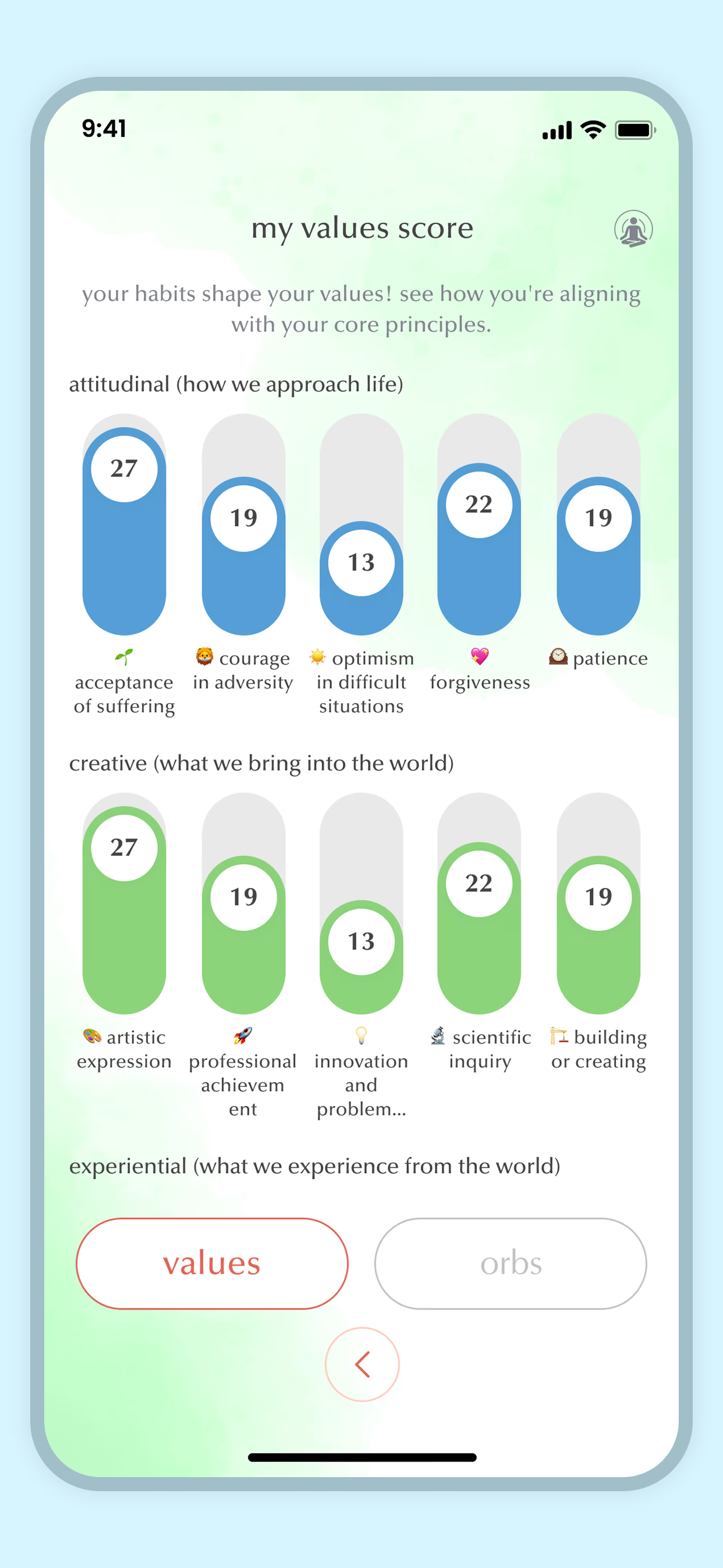
From Science to Art.
Understanding explains what is happening. Art allows you to feel it—without fixing, judging, or naming. Pause here. Let the images work quietly. Sometimes meaning settles before words do.
One Quiet Window, one insight, one reflection — every Sunday