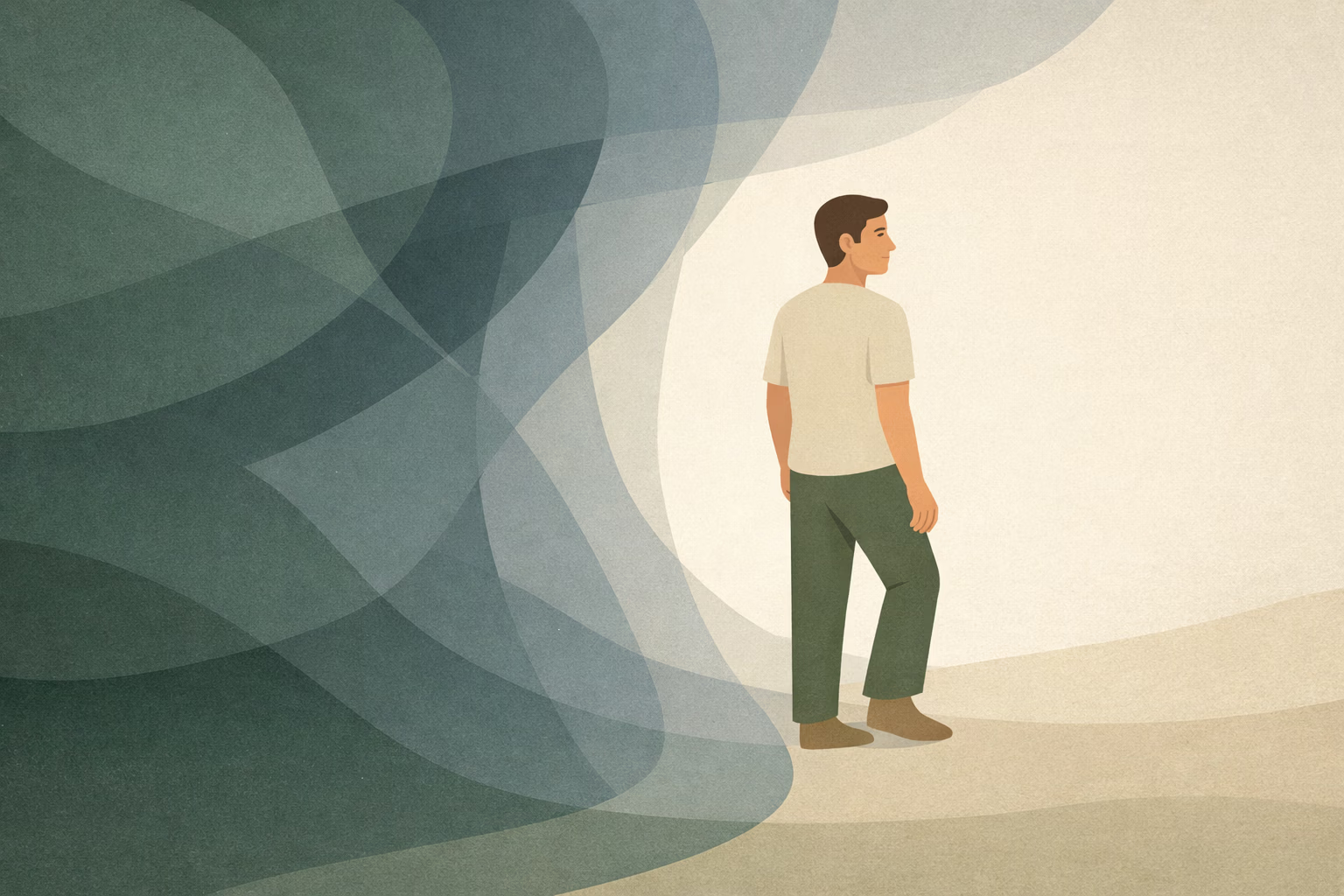
The Modern Attention Crisis: Why You Can't Stay Present
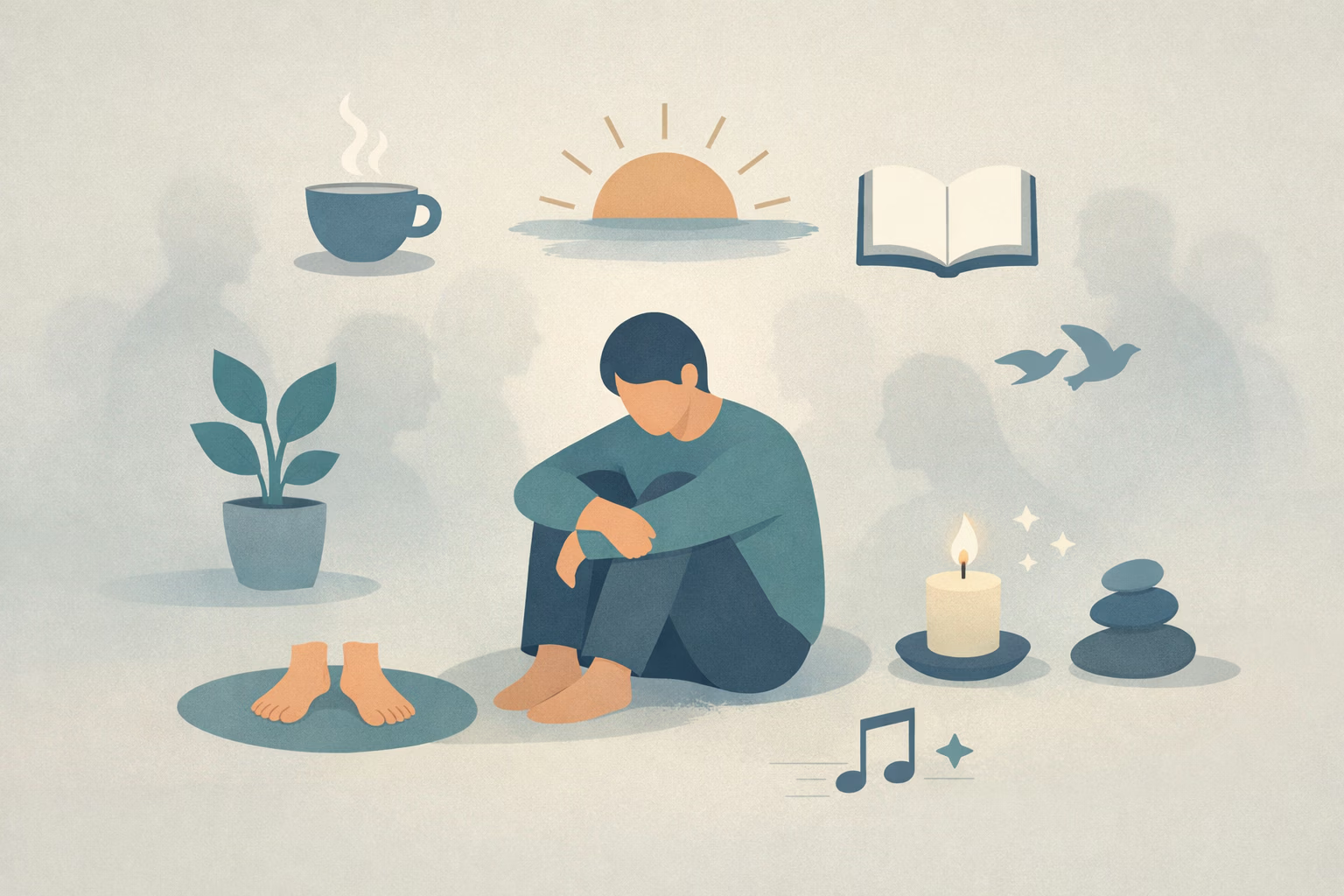
In short: There’s a particular kind of tired that doesn’t come from doing too much. It comes from doing many small things that never settle—checking, switching, scanning, responding—until the day feels full but strangely un-lived.
There’s a particular kind of tired that doesn’t come from doing too much. It comes from doing many small things that never settle—checking, switching, scanning, responding—until the day feels full but strangely un-lived.
What if your “lack of purpose” is sometimes just interrupted completion?
Meaning isn’t something you force yourself to believe in. It tends to arise when experience can finish its arc: attention gathers, effort consolidates, something completes, and your system gets the signal that it’s safe to stand down. Meaning interference is what happens when that arc is repeatedly cut short—by external inputs and internal pulls—so your life keeps running, but coherence doesn’t get to land.
Many people describe the same pattern: you sit down to do something that matters, and within minutes you’re elsewhere—email, news, a message, a tab you don’t remember opening. You come back, start again, then drift. By the end, you may feel irritated with yourself, as if you “should” be able to focus.
But this experience is often less about personal deficiency and more about a system responding to repeated interruption. Attention and meaning are built to run in sequences. When those sequences are constantly broken, the nervous system doesn’t register completion—it registers ongoing demand. That can feel like restlessness, pressure, or a low-grade agitation that never resolves. [Ref-1]
“I’m not choosing to abandon what matters. It’s more like my attention keeps getting taken before it can settle.”
Executive attention—the capacity to hold a goal, inhibit competing cues, and return to a chosen thread—works best when the environment cooperates. Modern attention environments often do the opposite: they supply frequent novelty, social cues, and unpredictable rewards that pull the system outward.
Notifications, feeds, and rapid content shifts don’t just “distract.” They compete at the level of salience. They recruit the same machinery that would normally help you orient toward what matters, except now it’s oriented toward what is most immediate, most changing, and most likely to deliver a quick signal of relevance. Research on social media distraction describes how situational cues and platform features can reliably disrupt goal-directed focus. [Ref-2]
In that state, purpose can start to feel vague—not because it isn’t there, but because it can’t get enough uninterrupted time to assemble into a stable direction.
From an evolutionary perspective, attention is not primarily a “productivity tool.” It’s a survival tool. It is tuned to detect novelty, track changes, and scan for potential opportunity or threat. In a landscape where information arrived slowly, this was efficient: notice the new thing, assess it, then return to the prior task.
Digital environments turn that occasional “new thing” into a continuous flood. The novelty system stays engaged because there is always another update, another micro-signal, another possible social cue. In knowledge work settings, digital distraction is described as a persistent challenge precisely because attention is repeatedly pulled away before deeper engagement can stabilize. [Ref-3]
So the problem isn’t that your brain is weak. It’s that it’s working as designed in a context that continuously presses its “orienting” buttons.
When attention shifts away from a meaningful task, the change often brings a short-term state shift: the pressure eases, the boredom signal quiets, or the uncertainty drops for a moment. The nervous system reads that as relief.
This is one reason multitasking can feel strangely productive. You’re moving, responding, clearing inputs—so the system gets frequent “I did something” cues. But those cues aren’t the same as completion. They’re more like momentary reductions in load. Research on digital technology’s effects on cognition describes how constant task-switching and information exposure can undermine sustained attention and working memory—two capacities that support coherent follow-through. [Ref-4]
Over time, the brain learns a simple rule: when a task starts to thicken (complexity, uncertainty, delayed payoff), shifting away provides immediate regulation. Not because you’re avoiding feelings, but because the environment offers quick exits from unfinished loops.
Meaning interference often hides behind a socially acceptable mask: you look engaged, reachable, responsive. Your day contains movement and input. But meaning tends to require something else: sustained contact with a thread long enough for it to close.
When closure is delayed, identity-aligned action can start to erode. You may still care deeply, but your life begins to feel as if it’s happening around your values rather than through them. Not because you don’t have values—because the conditions don’t let values express themselves into completed reality.
Interestingly, studies that reduced mobile internet access found improvements in sustained attention, wellbeing, and time use—suggesting that when the capture layer quiets, deeper capacities can re-emerge. [Ref-5]
Distraction isn’t only interruption; it’s often a loop. A cue appears, attention shifts, a small reward arrives (novelty, social signal, certainty, entertainment), and the nervous system gets a brief regulatory hit. That hit is real. It changes state quickly.
But meaning tends to form through a different kind of payoff—one that arrives after effort consolidates and something completes. When the environment repeatedly offers fast reward before completion, the system can begin to prefer the faster loop. Over time, this can shape attention allocation through dopamine-related reward circuitry, especially around smartphone-mediated social activity. [Ref-6]
This is why “just focus harder” often fails as a framing. The competing loop isn’t moral weakness; it’s a well-reinforced regulatory pathway that delivers immediate resolution when deeper work can’t yet offer closure.
Meaning interference has patterns that are easy to misread as personality traits. They’re often better understood as signals that attention and closure are being disrupted faster than the system can integrate experience into “this is who I am and what I do.”
Novelty-seeking is not inherently a problem—it’s a human attentional feature. Dopamine modulation is associated with how novelty influences decision-making, which helps explain why “new” can feel compelling even when it costs depth. [Ref-7]
Purpose usually isn’t lost in a dramatic moment. More often it thins out. You still know, intellectually, what matters. But it doesn’t feel like a lived axis. The sense of direction weakens when your days don’t reliably end in completion of value-linked arcs.
Over time, prolonged distraction can reduce clarity, increase dissatisfaction, and make long-term motivation harder to access—not because motivation disappeared, but because the system doesn’t get enough confirming experiences that “I do what I say matters.” Digital wellness research commonly notes links between heavy, fragmented digital use and stress, sleep disruption, and reduced wellbeing—conditions that further narrow attentional capacity. [Ref-8]
When capacity narrows, the mind often defaults to whatever is easiest to engage and easiest to exit. That’s not a personal failure. It’s load management.
Once attention has been trained toward rapid reward, deeper engagement can start to feel unusually effortful—not because it is objectively harder than before, but because the contrast has changed. Quiet tasks offer fewer micro-rewards, and their payoff arrives later, after sustained contact.
In this state, the “meaning loop” struggles to activate. It needs a runway: time, reduced input, and enough internal steadiness for attention to gather. If the system keeps getting pulled into small hits of stimulation, it never reaches the phase where effort consolidates into completion—and completion is what gives the nervous system a stand-down signal.
Popular explanations of digital distraction often describe how intermittent reinforcement and endless scroll mechanics keep attention engaged; even when the sources are non-academic, the behavioral pattern aligns with established reward-learning principles. [Ref-9]
It can help to separate two different ideas that often get blended: state change versus integration. A quick break, a quick check, or a quick technique can shift state—less pressure, more stimulation, a brief sense of control. Integration is different. It’s what happens after an experience completes and settles into identity: “this mattered, I followed it through, and now my system can rest.”
What if focus isn’t a virtue, but a condition?
In many discussions, “focus blocks,” attention routines, or mindfulness practices are framed as self-improvement strategies. Another way to understand them is as environmental and physiological scaffolding—ways a modern brain sometimes needs the world to quiet down long enough for completion signals to occur. Screen-based attention capture is widely discussed as a design and context issue as much as an individual one. [Ref-10]
This reframing matters because it replaces self-blame with a more accurate question: what prevents closure from landing?
Humans regulate in relationship. Not only emotionally, but cognitively: shared goals, shared timing, and shared context can reduce the number of competing signals your attention has to negotiate alone. When you’re part of a coordinated effort, the “why” is externally echoed, and the “done” signal becomes more visible.
Social accountability is sometimes described as motivation, but it can also be understood as coherence support. When another person is oriented to the same outcome, your attention doesn’t have to keep renegotiating whether the task matters. The meaning is held in the environment.
Many summaries of deep work emphasize the role of structure and norms (protected time, clear expectations) in supporting sustained attention; the mechanism here isn’t moral discipline, but reduced switching costs and fewer incoming claims on the executive system. [Ref-11]
When attentional load drops and interruptions reduce, something subtle can return: the ability to stay with a thread long enough for it to complete. This is often experienced less as “trying harder” and more as fewer internal jolts—less need to check, less sense of being chased by inputs.
Deep engagement tends to have recognizable qualities: time feels different, decisions simplify, and effort becomes more continuous rather than repeatedly restarted. The system begins to receive more “done” signals, which reduces background activation. Discussions of attention residue highlight how switching tasks leaves a trace that can impair performance and felt clarity; when switching decreases, that residue decreases too. [Ref-12]
“It’s not that life got easier. It’s that my attention stopped shattering, so what I care about could finally take shape.”
Agency isn’t just decision-making. It’s the lived sense that your actions belong to you and accumulate into a narrative you recognize. When attention is constantly fragmented, life can feel like a series of reactions. When attention can hold, life can become a sequence of choices that close.
Over time, completed value-linked actions don’t just produce outcomes; they shape identity. You don’t need to constantly remind yourself what matters because your days keep proving it in small, finished ways. And as attention residue decreases, it becomes easier to transition deliberately rather than carrying fragments of the last thing into the next. [Ref-13]
Purpose, in this frame, isn’t a grand statement. It’s the coherence that emerges when your nervous system is allowed to complete what it starts—often in ordinary, repeatable ways.
Distraction is often treated as a personal defect: lack of grit, lack of discipline, lack of seriousness. A more humane interpretation is that distraction is information. It can signal that your environment is too fast, your inputs are too numerous, or your days don’t provide enough closure for your system to stand down.
When you view meaning interference structurally, shame has less to attach to. The question becomes less “What’s wrong with me?” and more “What conditions keep pulling attention away before completion can occur?” Research exploring ways to reduce distraction often focuses on toggling attention capture patterns—an implicit acknowledgment that the environment is part of the mechanism. [Ref-14]
Purpose doesn’t always need to be found. Sometimes it needs to be given room to finish.
In a high-velocity world, it’s easy to confuse constant engagement with a meaningful life. But meaning tends to arrive after things are carried through—when effort resolves, when the body registers “done,” and when identity can quietly update: this is what I’m about.
Attention isn’t merely a tool for getting more done. It’s one of the main ways a human life becomes coherent. And coherence—more than pressure, more than self-critique—is what lets purpose become stable enough to live from. Digital wellness education consistently notes that heavy distraction can strain wellbeing and functioning, which underscores how central attention is to a settled, values-led life. [Ref-15]
From theory to practice — meaning forms when insight meets action.
Usually no. The article reframes it: attention and meaning are built to run in sequences, and when those sequences are constantly broken by notifications, feeds, and micro-pulls, the nervous system never registers completion — it registers ongoing demand. That's what we feel as restlessness or low-grade agitation, not laziness. Modern attention environments compete at the level of salience, recruiting the same machinery that would normally orient you toward what matters. Calling this a moral failure misses the mechanism. It's a Pleasure Loop running in a context that continuously presses the orienting buttons your brain evolved to respond to.
Because each switch produces a real, immediate state shift — pressure eases, boredom quiets, uncertainty drops for a moment. The system reads that as relief, and clearing inputs sends frequent I-did-something cues. But those cues aren't completion; they're momentary load reductions. Over time the brain learns a simple rule: when a meaningful task starts to thicken with complexity or delayed payoff, shifting away delivers fast regulation. The Pleasure Loop wins because it pays out before the deeper Meaning Loop has time to assemble. Multitasking can feel productive while quietly eroding the closure that makes effort feel real.
It rarely looks dramatic. Compulsive checking that happens almost before you notice. Starting meaningful tasks repeatedly without ever reaching a satisfying Done Signal. Multitasking that leaves you tired without a sense of progress. A sticky residue feeling when you try to return to a thread after interruption. Late-day novelty cravings paired with reduced patience for depth. These read like personality traits — restless, scattered, unfocused — but they're better understood as signals that closure is being disrupted faster than experience can integrate. The structural read replaces self-blame with a more accurate question about what conditions are blocking completion.
Humans co-regulate cognitively, not just emotionally. When you're inside a coordinated effort, the why is externally echoed and the done signal becomes more visible — you don't have to keep renegotiating alone whether the task matters. That reduces the number of competing claims your executive system has to fend off. What gets called accountability is partly coherence support: meaning held in the environment instead of carried entirely by private willpower. Protected time, clear expectations, and shared timing lower switching costs. Loop Sovereignty here isn't lone discipline — it's choosing contexts that give your attention a runway to actually finish something.
From Science to Art.
Understanding explains what is happening. Art allows you to feel it—without fixing, judging, or naming. Pause here. Let the images work quietly. Sometimes meaning settles before words do.
One Quiet Window, one insight, one reflection — every Sunday