
Self-Avoidance: When You Keep Escaping Your Own Thoughts
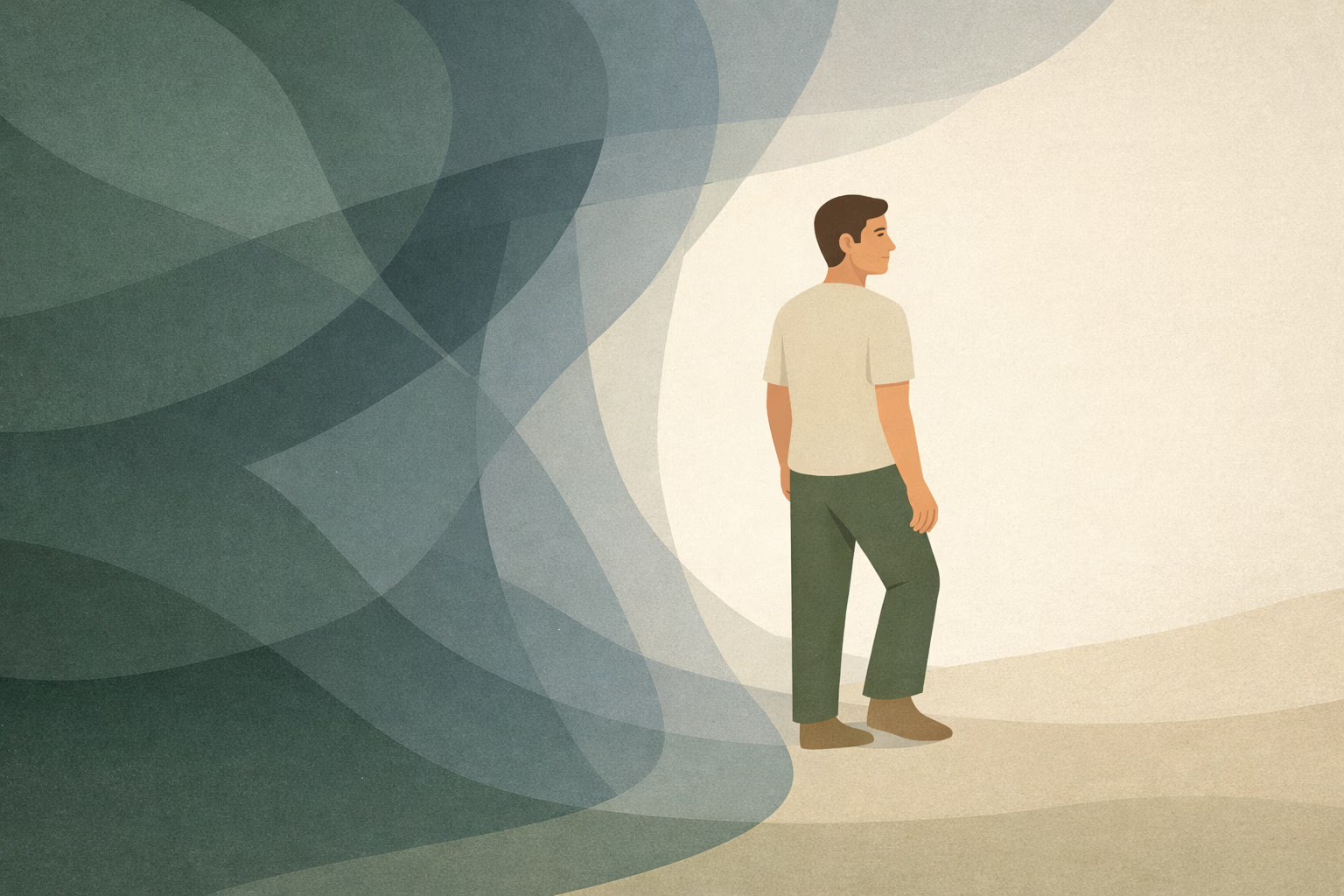
In short: There’s a particular kind of stuckness that doesn’t feel like a single problem. It feels like living inside a narrowed version of life—same reactions, same assumptions, same “I guess this is just how it is.” And even when you can name the pattern, the pattern can keep running.
There’s a particular kind of stuckness that doesn’t feel like a single problem. It feels like living inside a narrowed version of life—same reactions, same assumptions, same “I guess this is just how it is.” And even when you can name the pattern, the pattern can keep running.
What if the issue isn’t that you’re not trying hard enough—but that your nervous system is viewing reality through a protective filter?
In this frame, avoidance isn’t a character flaw or a lack of courage. It’s a regulatory response: a way the system reduces load, uncertainty, and exposure. The cost is that the filter can start shaping not just what you do, but what you notice, what you expect, and what feels possible.
Many people recognize a familiar loop: you anticipate a difficult situation, your mind searches for the cleanest exit, and your day quietly reorganizes around not having to face it. Then later, the consequences arrive—pressure, regret, shrinking options—and the cycle feels confusingly inevitable.
What makes this frustrating is that insight often exists. You may know what’s happening. You may even understand the pattern in detail. But understanding alone doesn’t automatically create the internal “done” signal that lets the body stand down. The loop can persist because it’s supported by physiology and reinforcement, not because you’re missing information. [Ref-1]
It can feel like you’re living the same day in different outfits: different contexts, same internal choreography.
Avoidance is often described as “not doing the thing.” But in practice, it also changes what gets through to awareness. When the system is prioritizing safety, attention can become selective: cues that suggest threat become louder, and cues that suggest neutrality or possibility become quieter.
This isn’t a moral choice. It’s an attentional economy. If your body is already loaded, it will prefer quicker certainty over ambiguous exploration. That means the mind may scan for what could go wrong, while positive or workable details fail to register with the same weight. Over time, your lived reality can feel increasingly consistent with the avoidance—because the filter keeps highlighting the same categories of information. [Ref-2]
From an evolutionary perspective, narrowing was useful. When danger was more immediate and the environment less abstract, reducing the range of attention conserved energy, lowered exposure, and simplified decision-making. Avoidance reduced risk and cognitive load.
The problem is not that the system is “irrational.” The problem is mismatch. Modern stressors are often social, symbolic, long-term, and layered—emails, ambiguity, reputation, choices without clear endpoints. A survival system built for discrete threats can still respond by compressing reality into “safe” vs “not safe,” even when the situation requires nuance, flexibility, and time. [Ref-3]
In a complex world, a binary filter can start misrepresenting the terrain.
Avoidance often brings immediate relief—not necessarily pleasure, but a drop in activation. That drop is meaningful to the nervous system. It signals: “Exposure reduced. Uncertainty contained.” The body reads this as increased safety.
Predictability is a powerful stabilizer. When you avoid, the situation becomes simpler: fewer variables, fewer unknown reactions, fewer chances of awkwardness or failure. This is why avoidance can be sticky even when it costs you later. The short-term effect is a calmer internal forecast, and that calm can become the nervous system’s preferred reference point. [Ref-4]
Relief can be real while also being incomplete. Avoidance reduces immediate activation, but it can also reduce contact with information that would update your internal model: “I can handle this,” “It wasn’t as bad,” “There are more options than I assumed.” Without that updating, the system remains cautious, and the world remains interpreted as narrow.
Another cost is that avoidance often requires “safety behaviors”—extra strategies to prevent discomfort or uncertainty. These can look like over-preparing, rehearsing, checking, monitoring, or keeping escape routes open. They may help you get through, but they also keep the nervous system from receiving a clean completion signal, because the experience never fully resolves as safe in a settled way. [Ref-5]
When avoidance becomes a primary regulator, it can start functioning like a reality engine. The system filters out experiences that might broaden your model, and it repeatedly selects experiences that confirm the need for protection.
This is the “Matrix” feeling: not that reality is fake, but that your access to reality is curated by a protective algorithm. The more you avoid, the less data you have that contradicts the avoidance. And the less contradicting data you have, the more reasonable avoidance feels. This is how escape can begin to feel impossible—because the very mechanism meant to protect you also reduces the information that would loosen its grip. [Ref-6]
The loop isn’t powered by weakness. It’s powered by a closed circuit that keeps producing the same conclusion.
Avoidance isn’t always obvious. It often hides inside respectable or invisible strategies—mental detours, background scrolling, perfectionistic planning, or staying busy in “safe” tasks. The nervous system may not label these as avoidance; it labels them as regulation.
Over time, the pattern can create recognizable shapes in daily life: [Ref-7]
As the filter persists, it can begin to shape identity—not as a conscious decision, but as a gradual narrowing of what you reliably do, choose, and tolerate. Identity tends to form around what repeats. If your system repeatedly organizes around escape, then “who you are” can start to feel like “someone who can’t.”
In this way, avoidance doesn’t only reduce contact with situations; it reduces contact with possibility. Life becomes a set of managed corridors. The nervous system becomes skilled at preventing spikes, but less practiced at completing experiences in a way that generates closure and expansion. Agency can feel theoretical—something you believe in, but can’t access reliably under load. [Ref-8]
Once the protective filter is in place, interpretations tend to tilt in the same direction. Ambiguity gets read as danger. Neutral cues get interpreted as negative. The system isn’t trying to be pessimistic; it’s trying to avoid costly surprises.
This is one reason avoidance is so durable: the perception of threat can become amplified by attention itself. When attention locks onto threat-related features, they feel more prominent and more compelling, which strengthens the internal logic for avoidance. The loop sustains: amplified threat perception → protective withdrawal → reduced disconfirming experiences → amplified threat perception. [Ref-9]
It’s tempting to think the way out is to force exposure to what’s avoided. But widening perception depends on internal conditions. When the system is already operating near its capacity, additional demand can read as threat, even if the goal is growth.
In more settled states, perception naturally broadens. Your brain can take in more context, notice more nuance, and hold competing possibilities without urgently collapsing them into one conclusion. That’s not a mindset achievement; it’s a state-dependent function. When internal safety cues increase and load decreases, the nervous system can risk updating its map. [Ref-10]
Coherence isn’t manufactured by pressure. It emerges when the system has room to complete experiences.
Because avoidance shapes perception, it can also shape narrative: “This is dangerous,” “I can’t,” “It will go badly.” These stories often feel like accurate reports, when they may be the mind’s best available summary under constraint.
One of the few things that reliably softens rigid internal narratives is contact with other perspectives—especially relational mirroring that feels safe enough to be credible. When someone else helps hold a wider view, the brain receives additional data: alternative interpretations, missing context, and a different weighting of cues. Over time, this can reduce the dominance of threat-biased decision-making and allow the internal model to become less absolute. [Ref-11]
Sometimes the story doesn’t change because you argued with it. It changes because reality got bigger around it.
As load decreases and the system receives more “this completed and I’m okay” signals, flexibility can return in quiet ways. You may notice more options in real time. You may detect early tightening and also notice that it can pass. The world can start to contain gradients again—not just safe/unsafe.
Importantly, this is not the same as constant confidence or constant comfort. It’s increased capacity for signal return: the ability to come back to baseline after activation, and to let cues update your model instead of locking onto one interpretation. Research on perceptual bias shows how easily attention and subtle cues can shape what we perceive—so a widening of perception is often a sign that the threat-tuning has softened. [Ref-12]
When perception widens, choice becomes more real. Not because you’re forcing yourself to be brave, but because your internal model is no longer compelled to collapse everything into avoidance as the primary solution. More of you is available to participate.
This is where meaning becomes stabilizing. When actions connect to values and identity in a lived, settled way, they generate coherence—less inner negotiation, less constant re-deciding. The nervous system tends to trust what repeats with completion. Over time, orientation can shift from “How do I get out of this feeling?” to “What kind of life am I inhabiting here?” That shift isn’t inspirational; it’s structural. It reflects a system with enough safety to prioritize direction over escape. [Ref-13]
In this view, avoidance is not evidence that you’re broken. It’s evidence that your system learned a particular way to reduce threat and uncertainty. The “Matrix” is simply what happens when that protective method becomes the primary way you relate to reality—filtering inputs, narrowing options, and repeating the same conclusions.
There’s dignity in recognizing that the lens once served a purpose. And there’s agency in noticing that a lens is not the whole world. Meaning tends to return when experience can complete—when life includes enough closure that the system stops bracing, and enough coherence that choices feel anchored in who you are rather than in what you need to escape. [Ref-14]
“Escaping the Matrix” doesn’t begin with self-attack. It begins when the protective filter loosens enough for reality to come back into full resolution—more nuance, more options, more accurate proportions.
As fear-and-avoidance loops are understood as regulatory circuits rather than identities, shame has less to hold onto. And when the system can complete experiences rather than endlessly manage them, meaning becomes less like a concept and more like a stable orientation. Not a dramatic breakthrough—more like a quiet return to a life that feels inhabitable from the inside. [Ref-15]
From theory to practice — meaning forms when insight meets action.
Because insight isn't the same as completion. You can know what's happening in detail and still find the loop running, because it's supported by physiology and reinforcement, not by missing information. Avoidance changes what gets through to awareness — under load, attention becomes selective, threat cues get louder, and neutral or workable details get quieter. The lived reality starts feeling consistent with the avoidance because the filter keeps highlighting the same categories. The Avoidance Loop isn't powered by weakness; it's a closed circuit that keeps producing the same conclusion and prevents data that would loosen it.
It's a perception filter, not just a behavior. When the Threat & Safety System prioritizes safety, attention becomes an attentional economy — quicker certainty wins over ambiguous exploration. The mind scans for what could go wrong, while positive details fail to register with the same weight. "Safety behaviors" — over-preparing, rehearsing, checking, keeping escape routes open — may help you get through, but they keep the nervous system from receiving a clean completion signal because the experience never fully resolves as safe. Avoidance privileges the quick relief signal over the slower work of reality-updating.
Because avoidance functions like a reality engine. It filters out experiences that might broaden your model and selects experiences that confirm the need for protection. The more you avoid, the less data you have that contradicts the avoidance — and the less contradicting data, the more reasonable avoidance feels. That's the Matrix effect: not that reality is fake, but that your access to reality is curated by a protective algorithm. Once threat-perception is amplified, attention locks onto threat-related features, which strengthens the internal logic for avoidance. The loop sustains itself.
Widening happens after safety, not before. Forcing exposure when the system is near capacity reads as more threat, even if the goal is growth. In settled states, perception naturally broadens — the brain takes in more context, holds competing possibilities without urgently collapsing them. That's a state-dependent function, not a mindset achievement. Relational mirroring helps: another perspective restores dimensionality and offers data the closed circuit didn't allow. As load decreases and experiences complete, the nervous system can risk updating its map. The story doesn't change because you argued with it. It changes because reality got bigger around it.
From Science to Art.
Understanding explains what is happening. Art allows you to feel it—without fixing, judging, or naming. Pause here. Let the images work quietly. Sometimes meaning settles before words do.
One Quiet Window, one insight, one reflection — every Sunday