
Emotional Labor Fatigue: The Hidden Work You Carry
In short: Emotional labor at work isn’t just “being nice.” It’s the ongoing effort of managing tone, reactions, and interpersonal dynamics so things keep moving—meetings stay smooth, customers feel cared for, teammates don’t escalate, leaders don’t get reactive, and the day remains workable. For many people, this labor is invisible because it doesn’t produce a document, a metric, or a deliverable.
Emotional labor at work isn’t just “being nice.” It’s the ongoing effort of managing tone, reactions, and interpersonal dynamics so things keep moving—meetings stay smooth, customers feel cared for, teammates don’t escalate, leaders don’t get reactive, and the day remains workable.
For many people, this labor is invisible because it doesn’t produce a document, a metric, or a deliverable. But it does produce something: stability. And that stability often comes from one person quietly absorbing friction that a system hasn’t learned how to hold collectively.
What if your exhaustion isn’t a personal shortcoming, but a predictable cost of doing unrecognized regulation for a group?
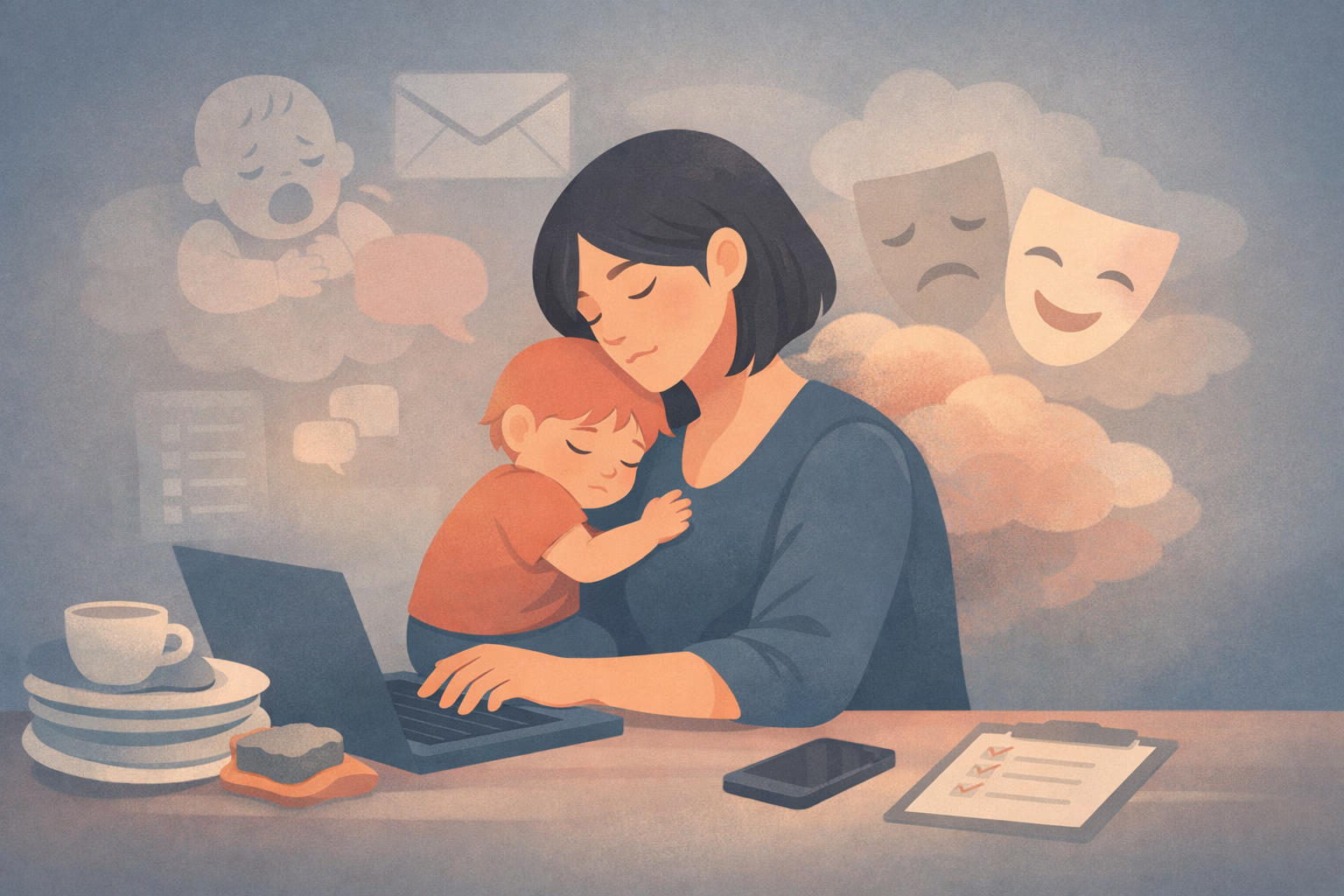
There’s a specific kind of tired that shows up when you’re the one who keeps the temperature of the room. You track who’s tense, who needs reassurance, who might take feedback personally, and which phrasing will prevent a spiral. You buffer, soften, translate, de-escalate, and repair—often while doing your actual job.
This can look like competence from the outside. Inside, it can feel like constantly holding your breath in small ways: monitoring your face, calibrating your words, and carrying the emotional aftermath of conversations that never fully land anywhere. Over time, that sustained effort is strongly linked with exhaustion and burnout. [Ref-1]
It’s not that the work is hard in one big moment. It’s that nothing ever feels fully “set down.”
Emotional labor draws on the same limited resources you use for attention, inhibition, decision-making, and social problem-solving. Even when it’s done skillfully, it costs energy because the nervous system is running extra computations: reading micro-signals, forecasting reactions, and preventing disruption in real time.
When your external presentation must stay pleasant, calm, or neutral regardless of what’s happening internally, the system has to maintain two tracks at once: the situation as it is, and the version of you that is allowed to appear. That split consumes capacity and can reduce recovery—especially when it happens across long shifts, repetitive interactions, or high-stakes roles. [Ref-2]
Importantly, this is not about being “too sensitive.” It’s about load. A well-tuned social nervous system is a powerful tool, but tools wear down when they’re used nonstop without reset conditions.
Humans evolved in small groups where social attunement helped you stay safe: noticing shifts in mood, responding quickly to conflict, and maintaining belonging. In those settings, regulation was naturally shared. If someone was distressed, someone else stepped in; if tension rose, the group adjusted.
Modern workplaces can require that same level of social navigation, but without the stabilizers that made it sustainable—fewer stable bonds, faster interactions, higher stakes, and constant evaluation. The “show must go on” dynamic can reward surface smoothness while quietly draining the people who produce it. [Ref-3]
What happens when a survival-grade skill becomes a full-time job requirement?
In many teams, emotional labor is a practical strategy. It keeps customers from escalating, prevents meetings from derailing, and helps people feel respected enough to stay engaged. In the moment, it can reduce interpersonal threat signals and preserve a sense of belonging.
This is why emotional labor can become a default. When someone reliably smooths the edges, the group experiences fewer disruptions. The immediate outcome looks like “good teamwork,” even if the real mechanism is one person doing extra regulation to reduce friction.
Research on surface acting and recovery suggests that when emotional display is demanded by the role, the need for recovery increases—because the system stays activated even when the interaction ends. [Ref-4]
Many workplaces run on an unspoken bargain: if you keep things pleasant, you’ll be seen as capable, reliable, and easy to work with. The group stays stable, deadlines get met, and no one has to name what’s uncomfortable.
But stability created by one person’s unshared load is fragile. It depends on continued output from the same nervous system, without a real redistribution of responsibility. Over time, the body starts to treat work as a place where completion doesn’t happen—where interactions don’t resolve, accountability doesn’t land, and “done” never arrives.
Studies connecting emotional labor to burnout dimensions point to a predictable outcome: when empathic effort is high and the demand to manage feelings is constant, depletion rises. [Ref-5]
Emotional labor often becomes an avoidance loop—not because someone is cowardly, but because the environment rewards immediate smoothness and punishes friction. If you anticipate that a direct conversation will create fallout (more work, more tension, more social cost), your system learns to route around it.
So the pattern becomes structural: you pre-empt discomfort by adjusting yourself. You take responsibility for the emotional weather so the work can proceed. The group receives a regulated surface, and the original tension remains unresolved underneath.
In this loop, “conflict avoided” can look like success while the internal cost accumulates. Over time, emotional labor is associated with burnout risk, especially when demands are high and reciprocity is low. [Ref-6]
Because emotional labor is often normalized, people don’t always recognize it as work. They just know they’re tired, irritable, or strangely unable to rest after a day of “mostly talking.”
These are not character traits. They’re signs of a nervous system running continuous interpersonal stabilization in an environment that doesn’t reliably provide closure.
When emotional labor is sustained, it can erode more than energy. It can blur the line between who you are and what the role requires. If you’re always adapting, you may lose access to clear internal signals about preference, capacity, and “enough.”
Boundaries can start to feel abstract—not because you don’t value them, but because the day-to-day system never rewards them. The body learns that belonging and safety are maintained through responsiveness, availability, and emotional containment.
Over time, people may feel less real at work, more replaceable, or oddly detached from what used to matter. This isn’t a personal failure of authenticity; it’s what can happen when your identity is repeatedly shaped by external regulation demands without adequate recovery and completion. [Ref-8]
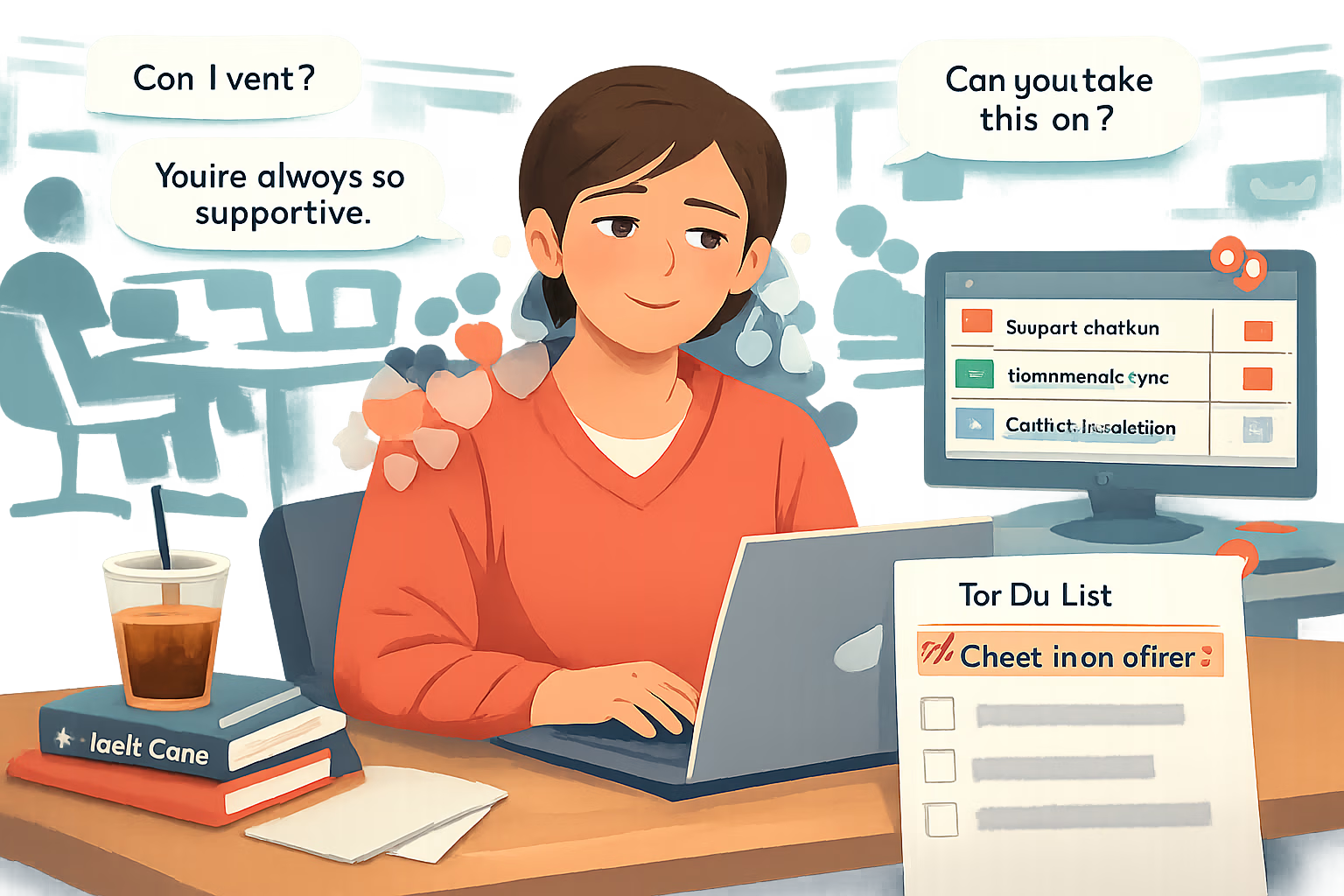
Invisible work tends to become assumed work. If you’re the person who remembers birthdays, notices tension, onboards the new hire emotionally, or repairs misunderstandings, the system quietly counts on that output. The more reliably you provide it, the less likely others are to notice it’s happening at all.
This creates a reinforcing dynamic: the group offloads emotional complexity onto the person who can handle it, and that person becomes increasingly responsible for keeping the social field stable. In many workplaces, this expectation is unevenly distributed along lines of role, gender, race, seniority, or “who’s easiest to approach.” [Ref-9]
Because the labor isn’t named, it’s hard to renegotiate. And without renegotiation, the loop rarely completes—there’s no shared “we’re done with this” signal, only ongoing demand.
There is a distinct kind of relief that isn’t about escaping work—it’s about no longer having to hold the whole relational structure in your body. When emotions are allowed to be real in the room, when limits are respected, and when repair is a shared practice, the nervous system receives a different message: the environment can carry truth without collapse. [Ref-10]
This is not the same as insight or “finally understanding.” It’s a shift in conditions. The social field becomes less dependent on one person’s masking, and more capable of absorbing normal human variance—stress, disappointment, disagreement—without making someone pay for it privately.
When responsibility is shared, the body stops bracing as if it’s the only support beam.
Emotional labor spikes when roles are unclear and consequences are unpredictable. If it’s not safe to name problems, someone will quietly manage them. If responsibilities are ambiguous, the most conscientious nervous system often becomes the default container.
Clear roles, mutual responsibility, and psychological safety reduce the need for constant interpersonal patching. Not because people become perfectly regulated, but because the system can tolerate reality: feedback can be delivered, needs can be stated, and repairs can occur without outsourcing the emotional cost to one person.
When workplaces recognize and redistribute unpaid emotional labor, burnout risk can decrease—not through motivation, but through structural load sharing. [Ref-11]
When emotional load is right-sized, people often notice changes that are surprisingly practical. Meetings take less out of you. You can think after you talk. You can stop “performing okay” and still remain professional. The body begins to expect that interactions can end—cleanly enough to allow recovery.
Authenticity here isn’t a dramatic confession or emotional intensity. It’s the quiet return of signal: clearer yes/no, clearer fatigue cues, clearer interest, clearer limits. Many people recognize it as less resentment, less post-meeting collapse, and more usable energy for both work and life. [Ref-12]
What if “being yourself” is simply what happens when you’re no longer over-assigned to emotional maintenance?
When emotional labor is constant, work engagement can become a vigilance project: staying ahead of reactions, preventing disappointment, and managing impressions. Over time, that can flatten meaning. You’re not oriented toward contribution; you’re oriented toward avoiding relational disruption.
As containment demands decrease, motivation often becomes less relevant—because coherence becomes more available. You can care about outcomes without carrying the emotional stability of the whole room. Effort starts to go toward craft, service, problem-solving, or leadership rather than constant self-monitoring.
This matters because emotion regulation effort is not free; it’s tied to fatigue when demands are prolonged. [Ref-13] When regulation is shared and closure is possible, meaning can re-form around what you actually contribute—not what you prevent.
Emotional labor is not a personality type. It’s a form of labor that emerges when a system needs regulation, harmony, and safety cues—and assigns that work informally instead of structurally.
When this labor is named with dignity, it becomes easier to see what’s actually happening: a distribution problem, not a personal deficiency. And when the load is seen, the possibility of fair recognition and shared responsibility becomes thinkable—without requiring anyone to become less caring. Chronic work stress has measurable effects on health, which is one reason this “invisible” workload deserves seriousness. [Ref-14]
Agency often begins as orientation: recognizing that what you’ve been carrying has a real cost, and that sustainable participation depends on conditions that allow completion.
Many people learned to create safety by being the calm one, the flexible one, the one who makes it easier for everyone else. That skill has value. It also has a limit.
Workplaces are healthiest when regulation is shared—when truth can be spoken without punishment, when boundaries are normal, and when people don’t have to disappear inside a role to keep belonging. In that kind of environment, caring becomes connective rather than costly. [Ref-15]
From theory to practice — meaning forms when insight meets action.
Because emotional labor draws on the same limited resources you use for attention, decision-making, and social problem-solving. The article describes it directly: tracking who's tense, calibrating words, buffering, translating, repairing — all done while doing your actual job. When external presentation must stay calm regardless of internal state, the system runs two tracks at once: the situation as it is, and the version of you allowed to appear. That split consumes capacity and reduces recovery, especially across long shifts and high-stakes interactions. Nothing felt 'hard' in a single moment — but nothing felt set down, either.
It can look that way from outside, but the article challenges the bargain. Workplaces often run on an unspoken deal: keep things pleasant and you'll be seen as capable. The group stays stable, deadlines get met, no one names what's uncomfortable. But stability created by one person's unshared load is fragile. It depends on continued output from the same nervous system without a real redistribution of responsibility. Over time, the body starts treating work as a place where completion doesn't happen — interactions don't resolve, accountability doesn't land, and Done never arrives. Care becomes carrying.
Because the environment rewards immediate smoothness and punishes friction. The article frames it structurally: if you anticipate a direct conversation will create fallout — more work, tension, social cost — your system learns to route around it. So you pre-empt discomfort by adjusting yourself. You take responsibility for the emotional weather so the work can proceed. The group receives a regulated surface, the original tension stays unresolved underneath. 'Conflict avoided' looks like success while the internal cost accumulates. Empathic effort plus chronic demand plus low reciprocity is a predictable formula for depletion.
The body stops bracing as if it's the only support beam. The article points to clearer roles, mutual responsibility, and psychological safety as the structural fix — not more individual resilience. When it's safe to name problems, when feedback can be delivered and repairs occur without outsourcing emotional cost to one person, the social field can absorb normal human variance without making someone pay privately. Restoration shows up practically: meetings take less out of you, you can think after you talk, you can stop performing okay and still remain professional. Authenticity becomes what's left when you're no longer over-assigned to maintenance.
From Science to Art.
Understanding explains what is happening. Art allows you to feel it—without fixing, judging, or naming. Pause here. Let the images work quietly. Sometimes meaning settles before words do.
One Quiet Window, one insight, one reflection — every Sunday