The Trap of Emotional Reactivity: When Feelings Hijack Behavior

In short: Many people think emotional maturity is something you “get” with age, success, or enough self-control. But what most of us call “immaturity” is often a predictable result of load: too many inputs, too little closure, and a nervous system that stays on alert because nothing feels finished.
Many people think emotional maturity is something you “get” with age, success, or enough self-control. But what most of us call “immaturity” is often a predictable result of load: too many inputs, too little closure, and a nervous system that stays on alert because nothing feels finished.
What if the real marker of growth is not how intensely you feel—or how little you feel—but how reliably you can return to coherence?
In that frame, emotional maturity becomes less about personality and more about capacity: the ability to stay oriented to what matters even when your body is running hot, your attention is split, and your story about what’s happening hasn’t fully settled yet.
Almost everyone has moments where their response surprises them: snapping at someone they care about, shutting down mid-conversation, spiraling after a small comment, or getting pulled into an argument that doesn’t match their values. It can feel embarrassing—like you “should be past this.”
But these moments usually aren’t proof of a flawed character. They’re signs of a system briefly running without enough bandwidth: the body detects threat, urgency, or social risk, and it reaches for the fastest available regulation pattern. That pattern may have been shaped early, practiced often, or reinforced by recent stress.
In other words, the reaction is not an identity. It’s a shortcut your nervous system takes when coherence is low and closure hasn’t arrived yet. [Ref-1]
Emotions are not the problem. They’re signals—changes in state that help the body allocate energy, attention, and protection. The struggle begins when signals keep rising without a “done” moment: no resolution, no repair, no clear ending, no sense that the situation has been metabolized into a coherent narrative.
When the nervous system is steadier, emotions can move through without commandeering behavior. That steadiness isn’t the same as insight or self-awareness. You can understand what’s happening and still be physiologically unable to come back online in the moment. Regulation is more like a return pathway: the ability to downshift from activation, re-enter perspective, and regain choice. [Ref-2]
Completion matters here. When a loop is completed—through a real-world ending, a repair, a boundary that holds, or a conflict that resolves—your system receives a stand-down signal. Without that, it often keeps recruiting the same reactions because it never gets evidence that the story is actually over.
Human development isn’t only about learning skills. It’s also about integrating experience into a workable sense of self: “This is what happened, this is what it meant, this is what I do now.” Emotional maturity is closely tied to that integration process—not as a thought exercise, but as a settling that shows up in behavior.
When experiences remain fragmented, people can feel like they have multiple selves in rotation: composed at work, reactive at home, numb in conflict, urgent in uncertainty. That isn’t hypocrisy. It’s the nervous system selecting different survival-compatible modes in different contexts, because a unified “this is me” hasn’t had enough closure to stabilize.
As identity becomes more coherent, emotional responses tend to become less absolute. Not because feelings are smaller, but because the person has more internal continuity to hold them. [Ref-3]
Regulation is not about never reacting. It’s about shortening the distance between activation and return. The sooner a system can return, the less collateral damage tends to accumulate—fewer sharp words, fewer impulsive decisions, fewer spirals that take hours to unwind.
This matters because regret is often not about what you felt; it’s about what the feeling recruited you to do before you had your full self available. When the return pathway is stronger, behavior becomes more consistent with values, and life generates fewer unfinished loops that need repairing later. [Ref-4]
Emotional maturity often looks quiet from the outside: fewer dramatic swings, more clean endings, and a steadier sense of what matters.
Our culture frequently uses external milestones as shorthand for maturity: career progress, relationship status, competence, independence. But those markers can coexist with a nervous system that’s still running on urgency, defensiveness, or avoidance.
Emotional maturity shows up less in what you can accomplish and more in how you move through friction: whether you can stay in contact with your values when something is disappointing, whether you can tolerate uncertainty without escalating, whether you can participate in repair without collapsing into shame or blame. [Ref-5]
Seen this way, maturity isn’t a badge you earn. It’s a capacity that becomes visible when the environment is challenging and the system must choose between reactivity and coherence.
A useful way to understand “immaturity” is as a disruption in the meaning loop: signal comes in, the system can’t complete it, and behavior becomes the fastest route to short-term stabilization. The goal isn’t to “be immature.” The goal is to reduce internal conflict quickly.
In a coherent loop, experience moves toward completion: a conversation reaches clarity, a boundary becomes real, a disappointment is metabolized, a misunderstanding gets repaired. In a disrupted loop, the system stays in partial activation, and decisions are made to relieve pressure rather than to express identity.
This is why people can sincerely value patience, honesty, or kindness—and still act in ways that don’t match. Under load, the system prioritizes immediate regulation over long-range meaning. [Ref-6]
When closure is missing and the nervous system is overloaded, certain patterns become especially likely. Not because someone is “bad at emotions,” but because these patterns reduce complexity fast.
These aren’t “types of people.” They are states and strategies—often learned because they worked at some point. [Ref-7]
Relationships rely on predictable return: the sense that if something goes sideways, there will be repair, clarity, and a coherent ending. When reactivity dominates, people around you may not feel safe enough to stay present. They may start walking on eggshells, withholding honesty, or disengaging to protect themselves.
In leadership and collaboration, the costs are similar. If others can’t anticipate how you’ll respond under stress, they will route around you. Work becomes about managing moods and avoiding triggers rather than building trust and shared meaning.
Over time, growth can stall—not because you don’t want to change, but because life keeps generating unfinished loops: conflicts that never close, feedback that becomes personal threat, and situations that repeat with new characters. [Ref-8]
When an emotional episode doesn’t reach completion, it often returns—not necessarily as the same feeling, but as the same structure. The next disappointment arrives and the nervous system reacts as if it’s cumulative. The next conflict arises and it carries the weight of every unresolved ending before it.
This is one reason people feel stuck: they are not failing to understand. They are living inside a system that keeps reactivating because the “done” signal hasn’t landed. In those conditions, the brain tends to conserve energy by repeating familiar responses, even if those responses create more long-term turbulence. [Ref-9]
So the pattern isn’t “I always overreact.” The pattern is “my system hasn’t been able to close the loop.”
Self-awareness is valuable, but it is not the same as integration. You can accurately label your triggers, your history, and your attachment style—and still respond in the old way when your body is flooded or depleted.
Mature response is less a mental achievement and more a capacity event: enough pacing, enough safety cues, enough internal room for multiple truths at once. When capacity is present, the system can delay immediate discharge and stay oriented to meaning. When capacity is absent, reactivity becomes the body’s way of reducing overload.
In workplaces and high-demand settings, research and applied training often emphasize this distinction: regulation skills are not “soft.” They change decision quality, relational stability, and recovery after stress. [Ref-10]
Emotional maturity isn’t only internal. It’s also relational: the ability to stay in contact with other people’s reality without losing your own, and the ability to create clean repairs when something goes wrong.
Accountability is not self-punishment. It’s the act of restoring coherence: acknowledging impact, clarifying intent, and closing the loop so the relationship doesn’t have to carry unfinished tension. Empathy supports that closure by widening the frame—more context, less urgency, fewer zero-sum interpretations.
In leadership contexts, emotional regulation is repeatedly associated with effectiveness because it stabilizes the social field: people can predict responses, take appropriate risks, and resolve friction without escalation. [Ref-11]
When emotional maturity is emerging, it often looks surprisingly ordinary. Not constant calm, but a more dependable return. Less time spent in all-or-nothing states. More capacity to hold a situation without needing it to resolve instantly.
This steadiness is closely linked with identity development: when the self is more coherent, regulation tends to be more consistent across contexts. The person doesn’t have to rebuild their orientation every time something challenging happens. [Ref-12]
The clearest sign of emotional maturity is not suppression and not intensity. It’s governance: feelings get a seat at the table, but they don’t become the entire government.
When meaning is intact, impulses are less compelling because the system has an alternative anchor: identity, values, and a stable narrative about what kind of person you are becoming. This doesn’t eliminate distress. It changes what distress can make you do.
Research on emotion regulation and identity suggests that how we manage internal states is intertwined with how stable and coherent the self feels over time. As coherence strengthens, regulation becomes less like a battle and more like a natural return to what fits. [Ref-13]
“Honor” doesn’t mean obeying every urge, and it doesn’t mean forcing yourself to feel differently. It means recognizing feelings as real signals inside a larger system—signals that deserve acknowledgment, context, and completion.
When identity development is supported—by environments that allow repair, by relationships that can hold truth without humiliation, and by rhythms that permit closure—people often become steadier without needing to become harder. Agency returns as coherence returns. [Ref-14]
You don’t have to win against your emotions. You do have to live with them in a way that lets your life come back together.
True growth is not best measured by achievements, intensity, or how impressive your coping looks from the outside. It is measured by the depth of your return: how reliably your system can come back from activation, close what’s unfinished, and keep your actions aligned with what matters.
From early life onward, regulation develops through repeated experiences of settling after disruption—learning, over time, that states can move and end. Emotional maturity is that same developmental arc continuing into adulthood: a steadier nervous system, a more coherent identity, and fewer moments where your life gets steered by an unfinished loop. [Ref-15]
From theory to practice — meaning forms when insight meets action.
Not automatically, no. The article reframes it as capacity, not personality or milestone. External markers like career, status, or independence can coexist with a nervous system still running on urgency or defensiveness. Maturity shows up less in what you accomplish and more in how you move through friction — whether you can stay in contact with values when something is disappointing, tolerate uncertainty without escalating, participate in repair without collapsing into shame. It's coherence under load, not a badge you earn by getting older.
Because under load, the body reaches for the fastest available regulation pattern — often one shaped early or practiced often. That reaction isn't an identity; it's a shortcut your nervous system takes when coherence is low and closure hasn't arrived. The 'snap mid-conversation' or 'spiral after a small comment' isn't proof of flawed character. It's a sign of a system briefly running without enough bandwidth. You can accurately label your triggers and still respond in the old way when your body is flooded — because mature response is a capacity event, not a mental achievement.
Unfinished loops. When an emotional episode doesn't reach completion, it returns — not always as the same feeling, but as the same structure. The next disappointment lands with cumulative weight; the next conflict carries every unresolved ending before it. People feel stuck not because they fail to understand, but because they're living inside a system that keeps reactivating because the Done Signal hasn't landed. The pattern isn't 'I always overreact.' It's 'my system hasn't been able to close the loop.'
Surprisingly ordinary. Not constant calm, but a more dependable return. Less time in all-or-nothing states. Conflict becomes more solvable because endings are cleaner. Feedback creates information, not identity threat. Values show up in behavior more reliably, especially when it's inconvenient. The clearest sign isn't suppression or intensity — it's governance: feelings get a seat at the table, but they don't become the entire government. You're not winning against your emotions; you're living with them in a way that lets your life come back together.
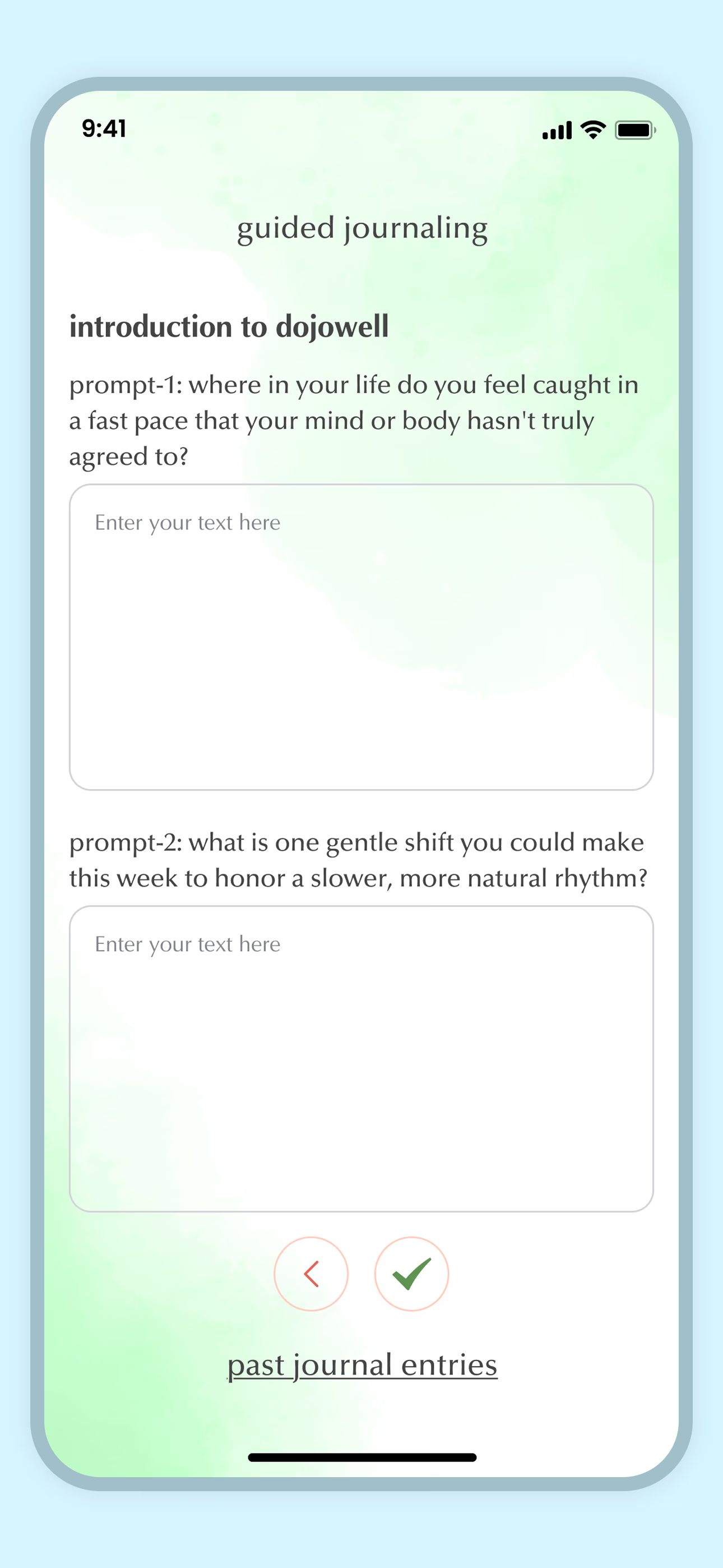
From Science to Art.
Understanding explains what is happening. Art allows you to feel it—without fixing, judging, or naming. Pause here. Let the images work quietly. Sometimes meaning settles before words do.
One Quiet Window, one insight, one reflection — every Sunday