Digital Dependence: When Technology Becomes Emotional Support

In short: A place to log your mood, write a few lines, follow a guided prompt, or get a steady reminder to check in with yourself. For many people, that structure can feel surprisingly relieving—not because it “fixes” anything, but because it adds a small island of consistency inside a week that may otherwise feel scattered.
Emotional support apps are often marketed as simple helpers: a place to log your mood, write a few lines, follow a guided prompt, or get a steady reminder to check in with yourself. For many people, that structure can feel surprisingly relieving—not because it “fixes” anything, but because it adds a small island of consistency inside a week that may otherwise feel scattered.
What if the comfort isn’t the phone itself, but the sense of being met—regularly, predictably, without judgment?
From a nervous-system perspective, the appeal makes sense. When life has too many open loops—unfinished conversations, unclear roles, constant evaluation—systems stay activated. A well-designed app can offer a small form of closure: a beginning, middle, and end to a daily check-in. That can reduce load, even if it doesn’t replace the deeper settling that comes from lived completion and real attunement.
Isolation isn’t always about being alone. Many people are surrounded by others and still feel unheld—because there’s no reliable place to land with what’s happening inside. In that state, the nervous system often prioritizes predictability over depth: a consistent signal that says, “You can come back here.”
Emotional support apps tend to meet this need in a specific way: they offer a nonreactive space. No facial expressions to interpret, no fear of burdening someone, no social negotiation. That can lower pressure and create a sense of safety-by-structure.
Research on emotion regulation apps suggests benefits are often modest but real, especially around emotion regulation skills rather than dramatic symptom removal. [Ref-1]
In overwhelm, the hardest part is often not “what to do,” but the cognitive and physiological effort of choosing. A prompt—“How are you right now?”—shrinks the decision field. A short exercise offers a contained sequence. Even a simple rating scale can convert a diffuse state into something trackable, which reduces ambiguity.
Many evidence-based mental health apps use elements like mood tracking, guided reflection, CBT-style prompts, or mindfulness modules. When these are well matched to the user, they can reduce stress load by making the next step concrete rather than endless. Meta-analytic findings suggest small but significant improvements in anxiety and depressive symptoms across evidence-based apps, with outcomes depending on design and engagement. [Ref-2]
It’s important to notice what this kind of support actually provides: not integration by insight, but a repeatable container that can help the system downshift enough to regain capacity.
Human regulation is deeply social. Nervous systems learn safety through cues: timing, tone, responsiveness, repair after misattunement. That’s part of why distress can intensify when there’s no feedback loop—no “I see you,” no adjustment, no shared sense of done.
Apps can partially bridge the gap by offering consistent responsiveness (a check-in always “answers”), and that can be stabilizing in moments of high activation. But it’s a partial bridge. The kind of settling that comes from being known, responded to, and repaired-with happens in a relational field that updates identity over time.
Reviews of mobile apps used alongside psychotherapy often frame them as helpful adjuncts—support between sessions—rather than substitutes for the relational mechanisms that make care effective. [Ref-3]
When distress spikes, the body often wants immediacy: a quick reduction in uncertainty, a clear next step, a contained sequence. Emotional support apps can provide “short loops” that end cleanly—start the exercise, complete it, receive a summary or reflection, and stop. That completion matters because it gives the nervous system a small “done” signal.
Some studies suggest that structured skill-based apps (for example, CBT-informed tools that include guidance and feedback) can outperform simple self-monitoring alone. In other words, it’s not only tracking that helps, but the presence of a guided pathway that completes a cycle. [Ref-4]
Sometimes what you need isn’t a breakthrough. It’s a safe, repeatable ending.
It’s easy to slip into a quiet hope that an app will fill a deeper gap: the missing sense of being anchored in a relationship, a community, or a coherent story of self. But attachment and identity aren’t solved by access to tools. They stabilize through lived continuity—through experiences that complete and re-complete over time until they settle into “this is who I am” and “this is where I belong.”
Emotion regulation apps commonly include features like journaling, mood tracking, CBT modules, and mindfulness components, and these can be legitimately supportive. [Ref-5] Still, the app’s consistency is not the same as relational integration. Structure can reduce activation; it cannot on its own create the kind of identity-level coherence that comes from real-world completion.
This isn’t a critique of users or apps. It’s a reminder of what each tool is built to do.
Many people download emotional support apps during a period when life feels ungraspable: too many demands, too much uncertainty, too few places to process. In that context, an app can function like scaffolding—supporting a structure while other parts are under strain.
Journaling and mood tracking can help organize experience into sequences: what happened, what changed in the body, what eased it, what intensified it. This doesn’t equal integration on its own, but it can reduce fragmentation and make it easier for future experiences to land with more order. Development work on journaling and mood-tracking tools often emphasizes this organizing function—turning diffuse states into patterns that can be named and followed over time. [Ref-6]
In Meaning Loop terms, the app offers a repeatable “beginning-middle-end.” That’s not a personality upgrade; it’s a closure support.
When an emotional support app fits well, the changes are often subtle and structural. Not a new identity overnight, but fewer spirals and a clearer sense of sequence. Over time, that can restore capacity for signals to return—sleep, appetite, concentration, relational patience.
Many apps operationalize this through thought diaries, mood check-ins, and guided writing prompts—features commonly found in CBT-style tools. [Ref-7]
Overreliance usually doesn’t start as “dependence.” It often starts as relief: the app works, the body settles, and the day becomes manageable. The risk emerges when the app becomes the only place where experience gets organized—while the rest of life stays structurally unfinished.
In that situation, the nervous system can learn a narrow pathway to calm: “I’m okay when the app is present.” That can create a kind of false security, where momentary soothing stands in for deeper completion—like a pause button that delays the real ending.
Mood tracker and support apps vary widely in how they structure reflection versus merely collecting data, and that difference can shape whether users feel more coherent or simply more monitored. [Ref-8]
Not all calm is closure.
App design matters because nervous systems respond to cues. A reminder can act like an external regulator: a time anchor that interrupts drift. A streak can create continuity when days feel interchangeable. A prompt can reduce the burden of generating language from scratch.
These features also reinforce engagement by making the loop easy to repeat: cue → action → completion → small reward (a badge, a summary, a sense of “I did it”). CBT-oriented app ecosystems often use structured prompts and modules precisely because structure increases follow-through. [Ref-9]
The value is not in gamification as motivation. It’s in the predictability of the sequence—something that ends cleanly and returns tomorrow.
Over time, many users find that what once felt like “the app helping” starts to look more like “a pattern forming.” Not a sudden transformation, but an emerging inner sequence: noticing earlier, labeling more clearly, recovering faster after spikes, and recognizing the difference between overload and true danger.
It’s not that awareness becomes integration. Integration is more like a settling that shows up after enough lived completion—when the system stops re-opening the same loop. But reflective habits can create conditions where completion is more possible: less chaos, fewer untracked triggers, fewer days lost to undefined urgency.
Some clinics describe these apps as supportive daily check-ins that can help people build stable reflection rhythms alongside other forms of care. [Ref-10]
An app can be steady. It cannot be attuned in the full human sense. Attunement isn’t just “response”; it’s responsiveness that changes with you—context, history, subtle cues, and repair when something lands wrong.
This is why many clinicians frame mental health apps as complements: useful between sessions, supportive for practice, but not replacements for therapy or trusted relationships where a person is known and responded to in real time. [Ref-11]
Relational feedback does something unique: it updates identity. It helps experiences land in a shared reality, which makes completion more likely. An app can organize; a relationship can metabolize.
Consistent scaffolding can reduce reactivity by lowering uncertainty and giving distress a predictable channel. When the system isn’t constantly improvising, capacity returns: attention widens, choices feel less urgent, and the body spends less time bracing.
At the same time, some concerns have been raised about overreliance on AI-style emotional support and conversational tools—particularly if they displace human contact or reduce opportunities to practice real-world relational regulation. The risk is not “getting attached to an app” as a character flaw, but the narrowing of regulation pathways when one channel becomes the default. [Ref-12]
Stability grows when regulation is distributed—across routines, relationships, environments, and inner sequences—rather than concentrated in a single tool.
At their best, emotional support apps are transitional supports: a way to hold experience long enough for life to become more finishable. They can help someone keep a thread during a hard season—until other parts of the system can participate again.
Deeper coherence tends to show up as fewer reopened loops: less repetitive self-interrogation, less chasing of reassurance, less urgent control. Not because the person learned the perfect technique, but because more experiences reached completion and began to belong to a stable identity.
Public conversations about mental health tech often return to the same point: apps can be helpful, but they are not adequate substitutes for psychotherapy or the therapeutic relationship when deeper repair is needed. [Ref-13]
Emotional support apps can be a genuine kindness: a structured pause, a steady mirror, a small closure ritual in the middle of a fragmented day. For many nervous systems, that’s not trivial—it’s a form of load reduction.
They’re also limited by design. Belonging, repair, and identity-level settling tend to require contact with reality outside the screen: relationships that respond, environments that change, and experiences that truly end rather than simply being managed. Blended and online models of support often emphasize this balance—tools can extend care, but human attunement and context still carry unique weight. [Ref-14]
If an app helps, it can be understood as scaffolding: not proof that you should handle everything alone, and not evidence that you’re broken without it—just a tool that makes today more coherent than it would have been otherwise.
Emotional resilience usually looks quieter than the internet makes it seem. It’s the return of “enough”: enough steadiness to sleep, enough clarity to speak, enough capacity to be with others without bracing. Apps can support that by offering repeatable structure, especially when the system is overloaded.
And the deeper stability most people are longing for tends to come from a wider weave—digital scaffolds alongside reflection that actually completes, relationships that provide real feedback, and a life that gradually makes more sense to inhabit. Engagement research on conversational agents suggests people can connect with these tools, but also that engagement has limits and patterns that don’t automatically translate into lasting change. [Ref-15]
You don’t need to become a different person to feel better. Often, you need fewer open loops—and more moments that genuinely end.
From theory to practice — meaning forms when insight meets action.
Research suggests benefits are real but modest, especially around emotion regulation skills rather than dramatic symptom removal. Meta-analytic findings show small but significant improvements in anxiety and depressive symptoms across evidence-based apps, with outcomes depending on design and engagement. The most useful framing is structural: a well-designed app offers a small form of closure inside a fragmented day — a beginning, middle, and end to a check-in. That can reduce load and provide repeatable scaffolding for nervous systems carrying too many open loops. They aren't placebos, but they aren't deeper repair either; they're load reduction tools that work best when expectations match what they can actually do.
Apps can echo attunement but not fully supply it. Human regulation is deeply social — nervous systems learn safety through cues like timing, tone, responsiveness, and repair after misattunement. Apps offer consistent responsiveness (a check-in always answers), and that's stabilizing in moments of high activation. But the kind of settling that comes from being known, responded to, and repaired-with happens in a relational field that updates identity over time. Apps organize; relationships metabolize. Most clinicians frame these tools as helpful adjuncts — supportive between sessions or for daily reflection — rather than substitutes for the relational mechanisms that make care effective.
Overreliance usually doesn't start as dependence — it starts as relief. The app works, the body settles, the day becomes manageable. The risk emerges when the app becomes the only place experience gets organized while the rest of life stays structurally unfinished. The system then learns a narrow pathway to calm: 'I'm okay when the app is present.' That can create a kind of false closure where momentary soothing stands in for deeper completion. Stability grows when regulation is distributed across routines, relationships, environments, and inner sequences — not concentrated in a single tool. Not all calm is closure.
The changes are usually subtle and structural rather than dramatic — fewer spirals, clearer sense of sequence, restored capacity for signals to return (sleep, appetite, concentration, relational patience). People notice more consistent reflection, check-ins that make internal states easier to track, less time lost to vague urgency ('something is wrong but I can't tell what'), temporary reduction in reactivity because there's a predictable container, and clearer language for patterns. Over time, what once felt like 'the app helping' starts looking more like a pattern forming inside — noticing earlier, recovering faster, recognizing the difference between overload and true danger. Scaffolding becomes inner sequence.
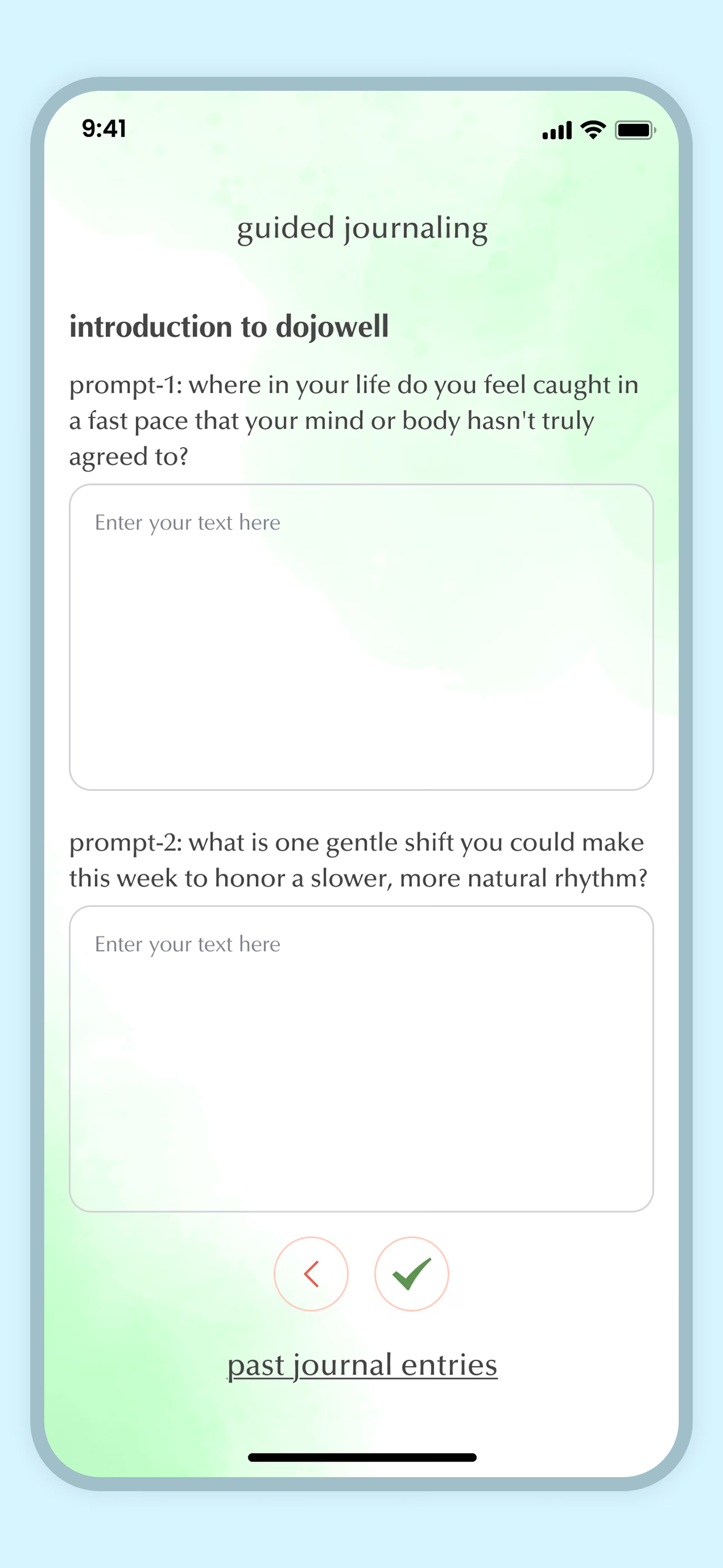
From Science to Art.
Understanding explains what is happening. Art allows you to feel it—without fixing, judging, or naming. Pause here. Let the images work quietly. Sometimes meaning settles before words do.
One Quiet Window, one insight, one reflection — every Sunday