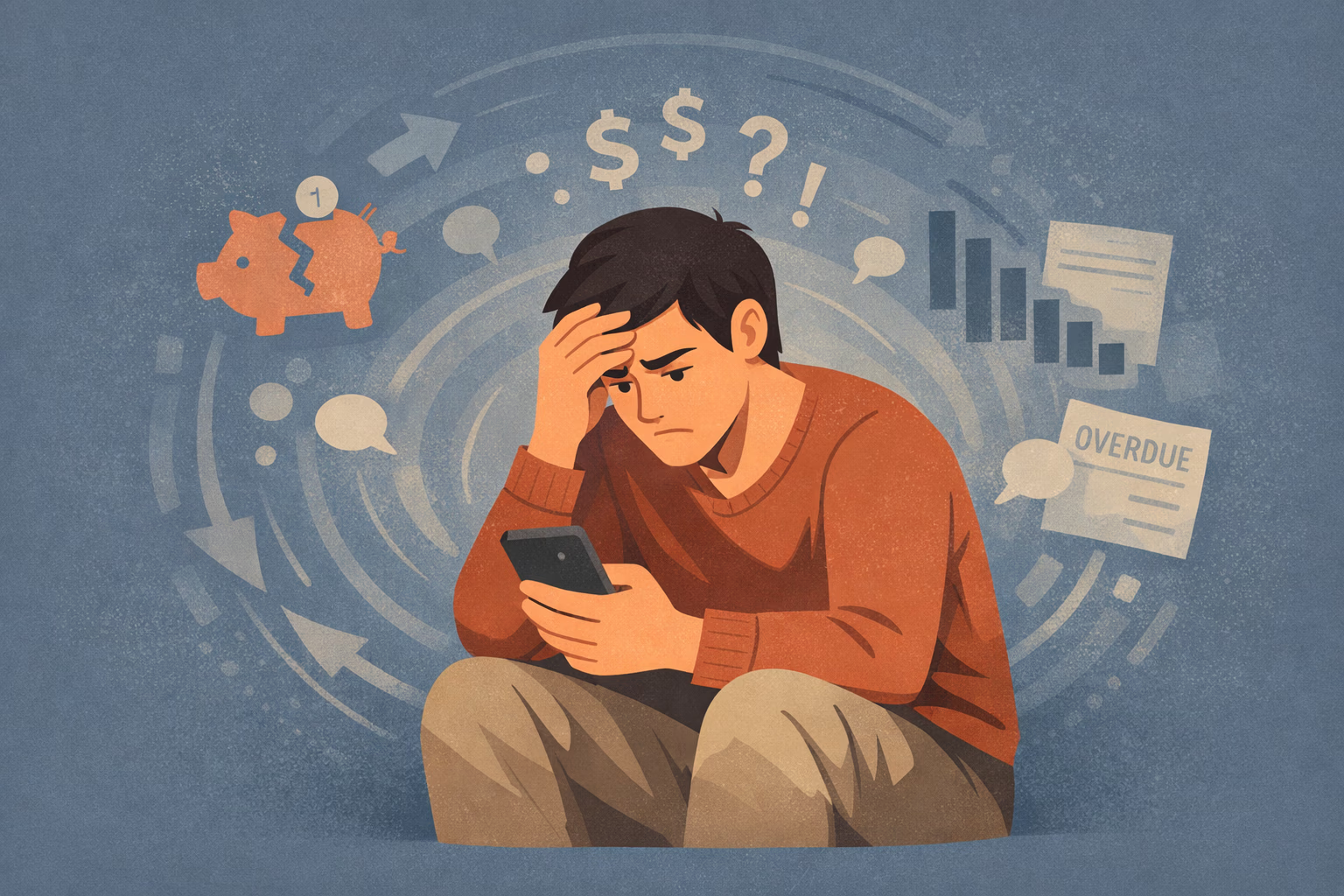
Paralysis by Overthinking: When Every Decision Feels Heavy
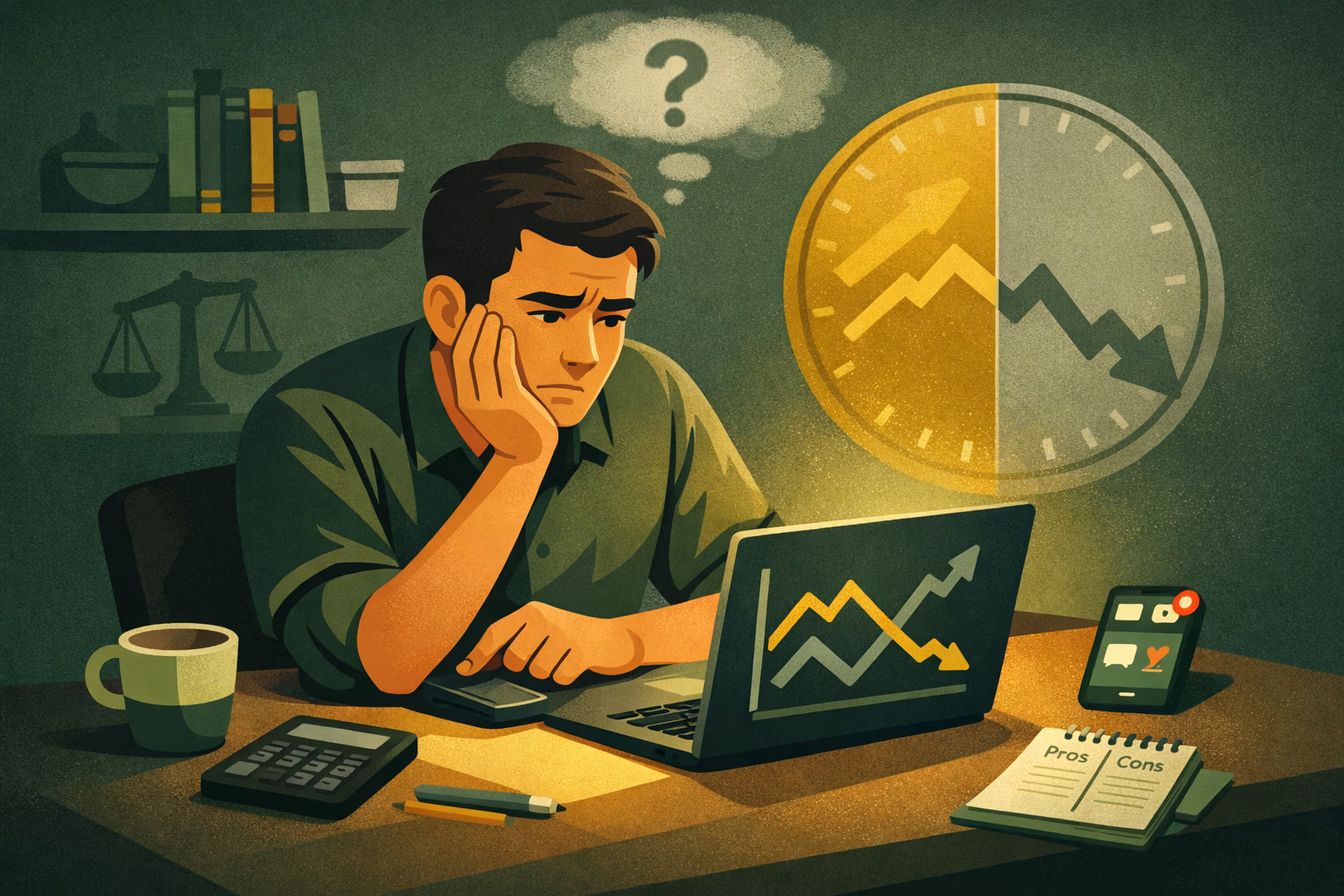
In short: Investment anxiety often looks like “being careful,” but inside it can feel like standing at the edge of a cliff with a spreadsheet in your hands. The choice isn’t just about money; it’s about responsibility, identity, and the possibility of regret.
Investment anxiety often looks like “being careful,” but inside it can feel like standing at the edge of a cliff with a spreadsheet in your hands. The choice isn’t just about money; it’s about responsibility, identity, and the possibility of regret. Under enough pressure, even simple decisions can start to register as high-stakes.
What if the problem isn’t that you’re bad at decisions—but that your system is overloaded and can’t find a “done” signal?
This kind of hesitation is not a character flaw. It’s a regulatory response that makes sense in a world where outcomes are uncertain, information is endless, and social comparison is always nearby. When the brain can’t reliably complete the loop from “consider” to “choose” to “learn,” it often tries to protect you by keeping the decision open.
Investment anxiety commonly shows up as a loop: read more, compare more, run one more scenario, then feel less certain than before. You might notice a constant “check again” impulse—like certainty is just one more article away. [Ref-1]
In that state, not choosing can feel like the safest option, because it postpones the moment where reality could confirm or contradict your judgment. The nervous system often prefers an open loop with imagined control over a closed loop with unpredictable feedback.
It can feel like you’re being responsible, but your mind never gets to put the decision down.
When the outcome is probabilistic and the stakes feel personal, the brain’s threat-and-control circuits tend to light up. Uncertainty increases scanning; scanning increases perceived complexity; complexity increases hesitation. Information overload doesn’t always expand clarity—it can compress attention into threat detection. [Ref-2]
Losses also tend to feel louder than gains. Under stress load, the mind weights “what could go wrong” more heavily than “what could go right,” not because you’re pessimistic, but because risk management is a core survival function. In this narrowed state, decisions can start to feel like traps: every option contains a future you might regret.
Humans evolved in environments where resources were concrete and feedback was immediate: you could often see what you had, what you lost, and what it meant for your standing and safety. A cautious bias made sense when mistakes could be irreversible.
Modern investing asks for something very different: choosing under abstraction. You’re asked to commit without full visibility, tolerate noise, and accept that even “good” decisions can have short-term negative outcomes. Regret aversion and information cascades can intensify this, pulling people toward delays or crowd-following when personal certainty feels unavailable. [Ref-3]
Delaying an investment decision often reduces anxiety quickly—not because the situation improved, but because responsibility temporarily lifts. The nervous system gets a short “stand down” signal: no choice made, no error possible today.
Structurally, postponement also keeps consequences muted. When the decision stays hypothetical, the mind can keep revising the story without needing to integrate a real outcome. That can feel like safety, especially when the imagined cost of regret is high. [Ref-4]
Waiting can look like prudence, but paralysis has its own price: missed time, missed compounding, and prolonged cognitive load. The mind often treats “no decision” as a neutral state, yet in real financial systems, time itself is a variable.
Analysis paralysis isn’t just “too much thinking.” It’s what happens when thinking becomes the substitute for closure—when research is used to delay the finality of choosing. The longer the loop stays open, the more the decision can feel charged and dangerous. [Ref-5]
What if “not choosing yet” is still a choice—just one that keeps the nervous system on duty?
Investment anxiety often follows a Power Loop: uncertainty triggers a need for control; control is pursued through more analysis; analysis increases complexity; complexity increases uncertainty. Over time, the attempt to eliminate risk becomes the mechanism that keeps risk feeling intolerable. [Ref-6]
This loop is not irrational. It’s a system trying to restore stability by expanding cognition. But cognition can’t always deliver the “complete” signal the body is looking for—especially when the environment keeps updating, and the target (a perfect decision) doesn’t exist.
Because this is a regulation issue, it often repeats in recognizable shapes. The details differ, but the structure is similar: more input, less closure.
These aren’t “bad habits.” They’re ways a loaded system tries to stay safe in a domain where certainty can’t be earned in advance.
When a decision remains open for too long, the mind doesn’t just stay busy—it can start revising your identity: “I’m not someone who can choose,” or “I always mess this up.” That narrative shift is often the heaviest cost, because it reduces future agency even if the market conditions improve.
There’s also a momentum cost. Without real-world feedback, confidence can’t be built through lived evidence. And the longer the loop stays incomplete, the more any eventual decision feels like a referendum on your competence. Research on investment decisions notes how regret aversion and social influence can amplify these spirals over time. [Ref-8]
In many parts of life, uncertainty decreases through exposure to outcomes: you choose, you see what happens, you adjust. With investment anxiety, avoidance interrupts that sequence. The system doesn’t get clean data, so it keeps treating the domain as unknown and potentially threatening.
This is one reason regret aversion can grow stronger: if you don’t practice tolerating imperfect outcomes, the mind can keep inflating the meaning of a “wrong move.” The decision becomes less about portfolio fit and more about protecting yourself from a future story where you feel at fault. [Ref-9]
When experience can’t complete the loop, the mind tries to finish it with imagination.
There is a distinct shift that can happen when the nervous system is no longer demanding total certainty before allowing movement. It’s not a burst of confidence or a clever reframe. It’s more like internal noise drops, and the decision stops feeling like a personal emergency.
In that settled state, “unknown” is still present, but it isn’t consuming the whole frame. The mind can hold probability without turning it into catastrophe, and the body can remain oriented instead of braced. This is the kind of stabilization often described in decision paralysis: not the removal of uncertainty, but the reduction of threat activation around it. [Ref-10]
Isolation can intensify investment anxiety because it concentrates responsibility into a single nervous system. When there’s no relational buffering—no normalization, no reality-checking, no shared frame—the decision can start to feel like it must be perfect to be legitimate.
By contrast, guidance and shared decision-making can reduce the sense that you’re alone with the consequences. It doesn’t remove risk; it changes the social and cognitive load around the risk, which often reduces the compulsive need to control every variable. [Ref-11]
When the body is less activated, attention becomes more flexible. You can zoom out, consider time horizons, and weigh trade-offs without the same urgency. Risk becomes something you can relate to proportionally rather than something that defines your safety.
This is also when confidence tends to look more realistic: not “I know the market,” but “I can make a decision and stay coherent even if the outcome isn’t ideal.” Research on risk perception consistently shows that our sense of risk shifts with context, stress, and how immediately threatened we feel. [Ref-12]
When the Power Loop loosens, investing can return to its rightful place: a tool in service of a life. Decisions become easier to situate within longer-term values—security, family stability, freedom, generosity, dignity—rather than being driven primarily by the need to avoid regret.
In that frame, the question subtly changes. It’s less “How do I guarantee I won’t be wrong?” and more “What direction fits the person I’m becoming, given the reality that markets fluctuate?” This is how regulated decision-making supports a coherent identity: choices begin to feel like continuity, not like a gamble with your self-respect. [Ref-13]
Investment anxiety is often a fear of responsibility under uncertainty—made heavier by modern information density and constant evaluation. That doesn’t mean you’re incapable. It means your system is treating the decision as a high-impact identity event, and it’s trying to keep you safe by keeping the loop open. [Ref-14]
When life becomes more coherent, decisions don’t necessarily become easy—but they become less loaded. You can sense the difference between careful consideration and endless scanning. You can feel when a choice is anchored in values rather than in an attempt to eliminate all future regret.
Agency isn’t the absence of risk. It’s the return of orientation.
In investing, regret can never be fully engineered away—because the future is not a controlled experiment. Regret aversion is a human bias, not a personal failing, and it tends to get louder when decisions are treated as verdicts on who you are. [Ref-15]
What steadies people over time is often quieter than confidence: a sense of direction, humility about outcomes, and the experience of completing decisions and living through the results. Not perfect control—coherence.
From theory to practice — meaning forms when insight meets action.
Investment anxiety often looks like "being careful" but feels closer to standing at the edge of a cliff with a spreadsheet. The decision isn't just financial; it's tangled up with responsibility, identity, and the possibility of regret. Under uncertainty, loss salience rises sharply — the brain weighs potential losses far more heavily than equivalent gains, and attention narrows toward worst-case modeling. Research stops being preparation and becomes a holding pattern: motion that feels productive but is actually preventing the loop from closing. Risk sensitivity is an ancient feature, not a modern defect, but in modern life it can keep coherent action perpetually deferred.
It usually feels safer because delay temporarily removes the possibility of being wrong. But the safety in waiting is an illusion — the decision is still being made, just in the form of inaction, and the costs of inaction are simply less visible. This is the Power Loop signature: control-seeking that keeps real control out of reach. The longer indecision runs, the more it erodes self-trust, because the system collects evidence that you can't move under uncertainty. Avoidance also blocks the learning that would lower future uncertainty — you only become more accurate at risk by making real decisions and watching what happens.
Endless research is often a regulator, not a method. It keeps the Threat & Safety System occupied with the appearance of vigilance while preventing the moment of commitment that the body registers as exposure. Common patterns include rereading the same materials, seeking one more opinion, and waiting for a feeling of certainty that never arrives. The pattern signals that the loop is running. What helps isn't more information; it's lowering the threat charge around being wrong, often through smaller decisions that let the system practice tolerating uncertainty without collapse. Decisions made with shared input also redistribute the felt weight.
Settling looks like making the decision when certainty is no longer required as a precondition. As threat activation decreases, proportional risk returns — the same numbers feel less catastrophic because they're being read by a regulated system rather than an alarmed one. Coherent investing aligns with values rather than with panic avoidance: the decision reflects what the money is for, not just what could go wrong. Clarity doesn't come from eliminating risk; it comes from the body being able to hold risk without flooding. A more accurate story than "I'm bad with money" is usually "my system has been treating financial decisions as survival decisions."
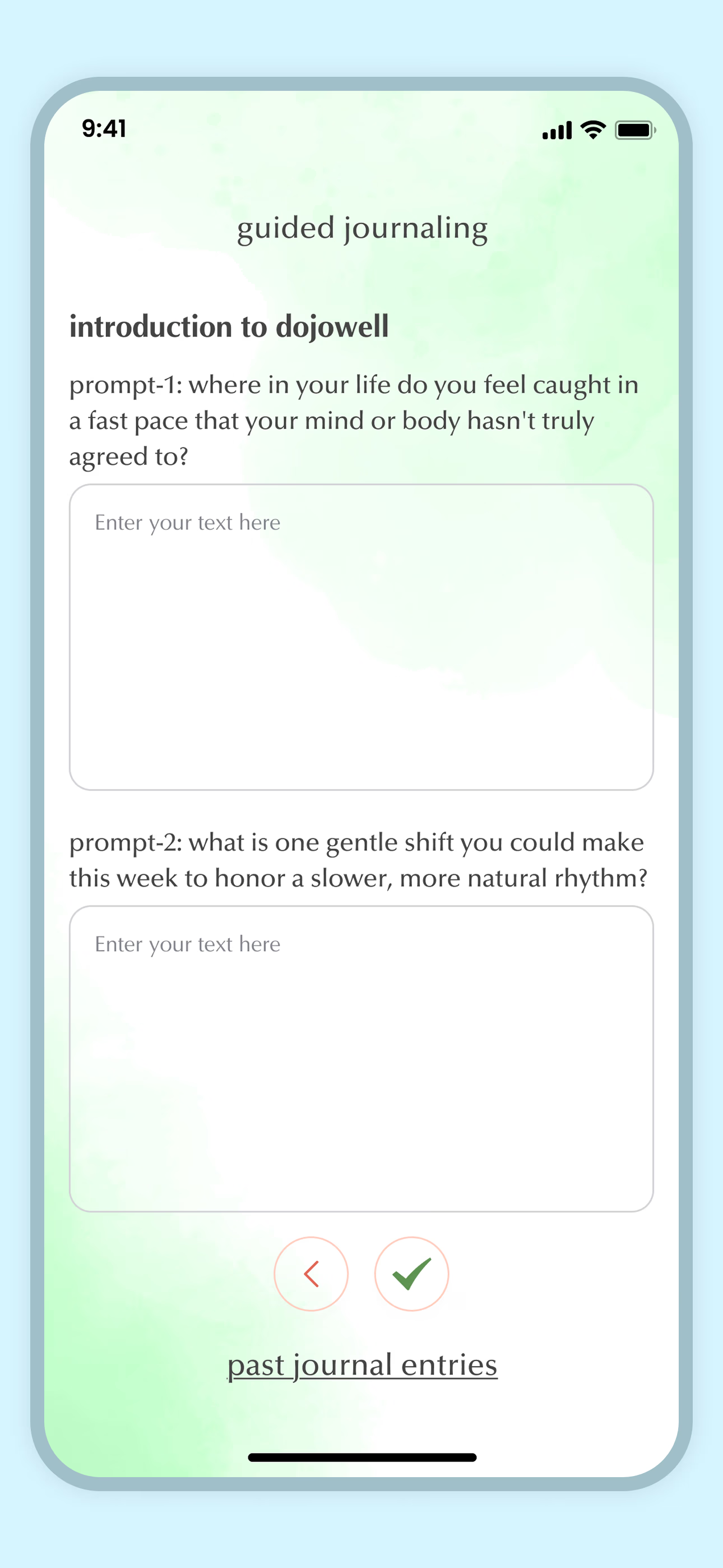
From Science to Art.
Understanding explains what is happening. Art allows you to feel it—without fixing, judging, or naming. Pause here. Let the images work quietly. Sometimes meaning settles before words do.
One Quiet Window, one insight, one reflection — every Sunday