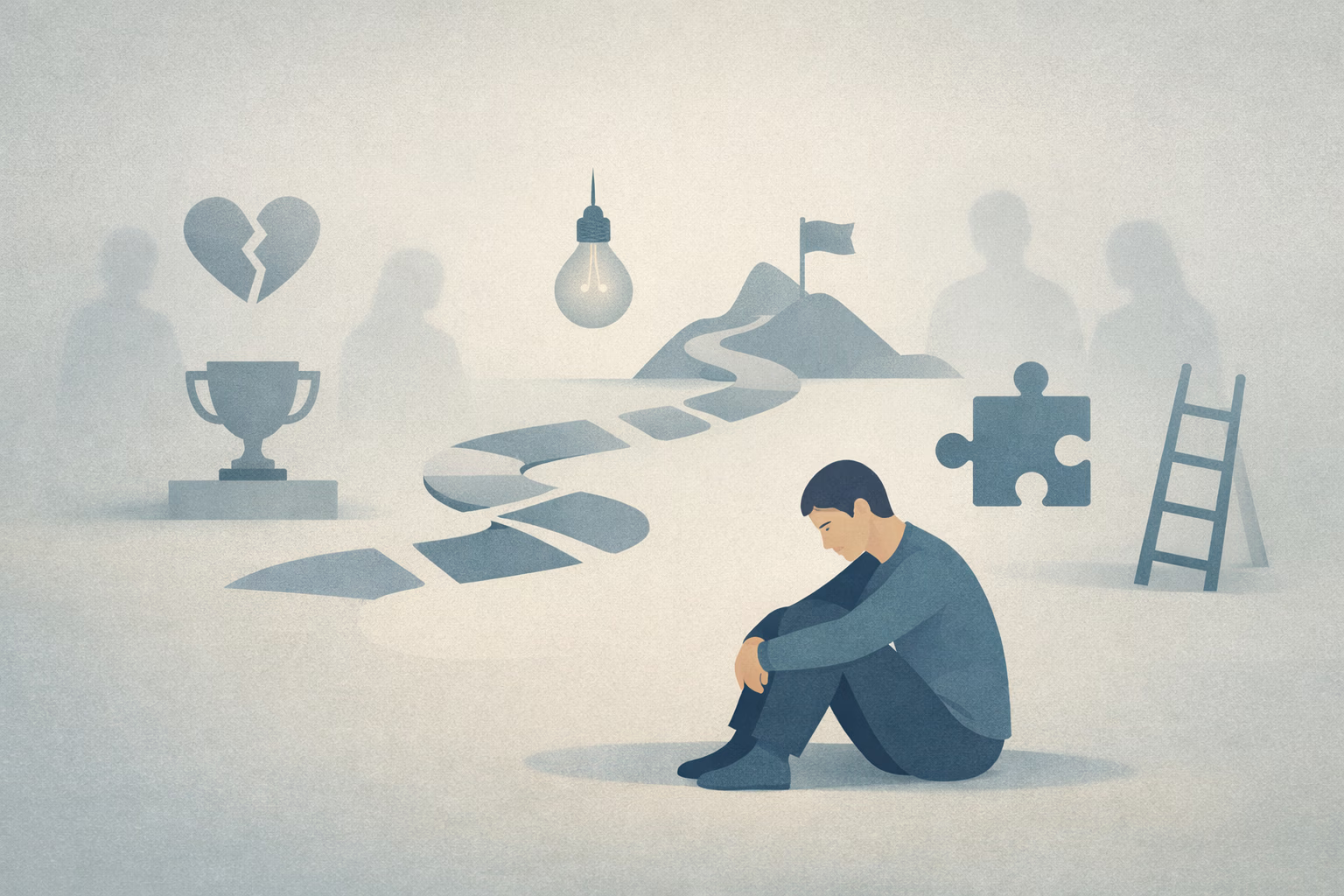
Emotional Exhaustion: When Your Tank Is Empty but Life Keeps Going
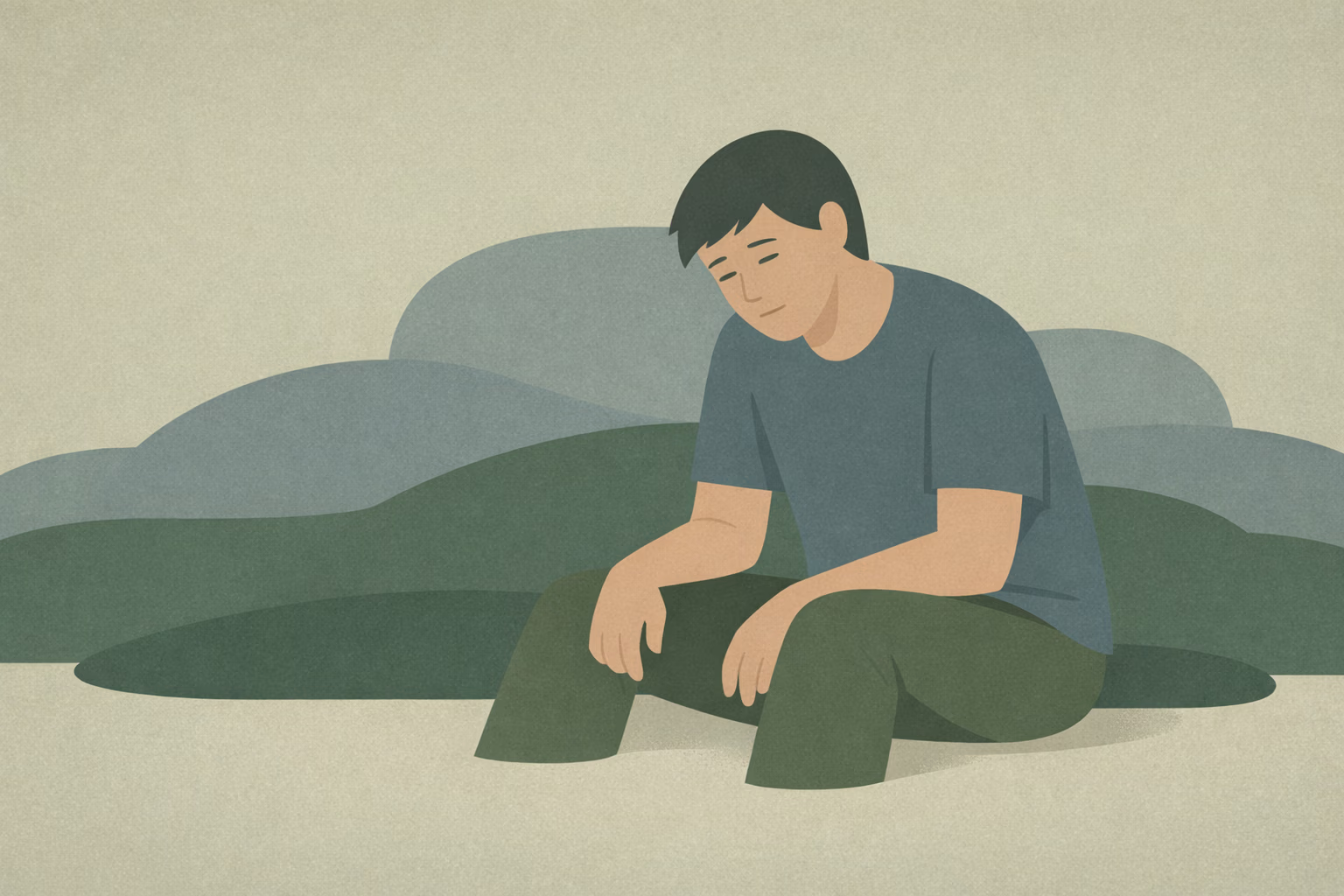
In short: When the System Overloads There’s a specific kind of low motivation that doesn’t feel like ordinary procrastination. You may still care. You may even feel urgency. But when you reach for the first step, your system doesn’t deliver the spark—only heaviness, fog, or a strange blankness.
There’s a specific kind of low motivation that doesn’t feel like ordinary procrastination. You may still care. You may even feel urgency. But when you reach for the first step, your system doesn’t deliver the spark—only heaviness, fog, or a strange blankness.
What if “no motivation” is not missing desire, but a nervous system that has stopped offering initiative because the load has been too high for too long?
From a biological perspective, shutdown can be a form of conservation. When effort has repeatedly failed to create safety, predictability, or completion, the body can reduce drive signals and narrow engagement—not as a choice, but as a stabilizing response to overwhelm.
Motivational shutdown often feels internally inconsistent: part of you wants to act, and another part of you cannot initiate. It can look like sitting with a task open but untouched, or watching days pass while your mind lists consequences that still don’t translate into movement.
Because the outside world typically interprets motivation as a moral quality, this state can quickly collect self-blame: “I’m lazy,” “I’m wasting my life,” “Something is wrong with me.” Yet the lived sensation is frequently more physical than philosophical—heavy limbs, slowed thinking, reduced appetite for complexity, a dimming of urgency.
This pattern commonly shows up after sustained stress, high responsibility, ongoing uncertainty, or long periods of “holding it together.” It can be understood as a cost of cumulative strain rather than a lack of character. [Ref-1]
Motivation is not a single trait; it’s an outcome of multiple systems coordinating: threat detection, reward learning, memory, planning, and the body’s energy availability. Under chronic stress, those systems are asked to stay online longer than they were designed to, and the overall “energy budget” gets tighter.
As stress load accumulates, the brain and body prioritize what keeps you functional in the shortest term: vigilance, problem scanning, and rapid adjustments. Over time, that can reduce resources available for initiative, flexible planning, and sustained follow-through—not because you don’t value your goals, but because the system is managing scarcity. [Ref-2]
In that state, even simple tasks can register as expensive: too many steps, too many decisions, too much exposure to evaluation. The body’s response is often to reduce output.
In nature, organisms don’t keep spending energy indefinitely when spending doesn’t change outcomes. When the environment stays unpredictable or unsolvable, a conservation strategy can take over. In humans, this can look like reduced drive, reduced pleasure in anticipated rewards, and less willingness to “go out on a limb.”
This isn’t a psychological story about not wanting something enough. It’s closer to a systems-level recalibration: when effort has not reliably produced safety or completion, motivation circuitry becomes harder to access, and the body leans toward minimizing additional cost. [Ref-3]
Importantly, the subjective experience can be confusing: you might still have values and goals, but the physiological support for action—momentum, energy, confidence in payoff—doesn’t arrive.
Initiative is a form of exposure. Starting a task means opening multiple loops: decisions, potential criticism, uncertain outcomes, and the need to sustain attention. When a system is already depleted, refusing to open more loops is a kind of automatic boundary.
This protective boundary can be blunt. It may shut down more than what is strictly necessary. But its logic is consistent: limit engagement to limit demand; limit demand to avoid further depletion.
Seen this way, low motivation isn’t a “lack” to overcome. It can be a signal that your regulatory system has been running without enough closure and recovery time. [Ref-4]
“Laziness” assumes choice and comfort. Motivational shutdown often includes discomfort, worry, and ongoing mental effort—just not the kind that turns into action. Many people in this state are doing constant internal accounting: what’s late, what’s failing, what needs to be fixed, what’s at risk.
Under sustained stress, the nervous system can shift into protective modes that make engagement feel unsafe or too expensive. This is not about personal virtue; it’s about conditions and physiology. [Ref-5]
Sometimes the absence of movement isn’t avoidance of responsibility; it’s the body refusing another round of unsustainable demand.
Low motivation becomes especially sticky when it gets met with escalating pressure. Pressure can create short bursts of action, but under chronic load it often deepens depletion—leading to a cycle where the system needs more force to produce less output.
Structurally, this is an avoidance loop: not “avoiding because of fear,” but avoiding because engagement has become too costly and too rarely rewarded with completion. As demands rise, the internal cost of starting rises too, and the system protects itself by reducing initiative.
Over time, the loop can resemble burnout: reduced energy, reduced effectiveness, and reduced sense of impact, even when effort continues. [Ref-6]
This kind of shutdown has a recognizable “texture.” It isn’t restful. It’s often a limbo state where nothing feels finished and nothing feels startable.
People describe patterns like:
From a nervous-system lens, these are regulatory responses to depleted reward and high demand. Reduced reward sensitivity and reduced drive can appear when motivation systems are under strain. [Ref-7]
Agency isn’t just a belief; it’s a lived body-sense that action will matter. When repeated effort doesn’t produce improved safety, stability, or completion, the system can begin to treat action as ineffective—so it stops offering the energy for it.
Over time, this can show up as reduced confidence in your own follow-through, difficulty trusting your intentions, and a sense that life is happening “to you” instead of “with you.”
This shift can resemble learned helplessness—not as a label, but as a predictable adaptation when outcomes feel disconnected from effort. [Ref-8]
Self-judgment adds a second workload on top of the first. Now the system isn’t only managing tasks; it’s also managing threat signals about identity: “I’m failing,” “I’m behind,” “I’m not acceptable.” That internal evaluation can keep the body in a guarded state even when nothing external is happening.
External pressure can compound the same effect. When you’re met primarily with expectations, metrics, or comparison, the nervous system may interpret engagement as risk: more exposure, more consequence, more demand.
In that context, shutdown can look like hypoarousal, freeze, or collapse—states where the system reduces output to reduce threat load. [Ref-9]
When everything feels like a test, why would the body offer extra energy?
Motivation is easier to access when the nervous system has evidence that engagement is safe, bounded, and likely to lead to completion. When the environment (internal or external) stays intensifying, the body may keep withholding initiative as a protective measure.
In many people, motivational circuits begin to recover not through force, but through reduced demand, fewer open loops, and clearer safety cues—signals that the system can come out of conservation mode without immediate penalty. [Ref-10]
This isn’t the same as “understanding why you’re shut down.” Insight can be useful, but it doesn’t automatically change the body’s cost calculations. What shifts things is when life provides conditions where effort leads to closure and does not continuously multiply expectations.
Humans regulate in relationship. When you’re met with steadiness—without interrogation, urgency, or performance demands—the nervous system receives a different kind of information: that connection doesn’t require output, and that your value isn’t contingent on constant productivity.
This social “buffering” can lower stress responses and support a return of flexible engagement. It’s not about someone cheering you on; it’s about your system registering safety through tone, pacing, predictability, and non-contingent acceptance. [Ref-11]
When there’s no audience to impress and no threat to outrun, the body has room to come back online.
Recovery of motivation often arrives quietly. Not as a dramatic surge, but as small signs that the system has more room: a little curiosity, a willingness to consider a next step, a sense that your attention can stay with something without immediate overload.
These early signals matter because they reflect increased capacity—more available energy, more tolerance for complexity, more stable regulation. In nervous-system terms, it can look like a widening of the “window” where you can engage without tipping into urgency or collapse. [Ref-12]
Over time, action becomes more plausible not because you are forcing yourself, but because the internal cost of starting is no longer so high.
When the body isn’t consumed by threat management, attention can shift from immediate survival to longer arcs: values, relationships, contribution, and personal direction. This is where meaning becomes practical—not as a motivational slogan, but as an organizing force that reduces fragmentation.
Direction feels different from pressure. Pressure demands output now. Direction offers orientation: a sense of “this matters,” paired with enough safety to move at a humane pace. As coherence returns, choices tend to create more completion, and completion tends to create more stability. [Ref-13]
Not “How do I make myself do it?” but “What kind of life is trying to re-form underneath the overload?”
If your motivation has gone quiet, it may be communicating something precise: the system has been carrying more demand than it can metabolize, with too few “done” signals along the way. In that context, withdrawal isn’t a moral lapse—it’s a boundary set by physiology.
Agency often returns alongside meaning: when life contains more closure, more supportive connection, and fewer conditions that turn every task into a referendum on your worth. Social support, in particular, can reduce stress load and help the brain shift out of defensive modes. [Ref-14]
There’s nothing inherently broken about a system that stops pushing when pushing has stopped working. Sometimes what’s needed is not more force, but a world that makes engagement make sense again.
Motivation tends to be most stable when it grows from safety and direction—not from self-punishment. When the nervous system is supported and the load becomes finishable, initiative can reappear as a natural output of coherence.
You don’t have to prove you deserve momentum. Often, momentum is what arrives when your system finally gets enough evidence that effort can lead to completion, and that you don’t have to carry it alone. [Ref-15]
From theory to practice — meaning forms when insight meets action.
That gap between caring and moving is often a signature of motivational shutdown rather than ordinary procrastination. The desire is intact, but the body's drive signals have gone quiet because effort hasn't been reliably producing closure or completion. Under cumulative strain, the Threat & Safety System narrows engagement to conserve energy, and the Reward & Stimulation System dampens its anticipatory output. Initiation requires opening multiple loops at once, which a depleted system reads as expensive. So you sit with the task, list the consequences, and still find no spark. The block isn't moral; it's a regulatory state where the cost of starting has outpaced available capacity.
No. Laziness implies comfort and choice; motivational shutdown usually includes worry, guilt, and constant internal accounting that just doesn't translate into action. The body is doing work, but the kind that goes nowhere visible. Under sustained load, the nervous system can move into hypoarousal or freeze, where output drops as a protective response rather than a preference. Self-blame layers a second workload on top of the first, signaling more threat to identity. Calling it laziness misreads the physiology and increases pressure on a system that is already withholding initiative because every previous round of effort has cost more than it returned.
Structurally, it's a feedback cycle where rising demand meets shrinking capacity. As pressure climbs, the body's energy budget tightens; initiation becomes harder; missed tasks generate self-criticism, which the nervous system registers as more demand. The Avoidance Loop here isn't fear-driven, it's cost-driven: engagement has stopped delivering Done Signals often enough to justify the expense. Over time the pattern resembles burnout — reduced energy, reduced effectiveness, reduced sense of impact, even when effort continues. The exit isn't more force. It's reducing open loops, lowering demand, and letting the system collect evidence that effort can lead to completion again.
Usually quietly, and not as a surge of willpower. Recovery tends to show up as small widening of the window of tolerance: a flicker of curiosity, a willingness to consider one next step, an ability to stay with something without tipping into urgency. These are signs that the regulatory system has more room. Motivation circuits respond to evidence — fewer open loops, clearer safety cues, supportive contact that doesn't require performance — rather than to insight alone. As coherence returns, direction starts to organize attention again, and Meaning Density grows. Initiative reappears as an output of capacity, not as something you whip into existence.
From Science to Art.
Understanding explains what is happening. Art allows you to feel it—without fixing, judging, or naming. Pause here. Let the images work quietly. Sometimes meaning settles before words do.
One Quiet Window, one insight, one reflection — every Sunday