Why Meditation Apps Don’t Create Lasting Change
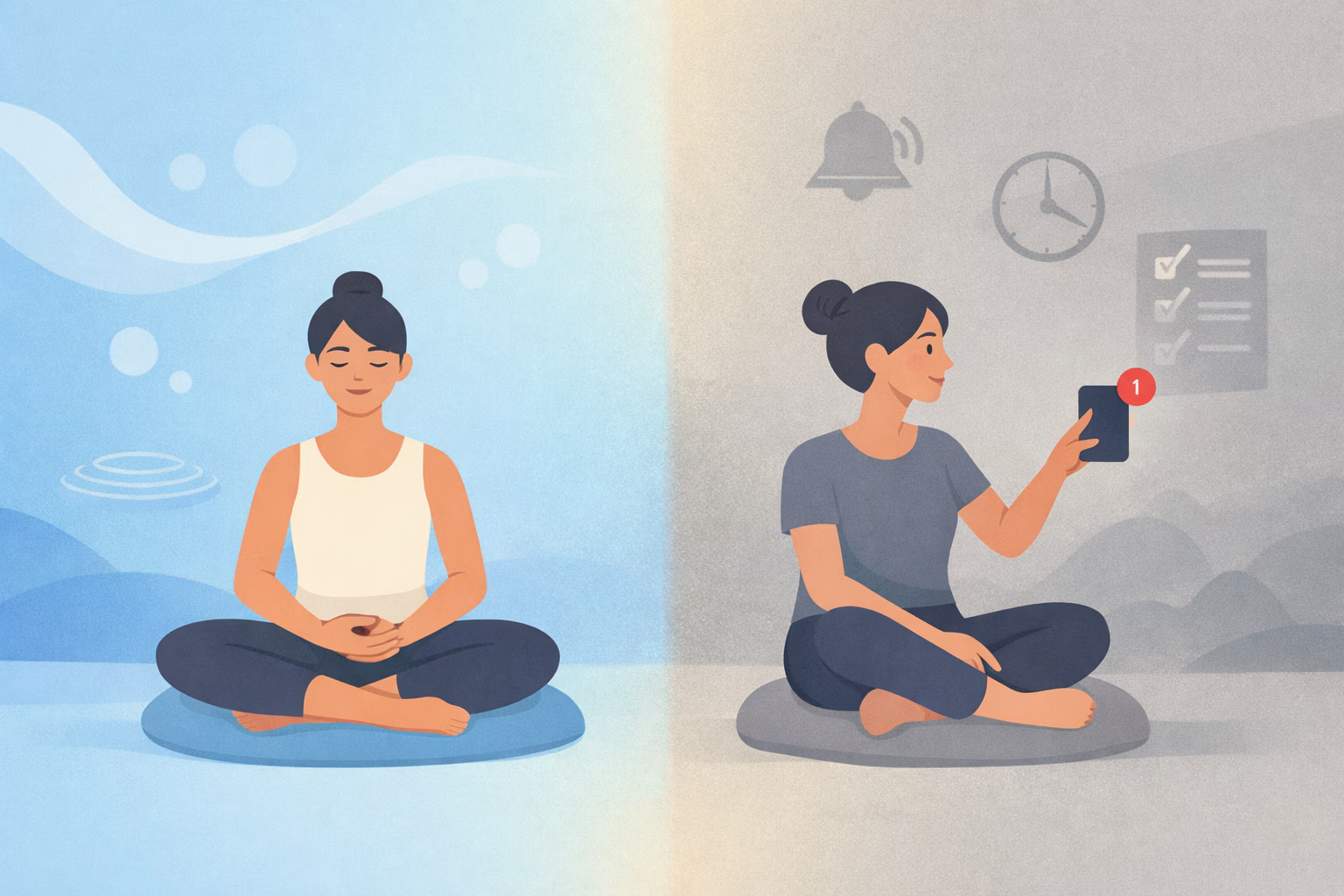
In short: Meditation apps are often genuinely helpful. They can lower stress in the moment, soften the edge of overwhelm, and provide a steady cue of safety when your day feels too loud.
Meditation apps are often genuinely helpful. They can lower stress in the moment, soften the edge of overwhelm, and provide a steady cue of safety when your day feels too loud. For many people, that relief is real—and earned.
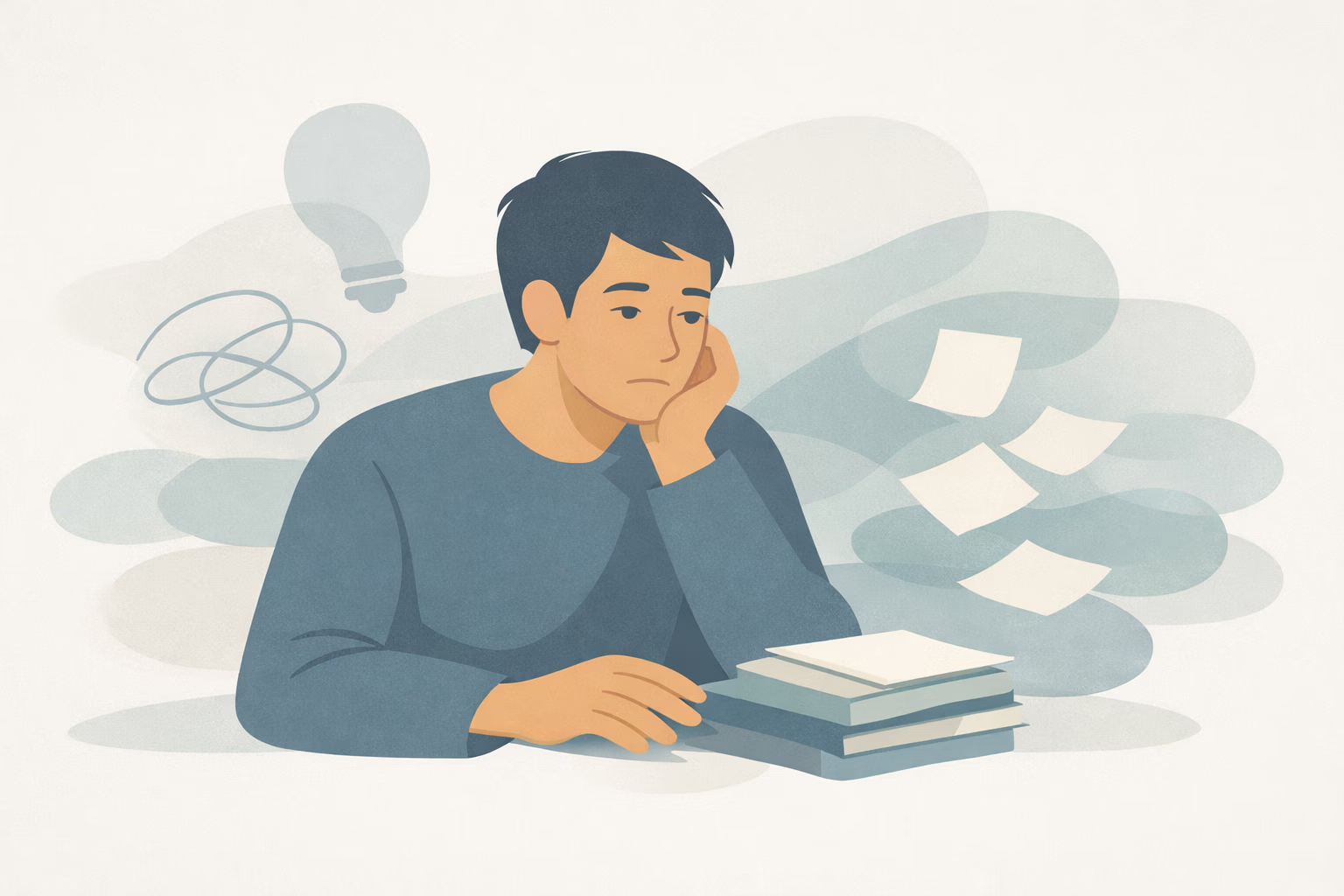
And still, a common experience follows: you finish a session feeling calmer, but your life doesn’t feel more coherent. The same choices return. The same stuckness returns. The calm didn’t “stick” as orientation.
What if the app is doing exactly what it’s designed to do—and you’re noticing the boundary of what calm alone can carry?
It’s possible to be skilled at soothing your nervous system and still feel quietly misaligned with your life. That combination can be confusing: if you can reliably downshift, why does the larger sense of “this is my path” remain shaky?
One reason is that calm is a state, not a story. It reduces internal noise, but it doesn’t automatically complete the unfinished parts of life that keep asking for a next step—decisions, endings, repairs, commitments, belonging. When those loops remain open, the system can re-activate as soon as the session ends.
In other words, the app may be giving your body a break, while your life still lacks “done signals” in key areas. That’s not personal failure; it’s a mismatch between what was soothed and what still needs completion. [Ref-1]
Most meditation apps are built to guide attention, breathing, and sensory focus in ways that can reduce physiological stress load. That can show up as lower perceived stress, fewer spiraling thoughts, and improved momentary well-being for some users. [Ref-2]
But meaning loops—how you interpret your life, what you’re moving toward, what you refuse to abandon, what you can finally put down—operate at a different level. An app can cue a quieter state, yet not touch the identity-level questions that keep a person activated: “Who am I in this season?” “What matters enough to organize my choices?”
Research reviews often find small-to-moderate benefits with high dropout and variable outcomes, which fits this picture: many people can access relief, but fewer find a stable shift in how life holds together.
Humans are meaning-making organisms. We don’t only regulate threat; we also seek coherence—an internal sense that our actions, values, and identity are pointing in the same direction. When that alignment is present, the nervous system tends to require less emergency management.
Meditation apps can provide external calm cues: a voice, a timer, a familiar routine. These cues can help the body stand down briefly. But orientation is an inside-out phenomenon: it forms when lived experience completes into identity, when choices become “this is who I am” rather than “this is what I forced myself to do.”
That helps explain why an app can improve mood and stress without necessarily reshaping the deeper narrative that stabilizes behavior over time. [Ref-3]
In a high-load environment, a short guided session can be like a pressure valve. Many apps reliably support a shift toward steadier breathing, reduced rumination, and improved attention—especially when the practice is brief and consistent. [Ref-4]
This matters because a nervous system that never downshifts can’t restore capacity. When arousal stays elevated, even simple tasks feel heavy, and meaning-making becomes harder because everything is processed through urgency.
It’s understandable to assume that if something helps, doing more of it will eventually produce a deeper change. But repetition primarily trains access to a state. It does not guarantee completion of the life loops that generate ongoing activation.
A person can build a strong habit of calming and still be carrying unclosed chapters: chronic ambiguity, deferred decisions, relational drift, work that contradicts values, or a life structured around evaluation instead of purpose. In that context, meditation can become a reliable reset button—while the underlying system remains organized around “not yet finished.”
Studies on novice users often show improvements in stress and perseverative thinking, which is meaningful, but still leaves room for the bigger question of identity-level coherence. [Ref-5]
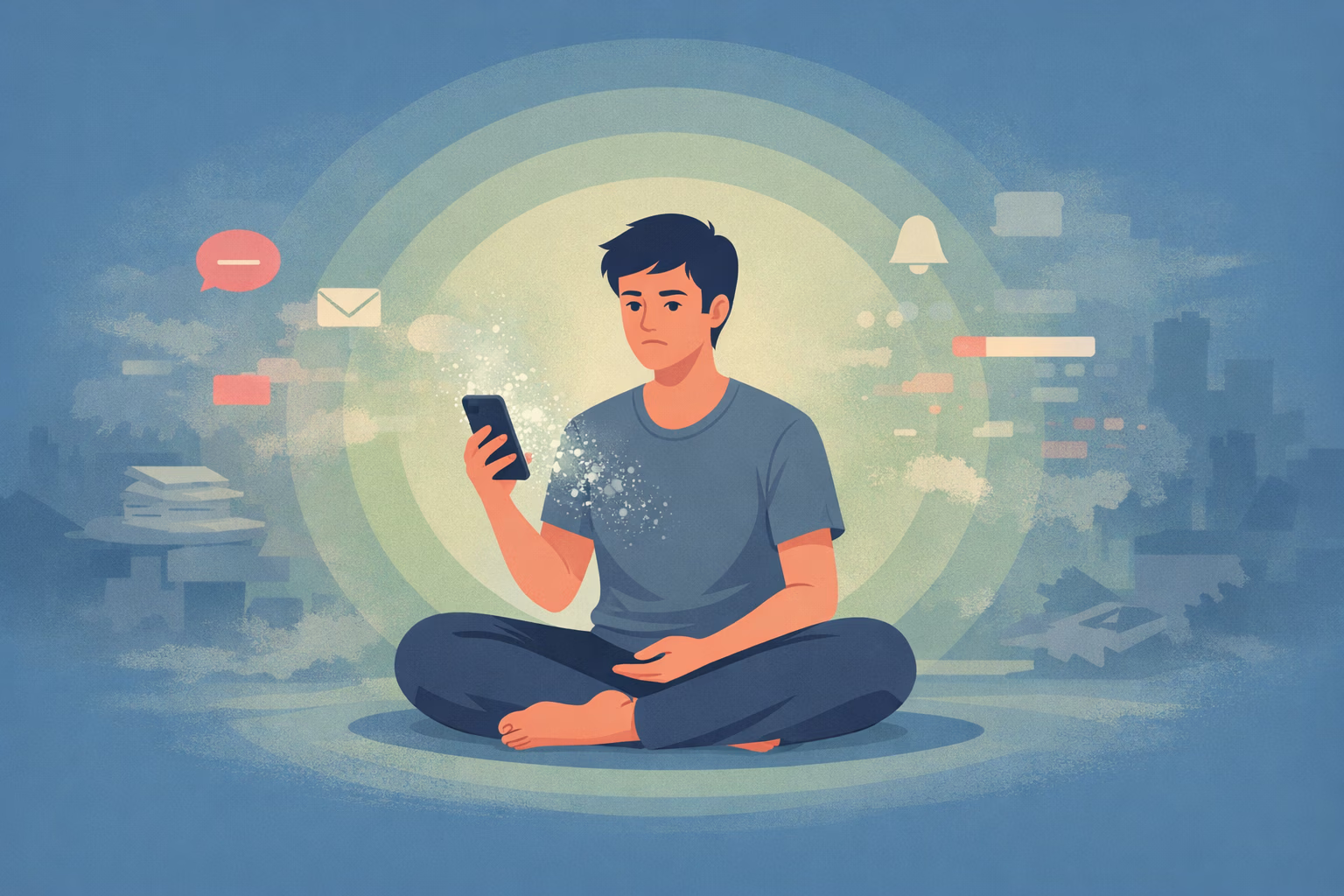
An Avoidance Loop doesn’t have to look like fear or denial. Structurally, it can look like repeated state-change that postpones completion. The person feels unsettled, uses the tool, feels better, returns to life, and finds the same unresolved shape waiting.
In that cycle, the app offers temporary safety signals. That can be kind and stabilizing—especially under real pressure. And it can also become a way the system learns to bypass the friction of meaning-engagement: the conversations, boundaries, endings, or commitments that would produce closure.
Many app-based programs show improved self-regulation and reduced perceived stress, which can make the loop easier to repeat: relief is available, while deeper “done” signals remain out of reach. [Ref-6]
Sometimes the session works so well that it quietly replaces the harder kind of settling: the kind that comes after a life step is actually completed.
None of these patterns mean someone is doing mindfulness “wrong.” They often indicate that the tool is being asked to solve a problem at a different layer: identity coherence rather than momentary arousal.
Research on popular apps shows mixed outcomes and modest effects overall, which fits the reality that some people experience real benefits, while others discover the limits quickly—especially under high load. [Ref-7]
Calm is valuable. The issue isn’t calm—it’s substitution. When calm becomes the primary response to discomfort, the system can normalize postponement: a softened internal alarm, but no closing of the open loop that set the alarm off.
Over time, this can subtly reshape what feels possible. Instead of “I can complete this,” the implicit learning becomes “I can manage myself around this.” That’s not a moral failure; it’s a predictable adaptation in environments where completion is difficult and pressure is constant.
Clinical overviews often describe mindfulness apps as useful supports, while emphasizing that they aren’t replacements for deeper work or broader life change. [Ref-8]
Many apps are designed for retention: streaks, badges, reminders, and micro-rewards. These features can help people return. They can also shift the center of gravity from internal orientation to external tracking—where “doing it” becomes the metric, regardless of whether life is becoming more integrated.
In a broader wellness culture, mindfulness can be framed as a personal upgrade: calm as a performance feature, serenity as a brand, regulation as an aesthetic. When that’s the backdrop, it’s easy for practice to become another arena of evaluation rather than a support for completion and coherence. [Ref-9]
When calm becomes a credential, what happens to the parts of life that need closure instead of soothing?
Calm can be a doorway—but doorways lead somewhere. When meditation is paired with reflection that clarifies values, with choices that reduce contradiction, and with lived follow-through that creates “done signals,” the calm is no longer the main event. It becomes supportive infrastructure.
What changes, then, isn’t just the ability to relax. It’s the way experience settles into identity: not as insight alone, but as completion that the nervous system recognizes. The sense of self becomes less like a project and more like a home you can stand in.
Critiques of commercialized mindfulness often point to what gets lost when practice is decontextualized: depth, ethics, community, and meaning. That critique doesn’t invalidate apps; it clarifies their lane. [Ref-10]
Meaning and identity stabilize in relationship—not because people need fixing, but because humans calibrate through shared reality. Mentors, peers, teachers, and communities can provide continuity: someone remembers what you said mattered, and the thread doesn’t reset every time the session ends.
Relational containers can also reduce fragmentation. Instead of practice being one more solo task, it becomes part of a lived culture—where orientation is reinforced by language, example, and accountability to what feels true (not to a streak).
Critical scholarship on commodified mindfulness often notes that app-based approaches can drift toward symptom management while leaving larger structures untouched; community contexts can help re-anchor practice in purpose and shared life. [Ref-11]
There’s a subtle shift that many people recognize: calm stops being the finish line and becomes a resource. In that configuration, regulation supports engagement—clearer perception, steadier presence, and more room to act from values instead of urgency.
Importantly, this isn’t about treating mindfulness as “value-neutral.” Human attention always serves something. When attention practices are disconnected from meaning, they can unintentionally support endurance in lives that feel misaligned—making it easier to tolerate the intolerable without changing the conditions that keep activation running. [Ref-12]
Calm isn’t a personality trait. It’s a capacity that works best when it’s in service of a life that makes sense to you.
Meditation can help you hear yourself again, which is different from “finding yourself.” Orientation comes from the slow accumulation of completed experiences: decisions made, values enacted, relationships clarified, endings honored, commitments lived long enough to become real.
When mindfulness is offered as a universal solution, it can obscure cultural and conceptual limits—especially when removed from the traditions and contexts that originally held it. That doesn’t mean modern practice is invalid; it means it has edges. [Ref-13]
Within those edges, an app can be a steady companion for regulation. Beyond them, the work is less about technique and more about coherence: the life you are actually building, and the identity that forms when that life starts to close its loops.
Meditation apps can be excellent at what they are: accessible tools for downshifting, stress relief, and brief returns to baseline. In a pressured world, that can be a genuine form of care.
But lasting stability usually isn’t purchased through more sessions, better streaks, or a more polished routine. It emerges when calm supports completion—when your life begins to send clearer “done” signals, and your actions align with what you recognize as worth living for.
In a celebrity-and-brand wellness culture, it’s easy for mindfulness to be marketed as a total solution. A more dignified framing is simpler: the app can help your nervous system breathe; your meaning is built elsewhere. [Ref-14]
If an app has helped you regulate, that counts. Relief is not trivial. And if you’ve also noticed that relief doesn’t automatically become direction, that also counts—you’re perceiving the true shape of the problem.
Calm can make space. Meaning completes the loop. When practice is connected to values, relationships, and lived identity, the nervous system often needs less constant management, because life itself becomes more internally consistent.
In a wellness marketplace that sells endless upgrades, it can be grounding to remember: stability isn’t something you download. It’s something that settles after your life begins to feel more whole. [Ref-15]
From theory to practice — meaning forms when insight meets action.
Calm is a state, not a story. Guided sessions can lower stress, soften rumination, and provide a steady cue of safety — and that relief is real. But calm doesn't automatically complete the unfinished parts of life that keep asking for a next step: decisions, endings, repairs, commitments, belonging. While those loops stay open, the system re-activates as soon as the session ends. The app is doing exactly what it was designed to do — modulate arousal. What it can't do is rewrite identity-level questions about who you are this season and what your choices are organizing around. That work happens elsewhere, through completion.
Yes, even without anyone intending it. An Avoidance Loop doesn't have to look like fear or denial. Structurally it can look like repeated state-change that postpones completion: you feel unsettled, run a session, feel better, return to life, and find the same unresolved shape waiting. The app offers temporary safety signals, which is genuinely stabilizing under pressure. But the system can also learn to bypass the friction of meaning-engagement — the conversations, boundaries, or commitments that would actually produce closure. Relief becomes available while deeper Done Signals remain out of reach, and the pattern quietly repeats.
Quite a lot, within their lane. In a high-load environment, a short guided session can act like a pressure valve: steadier breathing, less rumination, a brief return to baseline that the body learns to recognize. They provide a predictable pause in a fragmented day, reduce immediate overwhelm, and lower the cost of staying present for one more thing. That matters because a nervous system that never downshifts can't restore capacity — when arousal stays high, even simple tasks get processed through urgency. The app is a regulator. Useful and accessible. The mistake is mistaking it for an author of meaning.
Often, yes. Meaning and identity stabilize in relationship — not because people need fixing, but because humans calibrate through shared reality. Mentors, peers, and communities provide continuity: someone remembers what you said mattered, and the thread doesn't reset every time the session ends. That's co-regulation in a structural sense. Streaks and gamification can shift the center of gravity from internal orientation to external tracking, where doing it becomes the metric regardless of whether life is becoming more integrated. Relational containers re-anchor practice in purpose, language, and accountability to what feels true rather than to a badge.
From Science to Art.
Understanding explains what is happening. Art allows you to feel it—without fixing, judging, or naming. Pause here. Let the images work quietly. Sometimes meaning settles before words do.
One Quiet Window, one insight, one reflection — every Sunday