Paralysis by Overthinking: When Every Decision Feels Heavy
In short: In modern dating, it’s possible to have more access than ever—and still feel oddly stuck. You can be talking to people, going on dates, even enjoying someone’s company, and yet your mind keeps scanning for what might be “more right.” Not because you’re shallow or incapable of commitment, but because your system is doing what human systems do under high choice: it keeps evaluating.
In modern dating, it’s possible to have more access than ever—and still feel oddly stuck. You can be talking to people, going on dates, even enjoying someone’s company, and yet your mind keeps scanning for what might be “more right.” Not because you’re shallow or incapable of commitment, but because your system is doing what human systems do under high choice: it keeps evaluating.
What if the problem isn’t you—what if it’s that your brain was built for closure, not infinite comparison?
Multiple options anxiety is less like “being picky” and more like being held in a constant pre-decision state. Without a clear “done” signal, the nervous system stays in a mild (or not-so-mild) readiness mode—alert to losses, missed chances, and future regret. In that state, even good possibilities can feel surprisingly hard to choose.
Multiple options anxiety often shows up as mental spinning: comparing profiles, replaying conversations, checking for flaws, and imagining better matches you haven’t met yet. The experience is less about what you want and more about what you might lose by choosing.
Because the environment offers continuous alternatives, your attention can get recruited into “assessment mode.” Even after a pleasant date, the mind may keep searching for evidence that it was either the right call or a mistake—before anything has had time to settle into lived reality. This pattern is common in contexts of high mate-choice plurality and perceived abundance. [Ref-1]
High choice doesn’t only increase opportunity; it increases nervous-system load. Every new option adds a small spike of possibility—novelty, anticipation, potential reward. But it also adds a parallel computation: “What if I choose and then discover I could have had better?”
This is where abundance can create a double bind. Reward circuits respond to the availability of “more,” while loss-aversion mechanisms flag the cost of commitment (because commitment closes doors). When those systems fire together, the result is not clarity—it’s vigilance. The mind keeps running comparisons, and the body doesn’t receive the physiological stand-down that comes from completion and closure. [Ref-2]
Humans didn’t evolve in an infinite marketplace. Mate selection historically happened under scarcity: smaller pools, fewer repeated opportunities, and clearer social feedback loops. In those conditions, careful choice helped protect against real costs—conflict, resource strain, social consequences.
That older risk-management system is still here. It tends to take uncertainty seriously, and it treats relational decisions as consequential. When modern dating presents constant new candidates, the ancient logic can misread abundance as “ongoing risk”: more data needed, more checking required, more hesitation justified. The system isn’t broken; it’s doing a form of protective accounting in an environment it wasn’t built to interpret. [Ref-3]
When options multiply faster than trust can form, the body often chooses evaluation over direction.
Deferring a decision often reduces immediate pressure. If you don’t choose, you don’t have to risk regret. If you keep swiping, you don’t have to face the finality of selecting. Optionality can feel like safety—not emotionally, but structurally: fewer consequences, less commitment weight, less chance of “locking in wrong.”
In the short term, this can calm the system because it removes the moment of closure—the moment where something becomes real, and therefore accountable. But the same postponement also prevents the “done” signal the nervous system uses to quiet its monitoring. Over time, the loop can become self-reinforcing: uncertainty persists, so monitoring persists. Patterns tied to FOMO and ongoing checking can further amplify this cycle. [Ref-4]
Modern dating platforms implicitly suggest that more searching will produce a better outcome. The interface reinforces it: new faces, new matches, new micro-rewards. It can feel rational to keep browsing—especially if you’re trying to be careful and “get it right.”
Yet for many people, the lived result is rising dissatisfaction and decreased capacity to enjoy what’s in front of them. When the environment keeps offering a next option, the mind can start treating the current connection as provisional. Instead of deepening, the relationship becomes a draft. In broader digital contexts, validation loops and continuous evaluation have been linked with poorer psychological outcomes, especially when attention is repeatedly pulled toward external appraisal. [Ref-5]
If the system never closes, how would it ever feel settled?
There’s a particular kind of stimulation in possibility. It’s light, quick, and endlessly renewable: “maybe this one,” “maybe the next,” “maybe if I refine my criteria.” This is part of why choice overload is so confusing—because it can feel like you’re engaging with hope while actually being held in perpetual preview. [Ref-6]
In a pleasure loop, the “reward” is not necessarily the relationship; it’s the continued availability of alternatives. The nervous system stays activated by novelty and potential, while real attachment—which requires continuity and repeated contact—doesn’t get enough uninterrupted time to form. Desire stays high, direction stays low.
When choice overload takes hold, it often shows up in recognizable patterns—not as character flaws, but as regulatory strategies under high input. The system tries to reduce uncertainty with more data, more evaluation, more checking.
These are well-aligned with what research and behavioral science describe as choice overload effects: more options can reduce satisfaction and increase decision difficulty. [Ref-7]
When you stay in evaluation mode for a long time, something subtle can happen: your internal “yes/no” signals get quieter. Not because you’ve lost intuition, but because the system is overloaded with competing inputs and incomplete endings. Without closure, signals don’t consolidate into confidence.
Over time, you may start outsourcing certainty to the marketplace itself: more profiles, more opinions, more research, more checking. This can feel like being careful, but it often functions like a structural workaround for lost decisiveness. Instead of “I know enough to choose,” the baseline becomes “I need more information to feel safe choosing.” Many discussions of paradox-of-choice dynamics in dating note this erosion of confidence and depth when comparison stays constant. [Ref-8]
It’s tempting to think avoidance is driven by a single emotion (like fear). But structurally, avoidance often happens because it reduces immediate consequence. If you don’t decide, you don’t have to absorb the impact of being “in” with one person and “out” with others. The nervous system gets a quick reduction in pressure.
The cost is that uncertainty remains active. And when uncertainty remains active, the system continues scanning. This keeps the loop running: more evaluation creates more doubt, and more doubt calls for more evaluation. In online dating environments, this can become a dependence on endless assessment—because assessment is the only thing that reliably feels like movement when commitment feels like a cliff. [Ref-9]
Uncertainty can feel safer than commitment, until it becomes the thing that never lets your body stand down.
People often assume commitment is hard because they “can’t decide” or “aren’t ready.” But in many cases, commitment is hard because the nervous system is carrying simultaneous signals: reward-seeking (more novelty, more possibility) and threat-monitoring (don’t make a costly mistake). When both are loud, choosing can feel like stepping into danger—even if the person is kind and the connection is real.
When stimulation and threat responses are not constantly amplified, something different becomes possible: the body can tolerate continuity. The mind can stop treating each choice as a referendum on your entire future. Commitment stops feeling like a trap and starts feeling like a direction with edges—edges that give life shape. Experiences described in dating-app paralysis often reflect this collision of high stimulation with low settling. [Ref-10]
What changes when the goal shifts from “perfect outcome” to “coherent direction”?
Comparison thrives in abstraction. It’s easier to compare “potential partners” than to be with an actual person over time. But continuity changes the data your nervous system receives. Repeated interaction provides stability cues: predictability, responsiveness, shared context, and the slow accumulation of “this is what it’s like with you.”
As continuity increases, the mind has less need to fill gaps with imagined alternatives. The connection becomes less conceptual and more embodied—less about what could be and more about what is. Many discussions of choice overload in dating emphasize that too many perceived alternatives can prevent this deepening process from fully taking hold. [Ref-11]
When decisiveness returns, it usually doesn’t arrive as a dramatic breakthrough. It’s quieter: less scanning, less urgent checking, fewer mental rehearsals of alternate timelines. You may notice more capacity to stay with a single thread of experience long enough for it to become coherent.
This is not the same as “certainty.” It’s more like internal agreement: your system stops treating the decision as unresolved. The relationship (or the choice to step away) gains a sense of completion that reduces background noise. In popular descriptions of option paralysis, people often note that clarity increases when the loop of endless evaluation finally closes and lived reality is allowed to be the reference point. [Ref-12]
An infinite marketplace trains the mind to optimize: to search for the best possible match as if humans were interchangeable features. But humans don’t stabilize through optimization. They stabilize through meaning—through choices that align with values and become part of identity.
When choice capacity is stabilized, the question shifts. Instead of “Is there someone better?” it becomes “Is this direction consistent with the kind of life and love I’m building?” That shift matters because it reduces fragmentation. It turns dating from continuous evaluation into a form of orientation. Paradox-of-choice research consistently points toward this: more options can increase dissatisfaction, while limitation and commitment can increase coherence and satisfaction. [Ref-13]
Meaning isn’t something you think your way into. It’s what forms when a direction is chosen and lived long enough to become real.
If you recognize multiple options anxiety, it doesn’t have to mean you’re incapable of love or commitment. It may simply mean your nervous system has been asked to process more romantic possibility than a human evaluation system can gracefully close.
In that light, the anxiety isn’t proof that something is wrong with you. It’s a signal that the environment is keeping your loops open—reward without settling, information without completion, choice without an ending. And when loops stay open, the body stays on duty.
Meaning tends to return when life becomes choosable again—when selection is allowed to be an act of orientation rather than a guarantee of a perfect outcome. Choice overload frameworks often point to this pivot: fewer active alternatives can reduce strain and restore satisfaction. [Ref-14]
Keeping every possibility open can look like freedom, but it often functions like ongoing activation. A human system can’t fully rest inside “maybe.”
Over time, what feels stabilizing is not the absence of risk, but the presence of a coherent path—one that becomes lived, not endlessly evaluated. And when decisions are allowed to complete, they stop demanding constant mental supervision. That’s often when relief shows up: not as hype, but as quiet closure. [Ref-15]
From theory to practice — meaning forms when insight meets action.
Because your system is doing what human systems do under high choice: it keeps evaluating. Dating apps offer a continuous stream of alternatives, which fires reward circuits ('more possibility') and loss-aversion circuits ('what if I commit and miss something better') at the same time. The result isn't clarity — it's vigilance. Without a clear Done Signal, the nervous system stays in pre-decision mode, scanning for losses and missed chances. The mental spinning isn't proof you're shallow or incapable of commitment. It's what evaluation mode looks like when an environment refuses to let any choice complete and become real.
More access doesn't reliably translate to better outcomes — and often produces the opposite. Humans didn't evolve in an infinite marketplace; mate selection historically happened under scarcity, with smaller pools and clearer feedback. That ancient risk-management system reads modern abundance as ongoing risk: more data needed, more checking required, more hesitation justified. Meanwhile, the constant flow of new candidates trains the mind to treat current connections as provisional drafts instead of letting them deepen. The Pleasure Loop of possibility stays activated while real attachment, which needs continuity, never gets enough uninterrupted time to form.
Because postponing closure gives the nervous system immediate relief. If you don't decide, you don't have to absorb the impact of being in with one person and out with all the others. Optionality feels structurally safe — fewer consequences, less commitment weight, less risk of locking in wrong. But the same postponement prevents the Done Signal your system uses to quiet its monitoring. Uncertainty stays active, so scanning stays active, so doubt grows, which calls for more evaluation. The loop is self-reinforcing. Maybe feels safer than commitment, until it becomes the thing that never lets your body actually stand down.
Healthy caution updates with new information — you learn something, integrate it, and move toward a clearer position. Option paralysis runs in place: more analysis produces more doubt, which calls for more analysis. A useful signal is whether your internal yes/no signals are getting clearer or quieter over time. When you've outsourced certainty to the marketplace, your own read of a situation goes muffled, and the baseline shifts from 'I know enough to choose' to 'I need more information to feel safe choosing.' That's not pickiness. It's the nervous system asking for closure that the environment refuses to deliver.
From Science to Art.
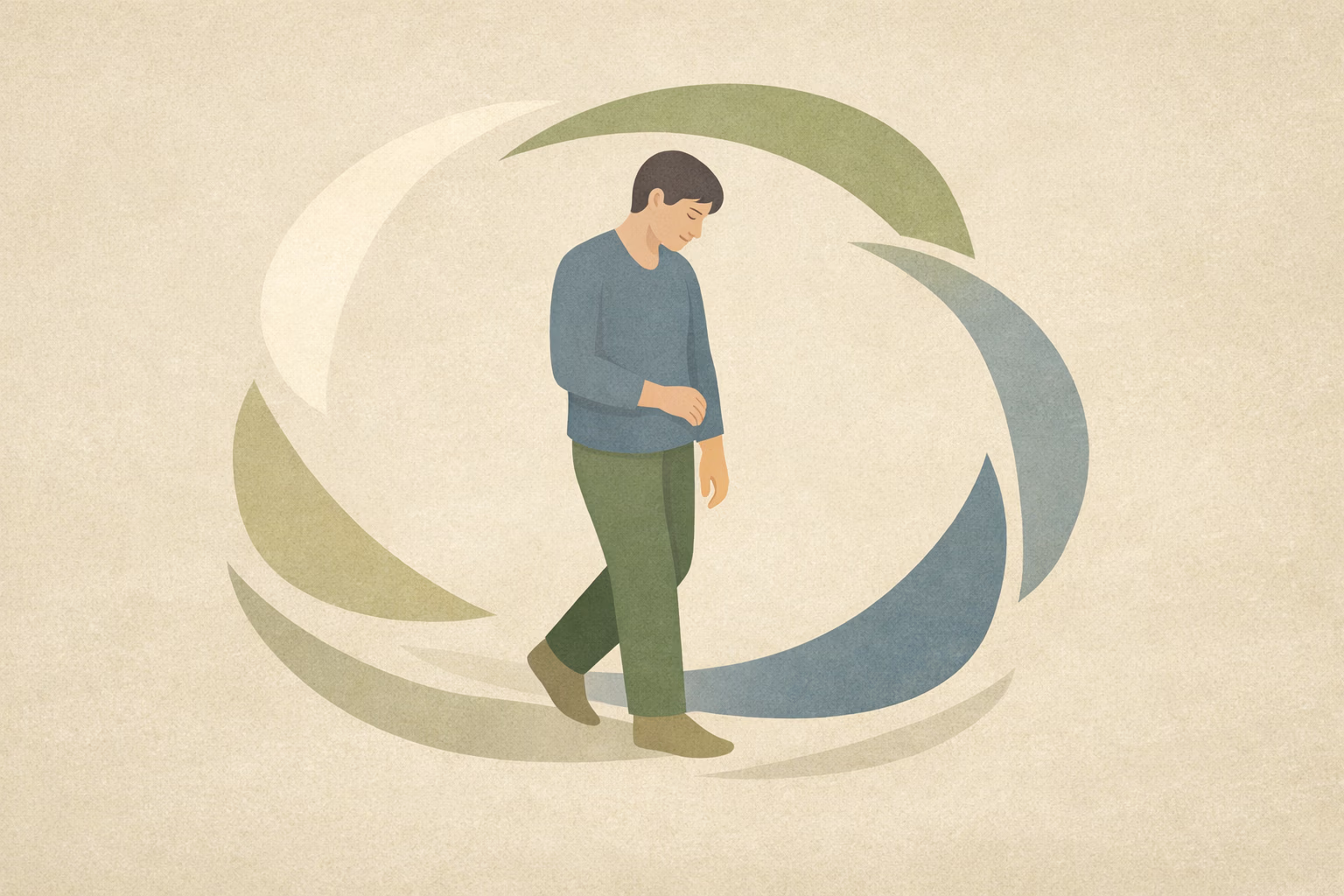
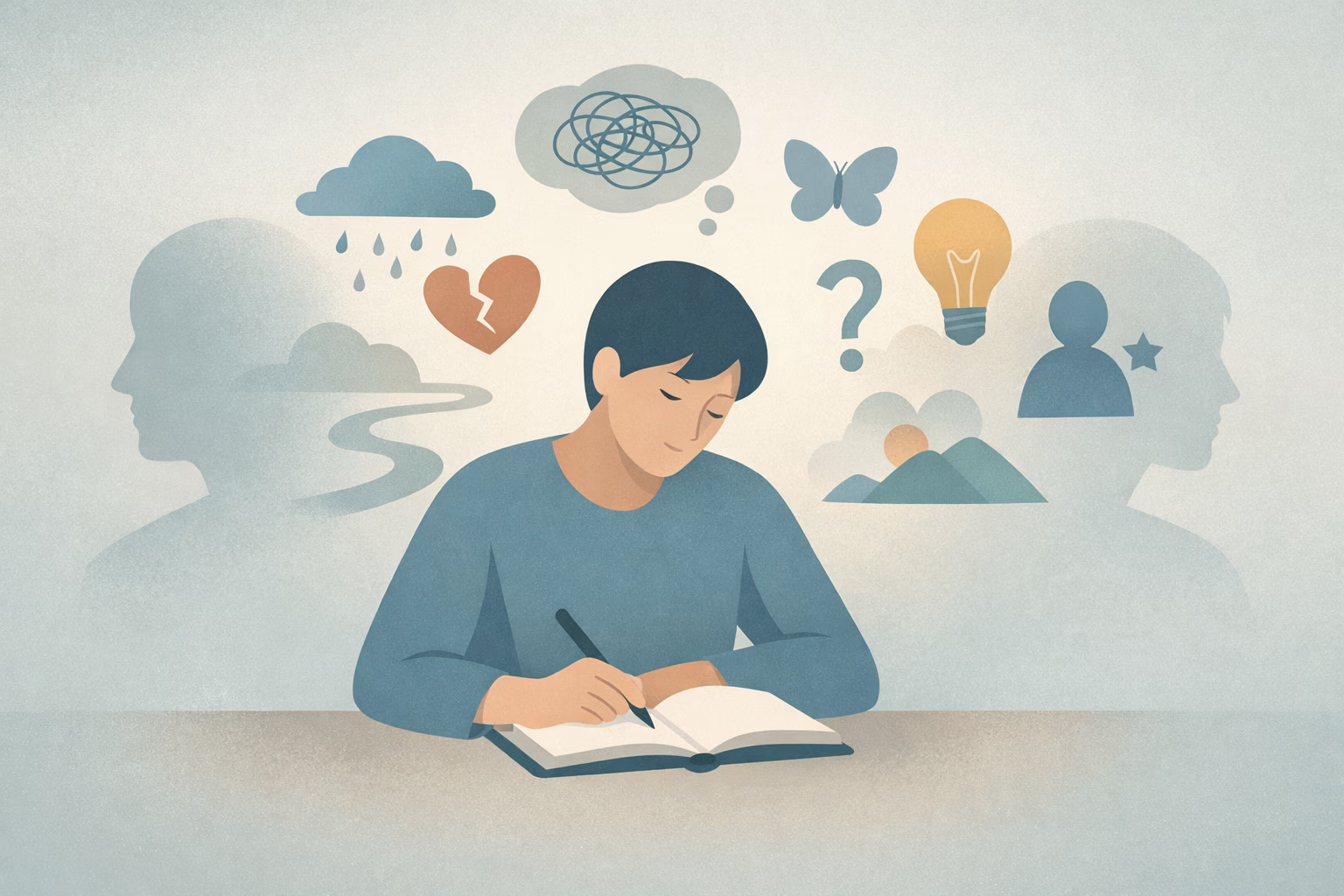
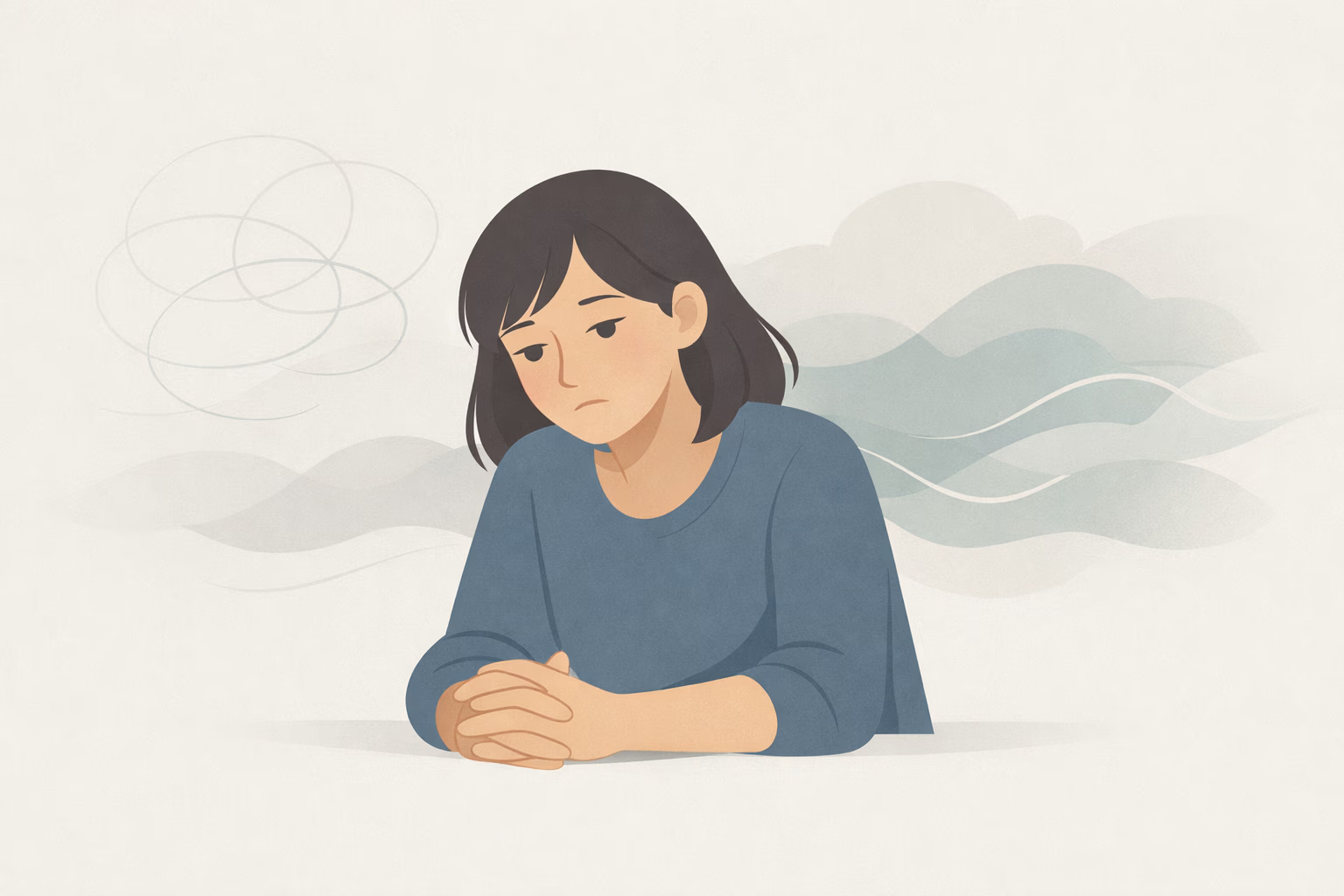
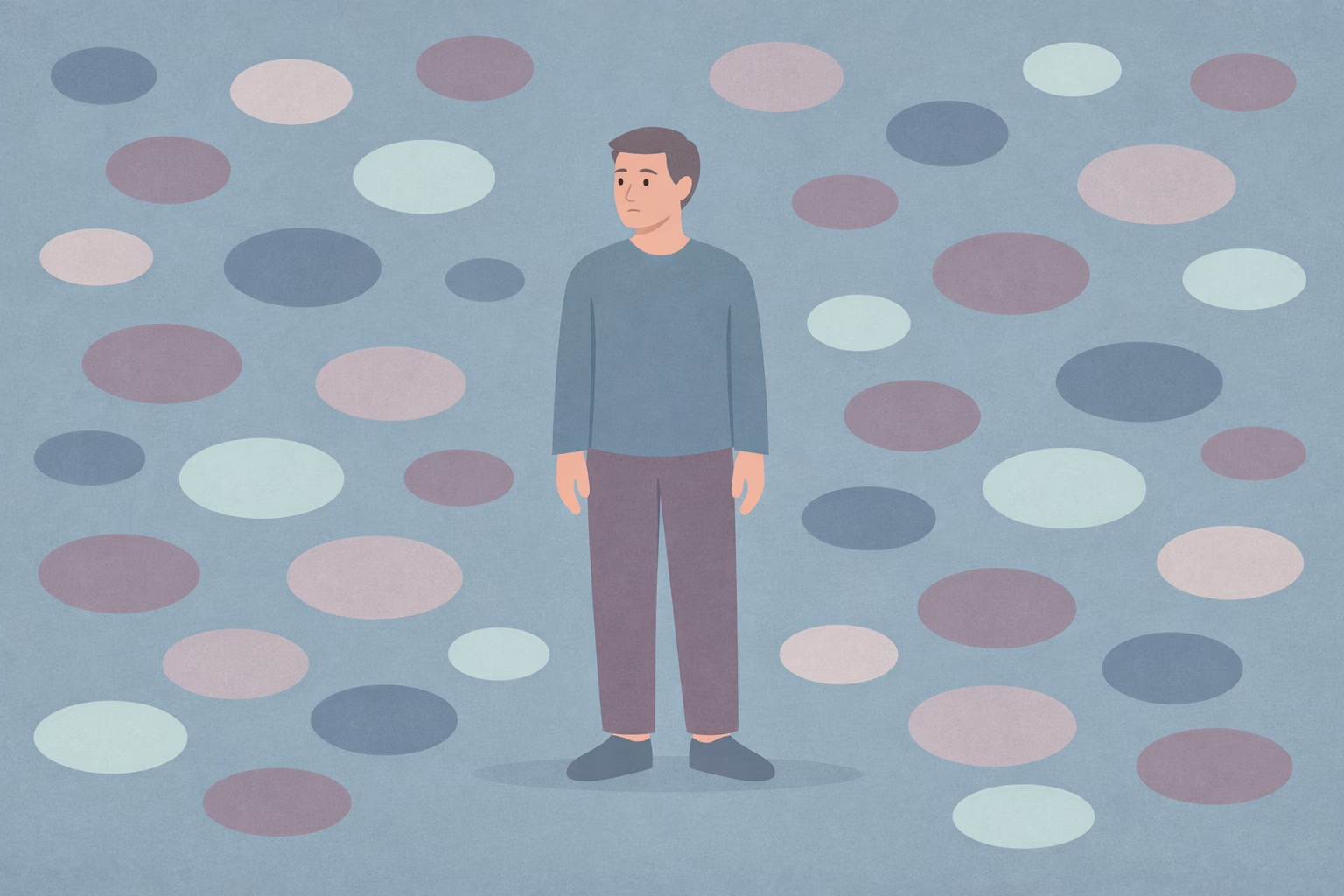
Understanding explains what is happening. Art allows you to feel it—without fixing, judging, or naming. Pause here. Let the images work quietly. Sometimes meaning settles before words do.
One Quiet Window, one insight, one reflection — every Sunday