

The Lure of Fantasy & Daydreaming: Escaping What Hurts

In short: Novelty can be beautiful: a new place, a new idea, a new conversation that makes life feel larger. But sometimes “new” stops being a pleasure and starts being a solvent—something that thins out the heaviness of being human for a moment.
Novelty can be beautiful: a new place, a new idea, a new conversation that makes life feel larger. But sometimes “new” stops being a pleasure and starts being a solvent—something that thins out the heaviness of being human for a moment.
What if the urge for constant novelty isn’t a personality flaw, but a stability strategy?
In a high-speed world, novelty can work like a quick-reset for attention and mood. It can also quietly keep deeper loops from completing—especially the ones that form meaning: the awareness that time passes, that life is finite, and that no amount of stimulation can fully replace a sense of inner continuity.
Many people recognize a cycle: something new arrives and the system lights up—focus sharpens, energy rises, the day feels more possible. Then the newness fades, and what remains can feel oddly flat: boredom, irritability, restlessness, or a low-grade unease.
This isn’t “being inconsistent.” It’s often the nervous system tracking stimulation as a proxy for aliveness. Novelty-seeking is a known human trait, and it tends to show up as quick engagement with new experiences, ideas, or risks, especially when the present moment feels thin or unrewarding. [Ref-1]
When the internal environment lacks a clear “done” signal—when nothing settles as complete—novelty can become the easiest way to get movement again. The chase isn’t always toward something; it can also be away from the friction of sameness.
Novelty recruits the brain’s reward-learning and attention systems. The effect isn’t just “pleasure.” It’s orientation: attention narrows, the world feels more vivid, and the mind temporarily stops scanning for unresolved threads.
That shift can be profoundly regulating in the short term. It reduces the bandwidth available for existential reflection—questions about time, purpose, and uncertainty—by filling the foreground with something bright and immediate. Over time, however, repeated novelty can produce a treadmill effect: what once felt exciting becomes baseline, and the system asks for a stronger “new” to get the same lift. [Ref-2]
In other words, novelty doesn’t only add stimulation. It can also subtract awareness—especially the slower, quieter awareness that helps experiences consolidate into meaning.
Humans don’t just react to the environment; we also carry narrative. We can imagine futures, replay pasts, and recognize that the story ends. That capacity can create depth and tenderness—and it can also create strain when life feels directionless or incoherent.
When mortality and uncertainty sit in the background without a stable place to land, the mind doesn’t necessarily “process” them. It often routes around them. Not because of weakness, but because ongoing, unresolved awareness increases load.
Existential philosophy has long noted that confronting finitude changes how life is lived; it can either deepen meaning or trigger strategies of escape. [Ref-3] Novelty can be one of those strategies—not as denial, but as displacement: keeping attention moving so nothing has to settle.
Novelty offers an immediate package: anticipation, intensity, a sense of forward motion. For a nervous system carrying unfinished loops, that can feel like relief—because it creates a temporary “okay-ness” without requiring anything to resolve.
In that sense, novelty doesn’t just feel good. It feels like an exit from inner stillness, especially when stillness has become associated with unfinishedness rather than rest.
Novelty-seeking is often described as a tendency toward exploration and excitement in response to new stimuli. [Ref-4] The important detail is what it replaces: continuity, digestion, and the slow internal settling that says, “This part of life is integrated enough to stand down.”
Sometimes the problem isn’t that life is boring. It’s that the system doesn’t trust quiet to mean safe and complete.
Modern culture often treats constant novelty as vitality: reinvent yourself, upgrade your life, stay interesting, don’t get stuck. This can sound like freedom. But it can also create a subtle contempt for continuity—like staying with anything long enough to deepen is a kind of failure.
When novelty becomes the main route to feeling awake, it can quietly hollow out meaning. The person isn’t “avoiding life.” They may be trying to keep life from collapsing into something too real, too finite, too hard to hold without steadier grounding.
Research on reward-learning and novelty suggests that novelty can amplify approach behavior and reinforce seeking patterns—especially when reward signals become the primary guide. [Ref-5] The mismatch shows up when stimulation is mistaken for substance.
A pleasure loop isn’t a moral failure. It’s a closed circuit: discomfort rises, the system finds a fast regulator, and relief arrives quickly enough that the deeper loop never completes. The “new thing” becomes a reliable state-change tool.
Over time, the nervous system learns: novelty is the bridge out of heaviness. That learning is adaptive in the short term, especially under chronic stress or fragmentation. But it can also reduce access to the slower cues that build identity—consistency, commitments, and the sense that your life is forming a coherent arc.
Traits associated with novelty seeking are linked to specific patterns of reinforcement and behavior selection, not just “preferences.” [Ref-6] In a high-stimulation environment, those patterns can get louder simply because the loop is easy to complete.
Novelty-seeking as an escape rarely looks dramatic. It often looks like a life that keeps starting but struggles to deepen. Not because someone is afraid of depth, but because depth requires continuity—enough time and quiet for experiences to consolidate.
Common patterns can include:
These patterns overlap with broader sensation-seeking tendencies described in the literature. [Ref-7] The key is not labeling the person; it’s noticing the regulatory logic: stimulation helps the system outrun incompletion.
Meaning is not created by intensity alone. It forms when experiences accumulate into something that feels internally “true,” finished enough to carry forward, and compatible with identity. That requires repetition, reflection, and closure—conditions that constant novelty can interrupt.
When attention is repeatedly fragmented, the brain becomes skilled at scanning and switching, but less practiced at sustained presence. The result can be a paradox: many experiences, little integration; many beginnings, few endings.
Work on attention and psychological functioning suggests that sustained focus and continuity support deeper processing, while ongoing interruption changes how experiences are encoded and held. [Ref-8] When life becomes mostly “next,” the self can feel less like a story and more like a feed.
If novelty has been doing the job of regulation, then quiet can begin to feel like withdrawal—not because quiet is dangerous, but because it reintroduces the signals that stimulation was muting. The body notices unfinishedness again: lack of closure, unresolved questions, the sense of time passing without a clear narrative container.
This is one way reliance on stimulation strengthens itself. The more often novelty provides fast relief, the less tolerance the system has for the slower sensations of continuity. The person can feel “wired” without knowing why, even when nothing is wrong in the immediate environment.
Trait-level sensation seeking is associated with stronger attraction to stimulating inputs and can shape comfort levels with low-stimulation contexts. [Ref-9] In a fast world, that tilt can become a default, making stillness feel like an absence rather than a resting place.
There is a quiet reframe available here—one that doesn’t require forcing stillness or “fixing” the urge for novelty. The reframe is structural: stability grows when the system receives enough completion signals that it no longer needs constant state-change.
Continuity—staying in contact with what remains when the sparkle fades—can function as a bridge back to coherence. Not as insight, and not as emotional intensity, but as the slow return of capacity: the ability to hold ordinary moments without needing them to perform.
Research discussing the downsides of excessive novelty seeking points toward how repeated stimulation can create downstream costs in regulation and decision patterns. [Ref-10] The point isn’t to demonize novelty; it’s to recognize that “more new” cannot substitute for the physiological settling that comes from enough closure.
What if the opposite of novelty-chasing isn’t dullness, but a life that can land?
One of the strongest counters to the novelty loop is not willpower—it’s durable connection. Relationships and communities create shared continuity: recurring roles, mutual memory, and the sense that you matter in a way that extends beyond the moment.
Novelty can provide stimulation, but it rarely provides mutual witness. Enduring bonds offer something different: a steady mirror that helps identity cohere over time. When life contains reliable relational “anchors,” the nervous system often has less need to chase intensity to feel real.
Personality research on novelty seeking highlights meaningful differences in how people approach reward and exploration. [Ref-11] Those tendencies can be shaped by context—and context includes whether one’s life has stable, shared sources of meaning that don’t disappear when the dopamine spike does.
When stimulation is no longer doing all the regulating, the internal world often becomes less urgent. Not necessarily more “emotional,” but more tolerable—more capable of returning to baseline after activation.
People often describe this shift in plain language: less frantic searching, more steadiness, fewer dramatic peaks and drops. There can be a sense of having room to live inside one’s life rather than constantly scanning for the next portal out.
Frameworks like Self-Determination Theory emphasize that well-being is supported when life contains autonomy, competence, and relatedness—conditions that tend to create steadier motivation than reward-chasing alone. [Ref-12] In meaning terms, the system starts to recognize: “I have a place here, and it holds.”
Calm isn’t a mood. It’s what becomes possible when enough in your life feels finished enough to stop demanding attention.
When novelty stops being the primary stabilizer, time can feel different. The future isn’t only a place where something better might happen; it becomes a continuation of a life that already has threads worth carrying forward.
Meaning becomes less about intensity and more about alignment—what you repeatedly return to, what you stand for, what your days quietly demonstrate. Identity stabilizes not through declarations, but through patterns that have had time to consolidate.
Research on identity and motivation suggests that when actions are congruent with identity, persistence and coherence strengthen over time. [Ref-13] In this orientation, novelty still exists—but it becomes one color in the palette, not the whole source of light.
If you recognize yourself in novelty-chasing, it can help to hold it with dignity: this may be your system’s way of managing existential load in a world that rarely provides closure. The urge for “new” can be a signal that something deeper is under-supplied—continuity, belonging, authorship, or the feeling that your life is cohering into a story you can live inside.
When meaning is thin, stimulation becomes louder. When meaning is thick—when life contains enough completion and self-direction—novelty becomes optional again, instead of compulsory. Research linking autonomy and well-being supports the idea that agency and inner alignment create more durable stability than external control or constant evaluation. [Ref-14]
Nothing here requires you to condemn novelty. The point is simply that relief and meaning are different kinds of nourishment—and the nervous system tends to settle more deeply when it receives the kind that lasts.
Mortality awareness doesn’t need to be conquered; it needs a coherent place in the story of a life. When experiences are allowed to complete—when relationships, values, and daily realities form continuity—the pressure to outrun stillness often softens on its own.
Novelty will always have its place. But many people discover that what finally feels like “enough” is not another spark. It’s a steadier sense of self—one that can endure ordinary time and still feel real. [Ref-15]
From theory to practice — meaning forms when insight meets action.
Usually it's a stability strategy, not a flaw. In a high-speed world, novelty works as a quick reset: a new place, idea, or experience temporarily narrows attention and stops the system from scanning for unresolved threads. That's a real form of regulation. The pattern often gets louder when life provides few clear Done Signals — when nothing settles as complete, the easiest way to get movement again is something new. The chase isn't always toward something; it can also be away from the friction of sameness. Recognizing that gives the urge dignity: it's your nervous system managing existential load in an environment that rarely delivers closure.
Because quiet reintroduces the signals stimulation was muting. Lack of closure, unresolved questions, the awareness of time passing without a clear narrative container — these don't disappear when novelty hits, they just get drowned out. When the system has been relying on intensity for regulation, stillness can feel like withdrawal even though nothing is actually wrong. The more often novelty provides fast relief, the less tolerance the body has for the slower sensations of continuity. Stillness then gets misread as absence rather than rest. It's not that quiet is dangerous — it's that the threshold for tolerating it has shifted.
Only briefly, and at a cost. Novelty fills the foreground with something bright and immediate, which reduces the bandwidth available for existential reflection — questions about time, purpose, finitude. That's regulating in the short term. But meaning forms differently: it requires repetition, reflection, and closure — conditions constant novelty interrupts. When attention is repeatedly fragmented, the brain becomes skilled at scanning and switching but less practiced at sustained presence. The result is a paradox: many experiences, little integration; many beginnings, few endings. Stimulation can substitute for substance for a while, but the system eventually notices the difference.
Continuity becomes tolerable, then nourishing. When the nervous system receives enough completion signals — through enduring relationships, lived values, and days that have a recognizable shape — the demand for constant state-change relaxes. People describe less frantic searching, fewer dramatic peaks and drops, and a sense of having room to live inside their life rather than scanning for the next portal out. Novelty doesn't disappear; it just becomes optional rather than compulsory. It returns to being one color in the palette instead of the whole source of light. That shift isn't suppression — it's what happens when meaning gets thick enough to stand on.
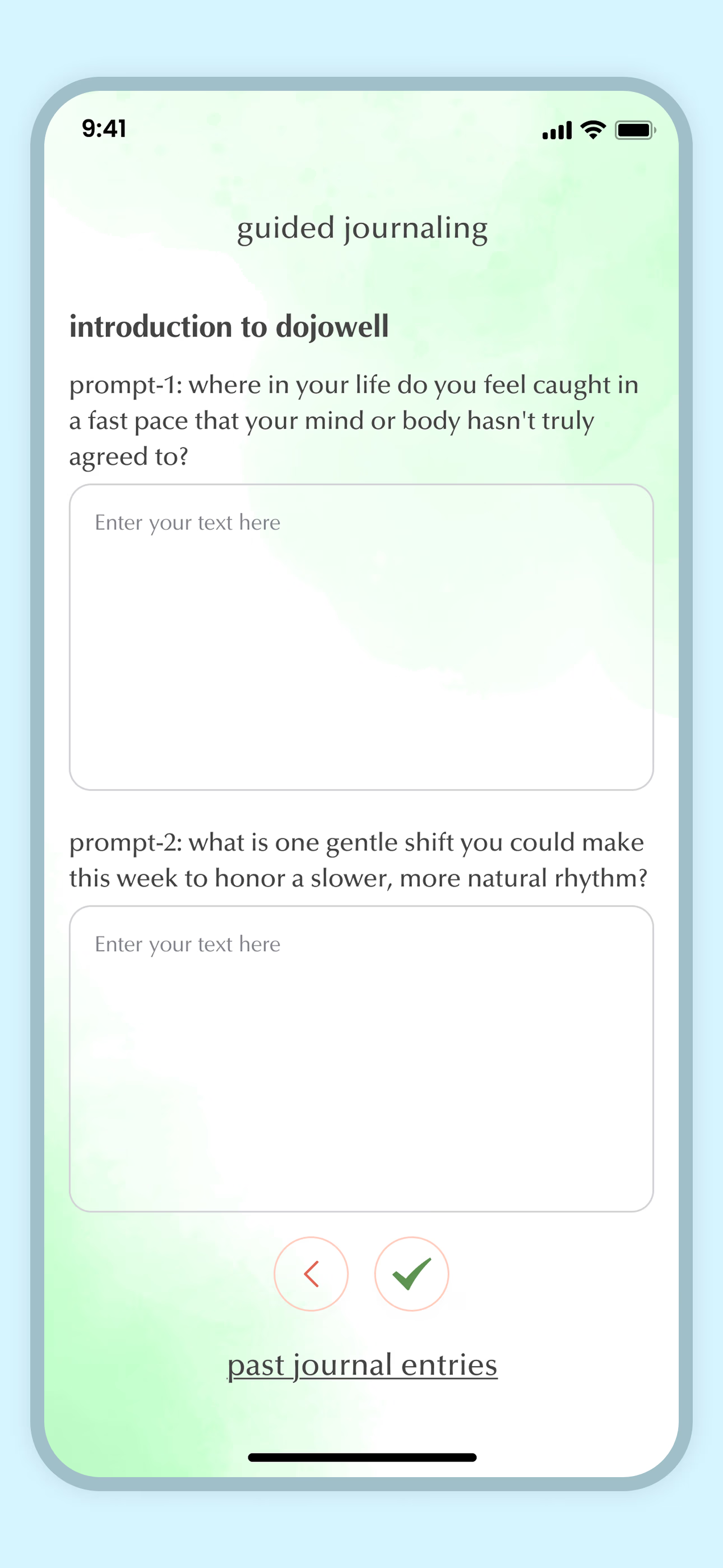
From Science to Art.
Understanding explains what is happening. Art allows you to feel it—without fixing, judging, or naming. Pause here. Let the images work quietly. Sometimes meaning settles before words do.
One Quiet Window, one insight, one reflection — every Sunday