Algorithmic Identity Shaping: When Platforms Decide Who You Become
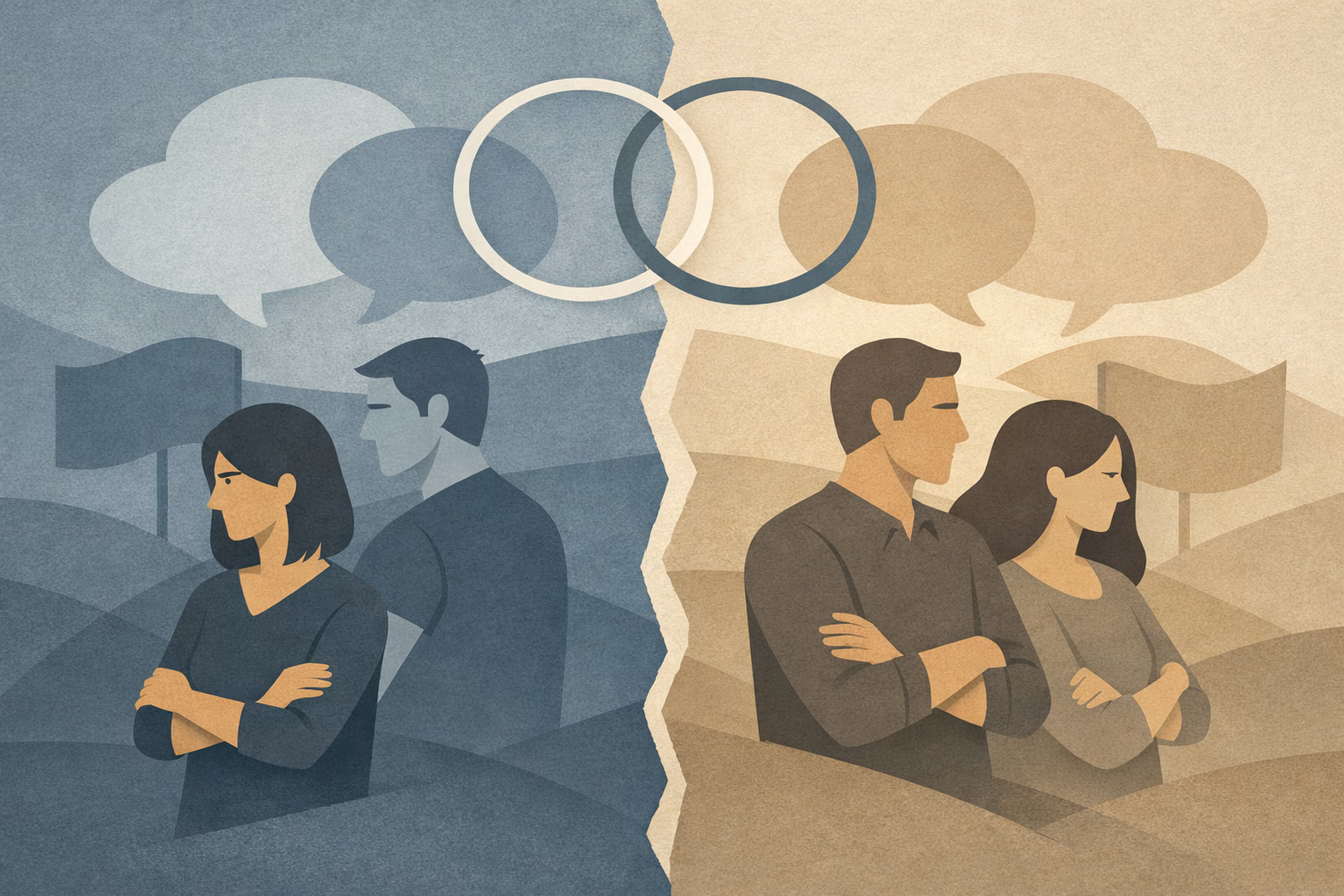
In short: Opinion tribalism isn’t just “having strong views.” It’s the state where a viewpoint becomes fused with identity, so disagreement doesn’t land as information—it lands as a threat to belonging, dignity, or self-respect. In that state, a conversation can start to feel less like shared reality-making and more like a referendum on who you are.
Opinion tribalism isn’t just “having strong views.” It’s the state where a viewpoint becomes fused with identity, so disagreement doesn’t land as information—it lands as a threat to belonging, dignity, or self-respect. In that state, a conversation can start to feel less like shared reality-making and more like a referendum on who you are.
What if the intensity you feel isn’t proof that you’re broken—just proof that your system is trying to protect something important?
When beliefs carry the weight of identity, the nervous system treats challenges as high-stakes. That doesn’t mean you’re irrational or “too sensitive.” It means your system is operating under conditions where closure, safety cues, and coherent belonging have become harder to come by—so opinions start doing extra jobs they were never meant to do.
There’s a recognizable felt shift when beliefs become personal property. The body tightens, attention narrows, and the room can start to feel subtly unsafe—even if nobody is yelling. It’s not that you consciously decide to be defensive; it’s that the system detects risk and prepares for impact. [Ref-1]
In that state, disagreement often comes with quick physiological markers: a hot face, a clenched jaw, rapid scanning for “gotchas,” or a strong urge to correct. The interaction can become less about the topic and more about maintaining footing—status, competence, morality, belonging.
When an opinion is carrying your worth, every counterpoint can feel like a push.
Humans are built to track social standing and group safety. When a belief is tied to identity, challenge can activate threat and status systems: attention narrows, nuance drops out, and the mind moves toward certainty and defense. This is a protective state shift—useful for conflict, not ideal for complexity. [Ref-2]
Once threat physiology is running, the brain prioritizes quick sorting over slow understanding. It becomes easier to detect disrespect than detail, easier to notice flaws than shared ground. That isn’t a character issue; it’s what nervous systems do when the cost of being “wrong” feels like social or personal loss.
Why does it feel so hard to “just be open” in that moment?
Because openness requires spare capacity. Under load, systems don’t expand—they conserve, simplify, and protect.
Unlike most animals, humans organize life through narratives: who we are, what matters, who can be trusted, what the future means. Shared stories have historically functioned as survival technology—coordinating cooperation, roles, and protection. [Ref-3]
So it makes sense that beliefs can become more than “ideas.” In many contexts, a belief is also a membership signal: I belong here. I know the rules. I’m safe with you. When those signals are scarce or unstable, tightening around a shared stance can feel like the quickest route back to coherence.
In other words, the pull of tribal alignment isn’t mainly intellectual. It’s an ancient appetite for dependable belonging and a stable place in the social world.
Tribal alignment can bring immediate psychological “snap-in”: clarity, moral direction, and a sense of being on the right side of things. It reduces ambiguity, which can feel like relief when the world is complex and the future uncertain. [Ref-4]
This is part of why opinion tribalism can feel soothing at first. It compresses complexity into simple categories—good/bad, safe/unsafe, us/them—creating a quick sense of order. The nervous system reads that order as stability, even when the underlying reality is messier.
But fast certainty isn’t the same as lasting closure. It changes state; it doesn’t necessarily settle the deeper need for completion and stable identity.
When defending a belief feels like defending the self, the system learns a simple rule: Change is dangerous. Not because you fear information, but because information has been structurally linked to threat—loss of belonging, loss of face, loss of coherence. Over time, this can restrict learning and make relationships feel conditional: safe only if agreement holds. [Ref-5]
There’s also a subtle narrowing of identity. If your “self” is maintained through holding the line, then curiosity becomes risky and nuance becomes expensive. The cost isn’t just interpersonal. It can show up internally as chronic tension—because a self built on defense has to keep scanning for intrusion.
When your stance is your shelter, you can’t renovate without feeling exposed.
In modern environments, “power” often shows up as dominance signaling: quick certainty, sharp takedowns, winning the thread, having the cleanest narrative. Those behaviors can be socially rewarded—likes, approval, in-group status—especially inside echoing communities. [Ref-6]
That reward structure can lock people into a Power Loop: the system stays vigilant because vigilance pays. You get brief hits of relief and status when you defend, correct, or outperform, but the baseline doesn’t settle. It’s hard to reach “done” when the environment keeps offering new threats, new outrages, new scorekeeping.
In this loop, identity doesn’t stabilize through completion; it stabilizes through repeated proof. And proof is never finished.
Opinion tribalism is often less about what you believe and more about how the belief has to function—like armor, membership card, or moral résumé. In that structure, certain patterns become predictable. [Ref-7]
These are not personality defects. They are nervous-system-consistent outcomes when belonging, status, and safety are routed through “being right.”
Over time, identity fusion can erode the conditions that make people feel safe with one another: room for mistakes, room for evolution, room for partial agreement. When disagreement reliably produces consequences—mockery, exclusion, moral condemnation—systems learn to stay guarded. [Ref-8]
That guardedness isn’t always loud. Sometimes it looks like withdrawal and quiet social thinning. Sometimes it looks like chronic readiness: always collecting evidence, always anticipating attack, always preloading arguments. Either way, the body pays. Tension becomes a baseline, and relationships can start to feel like a battlefield or a performance.
When was the last time a hard conversation ended with a real “done” feeling?
Without closure, the nervous system doesn’t stand down. It just changes strategies—fight, freeze, avoid, outperform—depending on context.
Digital environments don’t simply share information; they shape identity. Social validation rewards clear signals, quick alignment, and confident certainty. Algorithms amplify content that provokes, divides, or confirms group narratives, which can deepen rigidity over time. [Ref-9]
In that ecosystem, shifting your view can feel less like learning and more like public unmaking: loss of status, loss of community, loss of a stable self-story. The system interprets “I changed my mind” as “I might be alone.” So it doubles down—not because it loves conflict, but because it’s trying to preserve a coherent place in the world.
When the environment makes identity legible through opinions, beliefs stop being tools for orientation and become badges that keep you socially readable.
There is a different internal architecture available—one where beliefs matter, but they don’t function as life support. In that architecture, self-worth is not continuously negotiated in debate. It’s not earned through winning, and it’s not lost through being challenged.
This isn’t “just think differently” or “be more open.” It’s a deeper settling that happens when identity has other anchors—values that are lived, roles that feel real, relationships that don’t require constant proof. When that anchoring is present, the nervous system can treat disagreement as data instead of danger. [Ref-10]
When your self is bigger than your stance, the room gets quieter inside.
Flexibility, in this sense, isn’t a virtue performance. It’s what becomes possible when the system no longer needs an opinion to hold the self together.
As the threat signal reduces, conversations often change shape. Listening becomes more available—not as a moral choice, but as a capacity that returns when the body isn’t bracing. You can hold your position without trying to erase someone else’s, and you can recognize limits without turning them into contempt. [Ref-11]
Relational safety grows when people can disagree without punishment and without dominance games. That doesn’t mean everything becomes agreeable. It means the relationship isn’t used as a scoreboard for worth.
When identity is less defended through belief conflict, the system can tolerate complexity without immediate collapse into teams and slogans. Curiosity returns not as an “attitude,” but as a sign that load has reduced and safety cues are present. [Ref-12]
This is also where you may notice a subtle but meaningful shift: fewer internal aftershocks. Interactions complete more often. The mind doesn’t have to rehearse arguments for hours. You can encounter difference and still recognize yourself afterward.
In a coherent state, complexity doesn’t demand constant self-justification. It becomes something you can relate to—without needing to dominate it.
A stable sense of self can hold ideas more lightly. Not because beliefs don’t matter, but because they’re no longer tasked with securing belonging and status at every moment. In that structure, beliefs can return to their proper role: helping you navigate reality, make sense of experience, and coordinate with others. [Ref-13]
Identity, then, is not a brittle claim that must be defended. It is an orientation that can incorporate new information and still remain intact. Coherence shows up as a quieter inner posture: you can be committed without being consumed, principled without being perpetually mobilized.
Beliefs can guide a life without becoming the walls of it.
Opinion tribalism is often a signal that something deeper is underfed: stable belonging, dependable closure, a sense that your life has direction beyond performance and proof. In that context, beliefs can become identity because identity is searching for a place to land.
Seen this way, the goal isn’t to shame tribal impulses or force yourself into constant neutrality. It’s to recognize the structural conditions that make fusion likely—and to notice how much of the charge is about maintaining coherence under pressure. [Ref-14]
When meaning is grounded in lived values and real-world belonging, opinions don’t have to carry your worth. They can be strong, changeable, partial, or evolving—without destabilizing who you are.
Beliefs are tools: they help humans orient, interpret, and coordinate. They can be deeply held and still remain tools rather than identity containers. When selfhood is stable enough to hold ideas without fusing to them, dignity becomes less negotiable—and curiosity becomes less costly. [Ref-15]
In a fragmented world, it’s understandable to reach for certainty. But identity tends to strengthen when it can carry complexity without turning every difference into a threat.
From theory to practice — meaning forms when insight meets action.
Because once a belief fuses with identity, the nervous system treats challenges as high-stakes — a threat to belonging, dignity, or self-respect. The body tightens, attention narrows, and threat and status circuitry activates: hot face, clenched jaw, scanning for gotchas, urge to correct. Nuance drops out and the mind moves toward certainty and defense. This isn't oversensitivity; it's a protective state shift. When an opinion is carrying your worth, every counterpoint feels like a push. Openness requires spare capacity, and under load systems don't expand — they conserve, simplify, protect. The interaction stops being about the topic and becomes about maintaining footing.
Because tribal alignment compresses complexity into simple categories — good/bad, safe/unsafe, us/them — creating a quick sense of order. The Threat & Safety System reads that order as stability even when reality is messier. Certainty reduces the cost of constant evaluation. Belonging reduces the cost of standing alone. Moral clarity reduces the cost of unresolved ambiguity. When closure and stable belonging are scarce in life, tightening around a shared stance feels like the fastest route back to coherence. This is the Identity & Meaning System reaching for a familiar anchor. But fast certainty isn't lasting closure — it changes state, it doesn't settle the deeper need.
Because in identity fusion, the system has learned a structural rule: change is dangerous. Not because you fear information, but because information has been linked to threat — loss of belonging, loss of face, loss of coherence. In digital environments this is amplified; algorithms reward clear signals and confident certainty, so shifting your view can feel like public unmaking. The system interprets 'I changed my mind' as 'I might be alone,' and doubles down to preserve a place in the social world. This is the Power Loop: vigilance pays, softness costs. Identity stops stabilizing through completion and starts stabilizing through repeated proof — which is never finished.
Yes — when identity has other anchors. When values are lived, roles feel real, and relationships don't require constant proof, beliefs return to being tools rather than identity containers. They help you orient, interpret, coordinate. The nervous system can treat disagreement as data instead of danger because self-worth isn't continuously negotiated in debate. Flexibility, in this sense, isn't a virtue performance — it's what becomes possible when the system no longer needs an opinion to hold the self together. You can be committed without being consumed, principled without being perpetually mobilized. Beliefs can guide a life without becoming the walls of it.
From Science to Art.
Understanding explains what is happening. Art allows you to feel it—without fixing, judging, or naming. Pause here. Let the images work quietly. Sometimes meaning settles before words do.
One Quiet Window, one insight, one reflection — every Sunday