
Instant Gratification Traps: The Hidden Cost of Quick Rewards
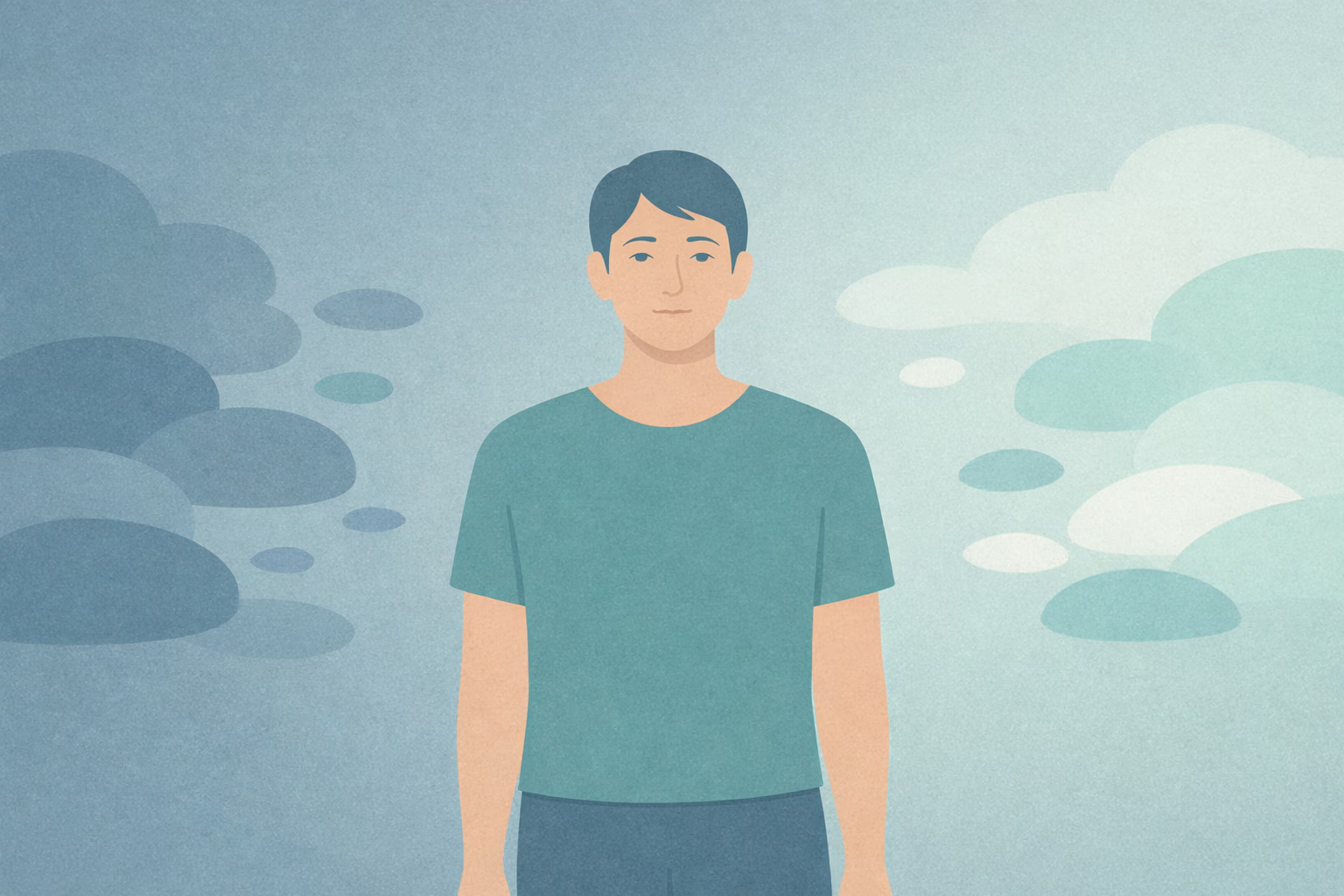
In short: Many people aren’t missing pleasure because they “don’t appreciate life.” They’re missing it because their systems have been asked to run too fast, too often, for too long—without enough completion, recovery, or “done” signals. What if your low desire isn’t a personal flaw, but a nervous system that’s protecting itself from more load?
Many people aren’t missing pleasure because they “don’t appreciate life.” They’re missing it because their systems have been asked to run too fast, too often, for too long—without enough completion, recovery, or “done” signals.
What if your low desire isn’t a personal flaw, but a nervous system that’s protecting itself from more load?
Reclaiming desire isn’t about forcing yourself to want more. It’s about restoring a natural, responsive relationship with pleasure—one that can rise, crest, and settle again without needing to be constantly fed.
Desire is often talked about like a mood you either have or don’t have. Biologically, it functions more like an orientation system: it helps you notice what matters, lean toward what’s nourishing, and allocate energy toward what might be worth pursuing. [Ref-1]
When desire feels absent, it doesn’t necessarily mean your capacity for joy is gone. It often means the pleasure system is conserving resources, dampening intensity, or reducing pursuit signals because the overall environment has been too activating—or too incomplete—for too long.
In that sense, “I don’t want anything” can be the body’s dignified way of saying: there isn’t enough room to want safely right now.
Reward signaling—often summarized as “dopamine”—doesn’t simply amplify pleasure. It helps with salience, pursuit, learning, and the sense that something is worth moving toward. [Ref-2]
When stimulation is constant, the system can shift into a higher baseline of alerting and seeking. Over time, the same inputs may feel less satisfying, not because you’ve become “hard to please,” but because the system has learned to expect intensity and frequency.
Resensitization tends to be associated with pacing, rest, and meaningful engagement—conditions where the brain can re-learn contrast, anticipation, and completion rather than perpetual chasing. This is less a mindset change and more a physiological rebalancing that shows up as steadier interest over time.
Human reward circuitry is built for environments where pleasure was rhythmic: periods of effort and searching, moments of contact and satisfaction, and then recovery. That pattern matters because it teaches the nervous system what “enough” feels like.
In evolutionary terms, wanting and enjoying are designed to be episodic. A responsive system turns up when there’s a meaningful opportunity, then turns down when the loop completes. Regulation of dopamine responsivity is part of how the brain stays adaptive rather than maxed out. [Ref-3]
When life becomes constant access—constant novelty, constant cues, constant evaluation—the system can lose its natural rise-and-fall. Not because you’re doing pleasure “wrong,” but because the underlying rhythm has been disrupted.
Fast, high-intensity rewards can create a temporary sense of relief: a brief lift, a hit of aliveness, a sense of “finally, something.” Under stress load, the brain is especially likely to prioritize immediate relief and quick signals. [Ref-4]
But relief isn’t the same as satisfaction. Relief changes state in the moment; satisfaction tends to include a completion signal—an internal sense of “that landed,” “that counted,” “that’s done.” Without that closure, the system often stays partially activated, still scanning for the next input.
So a person can have plenty of stimulation and still feel like desire is missing—because stimulation is arriving without the integrating finish that allows the nervous system to stand down.
There’s a distinct difference between pleasure that’s chased and pleasure that arrives. Chased pleasure often carries urgency, narrow focus, and a subtle sense of pressure—like the system is trying to extract a feeling on demand.
Organic joy tends to be quieter at first. It can show up as a small “yes,” a bit of interest, a softened attention—signals that the system has enough capacity to respond rather than compel.
When reward signaling has been strained or blunted, people often report a confusing mix:
These are not character problems. They’re common signatures of a system that’s learned intensity without closure, and stimulation without recovery. [Ref-5]
One way to describe modern reward strain is that many people get stuck in a Pleasure Loop: seek → get a quick lift → drop → seek again. The loop can run even when you’re “doing fine,” because it’s structurally reinforced by constant cues and frictionless access.
A Meaning Loop is different. It has a closing arc: interest → engagement → completion → settled satisfaction. That completion doesn’t have to be dramatic. It just has to register internally as real and finished.
Neuroscience research on reward and anhedonia points to how reward circuits interact with stress, motivation, and the capacity to experience enjoyment. [Ref-6] From this angle, reclaiming desire is less about generating more pleasure and more about restoring the conditions where reward can translate into lasting “enough.”
Desire returns more reliably when life offers endings you can feel, not just hits you can access.
When the system begins to re-balance, it rarely starts with fireworks. It often starts with a shift in what captures you: less compulsion, more curiosity; less urgency, more interest.
These signals are easy to dismiss because they’re subtle, but they’re meaningful. Dopaminergic systems are deeply involved in motivation, reinforcement learning, and the gradual reappearance of intrinsic “pull.” [Ref-7]
Returning desire may look like:
None of this is a “hack.” It’s a nervous system regaining the ability to register low-volume reward signals.
Many people interpret emotional flatness as a personal deficiency: “I’m ungrateful,” “I’m numb,” “I’m not myself.” A more grounded interpretation is that the system has reduced responsiveness to protect against overload, repetition, or disappointment.
In research, this territory is often discussed through the lens of anhedonia and global reward functioning—how stress, learning history, and neurobiology can narrow the range of what feels rewarding. [Ref-8]
Importantly, flatness is not the same as emptiness of character. It is often a sign that the organism is running a conservative energy policy: less pursuit, less intensity, fewer spikes. That conservation can be adaptive in the short term, even if it feels like life is happening behind glass.
Reward systems are designed to learn from patterns. When inputs arrive constantly and at high intensity, the nervous system adapts by requiring more signal for the same impact. This is not moral failure; it’s basic neuroadaptation.
Dopamine’s roles in motivational control include signaling what’s important, what’s worth effort, and what to learn from. [Ref-9] When everything is “important” (because everything is loud), the system can lose contrast. When contrast returns, sensitivity can return.
In lived experience, this often shows up as a shift from needing big stimulation to being able to register smaller satisfactions—especially those that come with completion: a finished conversation, a meal that lands, a walk with a clear beginning and end, a task that resolves.
Desire is not only about wanting. It’s also about permission—at the level of physiology—to reach outward. When the nervous system is scanning for threat, comparison, or interruption, it tends to prioritize control and predictability over expansion.
So the return of desire often correlates with safety cues: enough time, enough space, fewer sudden demands, less social evaluation, less background friction. Not a perfect life—just a life where the body believes it can engage without being punished by overwhelm afterward.
This matters because reward function is closely tied to stress physiology. Under chronic load, reward can flatten, narrow, or become more dependent on quick relief. [Ref-10] When load reduces and closure increases, desire doesn’t need to be forced; it can reappear as a natural outward signal.
What if “not wanting” is simply what wanting looks like under pressure?
Humans are social regulators. Reward is not only found in things; it’s also found in attunement—being seen, being with, being responded to. Social interaction can enhance enjoyment and engage reward circuitry, especially when it feels safe and mutual. [Ref-11]
This can be especially important when solo stimulation has become the primary way of changing state. Shared presence offers something different: it can create a completion signal through reciprocity—an arc of connection that begins, unfolds, and ends.
That’s one reason certain experiences feel satisfying in a deeper way than their “fun level” would predict. They don’t just excite the system; they help it settle.
When desire returns, people often expect a dramatic emotional surge. More commonly, what changes first is capacity: the ability to register positive signal without needing it to be intense, and without paying for it afterward.
In studies linking social frequency with enjoyment enhancement, the picture that emerges is not simply “more happiness,” but increased responsiveness of reward systems under the right conditions. [Ref-12]
In everyday terms, “alive again” can mean:
These are integration-adjacent signals: not just feeling better, but stabilizing in a way that supports continuity of self.
Overstimulation teaches a person to relate to pleasure as consumption: something to obtain quickly, optimize, and repeat. Meaning restores a different relationship: participation—showing up inside experiences that have sequence, friction, and completion.
Participation creates identity-level coherence because you aren’t only receiving sensation; you’re inhabiting a role: friend, maker, learner, caregiver, partner, neighbor, citizen, artist, builder. Those roles carry natural endpoints and consequences that help the nervous system close loops.
Research on reward circuitry and anhedonia highlights how disruptions in reward processing can shape motivation and engagement. [Ref-13] From a meaning lens, the most stabilizing shift is often when pleasure becomes a byproduct of coherent engagement—rather than the primary thing being pursued.
Pleasure holds better when it has somewhere to belong.
When people feel cut off from desire, they often assume they need more excitement. But excitement isn’t the only route to reward. The nervous system also responds to clarity, contribution, and congruence—the felt sense that your effort connects to something that matters.
Dopamine-related systems are involved in salience and motivation, not just “liking.” [Ref-14] That means what lights you up sustainably is often what reduces fragmentation: experiences that complete, relationships that resolve into trust, work that produces a real ending, values that translate into lived identity.
In that frame, reclaiming desire isn’t about chasing pleasure harder. It’s about letting pleasure reappear where life becomes more coherent—where signals can rise, land, and finally say: done.
Human systems aren’t built for constant activation. They’re built for cycles: mobilize, engage, complete, recover. When life restores even small amounts of that rhythm, the body’s energetic costs can decrease, and the need for constant compensation can soften. [Ref-15]
Desire, then, is not something you manufacture. It’s something that returns when the organism has enough safety, enough closure, and enough coherence to risk wanting again—quietly, steadily, in a life that can hold it.
From theory to practice — meaning forms when insight meets action.
Because desire isn't a personality trait — it's an orientation system. It helps you notice what matters and lean toward what's nourishing. When desire feels absent, your capacity for joy isn't gone. The pleasure system is conserving resources, dampening intensity, and reducing pursuit signals because the environment has been too activating, or too incomplete, for too long. 'I don't want anything' can be the body's dignified way of saying there isn't enough room to want safely right now. Reclaiming desire isn't about forcing yourself to want more. It's about restoring the conditions where pleasure can rise, crest, and settle without needing to be constantly fed.
Chased pleasure carries urgency, narrow focus, and a subtle sense of pressure — like the system is trying to extract a feeling on demand. Organic joy tends to be quieter at first: a small 'yes,' a bit of interest, a softened attention — signals that the system has enough capacity to respond rather than compel. When reward signaling has been strained, people often report wanting something but not enjoying it once it arrives, or feeling soothed by intensity without anything actually changing afterward. Those aren't character problems. They're the signature of a system that learned intensity without closure, and stimulation without recovery.
Reward systems learn from patterns. When inputs arrive constantly and at high intensity, the nervous system adapts by requiring more signal for the same impact. That's neuroadaptation, not moral failure. When everything is loud, the system loses contrast — and without contrast, it can't tell what's worth pursuing. Pacing restores contrast. Recovery restores the rise-and-fall the pleasure system was actually built for: anticipation, effort, contact, satisfaction, recovery. Resensitization isn't willpower work. It's a physiological rebalancing. In lived experience it shows up as a shift from needing big stimulation to being able to register smaller satisfactions, especially those that come with completion.
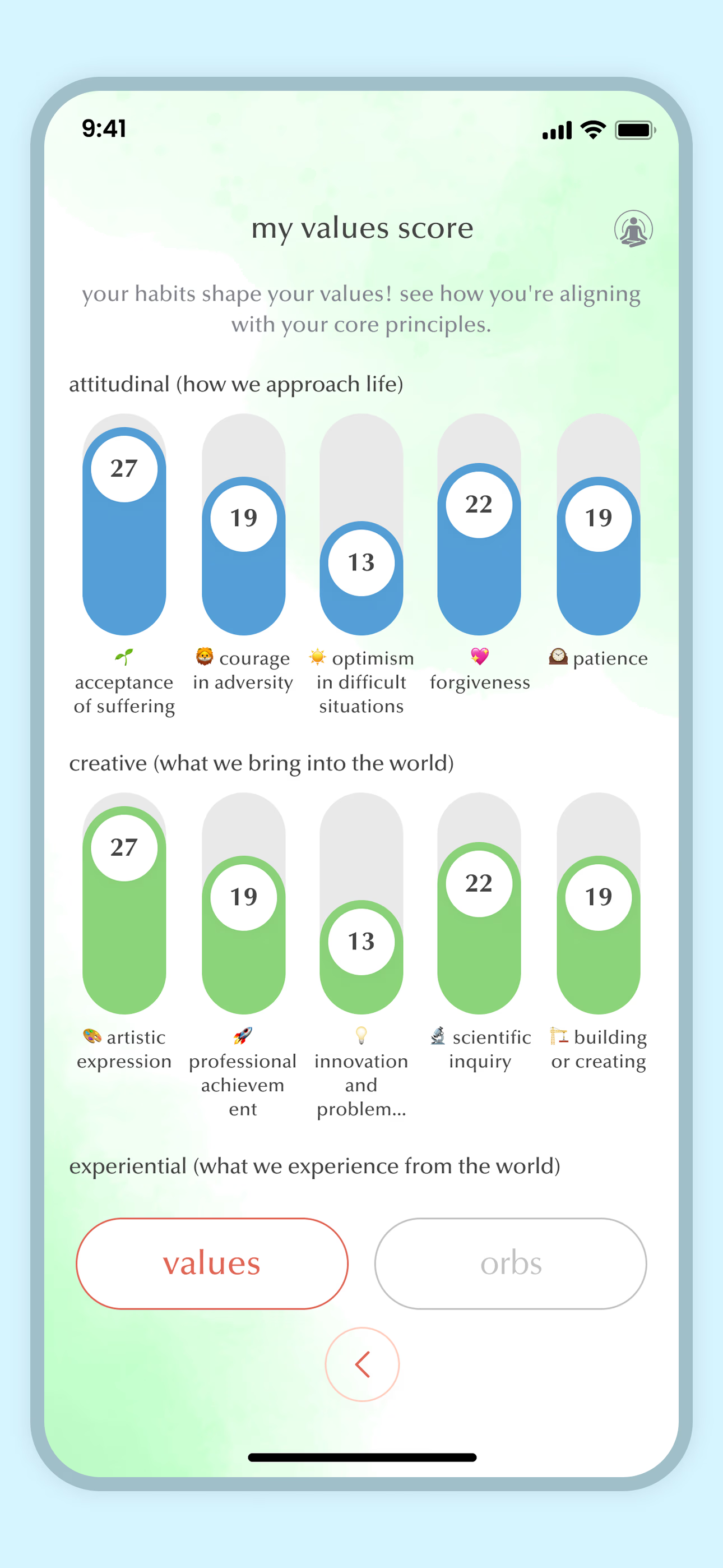
Overstimulation teaches a person to relate to pleasure as consumption — something to obtain quickly, optimize, and repeat. Participation is showing up inside experiences that have sequence, friction, and completion. It creates identity-level coherence because you aren't only receiving sensation; you're inhabiting a role: friend, maker, learner, caregiver, partner. Those roles carry natural endpoints that help the nervous system close loops. Pleasure becomes a byproduct of coherent engagement rather than the primary thing being pursued. That's the Meaning Loop in action: pleasure holds better when it has somewhere to belong, and the body trusts a life it can actually inhabit.
From Science to Art.
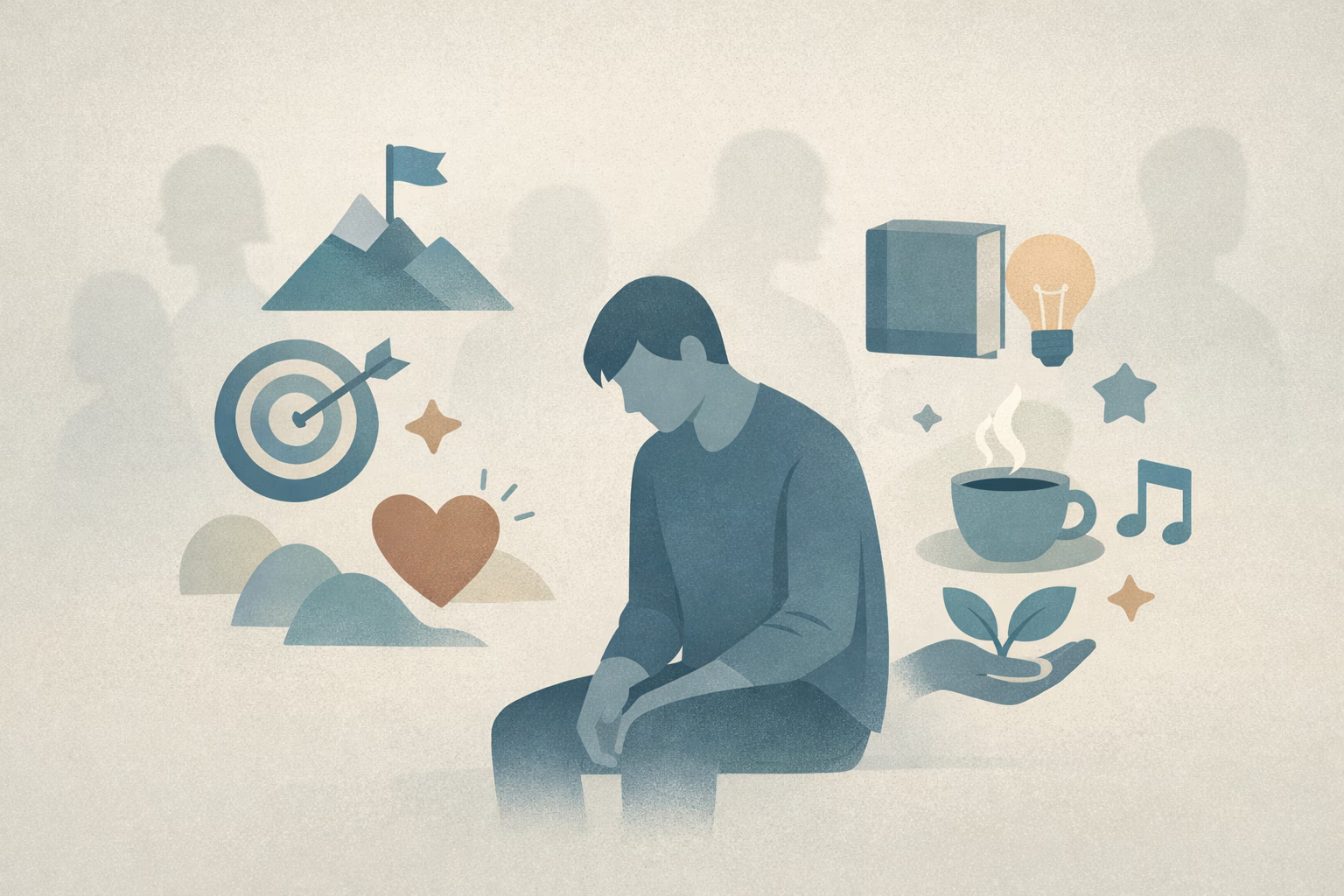
Understanding explains what is happening. Art allows you to feel it—without fixing, judging, or naming. Pause here. Let the images work quietly. Sometimes meaning settles before words do.
One Quiet Window, one insight, one reflection — every Sunday