Subscription Fatigue 2.0: Paying for Too Many Micro-Needs
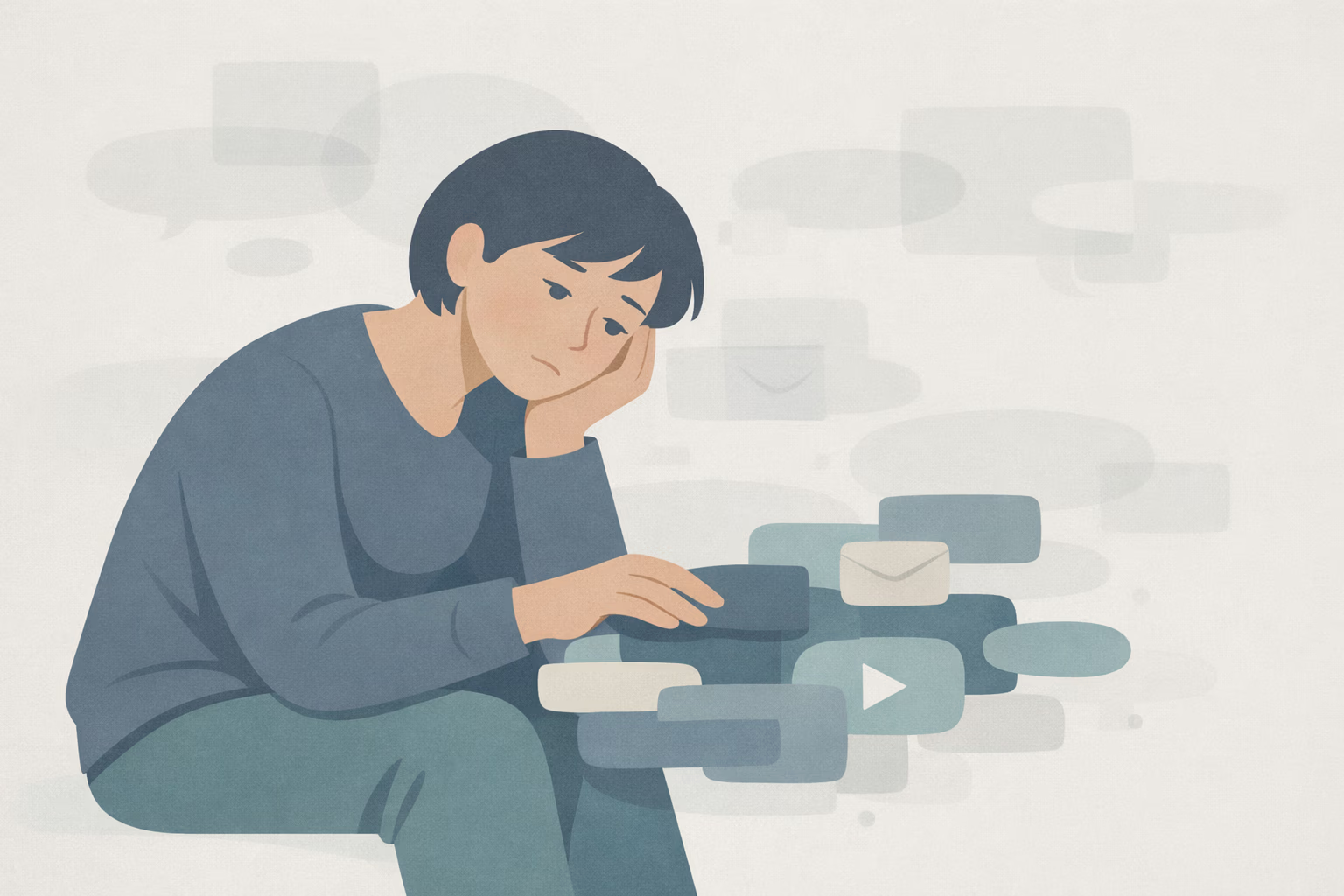
In short: Subscription overload isn’t only about money or apps. It’s the accumulation of small, ongoing demands—renewal dates, login resets, “free trial ending” banners, recommendation emails, and the low-grade sense that you should be using what you’re paying for.
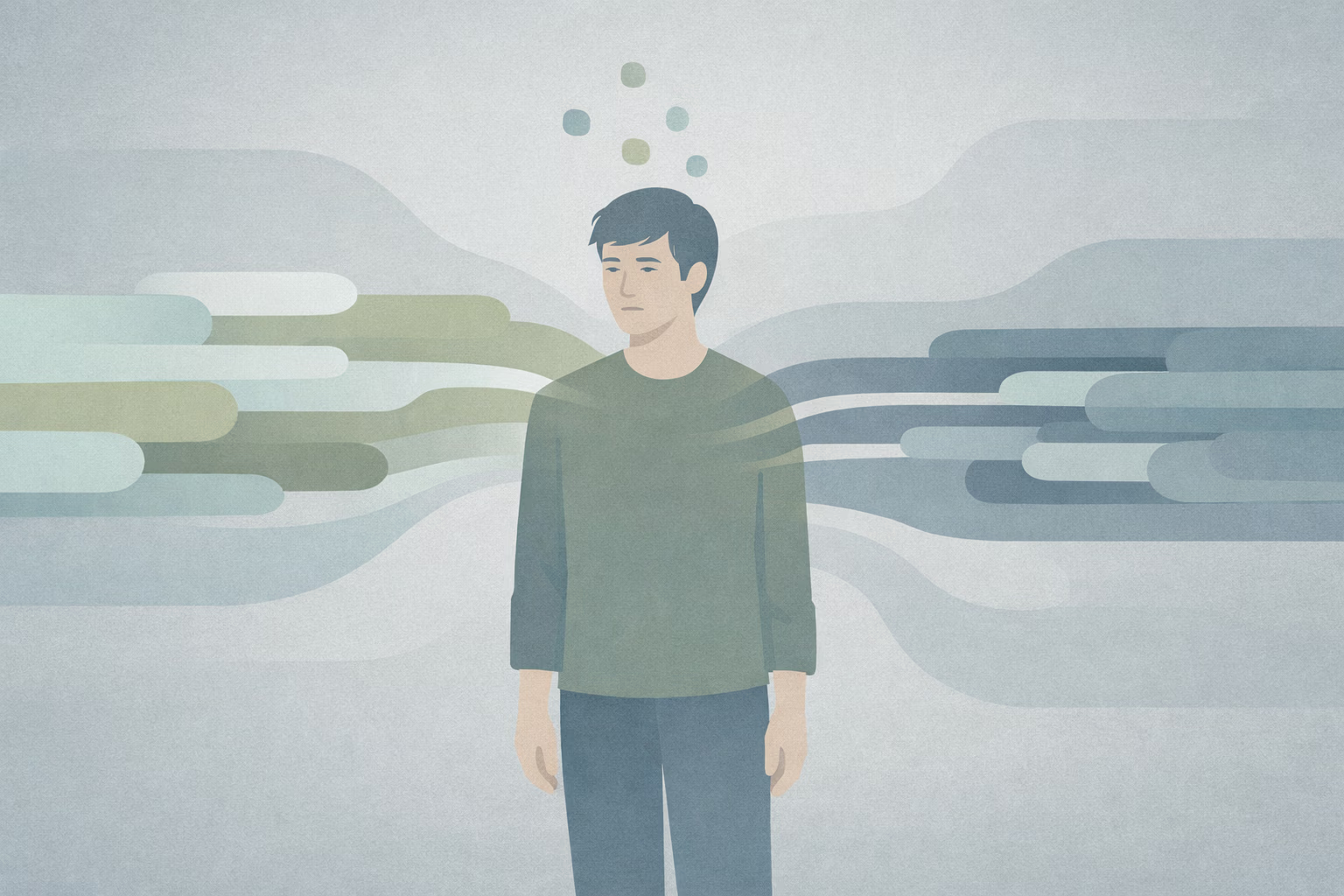
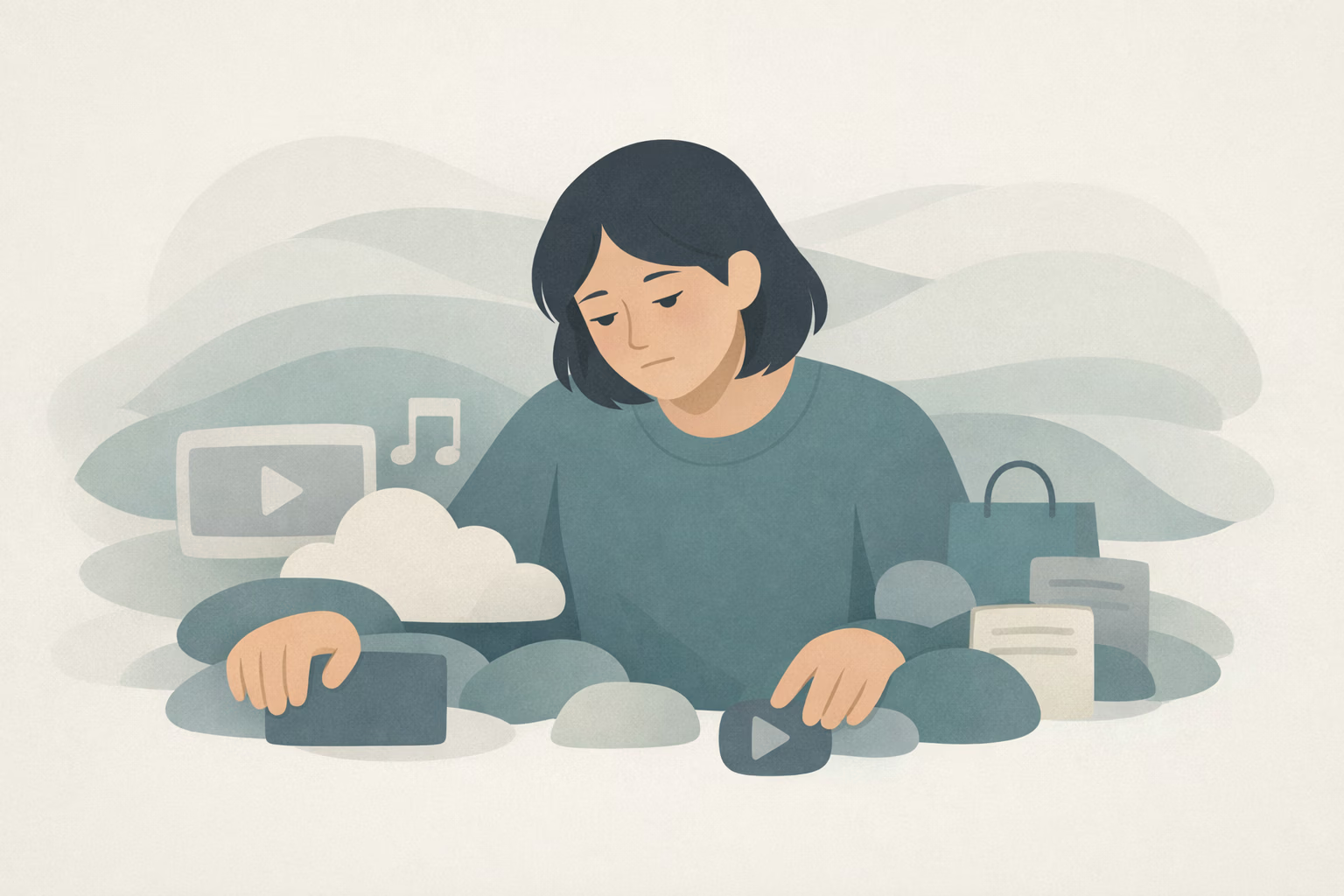
Subscription overload isn’t only about money or apps. It’s the accumulation of small, ongoing demands—renewal dates, login resets, “free trial ending” banners, recommendation emails, and the low-grade sense that you should be using what you’re paying for. Over time, that background demand can feel like mental fatigue without a clear cause.
In the Meaning Density view, this isn’t a personal failure of discipline. It’s what happens when life fills with open loops—unfinished decisions, partially owned commitments, and constant prompts that prevent a clean “done” signal. Your system stays slightly activated, not because you’re broken, but because the environment keeps asking for micro-responses.
What if the tiredness isn’t you—what if it’s the shape of your inputs?
Subscriptions are designed to be easy to start and easy to forget—until they surface again as reminders, charges, or renewed choices. Each one is a standing agreement with a future version of you: future attention, future evaluation, future management.
That can create a particular kind of low-level stress: not panic, not crisis, but a steady hum of “I should deal with this.” The nervous system registers this as unresolved demand. Even if you rarely think about it directly, the mind tends to keep a faint index of what’s pending—especially when payments and access are involved. [Ref-1]
Many people imagine fatigue as something caused by big events. But modern depletion often comes from repeated small cognitive switches: check, consider, compare, postpone, re-check. Subscriptions multiply these moments—choosing plans, skipping add-ons, rejecting upgrades, re-reading cancellation policies, deciding whether to keep or pause.
This isn’t about “willpower.” Executive systems have limited capacity for repeated selection and inhibition, especially when the choices recur and don’t reach closure. When decisions remain partially open—kept alive by automatic renewals and repeated prompts—they continue to draw attention like background processes. [Ref-2]
The mind gets tired not only from doing, but from having to keep deciding what counts as done.
Human attention systems developed in environments where choices were narrower and feedback was clearer. You selected what mattered, acted, and the world responded. Modern subscription ecosystems invert that: options are abundant, outcomes are delayed, and prompts arrive continuously.
Notifications and recommendation loops keep the attention system in a readiness state—orienting, scanning, and evaluating—often without a satisfying endpoint. When the environment is engineered to re-capture attention, the result is not simply distraction; it’s a sustained load that makes focus harder to regain once lost. [Ref-3]
When every service is “available,” can the mind ever fully stand down?
Subscribing often functions as a short-term settling mechanism. It promises convenience (“I’ll have it when I need it”), safety (“I won’t miss out”), and future competence (“I’m the kind of person who learns/streams/organizes”). That promise reduces uncertainty now, even if it creates a new ongoing commitment later.
In that sense, a subscription can serve as a quick closure substitute: it quiets the immediate question without requiring the slower work of determining what truly belongs in your life. Digital environments encourage this by making acquisition frictionless while making review and cleanup comparatively effortful. [Ref-4]
There’s a common modern belief that better life management comes from more tools, more content, more coverage. Yet each added service becomes part of your cognitive inventory. Even if you rarely use it, it still exists as something to remember, evaluate, or justify.
Digital clutter isn’t only visual. It’s informational and relational: a growing network of accounts, renewals, settings, and implied obligations. The mind has to maintain a sense of what’s “out there,” which contributes to a subtle but persistent feeling of being mentally crowded. [Ref-5]
Subscription overload often forms an avoidance loop—not in the sense of “not wanting to face feelings,” but in a structural sense: accumulation becomes a way to bypass the friction of choosing. Instead of deciding what you’re committed to, you keep access to everything.
This works temporarily because it reduces immediate resistance: you don’t have to say no, cancel, or confront the mismatch between what you intended and what you actually use. But the loop stays open. The lack of closure keeps the system slightly activated, and the number of open loops grows over time. [Ref-6]
Keeping everything is sometimes the easiest way to avoid the moment where life asks, “What is this for?”
Subscription fatigue tends to look like “I can’t deal with this right now,” even when nothing dramatic is happening. That response is often the nervous system protecting capacity by narrowing what it engages. Not a character flaw—an adaptive downshift under load.
Because subscriptions are ongoing and distributed across platforms, the mind rarely gets a single clean completion point. The result can be a persistent background tension, plus periods of avoidance around account management and review. [Ref-7]
Focus isn’t just the ability to concentrate. It’s also the ability to return to what matters after an interruption. Subscription ecosystems create frequent, low-stakes interruptions—new content drops, renewal notices, upgrade prompts, personalized offers.
Over time, this can weaken the felt sense of clarity: not because you’ve lost intelligence, but because the mind is constantly asked to re-orient. When attention is repeatedly pulled outward, it becomes harder to sense what you actually want to do with your finite time. The internal signal gets drowned out by options. [Ref-8]
When “what’s next” is always suggested, how does “what matters” stay audible?
Once the system is overloaded, avoidance becomes more likely—not from fear, but from muted consequence and reduced bandwidth. If dealing with subscriptions requires many steps (finding logins, navigating menus, confirming emails), the brain often postpones it because there’s no immediate reward and no immediate danger.
That postponement is logical under load. But it has a side effect: the inventory keeps expanding through renewals and new sign-ups, and each additional service adds more cognitive bookkeeping. This feedback loop is why subscription fatigue can feel like it “sneaks up” on people. [Ref-9]
When capacity is low, the simplest option is often “later.” Unfortunately, later stacks.
It can be tempting to interpret subscription overload as a motivation problem: “If I cared more, I’d use what I have,” or “If I were more organized, I’d keep it tidy.” But the more accurate frame is load and closure. When there are too many active inputs, the executive system spends energy on monitoring rather than living.
Reducing the number of active choices doesn’t just change the calendar or the budget. It changes the brain’s operating conditions: fewer prompts, fewer comparisons, fewer micro-decisions that need to be inhibited or re-evaluated. As decision friction decreases, the mind can reallocate resources toward steadier attention and clearer prioritization. [Ref-10]
Not “less because you should,” but less because your system can finally settle.
Subscription ecosystems don’t exist in a vacuum. They’re embedded in social norms: “Everyone has this platform,” “You need this tool,” “Don’t miss the drop,” “Stay informed.” When identity becomes tied to keeping up, subscriptions become symbolic—proof of relevance, competence, or belonging.
In information-rich environments, people often experience greater difficulty making satisfying choices because the mind must evaluate more attributes, more alternatives, and more imagined outcomes. That isn’t a personal weakness; it’s an expected effect of overload on decision processes. [Ref-11]
Shared norms that value enoughness can reduce this pressure—not by forcing anyone to opt out, but by making it socially coherent to choose fewer streams, fewer tools, fewer “just in case” commitments.
When digital clutter decreases, people often describe a shift that is more physiological than intellectual: less scanning, fewer background checks, a quieter sense of pending obligation. It’s not a permanent high, and it isn’t about becoming endlessly calm. It’s about the nervous system receiving more stand-down signals—more moments where nothing is asking to be managed. [Ref-12]
With fewer open loops, prioritization becomes clearer—not because you’re “trying harder,” but because the signal-to-noise ratio improves. The mind can hold a smaller set of commitments with more coherence, which supports steadier follow-through and less ambient self-negotiation.
Spaciousness isn’t emptiness. It’s having enough room for your life to register as yours.
Digital tools are not inherently harmful. The issue is when the attention economy turns them into persistent claim-makers—designed to pull you back, re-sell you, and keep you browsing. In that context, subscriptions can become less like helpful access and more like a network of tethers. [Ref-13]
As clarity returns, the relationship can invert: services become supports for an already-known direction rather than substitutes for direction. The difference is not in the apps themselves, but in the meaning structure around them—whether your commitments feel chosen, bounded, and complete enough to let your system rest.
Simplification is often described as minimalism, efficiency, or self-control. But it can also be understood as reclaiming attention for what actually forms a life: relationships, craft, rest, contribution, and the experiences that become part of identity.
When attention is continuously leased out to prompts and renewals, agency can feel thinner. When attention is less fragmented, meaning has more chances to consolidate—not as a new insight, but as a lived sense of “this is what I’m doing, and it fits.” Digital attention and well-being research increasingly highlights how the quality of inputs shapes the quality of mental life. [Ref-14]
In an information-rich world, it’s common to feel attention-poor. That tension is environmental as much as personal. [Ref-15]
When the number of active commitments decreases, many people notice a quiet return: less background vigilance, more steadiness, and a clearer sense of what deserves their limited days. Not because they became better at optimizing—but because their system finally received enough closure to settle into coherence.
From theory to practice — meaning forms when insight meets action.
Because each one is a standing agreement with a future version of you — future attention, future evaluation, future management. The nervous system registers these as unresolved demand. Even if you rarely think about them directly, the mind keeps a faint index of what's pending: charges arriving without fresh decisions, notifications reopening 'is this worth it?,' guilt about unused access, lingering uncertainty about what you're actually enrolled in. This isn't dramatic stress; it's a steady hum of 'I should deal with this.' Subscriptions stay alive as background processes because they never reach a clean Done Signal. Tiredness without a clear cause often means too many open loops.
Modern depletion comes from repeated small cognitive switches: check, consider, compare, postpone, recheck. Subscriptions multiply these moments — choosing plans, skipping add-ons, rejecting upgrades, rereading cancellation policies, deciding whether to keep or pause. This isn't about willpower. Executive systems have limited capacity for repeated selection and inhibition, especially when choices recur and don't reach closure. When decisions remain partially open — kept alive by automatic renewals and prompts — they continue drawing attention like background processes. The mind gets tired not only from doing, but from having to keep deciding what counts as done. Decision fatigue compounds when nothing finishes.
Because subscribing functions as a short-term settling mechanism. It promises convenience ('I'll have it when I need it'), safety ('I won't miss out'), and future competence ('I'm the kind of person who learns/streams/organizes'). That promise reduces uncertainty now, even if it creates a new ongoing commitment later. Subscribing serves as a quick closure substitute — it quiets the immediate question without requiring the slower work of determining what truly belongs in your life. This becomes an Avoidance Loop in structural form: accumulation bypasses the friction of choosing. Keeping everything is sometimes the easiest way to avoid the moment where life asks 'what is this for?'
Because reducing active inputs changes the brain's operating conditions: fewer prompts, fewer comparisons, fewer micro-decisions to inhibit or re-evaluate. As decision friction decreases, the mind reallocates resources from monitoring to living. With fewer open loops, prioritization becomes clearer — not because you're trying harder, but because the signal-to-noise ratio improves. The nervous system receives more stand-down signals, more moments where nothing is asking to be managed. Spaciousness isn't emptiness; it's having enough room for your life to register as yours. Not 'less because you should,' but less because your system can finally settle into coherence.
From Science to Art.
Understanding explains what is happening. Art allows you to feel it—without fixing, judging, or naming. Pause here. Let the images work quietly. Sometimes meaning settles before words do.
One Quiet Window, one insight, one reflection — every Sunday