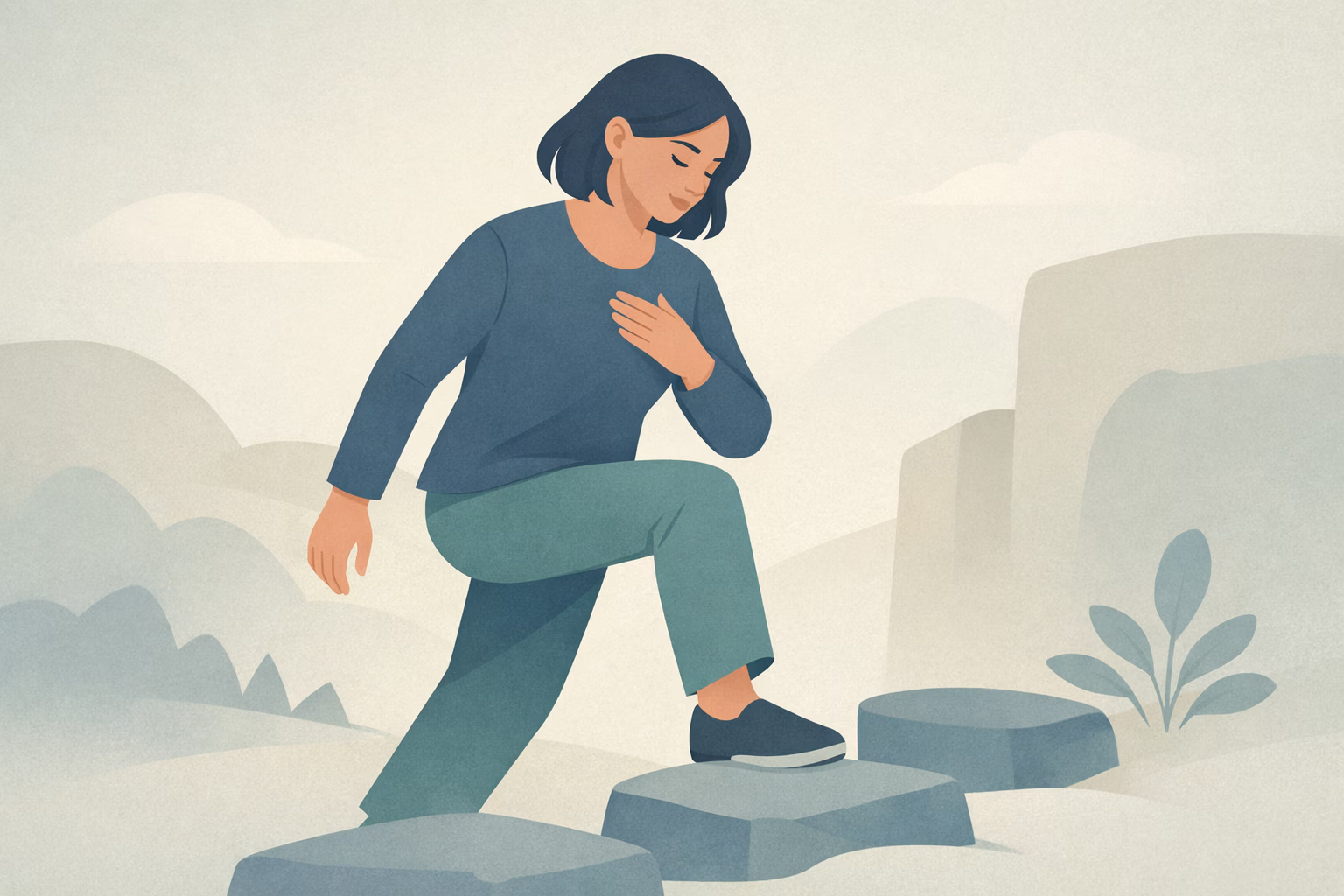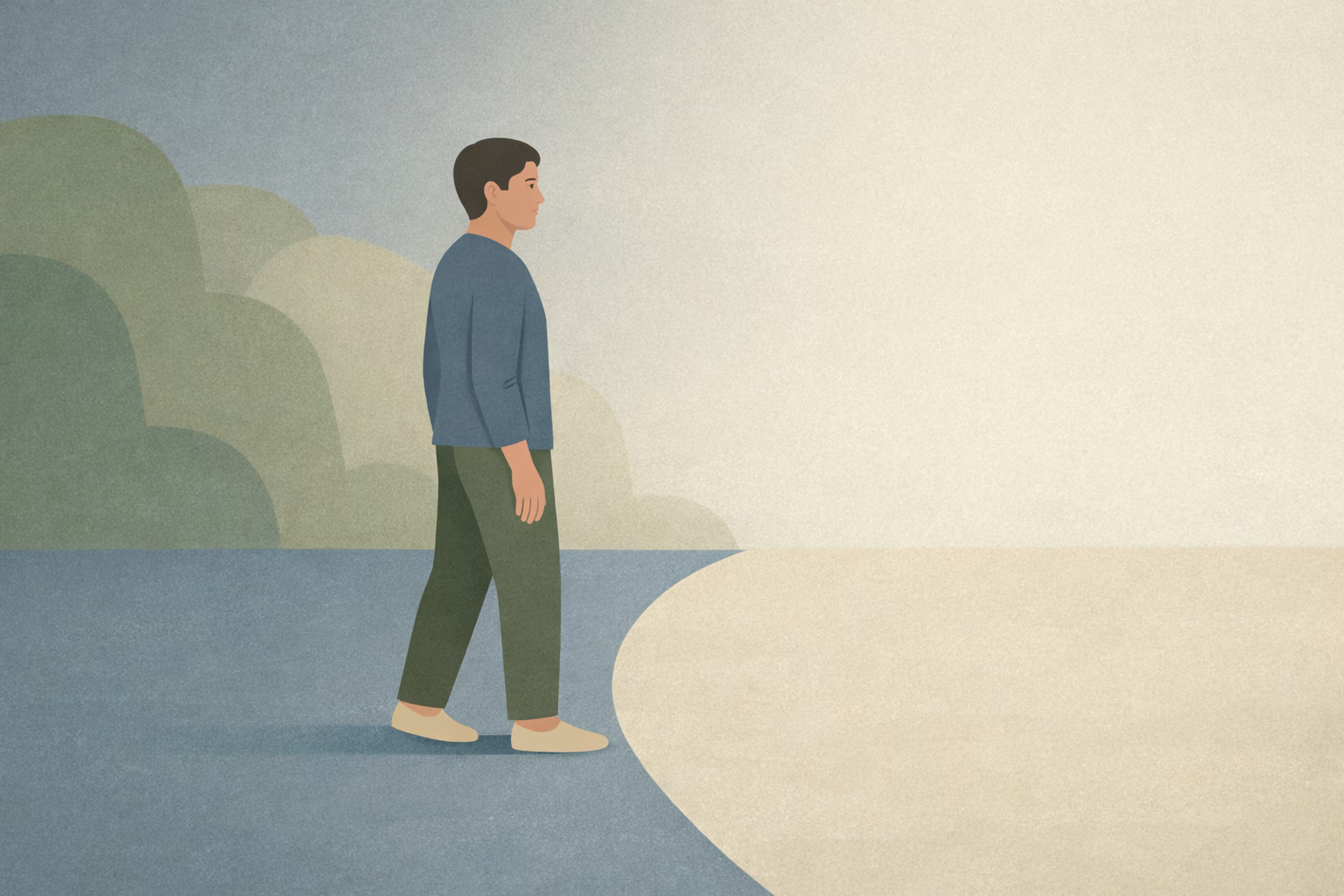
Why People Avoid Growth Even When They Want Change
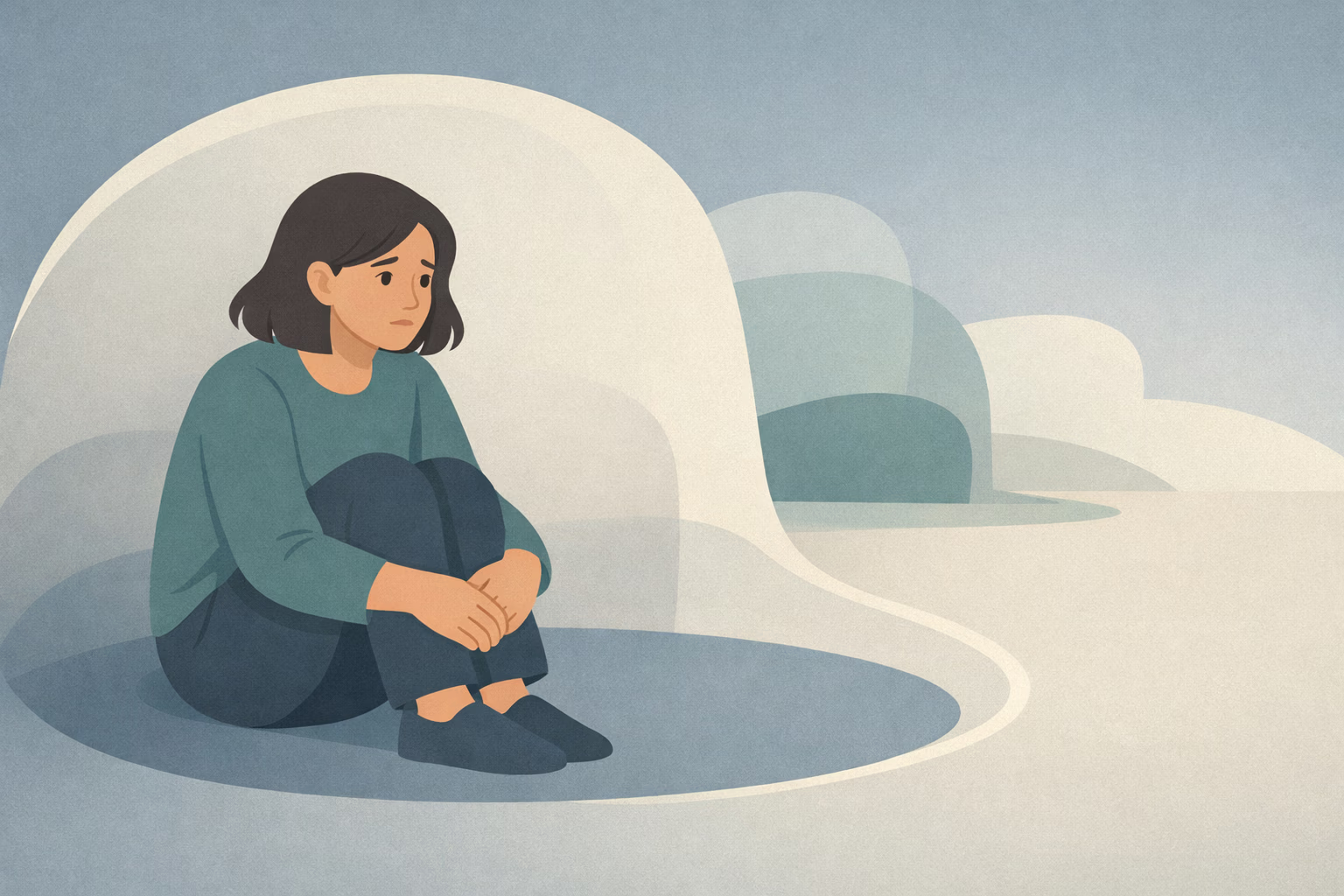
In short: A “comfort zone” usually gets framed as a mindset problem: you want something, so you should just go for it. But many people don’t feel merely unmotivated—they feel braced, foggy, resistant, or strangely blank the moment change becomes real.
A “comfort zone” usually gets framed as a mindset problem: you want something, so you should just go for it. But many people don’t feel merely unmotivated—they feel braced, foggy, resistant, or strangely blank the moment change becomes real. That experience isn’t a character flaw. It’s often a nervous system choosing what it can reliably predict.
The comfort zone is less a place and more a pattern: familiar routines, familiar roles, familiar expectations. Familiarity gives the body a kind of safety cue—signals that the environment is known and the consequences are manageable. Even when the pattern is limiting, it can still be stabilizing.
What if “impossible” isn’t laziness—what if it’s your system protecting coherence?
People often describe a split experience: part of them genuinely wants the new job, the conversation, the move, the class, the relationship shift. Another part goes offline or clamps down—suddenly the plan feels heavier, the timing feels wrong, the stakes feel enormous, or the body feels unusually tired.
This is a normal human tension. “Growth” is not just an idea; it’s a demand for new predictions. It asks your brain and body to update maps—social maps, competence maps, identity maps. When those updates are too fast or too uncertain, resistance can show up as hesitation, distraction, overthinking, delay, or a strong pull back toward what’s known. [Ref-1]
In other words, the discomfort isn’t proof you can’t do it. It can be evidence that your system is running a high-cost calculation: “Will this destabilize me?”
Threat detection isn’t only about obvious danger. It also tracks uncertainty: unclear outcomes, ambiguous social feedback, and situations where you don’t yet know the rules. In many bodies, novelty automatically increases alertness, because the system has fewer reliable predictions to lean on. [Ref-2]
Familiar patterns—same commute, same coping routines, same social role—reduce that uncertainty. They create a “known consequences” environment. Even when the familiar pattern includes stress, it’s a stress the system already knows how to manage.
So the comfort zone isn’t just comfort. It’s a stabilized set of expectations. Leaving it doesn’t only mean doing something new; it means temporarily losing the nervous system’s usual reference points.
From an evolutionary angle, the preference for the familiar makes sense. Unfamiliar terrain historically meant uncertain food, uncertain shelter, uncertain social dynamics, and unknown threats. In that context, the body’s tendency to conserve energy and minimize exposure wasn’t “avoidance”—it was strategy.
Modern life often demands frequent novelty: new platforms, new norms, new expectations, new forms of evaluation. But our baseline wiring still treats “unknown” as potentially costly. Comfort-seeking can be the nervous system doing what it was built to do: reduce risk, reduce energy burn, increase predictability. [Ref-3]
The comfort zone can be less about liking your life and more about your system recognizing it.
Comfort zones work because they reduce the amount of real-time processing required. When the script is familiar, you don’t have to continuously scan for consequences. Your system can allocate less attention to monitoring and more to simply getting through the day.
That’s why predictability can feel calming even when it’s not fulfilling. It provides a quick “stand down” signal. Research on comfort-zone orientation suggests that people differ in how strongly they prefer staying within familiar boundaries, especially under stress load. [Ref-4]
So why would a nervous system give up a known stabilizer without a clear replacement?
The comfort zone’s gift is immediate: reduced uncertainty, reduced activation, fewer surprises. The cost is cumulative: fewer new reference points, fewer lived updates to identity, fewer experiences that reach completion in a way that expands what feels doable.
Over time, life can begin to feel smaller—not because a person lacks potential, but because their system has learned to prioritize low-uncertainty pathways. That can look like staying in roles that no longer fit, repeating the same conflicts, or delaying changes that matter.
This is the paradox: the pattern that protects stability can also limit the experiences that would eventually make stability bigger. [Ref-5]
Many people imagine avoidance as a conscious choice to dodge discomfort. Structurally, it’s often simpler: a person reaches the edge of the known, the system spikes uncertainty, and the person’s behavior returns to what lowers the spike. That return creates relief, and relief becomes a powerful teacher.
Over time, the loop can organize life around preventing activation rather than building meaning. The nervous system learns: “I can get back to baseline fastest by staying close to what I can predict.” That’s not weakness. It’s a coherent adaptation to a world that can feel too fast, too evaluative, or too unstable. [Ref-6]
The avoidance loop rarely announces itself as “I’m avoiding.” It often appears as logic, timing, or practicality. The mind generates coherent reasons to preserve predictability, especially when the system is already carrying load.
Common disguises include:
These patterns aren’t proof of low character. They’re often a system bypassing a threshold it can’t yet metabolize into closure. [Ref-7]
Confidence is often treated like a personality trait. In practice, it’s frequently the byproduct of completed experiences: “I faced something uncertain, it played out, and my system updated.” When avoidance prevents completion, the update doesn’t land.
Over time, the world can feel more demanding—not because it objectively changed, but because the nervous system has fewer recent examples of successful adaptation to pull from. Avoidance coping can also add stress indirectly by leaving problems open-ended and unresolved, which keeps background load running. [Ref-8]
This is how a comfort zone can become stickier: not through moral failure, but through a narrowing of completed evidence.
When a system repeatedly turns back at the edge of uncertainty, it doesn’t get the full learning sequence that would recalibrate threat predictions. The “danger” estimate stays inflated because the situation never reaches an end point where the body can register, “That happened, and I’m still here.”
In learning science terms, experiences that allow fear responses to update require contact with the uncertain situation long enough for new predictions to form. When contact is consistently cut short, the alarm system remains quick to fire. Research on fear extinction and exposure mechanisms highlights how new learning can inhibit old threat associations, but it depends on sufficient, tolerable contact rather than repeated escape. [Ref-9]
So the spiral makes sense: the more often the loop protects you from uncertainty, the more uncertain things can begin to feel like they exceed capacity.
There’s a common misconception that change happens because you think differently or become more motivated. Those can shift perspective, but they’re not the same as integration. Integration looks like a bodily “settling” after an experience completes—when your system gains a new baseline because it has new finished evidence.
In many therapeutic models, gradual exposure is described as a pathway for this kind of updating: contact with uncertainty in a way that is paced enough to be metabolized, rather than overwhelming enough to force shutdown. Over time, neural fear pathways can reorganize when experiences are completed with manageable intensity. [Ref-10]
This is less about pushing past fear and more about letting the nervous system gather coherent endings: beginnings, middles, and finishes that it can file as “known.”
Humans don’t regulate in isolation. We read safety through faces, tone, pacing, and shared reality—signals that tell the body, “This is survivable; you’re not alone in it.” When encouragement is consistent and non-coercive, it can reduce the threat load of novelty by adding relational predictability.
Modeling matters too. Seeing someone else take a manageable risk—without dramatic consequences—provides the system with borrowed evidence. This is one reason exposure-based approaches often emphasize structured support and careful titration rather than brute forcing. [Ref-11]
Sometimes the most stabilizing thing isn’t confidence. It’s companionship.
When the system has more completed experiences with uncertainty, the unfamiliar can start to register differently. Not necessarily as pleasant—but as workable. The body spends less energy on pre-emptive defense, and more energy becomes available for attention, learning, and flexible response.
People often describe this shift as:
In exposure frameworks, this reflects new learning: the nervous system updates what it predicts will happen, and activation reduces as tolerable contact becomes familiar. [Ref-12]
A restored relationship with the comfort zone doesn’t require eliminating the need for safety. It means safety becomes portable—less dependent on perfect predictability, more tied to internal and relational cues that remain available even in change.
In that state, comfort isn’t the edge of your life; it’s the base you return to after completing meaningful loops. Novelty becomes less of a referendum on your worth and more of a direction your life can take when it aligns with values and identity.
Exposure-based traditions often describe this as expanding the range of what feels tolerable through repeated, completed experiences—not by forcing yourself into maximal distress, but by allowing the system to learn “I can adapt.” [Ref-13]
Growth, then, is not leaving comfort behind—it’s making comfort larger.
If leaving your comfort zone feels impossible, it may be because your nervous system is treating novelty as risk and familiarity as a safety signal. That’s a human design feature, not a personal deficiency. Familiarity has a well-documented calming power because it reduces uncertainty and makes outcomes feel more predictable. [Ref-14]
From this lens, “stuck” is often a sign that your system is trying to preserve coherence under load. And that means agency doesn’t begin with self-criticism. Agency begins when your life contains enough closure—enough finished experiences—that uncertainty stops reading as a threat to your stability.
Over time, meaning tends to return when choices aren’t organized only around relief, but around what you can live with, stand behind, and recognize as you.
Many people wait to feel fearless before they change. But human preference systems naturally lean toward familiarity; it’s how brains reduce cost and increase predictability. [Ref-15] What shifts a life isn’t the disappearance of that preference—it’s the gradual expansion of what counts as “familiar enough.”
When experiences complete in a way your system can absorb, your identity doesn’t have to be argued into growth. It settles into it. And the comfort zone, instead of being a cage, becomes a reliable home base for a wider world.
From theory to practice — meaning forms when insight meets action.
Because growth isn't only an idea — it's a demand for new predictions. The article frames the experience as a nervous system choosing what it can reliably predict: change asks the body to update social maps, competence maps, identity maps. When those updates feel too fast or uncertain, resistance shows up as hesitation, distraction, fatigue, or strange blankness. The discomfort isn't proof you can't do it. It's evidence your system is running a high-cost calculation: 'will this destabilize me?' Comfort zones aren't just comfort — they're stabilized expectations. Leaving means temporarily losing the nervous system's usual reference points.
Because threat detection tracks uncertainty, not just obvious danger. The article frames familiar patterns — same commute, same coping routines, same social role — as creating a known-consequences environment. Even when the familiar pattern includes stress, it's a stress the system already knows how to manage. Novelty automatically increases alertness because the system has fewer reliable predictions to lean on. The comfort zone reduces real-time processing required, which is why predictability can feel calming even when it's not fulfilling. The pattern that protects stability can also limit the experiences that would eventually make stability bigger.
Because the threat estimate stays inflated when situations never reach an end point where the body can register 'that happened, and I'm still here.' The article frames the missed recalibration: experiences that allow predictions to update require contact with uncertainty long enough for new learning to form. When contact is consistently cut short, the alarm system stays quick to fire. Confidence isn't lost — it's underfed. Confidence is the byproduct of completed experiences that updated the system. When avoidance prevents completion, the world feels more demanding not because it changed, but because the nervous system has fewer recent examples of successful adaptation.
Through completion, not push-through. The article frames integration as the body settling after an experience reaches an end the system can metabolize — gathering coherent finishes it can file as 'known.' Co-regulation matters: humans read safety through faces, tone, pacing, shared reality. When encouragement is consistent and non-coercive, it reduces the threat load of novelty by adding relational predictability. The shift isn't eliminating the need for safety but making safety portable — less dependent on perfect predictability, more tied to internal and relational cues that remain available even in change. Growth isn't leaving comfort behind; it's making comfort larger.
From Science to Art.
Understanding explains what is happening. Art allows you to feel it—without fixing, judging, or naming. Pause here. Let the images work quietly. Sometimes meaning settles before words do.
One Quiet Window, one insight, one reflection — every Sunday