Emotional Wounds in Daily Life: How Pain Shows Up Quietly
In short: Many trauma responses don’t look like obvious flashbacks or dramatic panic. They can look like over-explaining, going blank in a conversation, feeling oddly irritated by a harmless tone of voice, or suddenly getting very efficient and emotionally distant.
Many trauma responses don’t look like obvious flashbacks or dramatic panic. They can look like over-explaining, going blank in a conversation, feeling oddly irritated by a harmless tone of voice, or suddenly getting very efficient and emotionally distant. From the outside, they can appear like “personality.” From the inside, they often feel automatic—like your system moves before you’ve decided anything.
What if the problem isn’t who you are, but what your nervous system learned it must do to stay safe?
This article is an orientation, not a diagnosis. It’s a way of naming subtle, everyday patterns as regulation responses shaped by past threat and unfinished protective loops—so shame loosens and agency becomes more available.
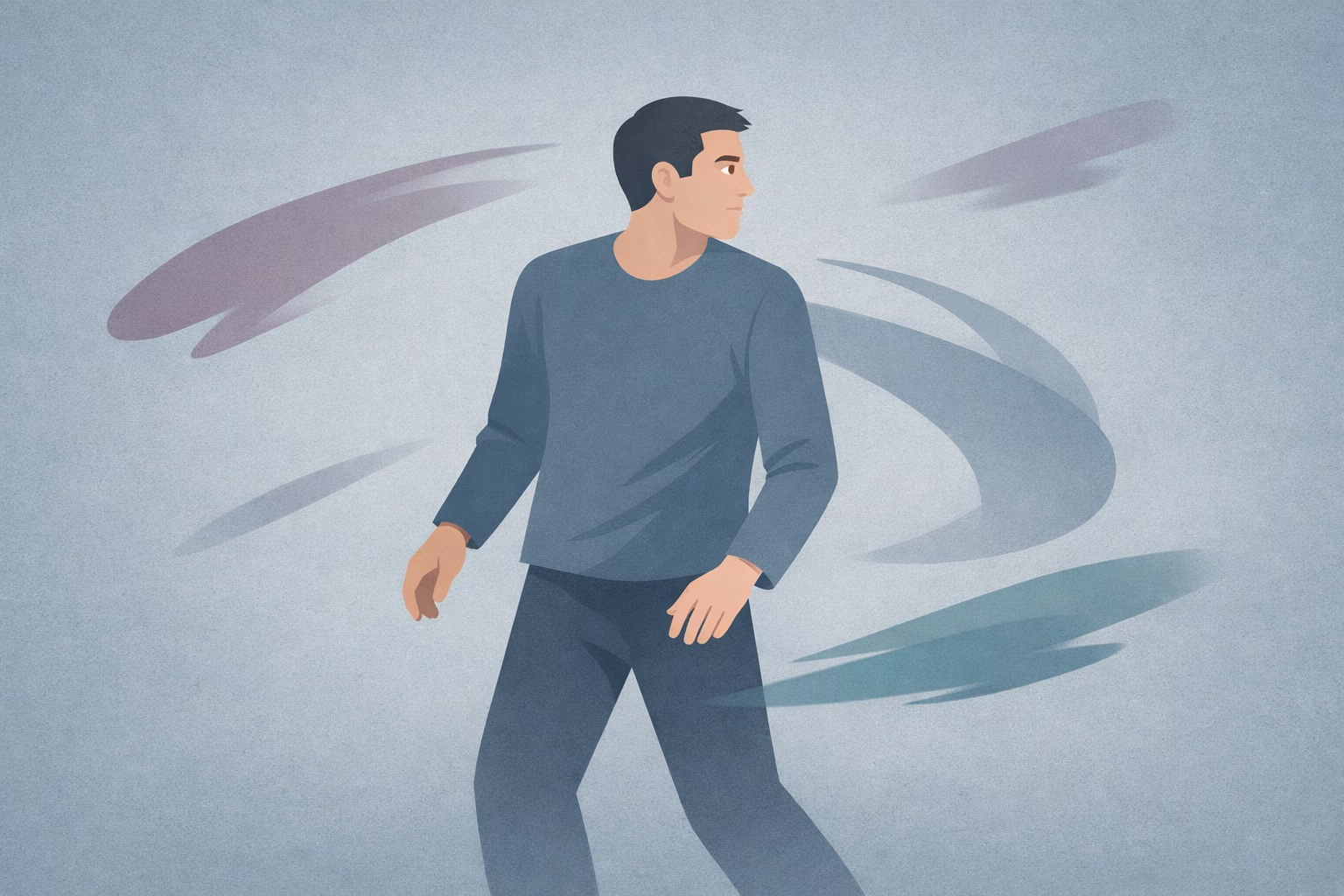
A common sign of trauma-based activation in daily life is mismatch: the intensity or speed of your response doesn’t fit what’s happening now. You might feel yourself snapping into urgency, shutting down, or getting unusually careful—even when the situation is objectively manageable.
These moments can be confusing because they often come without a clear story. It can feel like your mind is watching from the side while your body takes over: faster heart, narrowed attention, tight jaw, fogginess, a sudden need to leave, or a quick shift into pleasing and smoothing things over.
This isn’t “irrationality.” It’s often the nervous system prioritizing protection over interpretation, especially when something in the present resembles an older pattern of risk. [Ref-1]
Trauma learning isn’t stored only as a clear narrative you can recall on command. A lot of it is stored as body-readying: timing, tone, facial expressions, door slams, silences, footsteps, certain kinds of attention. Those cues can be enough to trigger a protective state shift before conscious appraisal finishes.
That’s why people often say, “I don’t know why I reacted like that.” The system is not waiting for a full explanation; it’s scanning for patterns and moving quickly when something resembles past danger. Memory can show up as sensation, impulse, or shutdown rather than a story you can tell. [Ref-2]
Importantly, understanding this mechanism can reduce self-blame—but it isn’t the same as integration. Integration shows up later as a more complete “done” signal in the body: less abrupt activation, more return to baseline, more room to choose.
From an evolutionary standpoint, survival favors speed. When threat is possible, nervous systems learn to respond fast and to generalize: “If this looks like that, act now.” That learning can be lifesaving in dangerous environments, especially when danger is unpredictable or relational (where the cues are subtle).
So patterns like hypervigilance, withdrawal, appeasing, or controlling the details can be understood as protective strategies. They are not character flaws; they are regulatory responses that made sense under earlier conditions. [Ref-3]
Sometimes the body protects first, and explains later.
In true danger, a few seconds of hesitation can be costly. Under chronic stress, the brain and body become biased toward rapid threat detection and rapid mobilization—or rapid shutdown. This can create “false positives” in safe situations, but the system often prefers false positives to missed threats.
That trade-off can show up as startingle responses, scanning for what’s wrong, anticipating criticism, or feeling unable to settle even when things are objectively fine. The point isn’t that you’re “overreacting.” The point is that your protective system is calibrated for a world where accuracy mattered less than not being caught off guard. [Ref-4]
Safety isn’t only a logical conclusion; it’s a set of cues that the nervous system can register. A room can be safe on paper, but if your system doesn’t detect enough safety signals—predictability, warm facial tone, respectful distance, non-urgent pacing—it may stay on alert.
This is one reason trauma responses can be strongest in “small” moments: a delayed text, an unreadable expression, a supervisor’s brief message, a friend’s distracted tone. The cue isn’t inherently dangerous, but it can resemble conditions where danger used to follow.
When safety cues are sparse or ambiguous, the body may keep preparing. Not because you’re failing at calm—because your system hasn’t received the information it needs to stand down. [Ref-5]
One of the most common daily-life trauma patterns is not dramatic fear, but structural avoidance: the system learns to reduce the chance of activation by narrowing exposure to certain cues, situations, or relational dynamics.
This isn’t always conscious decision-making. It can look like “I just don’t feel like going,” “I can’t deal with that conversation,” or “I’ll handle it later,” but underneath is often a fast, implicit loop: cue → body activation → exit or control → temporary relief. Because the relief is real, the loop strengthens.
Over time, the nervous system can treat avoidance as a form of safety. The cost is that the world slowly becomes smaller, even if nothing is obviously “wrong.” [Ref-6]
Trauma-based regulation often hides in plain sight because it can mimic competence, politeness, independence, or high standards. It can also look like “just being tired.” The core feature is not the specific behavior—it’s the automatic state shift underneath it.
Here are some subtle patterns that can function as protection in daily life:
These responses can be highly adaptive in the short term. They also tend to be self-reinforcing when they reliably reduce activation. [Ref-7]
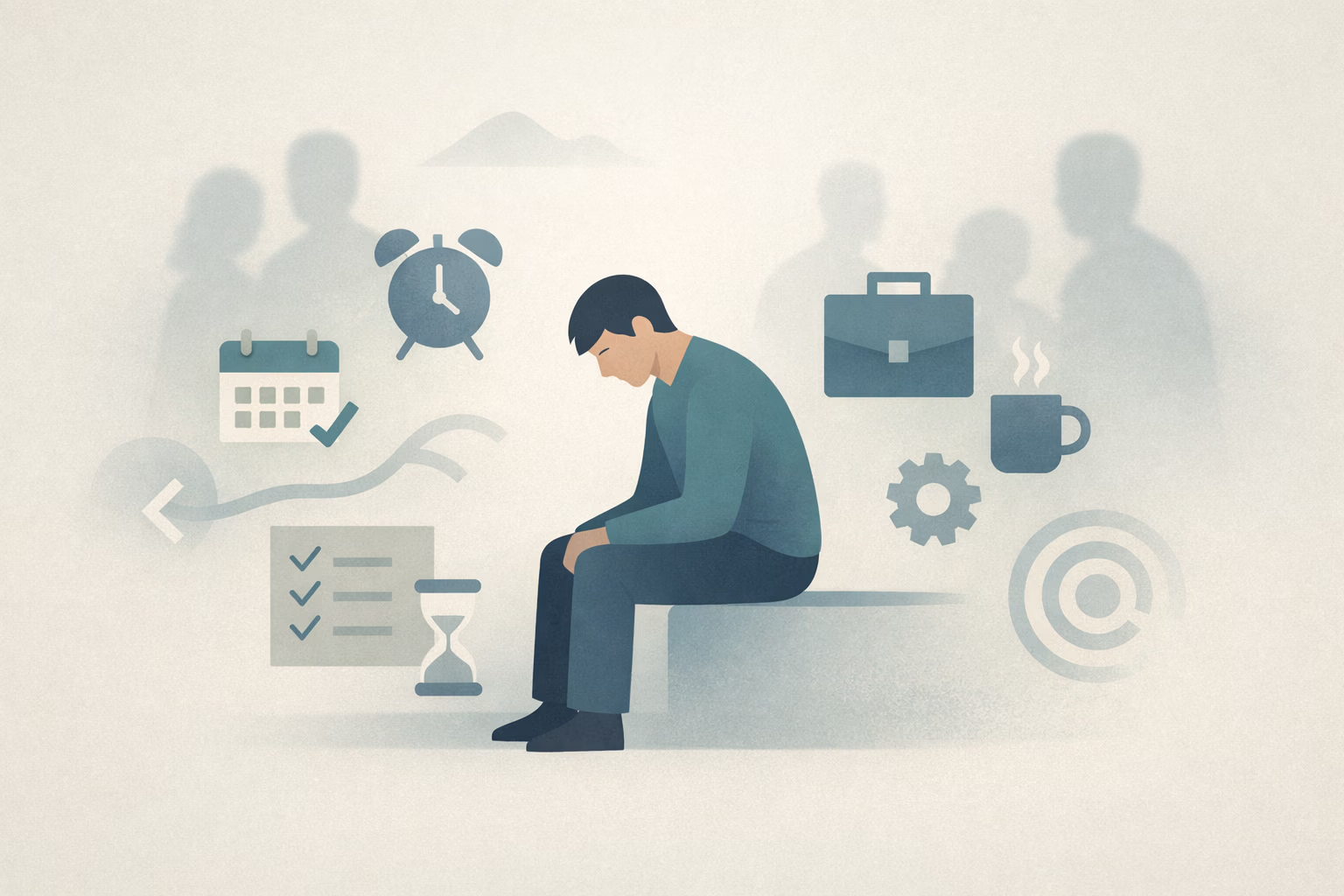
When protective responses become frequent, the nervous system may spend less time in a settled state where curiosity, play, and connection are accessible. Life can start to feel like constant management: managing impressions, managing risk, managing internal spikes, managing what might happen next.
This can limit range in subtle ways—less spontaneity, less tolerance for ambiguity, fewer conversations that feel worth it. It can also distort identity: instead of “who am I becoming?” the organizing question becomes “how do I avoid getting activated?” Over time, that can reduce a sense of agency, not because you lack strength, but because the system is allocating resources to protection.
Avoidance can maintain trauma-related patterns by preventing completion and closure. The loop never receives the “done” signal that would let the body revise its predictions. [Ref-8]
When you exit a triggering situation—cancel the plan, postpone the conversation, scroll to numb, tighten control—there is often an immediate downshift in discomfort. That downshift teaches the nervous system something simple: “That worked.”
This is not a moral failure; it’s basic learning. The nervous system tracks what reduces load quickly. If avoidance reliably produces relief, the body becomes more likely to choose it again, especially under fatigue, stress, or social pressure.
Shutdown and dissociation can be part of this same protective economy: when mobilization doesn’t feel possible or safe, the system may conserve by going offline. It’s not laziness; it’s an emergency brake. [Ref-9]
Many people assume the only two options are: push through, or avoid. But trauma responses often soften when the nervous system receives enough credible cues of safety—signals that the current moment is not the old one.
Safety cues can be relational (steady tone, non-shaming repair, predictable boundaries) or environmental (time, privacy, gentler pacing, clear expectations). When these cues are present, the system may not need to mobilize as hard. This isn’t a mental trick, and it isn’t “positive thinking.” It’s the body updating its prediction because conditions are different.
In that sense, “awareness” matters only insofar as it accompanies a real change in state: less bracing, more ability to stay present, more capacity for signal return after the moment passes. Coherence grows when the body can complete the loop and register that it is over. [Ref-10]
Humans regulate in connection. A well-attuned relationship can act like a buffer against stress load: it adds predictability, softens threat signals, and supports recovery back to baseline. A misattuned or unpredictable relationship can do the opposite—keeping the system vigilant because cues are inconsistent.
This is not about blaming partners, friends, or family. It’s about recognizing that nervous systems are responsive to the “shape” of interaction: interruption patterns, repair after conflict, whether needs are met with respect, whether boundaries are punished, whether emotions are used as leverage.
When relational cues are steady, the body doesn’t have to work as hard to stay safe. When cues are erratic, protection often becomes the default. Social buffering is a biological phenomenon, not a personal preference. [Ref-11]
As regulation improves, people often describe less reactivity and more flexibility—not because life becomes easy, but because the nervous system can move through states and return. The “return” is the key: quicker recovery, fewer hours lost to rumination or collapse, less need to constrict life to stay functional.
Instead of chasing constant calm, the marker is capacity: the ability to register internal signals without being overtaken by them, and the ability to stay in contact with reality while the body recalibrates. Interoceptive pathways (how the brain reads body signals) play a role in how quickly we notice activation and how quickly it resolves. [Ref-12]
This can also change identity-level experience. When your system isn’t spending so much energy on protection, values and preferences become easier to access—not as “motivation,” but as orientation.
Trauma responses often reorganize life around preventing reactivation. That makes sense when danger is real or unpredictable. But when the environment changes and protection stays locked on, meaning can thin out: days become management, relationships become risk, choices become calculations.
Movement toward engagement isn’t about forcing exposure or proving bravery. It’s about the nervous system gradually learning: “This ends. I can come back. I don’t have to live in permanent readiness.” When completion becomes more available, the system can update. And when the system updates, life feels less like bracing and more like participating.
Coherence has a specific texture: your actions align with what matters to you, and your body can settle after experience instead of carrying it forward unfinished. That settling is not a thought—it’s a physiological “done.” [Ref-13]
If you recognize yourself in these signs, the most important shift is often the removal of shame. These patterns are not proof of brokenness; they are evidence of an intelligent system that learned to survive with the information it had.
Seen through that lens, the question changes from “What’s wrong with me?” to “What did my system have to learn, and what has it not been able to complete yet?” That question invites dignity and choice without demanding immediate change.
When safety signals accumulate and unfinished loops finally get closure, agency tends to return naturally—less as willpower, more as a quiet widening of what feels possible. [Ref-14]
Healing often begins with recognition: not as a mental label, but as a respectful acknowledgement that your nervous system has been working hard. Fighting the response can add load; understanding its protective role can reduce internal conflict.
Over time, what once arrived as automatic urgency or shutdown can become less dominant—not because you forced yourself into different behavior, but because your system finally gets enough completion to stand down. And when the body stands down, meaning has room to re-form. [Ref-15]
From theory to practice — meaning forms when insight meets action.
Because most show up as subtle, automatic state shifts that mimic personality. The article describes them as over-explaining, going blank in conversation, getting oddly irritated by a harmless tone, suddenly becoming very efficient and emotionally distant, people-pleasing as preemptive safety, hypervigilance in normal settings, sudden shutdown. From outside they can appear like competence, politeness, independence, or high standards. From inside they feel automatic — like the system moves before you've decided anything. The core feature isn't the specific behavior; it's the protective state shift underneath. They're regulation responses shaped by past threat and unfinished protective loops, not character traits.
Because trauma learning isn't only stored as narrative you can recall. The article frames a lot of it as body-readying: timing, tone, facial expressions, door slams, silences, footsteps, certain kinds of attention. Those cues can trigger a protective state shift before conscious appraisal finishes. The system isn't waiting for a full explanation — it's scanning for patterns and moving quickly when something resembles past danger. Memory shows up as sensation, impulse, or shutdown rather than a story you can tell. That's why people say 'I don't know why I reacted like that.' Speed beats accuracy when the cost of missed threats was historically higher than false positives.
Because exiting a triggering situation produces immediate relief, which teaches the nervous system 'that worked.' The article frames this as basic learning, not moral failure: the system tracks what reduces load quickly, and if avoidance reliably produces relief, the body chooses it again. The structural cost is that the loop never gets the Done Signal that would let the body revise its predictions. Life narrows quietly — less spontaneity, less tolerance for ambiguity, fewer conversations that feel worth it. The organizing question shifts from 'who am I becoming?' to 'how do I avoid getting activated?' The world slowly becomes smaller even when nothing is obviously wrong.
Credible cues of safety, not insight or willpower. The article frames the body as needing the present moment to feel different from the old one — relational cues like steady tone, non-shaming repair, predictable boundaries, or environmental cues like time, privacy, gentler pacing. When these accumulate, the system doesn't need to mobilize as hard. Co-regulation acts as a buffer because nervous systems regulate in connection. The marker of restored regulation isn't constant calm but capacity — the ability to register internal signals without being overtaken, to stay in contact with reality while the body recalibrates, and to return to baseline faster. Recognition reduces shame; completion reduces load.
From Science to Art.
Understanding explains what is happening. Art allows you to feel it—without fixing, judging, or naming. Pause here. Let the images work quietly. Sometimes meaning settles before words do.
One Quiet Window, one insight, one reflection — every Sunday