Trauma Responses in Daily Life: Signs You Don’t Notice
In short: Some kinds of pain don’t arrive as a dramatic crisis. They arrive as a subtle shift: a tone change, a delayed reply, a glance that doesn’t land, a joke that feels a little too sharp.
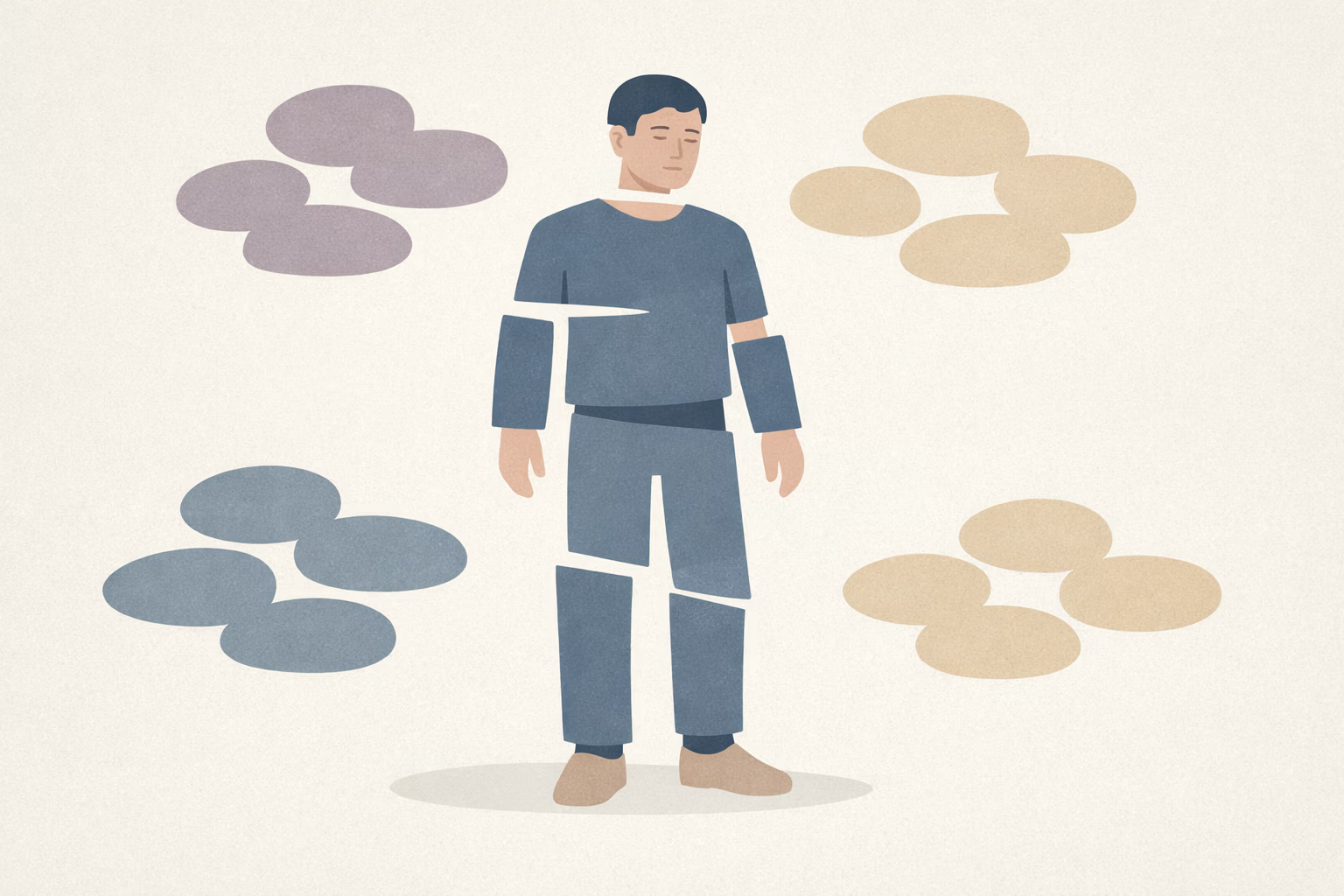
Some kinds of pain don’t arrive as a dramatic crisis. They arrive as a subtle shift: a tone change, a delayed reply, a glance that doesn’t land, a joke that feels a little too sharp. On the surface, life keeps moving. Inside, something tightens, goes blank, speeds up, or quietly pulls away.
These “quiet” moments often look too small to matter—until you notice how consistently they influence your day. Not because you’re fragile or broken, but because the human attachment-and-safety system is built to treat belonging as survival-relevant. When a moment doesn’t resolve, your body can keep tracking it as unfinished.
What if the problem isn’t that you’re overreacting—what if your system is trying to close a loop that never got to finish?
Disproportionate hurt is one of the most confusing signatures of an emotional wound in daily life. A mild comment can land like rejection. A neutral boundary can feel like exile. A simple misunderstanding can trigger an urge to disappear.
This isn’t a character flaw. It’s often a timing-and-signal issue: the present moment is being read through a sensitized attachment map. Your system isn’t only responding to what happened; it’s responding to what it predicts might happen next—loss of connection, status, or safety in the relationship. [Ref-1]
Common “quiet” outcomes can include sudden withdrawal, an emotional flare-up that surprises you, or a fast pivot into competence, humor, or caretaking—anything that reduces uncertainty and restores footing.
Not all memory is verbal. A lot of everyday learning is stored as bodily readiness: a slight tightening in the chest when someone’s voice changes, a stomach drop when you might be left out, a frozen feeling when you have to ask for something. These are not choices so much as fast protective configurations.
When social safety feels uncertain, the brain and body prioritize scanning and prediction. Over time, repeated micro-injuries—small dismissals, chronic misreads, inconsistent warmth—can prime a threat response in ordinary interactions, especially in moments of ambiguity. [Ref-2]
In this sense, an “emotional wound” is less like a dramatic scar and more like a hairline fracture: easy to miss, but it changes how force travels through the system.
From an evolutionary perspective, social exclusion wasn’t just unpleasant—it could be dangerous. Human nervous systems evolved to treat belonging as a core safety cue, and to treat signs of rejection as urgent information. [Ref-3]
So when relational pain happens, the system learns fast. It updates rules like: “Don’t ask for too much,” “Don’t disagree,” “Don’t show that you care,” or “Leave before you’re left.” These aren’t identities. They’re protective predictions designed to reduce the chance of repeat injury.
That learning can be especially sticky when the original moment didn’t reach closure—when there wasn’t repair, clarity, or a sense of “done.” Without completion, the nervous system keeps the file open.
Heightened sensitivity is often framed as being “too much.” But in many lives, it began as a practical skill: noticing micro-shifts early to prevent a bigger rupture later. When connection has been unpredictable, early detection becomes a form of safety management.
Biologically, repeated activation can increase reactivity over time. The system becomes faster to mobilize, quicker to brace, and slower to stand down—even when the current environment is relatively safe. This is a sensitization pattern, not a moral failure. [Ref-4]
What if your vigilance is evidence of training—rather than evidence of defect?
A painful part of quiet emotional wounds is how they can mismatch the present. You might be in a supportive relationship and still feel a surge of threat at small cues. You might be respected at work and still experience a casual correction as humiliation.
This happens because inherited alarms don’t measure “objective safety.” They measure pattern resemblance. If a present cue resembles a past moment of exclusion, the body can react as if the old outcome is about to repeat—before the thinking mind has gathered enough data.
Research suggests that social rejection and physical pain share overlapping neural representations, which helps explain why relational micro-injuries can feel intensely physical and immediate. [Ref-5]
When the nervous system anticipates relational pain, it often reduces exposure to the kinds of moments that might re-injure. That can look like “avoidance,” but it’s frequently a structural strategy: limiting uncertainty by limiting expression.
The loop is simple: a cue appears, the body prepares for impact, and behavior shifts toward minimizing contact with the vulnerable edge—less asking, less clarifying, less initiating, less revealing. Short-term, this can reduce activation. Long-term, it can keep the original wound uncompleted and therefore still influential. [Ref-6]
Importantly, this loop doesn’t require dramatic fear or conscious suppression. It can run quietly as a set of micro-adjustments that keep the system from having to find out what would happen.
Emotional wounds often announce themselves through patterns that look like “personality,” but function like regulation. Under attachment strain, the system tends to choose strategies that preserve connection or reduce threat—sometimes at the cost of aliveness and ease. [Ref-7]
None of these mean you’re “bad at relationships.” They often mean your system learned that closeness can become costly without warning.
One micro-injury is usually manageable. The trouble is accumulation. When many moments remain unresolved—no repair, no clarity, no completion—the system starts to treat everyday connection as terrain that requires armor.
Over time, this can create rigidity: a narrowed range of expression, fewer bids for support, and less flexibility in interpreting others. Relationships may become “stable” in appearance but costly in effort, because maintaining safety requires constant calibration.
Studies linking trauma-related patterns with hypervigilance, avoidance, and relationship difficulties echo this dynamic: not as personal weakness, but as predictable consequences of prolonged protective activation. [Ref-8]
Sometimes distance isn’t the opposite of love. Sometimes it’s the nervous system’s way of keeping love from becoming another unresolved injury.
Avoidance is effective in the short term because it reduces immediate discomfort and uncertainty. The body experiences a quick drop in activation: no conversation to navigate, no request to risk, no ambiguity to tolerate.
But the longer-term cost is that the system never receives updated information. Without completion, the original prediction remains unchallenged and the sensitivity stays high. In behavioral science, this is a known feature of experiential avoidance: relief reinforces the pattern, even when it narrows life over time. [Ref-9]
The result can be a quiet bind: the strategies that reduce stress today also preserve the conditions that keep stress easily triggered.
There is a difference between insight and integration. Many people can explain their pattern clearly and still feel their body do the same thing in real time. That’s not failure; it’s a clue about level. The loop isn’t only cognitive—it’s physiological, relational, and shaped by history.
A more stabilizing frame often begins when the question changes from self-judgment to function: not “Why can’t I stop?” but “What load is my system carrying?” and “What kind of connection would let this stand down?” That shift is not a pep talk; it’s an orientation toward closure rather than pressure.
Research on social buffering suggests that safety can be co-regulated—stress physiology can soften in the presence of reliable support and protection cues. [Ref-10]
Because these wounds live in the attachment-and-safety system, they often respond most to signals of attunement: being accurately read, having impact acknowledged, receiving steadiness when something is messy. This isn’t about perfect relationships. It’s about enough moments that convey, “You make sense here.”
When misattunement repeats—being minimized, rushed, mocked, ignored—the system doesn’t just “get upset.” It updates expectations again, and the protective loop becomes more efficient. Safety cues and threat cues are processed quickly and often below conscious awareness, which is part of what polyvagal-informed science highlights about how bodies detect social safety. [Ref-11]
What changes when your system has proof of repair, not just hope for it?
When load reduces and closure increases, people often describe a different kind of change than “being more emotional.” The shift is frequently about capacity: more ability to stay present, more words available in the moment, more room between a cue and a reaction.
In the body, this can look like improved interoceptive clarity—signals becoming easier to read and less urgent. Instead of sudden spikes or shutdown, there’s more graded information: “Something matters here,” without the immediate full-body alarm. [Ref-12]
Importantly, this is not forced openness. It’s a quieter confidence that the system can move through friction and return to baseline—because it has experienced completion often enough to trust it’s possible.
As protective patterns soften, identity tends to reorganize around engagement rather than defense. Not as a self-improvement project, but as a lived shift: relationships become places where meaning can be built, not just risk managed.
This doesn’t mean never getting hurt. It means hurt is less likely to become a totalizing signal. When regulation improves, the system can register rupture and still remain oriented toward repair, boundaries, and connection—without collapsing into shutdown or constant scanning.
Embodied regulation research emphasizes that the body plays a central role in emotion regulation and adaptive responding, which helps explain why restored capacity feels like steadiness, not constant effort. [Ref-13]
Emotional wounds are often evidence of something tender that needed protection—belonging, respect, steadiness, being taken seriously. When those needs weren’t met consistently, the system learned to carry them forward as vigilance, distance, or over-functioning.
A non-shaming lens matters here. Self-criticism tends to add load, while self-compassion is associated with better psychological health partly because it reduces threat responding and supports resilience. [Ref-14]
When quiet pain is treated as information rather than indictment, agency returns in a different form: not the pressure to “fix yourself,” but the possibility of coherence—where your patterns make sense, your needs are legible, and your life can move toward completion instead of repetition.
Healing often begins long before anything looks dramatic from the outside. It can start at the moment a subtle pattern is recognized with dignity: “This is a wound pattern, not who I am.”
Over time, painful experiences can become integrated into narrative identity—not as stories that keep re-opening the alarm, but as chapters that have edges and endings. That kind of integration tends to feel like a physiological “done,” where the body no longer has to keep the past on standby to stay safe. [Ref-15]
Quiet pain deserves that level of respect. Not because it makes you fragile—because it shows how hard your system has worked to protect what mattered.
From theory to practice — meaning forms when insight meets action.
Disproportionate hurt is one of the most confusing signatures of an emotional wound in daily life. A mild comment can land like rejection; a neutral boundary can feel like exile. This isn't a character flaw — it's a timing-and-signal issue: the present moment is being read through a sensitized attachment map. Your system isn't only responding to what happened; it's responding to what it predicts might happen next — loss of connection, status, or safety. The Threat & Safety system treats belonging as survival-relevant, so when a moment doesn't resolve, the body can keep tracking it as unfinished.
Not in the dramatic sense, but they operate on similar mechanics. The article describes them as more like hairline fractures than scars — easy to miss, but they change how force travels through the system. A lot of everyday learning is stored as bodily readiness: tightening when a voice changes, stomach drop when you might be left out, freezing when you have to ask for something. Repeated micro-injuries — small dismissals, chronic misreads, inconsistent warmth — can prime a threat response in ordinary interactions, especially in moments of ambiguity. The wound is the open file the system never got to close.
Heightened sensitivity is often framed as being too much, but in many lives it began as a practical skill: noticing micro-shifts early to prevent bigger ruptures later. When connection has been unpredictable, early detection becomes safety management. Biologically, repeated activation increases reactivity over time — the system becomes faster to mobilize, quicker to brace, slower to stand down, even when the current environment is relatively safe. This is sensitization, not defect. Your vigilance is evidence of training, not evidence of flaw. The system is doing exactly what it learned would prevent the next injury.
Because avoidance works in the short term — relief reinforces the pattern — but the system never receives updated information. The Avoidance Loop reduces immediate discomfort by limiting exposure to vulnerable edges: less asking, less clarifying, less initiating, less revealing. Without completion, the original prediction stays unchallenged and the sensitivity stays high. The bind is quiet: the strategies that reduce stress today also preserve the conditions that keep stress easily triggered. Healing requires what the article calls 'proof of repair, not just hope for it' — enough completed loops for the system to update what closeness now costs.
From Science to Art.
Understanding explains what is happening. Art allows you to feel it—without fixing, judging, or naming. Pause here. Let the images work quietly. Sometimes meaning settles before words do.
One Quiet Window, one insight, one reflection — every Sunday