
The Modern Attention Crisis: Why You Can't Stay Present
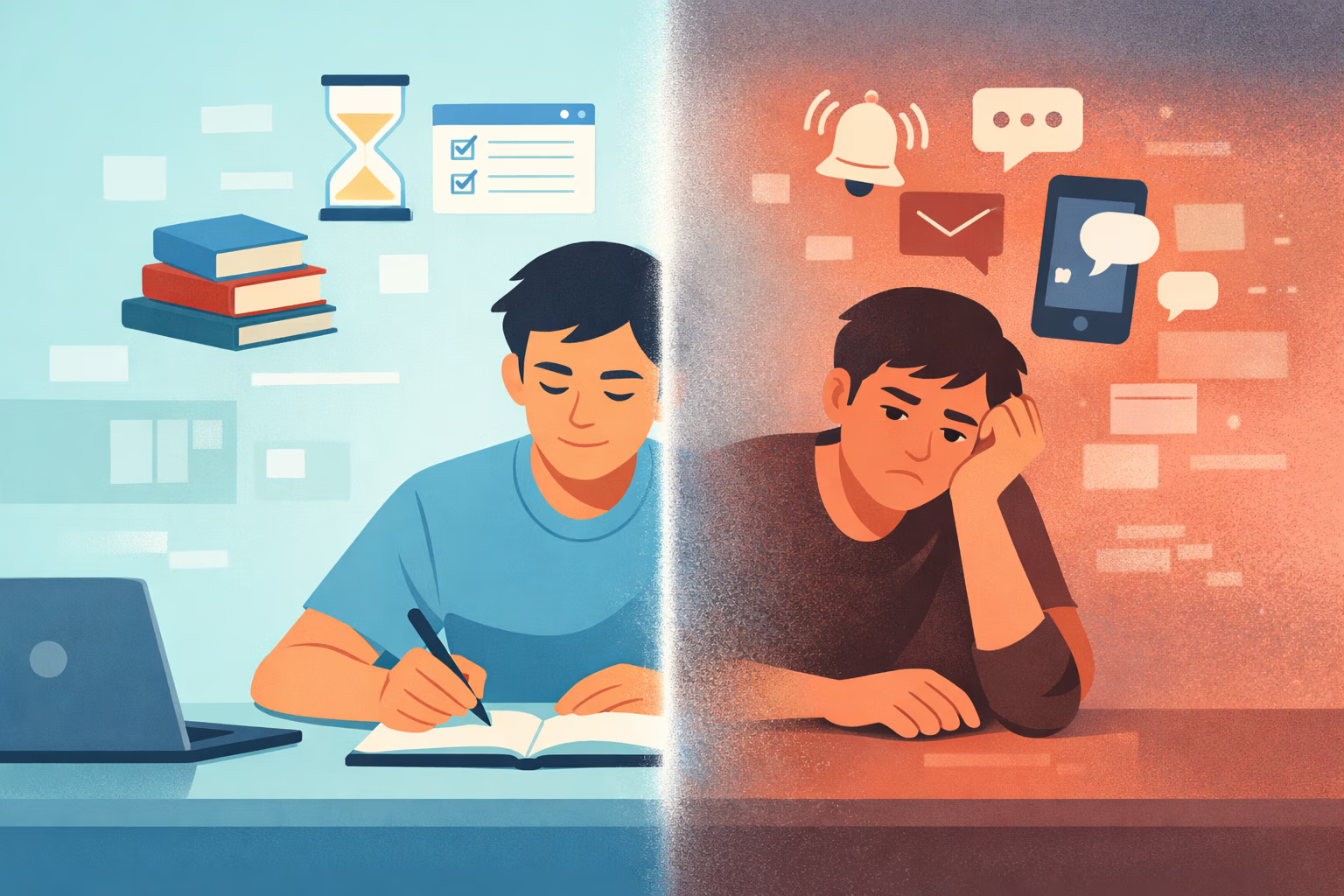
In short: Focus apps promise something many people genuinely need: a quieter mental environment. Blockers, timers, accountability screens, minimalist launchers—on paper, they seem like clean solutions to a messy reality. And yet the lived experience is uneven.
Focus apps promise something many people genuinely need: a quieter mental environment. Blockers, timers, accountability screens, minimalist launchers—on paper, they seem like clean solutions to a messy reality.
And yet the lived experience is uneven. For some people, a focus tool creates immediate relief and steadier work. For others, the same tool lasts a day, sparks rebellion, or quietly becomes another tab to manage. This difference is not a character test. It’s often a signal about load, safety cues, and whether your attention system has enough internal stability to “take” external structure.
Why does the exact same focus app feel supportive for one person and useless—or even agitating—for another?
Many people start with good faith: install the blocker, set the timer, make the rules. When it works briefly, the relief can feel almost tender—like proof that you still have access to yourself. When it stops working, the emotional residue is often heavier than the distraction ever was.
That swing can create a particular kind of self-doubt: “If the tool can’t keep me on track, maybe nothing will.” But inconsistent results are common in digital self-control interventions, even when people are trying hard. The effects are often mixed and modest—because attention isn’t only a rule-following problem. [Ref-1]
Sometimes the app doesn’t fail. Sometimes it reveals how much strain the system was already carrying.
Concentration is not simply the presence of willpower. It depends on how the brain is valuing options in real time, how much reward is available for staying with a task, and whether the nervous system is operating in a state that can tolerate effort without constant alarm.
In practice, that means focus tends to be more available when dopamine signaling is balanced enough to make “later rewards” feel real, when the body reads the environment as sufficiently safe, and when executive control systems aren’t already depleted. Many focus apps show some benefit, but engagement and motivation limits often determine outcomes—because the app can’t supply the internal conditions it depends on. [Ref-2]
So the question becomes less “How do I force attention?” and more “What state is my system in when I’m asking for attention?”
Attention is not designed to be loyal to plans. It is designed to be loyal to relevance. In a stable environment, relevance aligns with the chosen task. Under high load, relevance shifts toward whatever offers quick relief, fast certainty, or a clearer end point.
From this angle, distraction isn’t necessarily caused by “lack of discipline.” It can be what happens when the brain can’t find a clean completion signal in the work in front of it—so it scans for something more resolvable: a notification, a search spiral, a small hit of novelty. Many focus apps function as self-control artifacts, but artifacts can’t fully replace the nervous system’s internal sense of closure. [Ref-3]
What if your attention isn’t broken—what if it’s responding to incomplete loops?
When a focus app works, it often works by lowering the overall decision load. Fewer choices means fewer micro-negotiations. A timer can offer a boundary. A blocker can remove the need to repeatedly resist. This is not a moral victory; it’s scaffolding that reduces cognitive friction.
Executive control is strongly shaped by emotion and motivation—what feels urgent, what feels safe, what feels worth it. External limits can temporarily simplify that landscape, making it easier for the brain to stay with one channel. [Ref-4]
A common escalation is to assume the solution is stronger constraint: tighter blocks, harsher consequences, more tracking, more rules. This can feel logical in a culture that treats attention as something you can “dominate” with the right system.
But executive function is state-dependent. Under “hot” conditions—stress, emotional charge, social threat, fatigue—decision-making and self-control shift. The same tool that feels neutral on a calm day can feel intolerable on a loaded day, because the internal context changed. [Ref-5]
In other words: external structure can support attention, but it can’t substitute for a nervous system that is already signaling overload.
In the Power Loop, control becomes the main strategy for stabilizing discomfort. The person isn’t “addicted to productivity.” The system is trying to create certainty and containment by tightening the perimeter: more rules, more apps, more restrictions.
This can be understandable, especially when executive functioning is taxed. Executive skills underpin not only planning but also emotional regulation and motivational stability—so when those systems are strained, external control can look like the safest available substitute. [Ref-6]
The catch is that control can keep the system activated. If attention is being held in place by pressure, it often doesn’t get the physiological “done” signal that allows settling after the work is complete.
When focus apps collide with a nervous system that’s already loaded, the result is often not “no change,” but a recognizable set of compensations. These are not personality quirks; they’re regulatory responses to a mismatch between constraint and capacity.
Executive function difficulties are often intertwined with emotional and motivational dynamics, not simply time management. So it makes sense that a purely external fix can feel inconsistent. [Ref-7]
When attention is forced through sustained pressure, the costs often show up later: fatigue that feels disproportionate, avoidance that looks like “procrastination,” or a kind of internal flattening where everything starts to feel the same. This is not drama. It’s what can happen when the system has to keep generating activation without receiving enough closure.
Attention and action are shaped by emotional salience and safety cues. If the body reads the situation as evaluative, risky, or endlessly unfinished, the executive system has to work harder just to stay online. Over time, that effort can look like burnout or shutdown—not because someone is weak, but because the organism is protecting capacity. [Ref-8]
When focus depends on constant strain, the work may get done, but the self that did it doesn’t get to come home.
Modern productivity culture often frames attention as a personal shortcoming with a purchasable solution. The marketplace reinforces the idea that the next tool will finally create consistency. This doesn’t mean the tools are scams; it means they’re being asked to solve a problem that is partly environmental and physiological.
Many app guides acknowledge that external structure (like timers) helps some people but not others, and that fit matters. Still, the dominant story tends to stay external: find the right interface, the right lock, the right streak. [Ref-9]
In that storyline, if the tool doesn’t work, the conclusion defaults to “try harder” or “upgrade the system,” rather than noticing the internal conditions that determine whether structure feels supportive or coercive.
Focus often improves when the underlying systems are steadier first—when the brain can predict the day a little more, when reward isn’t exclusively coming from high-speed inputs, and when the task has a clear path to completion. This is less about insight and more about whether the organism can reduce activation and return to signal.
Even well-known techniques can land differently depending on state: for some, short timed intervals reduce overwhelm; for others, the countdown itself increases strain. That variability is a clue that attention is responding to internal context, not merely to the tool. [Ref-10]
What if the goal isn’t to win a battle with distraction, but to create conditions where attention no longer needs to escape?
Two people can use the same app and get different outcomes because the app is only one input in a larger system. Expectations matter—especially the hidden expectation that focus should feel clean, continuous, and self-contained. When reality is messier, effort can turn into constant self-monitoring, which adds load.
Environment matters too: interruption patterns, social evaluation, unclear priorities, ambiguous endpoints. When the surrounding context is noisy or uncertain, a focus tool may become a thin wall against a strong current. Many guides emphasize finding tools that match individual needs and emotional patterns, because mismatch is common. [Ref-11]
In supportive conditions, an app can be a gentle boundary. In high-pressure conditions, the same boundary can feel like another demand.
When focus becomes more resilient, it often doesn’t feel like heroic concentration. It feels more like return: the ability to come back to the task without needing a dramatic reset, and without needing constant external tension to stay there.
People vary widely in which apps feel calming versus overwhelming. Some experience structure as relief; others experience it as another stream of prompts and metrics. That variation is normal and shows that attention is shaped by capacity and load, not by a single universal method. [Ref-12]
Constraint can hold attention for a while. Meaning is what helps attention settle. When a task connects to values, relationships, identity, or a lived sense of contribution, the brain receives more consistent relevance signals—signals that don’t require constant novelty or constant threat to stay engaged.
This is one reason gentle, realistic design matters in tools: when the interface supports a humane pace, it can reduce the sense of being policed and leave more room for the work to feel coherent. Some lists of ADHD-friendly tools highlight exactly this: designs that accommodate real life rather than demanding perfection. [Ref-13]
Attention is more loyal to a life that feels coherent than to a rule that feels isolating.
It can be a relief to stop treating focus as something you must force out of yourself. For many people, concentration is an outcome: it shows up when load is manageable, when completion is possible, and when the day offers enough safety cues for the mind to stay present without scanning for escape routes.
In that frame, a focus app is neither a cure nor a failure. It’s a context tool—sometimes helpful, sometimes neutral, sometimes too much—depending on what your system is already carrying. Many tool roundups note the importance of flexibility and emotional safety because rigidity tends to break where strain is highest. [Ref-14]
Agency can look less like “more control” and more like recognizing what makes attention available in your actual life—what helps experiences complete, and what keeps them perpetually open.
If focus apps have ever worked for you, that’s meaningful: it suggests your system can use structure when the conditions are right. If they haven’t, that’s also meaningful: it suggests the problem isn’t a lack of effort, but a mismatch between external constraint and internal capacity.
Attention is not a moral trait. It’s a living function that steadies when life provides clearer endpoints, steadier reward, and a sense of orientation you can inhabit. Tools can be part of that picture—one part, not the whole story. [Ref-15]
From theory to practice — meaning forms when insight meets action.
Because focus is a biological state, not just a decision. The same app is only one input in a larger system. Concentration depends on how the brain is valuing options in real time, how much reward is available for staying with a task, and whether the nervous system is operating in a state that can tolerate effort without constant alarm. Focus is more available when dopamine signaling is balanced enough to make later rewards feel real, when the body reads the environment as safe enough, and when executive control isn't already depleted. Apps can't supply the internal conditions they depend on. The question isn't 'how do I force attention?' It's 'what state is my system in when I'm asking for attention?'
Usually not. Attention isn't designed to be loyal to plans. It's designed to be loyal to relevance. In a stable environment, relevance aligns with the chosen task. Under high load, relevance shifts toward whatever offers quick relief, fast certainty, or a clearer endpoint. From this angle, distraction often isn't 'lack of discipline.' It's what happens when the brain can't find a clean completion signal in the work in front of it — so it scans for something more resolvable: a notification, a search spiral, a small hit of novelty. Many focus apps function as self-control artifacts, but artifacts can't fully replace the nervous system's internal sense of closure. Your attention may not be broken. It may be responding to incomplete loops.
When control becomes the main strategy for stabilizing discomfort. In the Power Loop, the person isn't 'addicted to productivity.' The system is trying to create certainty and containment by tightening the perimeter — more rules, more apps, more restrictions. This is understandable, especially when executive functioning is taxed: external control looks like the safest available substitute. The catch is that control keeps the system activated. If attention is being held in place by pressure, it doesn't get the Done Signal that allows settling after work completes. Common patterns when tools collide with overload: app-switching for a feeling of control, rising resistance to the task, guilt spikes when the tool 'fails,' rebound distraction after blocks end.
Less like heroic concentration and more like return — the ability to come back to the task without needing dramatic resets, and without constant external tension to stay there. Constraint can hold attention for a while. Meaning is what helps it settle. When a task connects to values, relationships, identity, or lived contribution, the brain receives consistent relevance signals that don't require constant novelty or threat to stay engaged. Markers of restored focus: less white-knuckle staying power, more natural stopping points, clearer sense of what counts as done. Focus is more loyal to a life that feels coherent than to a rule that feels isolating. It's an outcome of alignment, not a battle to win.
From Science to Art.
Understanding explains what is happening. Art allows you to feel it—without fixing, judging, or naming. Pause here. Let the images work quietly. Sometimes meaning settles before words do.
One Quiet Window, one insight, one reflection — every Sunday