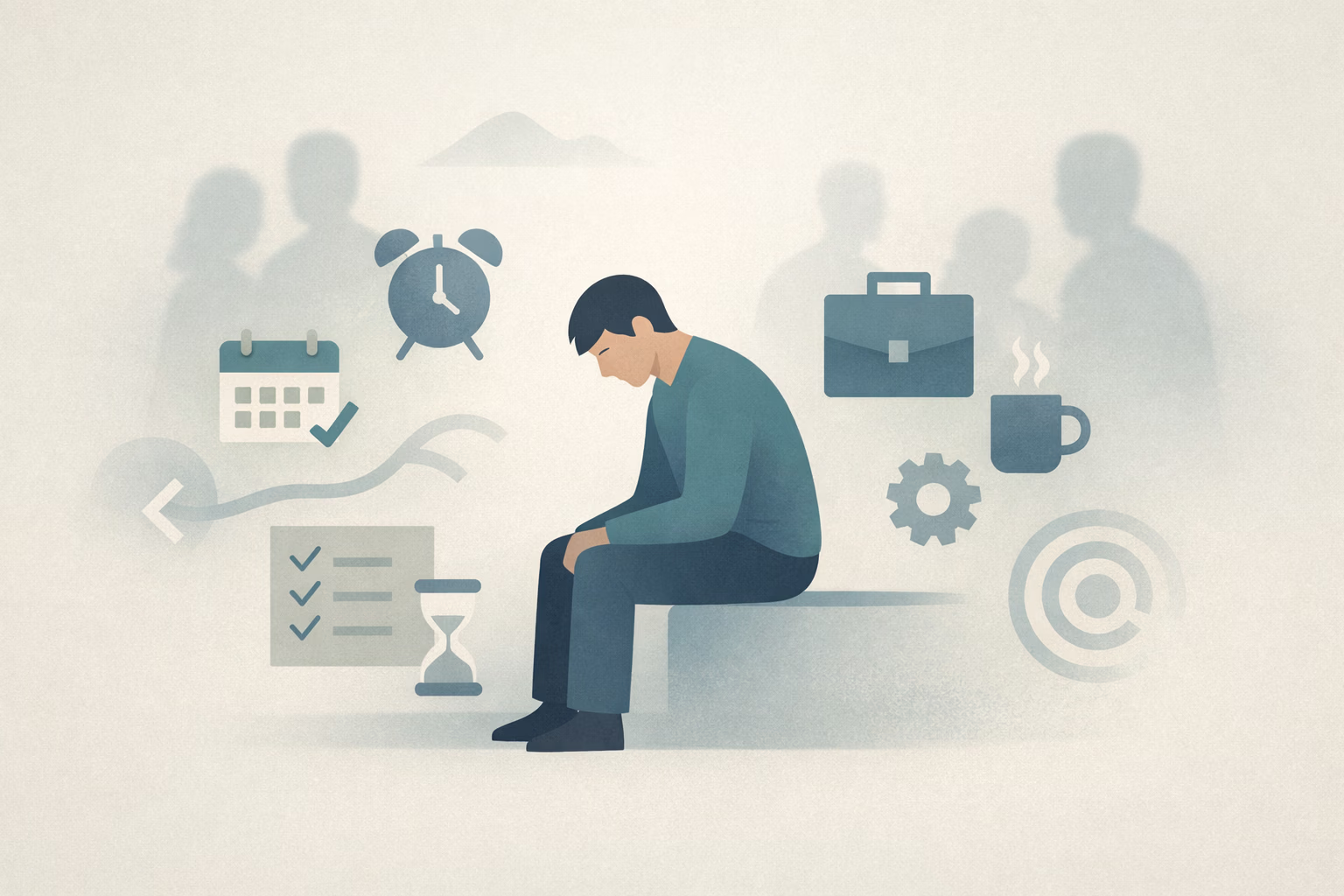
Avoiding Discomfort: The Modern Epidemic

In short: Workaholism is often described like a personality trait: ambitious, driven, intense. But for many people, it functions more like an escape hatch—an efficient way to step out of inner discomfort by stepping into tasks, metrics, and motion.
Workaholism is often described like a personality trait: ambitious, driven, intense. But for many people, it functions more like an escape hatch—an efficient way to step out of inner discomfort by stepping into tasks, metrics, and motion.
This doesn’t mean someone is broken or “avoiding feelings” in a moral sense. It means their system has learned that work reliably reduces internal noise. When pressure is high and closure is scarce, productivity can become a kind of temporary shelter—structured, rewarded, socially legible.
What if the pull to stay busy isn’t a character flaw, but a sign your system is searching for steadiness and completion?
Many people recognize a specific pattern: during work, there is traction—clarity, urgency, a sense of purpose. Then a meeting ends, the laptop closes, the weekend opens… and something unsettled arrives. Not necessarily sadness or fear—often just agitation, flatness, or a hard-to-name restlessness.
That contrast is important. It suggests that “being busy” isn’t only about achievement; it’s also about state. Work can organize attention so thoroughly that the body gets a break from ambiguity. When work stops, what returns is not a personal failure—it’s the nervous system re-encountering unclosed loops. [Ref-1]
Sometimes the most uncomfortable part of rest isn’t boredom. It’s the absence of a script.
Work often provides three stabilizers at once: clear demands, measurable progress, and external feedback. That combination can downshift inner uncertainty by replacing it with a track you can run on. In biological terms, predictable sequences and visible outcomes tend to reduce cognitive load and create a sense of safety through order.
It also recruits reward and reinforcement systems: checkmarks, inbox zero, praise, money, performance ratings. These signals can temporarily quiet distress by offering quick “done” moments—even if the deeper life themes underneath remain incomplete. Research has linked work addiction patterns with emotion dysregulation and other compulsive coping loops, suggesting that overwork can operate like a self-soothing mechanism rather than a simple preference. [Ref-2]
Not because work is bad—but because it’s reliable.
Humans evolved in groups where contribution mattered. Being helpful, skilled, and dependable increased protection and belonging. In that context, “I am useful” wasn’t a branding statement—it was a safety cue.
Modern workaholism can borrow that ancient logic. Productivity becomes more than output; it becomes a social survival signal: a way to feel anchored in value, legitimacy, and place. When life feels unstable, usefulness can feel like the most defensible identity available. This fits with models that conceptualize workaholism through an addiction framework where negative internal states can trigger work as regulation. [Ref-3]
Work narrows the field of attention. It offers immediate problems to solve, timelines to manage, and roles to perform. That narrowing can be profoundly relieving when internal experience feels diffuse, unresolved, or too complex to hold all at once.
From a structural perspective, immersion changes what the system has to process. Instead of open-ended social tension, ambiguous identity questions, or unfinished grief-like experiences, there is a concrete task with a clear next step. In the short term, this can reduce internal chaos and provide emotional discharge through effort and completion signals. [Ref-4]
The tricky part is that work can create “state relief” without creating closure. You can feel better while moving, and worse when still—not because rest is dangerous, but because the underlying experiences never reached a finished state.
Over time, bypassed completion tends to amplify load. Detachment gets harder, rumination increases, and the nervous system becomes more sensitized to downtime—because downtime is where the backlog becomes audible. Research on workaholism links it with reduced psychological well-being and difficulty disengaging, with rumination playing a meaningful role. [Ref-5]
Relief changes how you feel. Closure changes what needs to be carried.
In a Power Loop, the system learns a specific equation: more control equals more stability. Work is an ideal vehicle for this because it offers levers—planning, monitoring, improving, responding. It also offers validation—numbers, recognition, promotions, “neededness.”
When internal experience lacks coherence, control can become a stand-in for completion. Validation can become a stand-in for belonging. This is not vanity; it’s regulation. Some clinical descriptions of work addiction highlight overworking as a way to cope with distress and inadequacy, reinforced by the short-term relief it brings. [Ref-6]
Control is often what the nervous system reaches for when closure is missing.
Workaholism doesn’t always look like long hours. Often it looks like an inability to fully “stand down.” The body stays on-call, scanning for the next problem, the next improvement, the next signal of worth.
Common patterns include: [Ref-7]
These are not identities. They are regulatory strategies that became automatic under sustained load.
When work becomes the primary stabilizer, other stabilizers weaken. Relationships can start to feel like interruptions instead of refuge. The body’s signals become background noise. Meaning narrows into performance. Even success can feel oddly thin—because the system never receives a deep “done” signal.
Over time, chronic overworking is associated with burnout, emotional disconnection, and relational strain. Many accounts of work addiction emphasize validation-seeking alongside significant personal and interpersonal costs. [Ref-8]
The painful irony: the very strategy that once created steadiness can gradually reduce the capacity for steadiness outside of work.
Once the system learns that action is the fastest exit from discomfort, it repeats the pathway. Not out of stubbornness, but because reinforcement is powerful: work reduces unpleasant activation quickly, and the environment often rewards it.
Over time, the nervous system becomes trained to flee inward complexity through outward motion. Pauses begin to trigger urgency. Silence begins to feel like a problem to solve. This is one reason workaholism can feel compulsive—less like a choice and more like a gravitational pull toward the one place that reliably organizes the body. Descriptions of “overworking to avoid life” capture this functional escape dynamic. [Ref-9]
When stillness consistently equals unfinishedness, movement starts to feel like safety.
People often assume the opposite of workaholism is “trying to relax” or “getting better at rest.” But the deeper pivot is not a mindset shift. It’s what happens when previously unclosed experiences begin to reach completion—internally and relationally—so the body no longer has to outrun them.
As capacity returns, discomfort becomes less like an emergency and more like information. Not because you interpret it better, but because the nervous system is no longer overloaded by it. Some therapeutic perspectives describe workaholism as distraction from difficult inner states, with change involving increased tolerance for discomfort and direct regulation rather than constant task-driven relief. [Ref-10]
When closure increases, the need for escape decreases.
Humans regulate best in environments that provide safety cues: steady connection, predictability, and a sense of being met. When relationships feel risky—too much evaluation, too little reliability—work can become the place where you feel least exposed.
But when relational contexts are stable enough, the system doesn’t have to use productivity as armor. Shared reality helps experiences finish. Being understood reduces the pressure to prove. In many discussions of workaholism, overwork is described as a cover for unresolved pain, with relational costs accumulating over time. [Ref-11]
In this sense, connection isn’t “support” as an add-on; it’s a biological condition that changes what the nervous system must manage alone.
Rest can feel intolerable when it functions like a spotlight on everything that never got resolved. But when load reduces and more life experiences reach completion, rest stops feeling like a threat to identity. It becomes neutral territory—sometimes even replenishing.
In that state, emotions don’t need to be chased or dramatized to matter. They become proportionate signals: indicators of needs, boundaries, and meaning. Work loses its compulsive grip because it’s no longer the only reliable regulator. Discussions of avoidance coping often note how “staying busy” postpones discomfort while keeping the underlying tension active. [Ref-12]
Rest isn’t laziness. Sometimes it’s the first evidence that the system finally believes it can stand down.
Work can be meaningful—deeply. The goal is not to strip it of importance. The shift is in function: from using work to outrun inner unfinishedness, to letting work express values, skill, and contribution.
When work is no longer an escape, it becomes easier to sense its real shape: what fits, what drains, what aligns, what’s performative. In addiction frameworks, escapism can intensify emotional load over time; moving away from escape restores access to reality and choice. [Ref-13]
In coherence, work becomes one part of identity—not the entire container that holds it together.
If work has become the place you go to feel steady, that says something tender and intelligent about your system: it found a reliable way to reduce load in an environment that didn’t offer enough closure.
Seen this way, workaholism isn’t proof you’re shallow, avoidant, or incapable of presence. It can be a signal of unmet needs for safety, belonging, and completion—needs that don’t respond well to pressure or self-critique. Many discussions of escapism in addiction emphasize that the behavior is often a pathway away from pain, even when it creates new costs over time. [Ref-14]
Agency often returns not through force, but through coherence: when your life provides enough “done” signals that you no longer have to earn your right to be here by staying in motion.
Productivity is at its healthiest when it follows wholeness—not when it replaces it. When your system is not constantly bracing, work can be focused without being consuming, meaningful without being compulsory.
In the reward trap, it can feel like you must keep producing to stay safe, valued, or real. But the deepest stability doesn’t come from endless output; it comes from a life that can complete experiences, return to baseline, and let identity be larger than performance. [Ref-15]
From theory to practice — meaning forms when insight meets action.
Because during work there's traction — clarity, urgency, structure, measurable progress. Then the laptop closes and the noise arrives: agitation, flatness, a hard-to-name restlessness. The article frames this contrast as important: being busy isn't only about achievement, it's about state. Work organizes attention so thoroughly that the body gets a break from ambiguity. When work stops, what returns isn't personal failure — it's the nervous system re-encountering unclosed loops. The most uncomfortable part of rest isn't boredom but the absence of a script. Work has been doing regulatory work all along.
More functional than dispositional. The article reframes ambition and intensity as often masking something structural: a system that learned work reliably reduces internal noise. Work provides three stabilizers at once — clear demands, measurable progress, external feedback — which downshift inner uncertainty by replacing it with a track to run on. It also recruits reward systems with quick Done moments. But that's state relief, not closure. Workaholism research links overwork patterns with emotion dysregulation and rumination, suggesting overwork operates as self-soothing rather than simple preference. Not because work is bad — because it's reliable when other forms of completion are scarce.
Through the equation: more control equals more stability. The article frames work as an ideal vehicle for this — it offers levers (planning, monitoring, improving, responding) and validation (numbers, recognition, neededness). When internal experience lacks coherence, control becomes a stand-in for completion and validation becomes a stand-in for belonging. That's not vanity; it's regulation. Once the system learns action is the fastest exit from discomfort, it repeats the pathway. Pauses begin to trigger urgency, silence becomes a problem to solve. The behavior feels compulsive because it's a gravitational pull toward the one place that reliably organizes the body.
Closure of underlying loops, not better relaxation skills. The article frames the deeper pivot as not a mindset shift but what happens when previously unclosed experiences reach completion — internally and relationally — so the body no longer has to outrun them. Co-regulation matters because relationships that provide safety cues reduce the pressure to use productivity as armor. When connection is stable, the system doesn't have to manage everything alone. Rest stops functioning like a spotlight on what's unresolved. Discomfort becomes information rather than an emergency. Work returns to expressing values rather than escaping pain — productivity becomes one part of identity rather than the container holding it all together.
From Science to Art.
Understanding explains what is happening. Art allows you to feel it—without fixing, judging, or naming. Pause here. Let the images work quietly. Sometimes meaning settles before words do.
One Quiet Window, one insight, one reflection — every Sunday