

Logotherapy and Meaning: A Plain-English Map of Frankl's Framework
Viktor Frankl's framework for living through meaning, not motivation — the three pillars, three sources, and where modern research has caught up.
Evidence & intent (DojoWell standard)
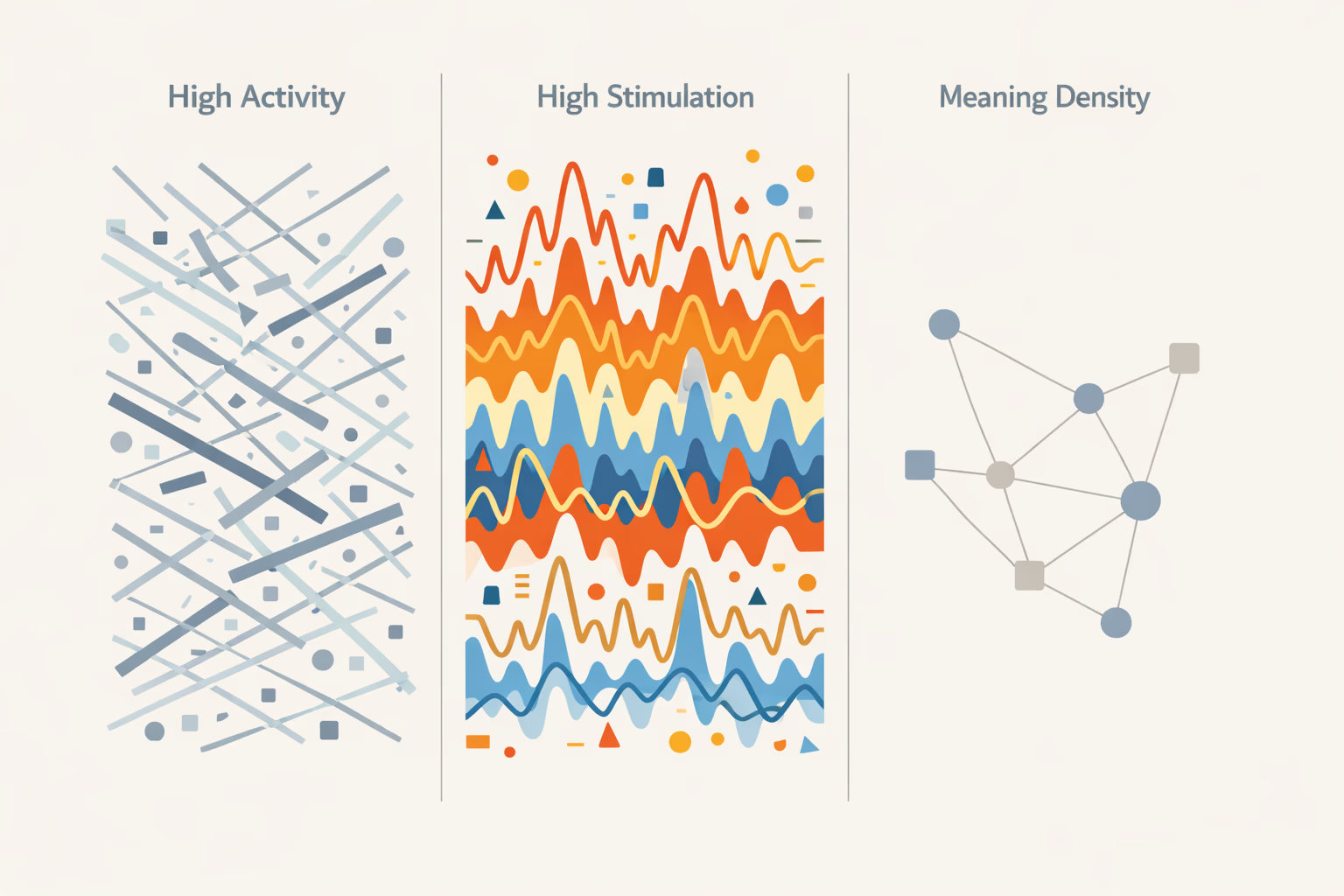
This page is educational and non-clinical. It maps Viktor Frankl's logotherapy — the three pillars, three sources of meaning, and modern empirical heirs — to research in meaning psychology and eudaimonic well-being. It also shows how DojoWell's named concepts (Meaning Density, the Done Signal, the seven-level journey, the Values Aura) sit inside that framework. Logotherapy here is treated as a structural model, not a clinical instrument; DojoWell complements therapy, it does not replace it.
Document status
Logotherapy and Meaning — Frankl explainer (v1.0)
First published: May 2026
Scope: Educational. Maps Frankl's logotherapy to modern empirical work on meaning, purpose, and eudaimonic well-being, and shows how DojoWell operationalises the framework. Not therapy, not diagnosis, not a substitute for clinical care.
1 I. What Logotherapy Actually Is
Logotherapy is a school of psychotherapy founded by Viktor Frankl that treats the search for meaning as the primary motivational force in human life.
The name comes from the Greek logos — translated by Frankl as "meaning" rather than "word" or "reason." Where Freud put pleasure at the centre of human motivation, and Adler put power, Frankl placed meaning. Logotherapy was the Third Viennese School of Psychotherapy: not a rejection of the first two, but a claim that beneath both pleasure-seeking and power-seeking sits a deeper, more durable orientation — the will to meaning (Frankl, 1969).
It is useful here to be precise about what logotherapy is not. It is not cognitive behavioural therapy (CBT): CBT works on the content and accuracy of thoughts, while logotherapy works on the structure of meaning beneath the thoughts. It is not positive psychology in the Seligman tradition: positive psychology cultivates positive states (gratitude, flow, engagement), while logotherapy treats meaning as the prior cause of which positive states are downstream. And it is not the traditional philosophical "meaning of life" question — Frankl was uninterested in the abstract meaning of life in general, and intensely interested in the meaning of this person's life, right now, in this situation. The question turns from "what is the meaning of life?" to "what is life asking of me?"
This shift — from asking life for an answer to letting life ask the question — is the structural move that distinguishes logotherapy from almost every other framework that uses the word "meaning."
2 II. Frankl in Three Paragraphs
Frankl's framework was not built in a lecture hall. It was tested, before it was published, under conditions where almost every other source of motivation had collapsed.
Viktor Emil Frankl (1905–1997) was a Viennese neurologist and psychiatrist who had already begun developing his ideas about meaning before the Second World War. In 1942 he was deported with his family to the Theresienstadt ghetto, and over the following three years he was held in four concentration camps including Auschwitz and Dachau. His wife, his parents, and his brother were murdered. He survived. After liberation in 1945 he returned to Vienna and, in nine days of dictation, produced the book that became Man's Search for Meaning (Frankl, 1946) — first published in German under a title that translates roughly as "Saying Yes to Life Despite Everything."
The camp section of the book is brief but precise. Frankl observed that survival in the camps did not correlate cleanly with physical strength, intelligence, or prior status. What did correlate — though never deterministically — was whether a prisoner could continue to find something to live for: a person to return to, a task to complete, a stance to hold. Where that thread of meaning was cut, prisoners often died within days, regardless of physical condition. Where it was held, even in fragments, the same person could survive conditions that broke others. The observation was not romantic — Frankl was clear that many people held meaning and still died — but it was structural. Meaning could survive in conditions under which motivation could not.
After the war Frankl held the chair of neurology and psychiatry at the University of Vienna and the Vienna Polyclinic Hospital for the rest of his career. He extended the framework in The Doctor and the Soul (Frankl, 1986; first German edition 1946), The Will to Meaning (Frankl, 1969), and The Unheard Cry for Meaning (Frankl, 1978). The Vienna Third School became an internationally taught approach, and the existential-analytic tradition that grew from it now overlaps substantially with modern meaning-centred psychotherapy and acceptance and commitment work.
3 III. The Three Pillars of Logotherapy
Logotherapy rests on three claims that Frankl returned to across forty years of writing.
1. The Will to Meaning
The primary motivational force in a person is the search for meaning, not pleasure (as Freud held) and not power (as Adler held). When the will to meaning is frustrated — when life feels coherent but pointless, or pleasant but empty — Frankl described the resulting state as the existential vacuum, expressed often as boredom, apathy, or a vague sense that nothing quite lands (Frankl, 1969). It is not the same as depression, although the two can coexist; it is a meaning deficit, and it tends to respond to changes in meaning structure rather than to mood-targeted interventions.
2. Freedom of Will
Within any set of circumstances — including circumstances as constrained as a camp — a person retains the freedom to choose their stance toward those circumstances. This is not freedom in the libertarian-philosophy sense, and Frankl was explicit that it is not unconditional. People are conditioned by biology, history, and environment. But conditioning is not the same as determination. There is a space, sometimes very small, between stimulus and response, and the work of meaning happens in that space. The famous formulation — sometimes attributed to Frankl, sometimes paraphrased — is that between stimulus and response there is a space, and in that space lies our power to choose our response (Frankl, 1946).
3. The Meaning of Life
Life has meaning under any conditions, including the worst imaginable, but the meaning is always concrete and situated — never abstract. The question is not "what is the meaning of life?" in general, but "what does this life ask of me, in this moment, given these people and these circumstances?" Meaning is therefore something a person discovers and responds to, not something they invent or assign. The implication is non-trivial: the work is to listen for what the situation is asking, not to project a self-chosen purpose onto it (Frankl, 1969; Frankl, 1978).
4 IV. The Three Sources of Meaning
Frankl identified three pathways through which meaning can be found in any life. These he called creative, experiential, and attitudinal values.
1. Creative values — what we give to the world
Meaning arrives through what we create, contribute, or do. Frankl's examples include work, craftsmanship, raising children, scientific research, art — anything where the person gives something to the world that would not exist without them. The modern parallel is clear: the contribution of a teacher to a student, of a craftsperson to an object, of a parent to a household, of an employee to a project they actually believe in. Creative values are the most visible source of meaning, and the one most modern cultures privilege — which is why work and productivity often masquerade as meaning even when they are not. Frankl's distinction is important: work itself is not meaning. Work that gives something to the world is.
2. Experiential values — what we receive from the world
Meaning arrives through what we take in — encountering beauty, truth, or another person fully. Frankl's examples include love, deep aesthetic experience, the apprehension of nature, encountering a person in their full particularity rather than as a function or category. The modern parallel: the experience of being in a place that arrests attention, of being known by another person, of recognising something true in a piece of music or a sentence. Experiential values are often missed in modern life because they require slow, undistracted attention — and most modern environments engineer the opposite. A walk without a phone, a meal eaten with attention, a conversation conducted without secondary screens — these are the small environments in which experiential meaning can land.
3. Attitudinal values — the stance toward unavoidable suffering
Frankl's most distinctive contribution. When suffering cannot be removed — through illness, loss, injustice, mortality — meaning can still be found in the stance a person takes toward it. This is not a denial of suffering, and Frankl was careful never to romanticise it ("there is no need to seek out suffering in order to find meaning," he wrote; if suffering is avoidable, removing its cause is the meaningful act). But when it is unavoidable, the way a person holds it becomes itself a form of meaning. The modern parallel is the parent caring for a dying child, the patient living through chronic illness, the worker surviving an unjust system without becoming the system. Attitudinal values are the load-bearing pillar of logotherapy: they explain how meaning can survive when the other two sources are stripped away (Frankl, 1946; Frankl, 1969).
Together, these three sources give logotherapy its breadth: there is no life so constrained that none of the three is available. A person without the freedom to create can still receive; a person without the freedom to receive can still choose a stance. The framework is structurally generous in a way that few other psychologies are.
5 V. Modern Empirical Evidence
For much of the twentieth century, "meaning" was treated by mainstream psychology as too soft to study. That changed in the 2000s.
Ryan and Deci's review of hedonic versus eudaimonic well-being (2001) gave the field a working distinction: hedonic well-being is feeling good, while eudaimonic well-being is living in accordance with one's values and potential — much closer to Frankl's territory. Across subsequent studies, eudaimonic measures tend to predict more durable outcomes (resilience, mortality, recovery from adversity) than hedonic measures alone.
Michael Steger and colleagues developed the Meaning in Life Questionnaire (Steger et al., 2006), which separates presence of meaning (do I experience my life as meaningful?) from search for meaning (am I actively seeking it?). The instrument is now one of the most widely used in the field and has enabled hundreds of studies linking presence of meaning to lower depression, better health behaviours, and greater life satisfaction across cultures.
Crystal Park's integrative review (Park, 2010) consolidated the meaning-making literature into a model in which adjustment to stressful events depends on the distance between global meaning (how a person understands their life overall) and situational meaning (how they understand a specific event). When the gap is too large, the system works to close it — through reappraisal, behavioural change, or revision of global meaning itself. The framework is now a standard reference in research on trauma recovery, grief, and chronic illness adjustment.
Hill and Turiano's prospective study of purpose in life as a predictor of mortality (Hill & Turiano, 2014) followed over 6,000 adults and found that higher purpose in life was associated with lower all-cause mortality across the adult lifespan, controlling for other psychological and demographic factors. Subsequent work — including a meta-analysis by Cohen et al. (2016) — has extended the finding to cardiovascular outcomes specifically. Damon, Menon and Bronk's developmental work on purpose in adolescence (Damon, Menon & Bronk, 2003) showed that adolescents with a clearly identified purpose report greater life satisfaction and engagement than those without one.
The composite picture is that meaning is good for you in a literal, measurable sense, and that what Frankl described from observation in the 1940s has since been substantially supported by quantitative work. It is no longer just philosophy.
6 VI. How Logotherapy Differs from CBT and Positive Psychology
All three frameworks help people, but they work on different layers. Understanding which layer each one addresses is useful for deciding what to use, and when.
Cognitive behavioural therapy works on the content and accuracy of thoughts. If a person thinks "nobody likes me" when in fact several people do, CBT helps them notice the distortion and replace it with a more accurate appraisal. CBT is the most rigorously studied psychotherapy of the modern era, and the appropriate first-line treatment for many anxiety and mood conditions. But CBT works above the meaning layer: it does not ask why this particular thought matters so much in the first place. Two people with the same thought distortion may need very different interventions, because one of them holds the thought inside a life that feels meaningful and the other does not.
Positive psychology, as developed by Martin Seligman and colleagues from 1998 onward, cultivates positive states — gratitude, flow, savouring, character strengths. The evidence base is substantial, and the interventions are well-designed. But positive psychology treats well-being as the primary target. Logotherapy, by contrast, treats well-being as a downstream consequence of meaning structure. From a Franklian point of view, a person who pursues happiness directly will often miss it; happiness arrives as a side-effect of having found something worth giving oneself to. This is not a refutation of positive psychology — Seligman's later PERMA model explicitly includes meaning as a pillar — but it is a difference in causal ordering.
Logotherapy, then, sits at the meaning layer beneath both. CBT clarifies distorted thoughts. Positive psychology cultivates positive states. Logotherapy works on the meaning structure that determines which thoughts feel important and which states feel worth having. For many people the most useful frame is layered: CBT for the immediate distortion, logotherapy for the underlying orientation, positive psychology practices to support both.
7 VII. How DojoWell Operationalises Logotherapy
DojoWell does not treat logotherapy as a citation. It treats it as the structural backbone of the product.
The Values Aura is a values-discovery surface organised around Frankl's three sources of meaning. Creative values surface as questions about what a person gives to the world — work, craft, relationships, contribution. Experiential values surface as questions about what they take in — beauty, presence, encounter. Attitudinal values surface as questions about the stance taken toward what cannot be changed. The intent is not to invent values for the user but to help them notice which values are already operating in their life, which sources are full, and which are starved (Frankl, 1969). The Aura is a structured mirror, not a personality test.
The seven-level journey is meaning-first rather than skill-first. Most habit and wellness apps stack techniques and assume meaning will follow. Logotherapy reverses the order: clarify meaning structure first, then technique becomes available because there is now something for it to serve. The early levels of the DojoWell journey are explicitly oriented toward orientation, awareness, and values — not toward behaviour change targets. Skill-stacking comes later, once the meaning frame is in place (Frankl, 1969; Meaning-First Burnout Recovery).
The Done Signal treats closure as a meaning event rather than a motivational event. Most apps reward completion with points, streaks, or stimulation. Logotherapy reframes completion as something the nervous system can register only when the action meant something — when it connected to a value the person actually holds. The Done Signal is the felt sense of an action having landed inside a meaning structure, not the dopamine bump of a tick-box (Frankl, 1946; see also the Done Signal explainer).
The Matrix of Loops — Pleasure, Power, Avoidance — is read through the Franklian lens as three modern forms of the existential vacuum: stimulation substituting for meaning (Pleasure), control substituting for meaning (Power), withdrawal substituting for meaning (Avoidance). The treatment is not loop-suppression but meaning-restoration; once the underlying meaning structure has thickened, the loops tend to loosen because their psychological function has been met by something more durable (Frankl, 1978).
The framework keeps DojoWell honest. The named concepts earn their keep by sitting inside Frankl's structure; they are not branded jargon for ordinary CBT. For the broader integrative explainer, see The Science of DojoWell.
8 VIII. What Logotherapy Is NOT
A few common misreadings, stated plainly.
- Logotherapy is not religious therapy. Frankl held that meaning is available to people of any faith or none, and was emphatic that the framework does not require belief in a particular metaphysics. Religious frameworks may provide meaning structures for those who hold them, but logotherapy itself does not depend on them.
- Logotherapy is not a cure for depression. It can support adjustment, motivation, and recovery, but clinical depression often requires properly evidence-based treatment — medication, CBT, IPT, or other modalities. If a person is in crisis or has a diagnosed condition, logotherapy is a complement, not a replacement.
- Logotherapy is not a substitute for clinical care. DojoWell makes the same disclaimer for itself. Frankl trained as a neurologist and psychiatrist; he was unambiguous that logotherapy belongs alongside, not above, other clinically validated treatments.
- Logotherapy is not "find your why" pop-business advice. The shape can look superficially similar — both ask about purpose — but the depth differs. Pop-purpose framings tend to ask the person to choose a purpose, project it onto their life, and then optimise toward it. Frankl's framework asks the person to discover what life is asking of them and respond to it. The difference is whether meaning is invented or recognised.
Naming the limits is part of taking the framework seriously. Logotherapy is structural, not magical; it does specific work in a specific layer of the human system, and it works best when used inside its actual scope.
9 IX. References
- Cohen, R., Bavishi, C., & Rozanski, A. (2016). Purpose in life and its relationship to all-cause mortality and cardiovascular events: A meta-analysis. Psychosomatic Medicine, 78(2), 122–133. PubMed
- Damon, W., Menon, J., & Bronk, K. C. (2003). The development of purpose during adolescence. Applied Developmental Science, 7(3), 119–128. DOI
- Frankl, V. E. (1946). Man's Search for Meaning. Beacon Press. Publisher
- Frankl, V. E. (1969). The Will to Meaning: Foundations and Applications of Logotherapy. New American Library. Publisher
- Frankl, V. E. (1978). The Unheard Cry for Meaning: Psychotherapy and Humanism. Simon & Schuster.
- Frankl, V. E. (1986). The Doctor and the Soul: From Psychotherapy to Logotherapy (3rd ed.). Vintage. (First German edition 1946.)
- Hill, P. L., & Turiano, N. A. (2014). Purpose in life as a predictor of mortality across adulthood. Psychological Science, 25(7), 1482–1486. PubMed
- Park, C. L. (2010). Making sense of the meaning literature: An integrative review of meaning making and its effects on adjustment to stressful life events. Psychological Bulletin, 136(2), 257–301. PubMed
- Park, C. L., & George, L. S. (2013). Assessing meaning and meaning making in the context of stressful life events: Measurement tools and approaches. The Journal of Positive Psychology, 8(6), 483–504. DOI
- Ryan, R. M., & Deci, E. L. (2001). On happiness and human potentials: A review of research on hedonic and eudaimonic well-being. Annual Review of Psychology, 52, 141–166. PubMed
- Smith, B. W., & Hill, P. L. (2009). The role of purpose in life in recovery from adversity. In P. T. P. Wong (Ed.), The Human Quest for Meaning. Routledge.
- Steger, M. F., Frazier, P., Oishi, S., & Kaler, M. (2006). The Meaning in Life Questionnaire: Assessing the presence of and search for meaning in life. Journal of Counseling Psychology, 53(1), 80–93. DOI
- Wong, P. T. P. (2012). The Human Quest for Meaning: Theories, Research, and Applications (2nd ed.). Routledge.
- Yalom, I. D. (1980). Existential Psychotherapy. Basic Books.
DojoWell is not affiliated with the Viktor Frankl Institute, the cited researchers, or their publishers. References are provided for verification of claims made on this page. Outbound research links use rel="nofollow". For the broader integrative explainer of DojoWell's full research base, see The Science of DojoWell. For related concept pages, see Meaning Density, the Done Signal, the Meaning-First Burnout Recovery pillar, and about the author.