Endless Scrolling: The Internet’s Most Addictive Loop
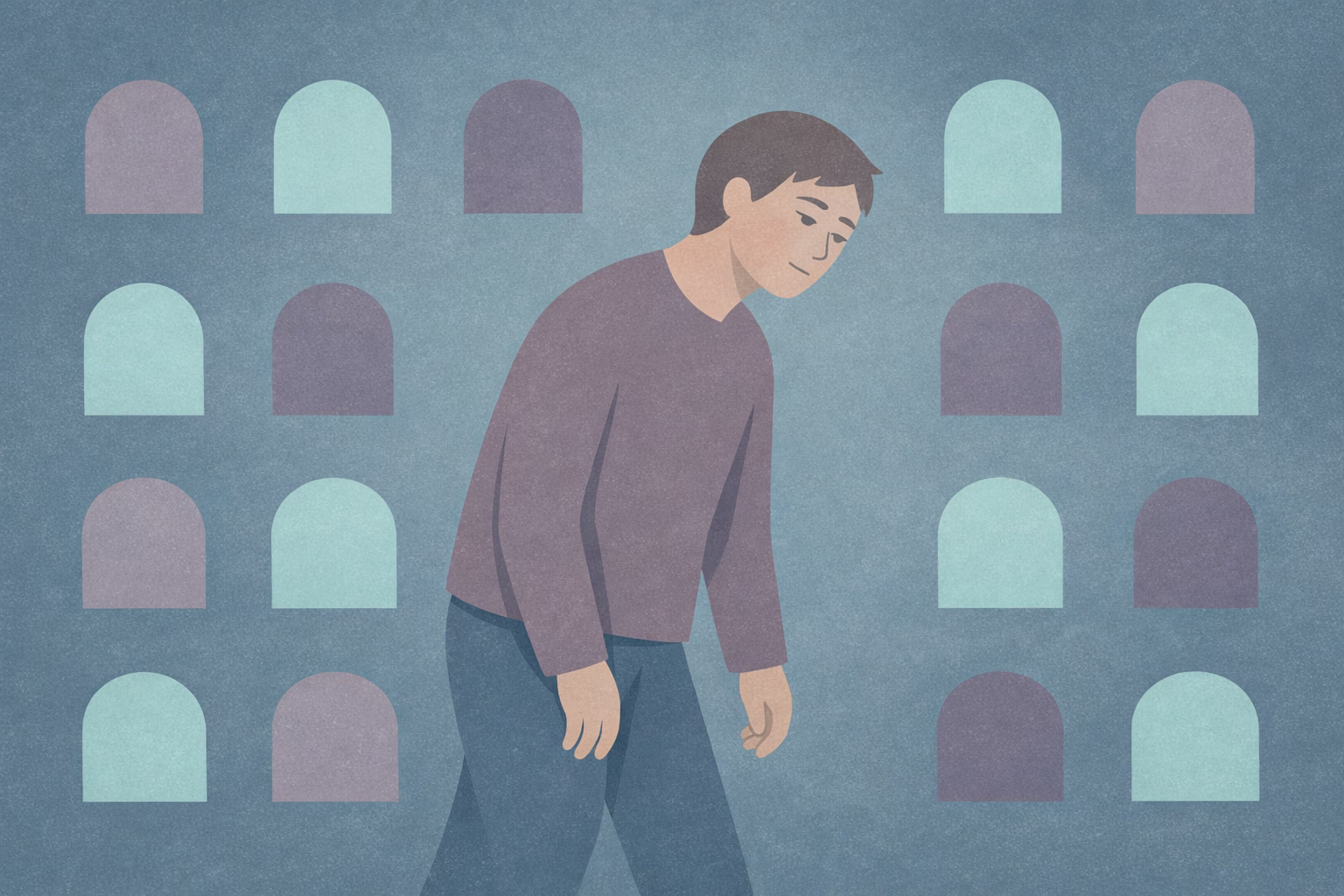
In short: Many people have a familiar moment: your phone is suddenly in your hand, an app is open, and you’re already scrolling before you can name what you came for. It can feel confusing—especially when you weren’t even particularly interested.
Many people have a familiar moment: your phone is suddenly in your hand, an app is open, and you’re already scrolling before you can name what you came for. It can feel confusing—especially when you weren’t even particularly interested.
This isn’t a character flaw or a lack of discipline. It’s what happens when a brain built to conserve energy meets an environment engineered for instant reward, frequent cues, and very few natural endings.
What if “opening the same apps” is less about wanting them—and more about your system seeking quick closure and low-cost regulation?
Autopilot app opening often shows up as a time-skip. You might unlock your phone to check one thing, then notice you’re in a completely different app. Or you open the same two or three apps in a loop, not because you decided to, but because your hands already know the route.
That late realization can bring a quick wave of self-judgment: Why did I do that again? But what’s actually happening is usually simpler: a cue pulled a well-worn routine online before your conscious intention fully arrived. In research on smartphone habits, relevant cues are strongly linked to habitual use—especially when the behavior is repeated in the same contexts. [Ref-1]
Habits aren’t powered mainly by “liking.” They’re powered by prediction. A cue (boredom, a pause, a notification, a hard email, a quiet elevator ride) becomes linked to an expected payoff (novelty, relief, social signal, a micro-hit of completion). Over time, the body starts preparing for the reward as soon as the cue appears.
This is why the urge can feel like it precedes thought. The sequence can look like: cue → anticipation → movement. That anticipation is part of dopamine’s broader role in learning and reward prediction, not just pleasure. [Ref-2]
Once the movement is learned, it becomes motor memory: unlock, swipe, tap. The routine is efficient, fast, and runs with minimal cognitive cost—which is exactly what the nervous system tends to do under load.
Your brain is designed to turn repeated actions into defaults. That’s how humans free up resources for what’s new, uncertain, or high-stakes. In an older environment, automation kept you alive: paths to water, scanning for threats, checking the perimeter, returning to known food sources.
In a modern environment, the same efficiency can quietly bind to small, repeatable digital routines—especially when those routines reliably change state quickly. Habitual phone and social media use has been linked with task delay in some groups, suggesting that automated checking can “take the wheel” precisely when tasks feel effortful or incomplete. [Ref-3]
So when you open an app without thinking, it’s often your system doing what it does best: selecting the lowest-effort familiar route to a predicted outcome.
App checking is unusually effective at changing internal state fast. It offers novelty, social information, and tiny “did something” signals—without requiring much setup. When there’s a gap in the day (waiting, transitioning, hesitating), the phone provides instant texture.
Importantly, the reward is not always excitement. Sometimes it’s relief: a brief reduction in the discomfort of not-knowing, not-yet, or not-finished. That’s why checking can happen even when the content isn’t enjoyable.
Research on mobile checking habits suggests that frequent checking can predict distractibility even when it isn’t framed as “problematic use,” pointing to how ordinary, low-effort checking can shape attention. [Ref-4]
Because the behavior is so easy, it can start to happen in more places than you intend—during transitions, between sentences, while cooking, during conversations, in the first seconds after waking. The app becomes a default bridge between moments.
That default bridging has a cost: attention stops feeling like something you direct and starts feeling like something that gets pulled. Not because you’re “weak,” but because the environment supplies constant cues and your brain responds efficiently.
Over time, the drift can feel like a loss of authorship: time passes, tasks fragment, and the day contains fewer segments that feel complete. Studies in mobile and ubiquitous computing have highlighted how pervasive device use can reshape patterns of attention and interruption. [Ref-5]
Autopilot checking often stabilizes as a Pleasure Loop: a repeating cycle where a cue triggers a routine that delivers a small reward quickly enough to reinforce the entire sequence. The key ingredient isn’t intensity—it’s reliability.
When the reward is easy and the cost is low, the loop becomes a dependable regulator. It’s especially likely to strengthen when your baseline load is high: stress, uncertainty, social friction, or a backlog of unfinished responsibilities. In that state, the nervous system prefers predictable, low-demand rewards.
Models of addictive or compulsive smartphone behavior often emphasize how reinforcement, impulsivity traits, and environmental cues can combine to maintain repeated checking. [Ref-6]
Autopilot phone use is often less dramatic than people imagine. It can look “normal” on the outside—just quick checks—yet still be highly patterned.
Research on smartphone habits describes how repeated, context-linked use can become pervasive and self-maintaining, even without strong conscious intent. [Ref-7]
One reason this pattern is hard to notice is that each episode is small. It’s “just a second.” But many small interruptions create a specific cognitive atmosphere: intention gets thinner, transitions get noisier, and focus becomes more effortful to re-enter.
This isn’t because you lack awareness. It’s because rapid switching reduces the chance for a clean “closing signal.” Without closure, the nervous system stays slightly mobilized—ready for the next cue, the next update, the next micro-decision.
Studies linking habitual smartphone/social media use with task delay highlight how automated checking can coexist with reduced follow-through, especially when tasks require sustained engagement. [Ref-8]
When the day is made of fragments, your system keeps searching for a clean landing.
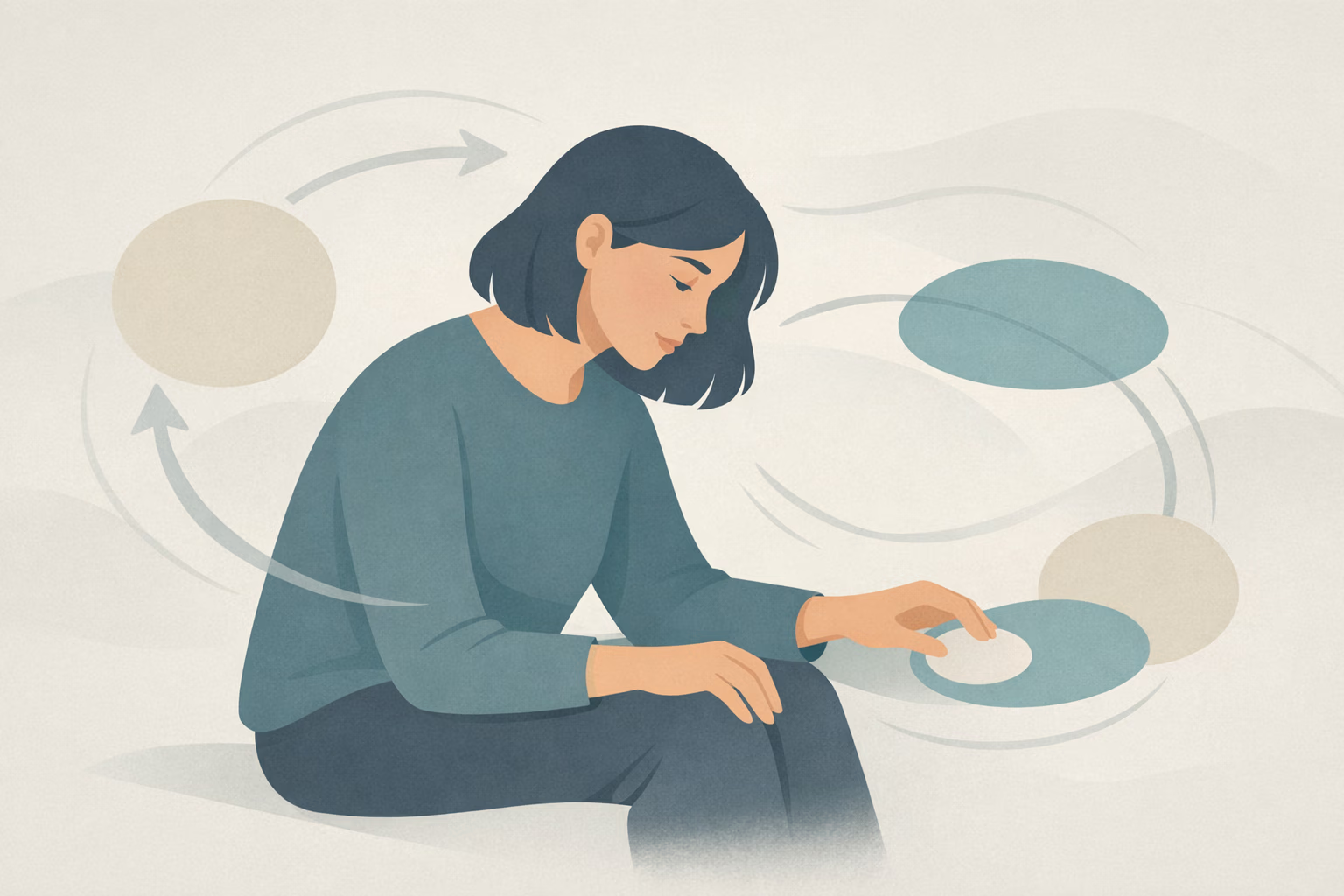
Each time a cue is followed by an app-open and a reward (novelty, social signal, relief, or even a small sense of completion), the cue becomes more potent. The body learns: this is what happens next. That expectation itself becomes motivating—sometimes more than the reward you actually receive.
In other words, the loop isn’t strengthened only by enjoyable content. It’s strengthened by the reliability of the sequence. Research on cue-dependent smartphone habits describes how relevant cues can prompt habitual use automatically, reinforcing the behavior over time. [Ref-9]
Because cues are everywhere—silence, waiting, discomfort, transition—the loop gets many training repetitions per day. That volume matters.
It can help to separate two experiences that feel identical on the surface: “I want this” and “my system is mobilized.” Autopilot checking frequently comes with a subtle urgency—an impulse to resolve a moment, fill a gap, or reduce internal friction.
When urgency is high, the habit runs cleaner. The cue doesn’t need to be strong; the nervous system is already leaning toward quick regulation. This is one reason the same person can feel relatively free around their phone on some days and pulled on others—without any change in morals or motivation.
Habit-loop framing often emphasizes the role of cues and rewards in maintaining routines; what’s easy to miss is how state-dependent those routines can become when the baseline is activated. [Ref-10]
What if the real issue isn’t “why do I keep choosing this,” but “why is my system so available for the cue to choose for me”?
Automated digital rewards tend to dominate when life has fewer experiences that feel complete, absorbing, or identity-confirming. Not grand purpose—just activities that naturally contain beginnings, middles, and ends, and that leave a “done” signal in the body.
When those experiences are present, the phone’s pull often decreases without a fight. Not because you “controlled yourself,” but because your system is already getting steadier closure elsewhere. The appetite for low-effort stimulation softens when there’s more genuine contact with what matters.
Research in adolescents suggests that habitual phone and social media use relates to task delay for some, implying that the quality of engagement with tasks and life context can shape how strong the habit becomes. [Ref-11]
When agency returns, it often doesn’t arrive as a dramatic breakthrough. It shows up as time awareness: you notice the beginning of the movement. You sense the cue earlier. There’s a small gap where your intention can register.
This change is less about forcing yourself to “be present” and more about reduced background pull. With lower load and more closure, the cue loses some of its authority. In studies of smartphone habits, context and space matter—habits can be stronger in environments chosen out of habit, suggesting that predictability and setting play a role in how automatic behavior becomes. [Ref-12]
Compulsivity tends to fade when the loop stops being the most reliable provider of state change and micro-closure. The phone becomes a tool again, not a reflex.
Over time, the most stabilizing shift is not “using your phone less.” It’s a quieter identity-level reorientation: I am someone who chooses where my attention goes. That identity becomes believable when the body repeatedly experiences completion—when moments end cleanly, and your actions leave coherent tracks.
Deliberate use means the behavior has a beginning you recognize and an end that actually ends. It’s not rigid. It’s simply authored. Research on interventions for smartphone use often focuses on self-regulation and checking habits, pointing to how habits can change when patterns become more intentional and less cue-driven. [Ref-13]
Agency isn’t a mood. It’s what becomes possible when your system isn’t constantly recruited by unfinished loops.
In many environments, phone habits become strongest in the same places, at the same times, and under the same internal conditions. That’s not a personal failing; it’s how learning works when cues are consistent and rewards are quick. Research suggests smartphone habits can be stronger in spaces chosen out of habit—highlighting how context quietly steers behavior. [Ref-14]
When you view autopilot checking as a context-trained loop, shame becomes less relevant. The more important question becomes: what is your attention trying to resolve, and where does your life reliably provide “done” signals?
Values don’t need to be forced into the moment. They function more like an orientation—something your system can settle toward when there’s enough space, closure, and reduced noise for choice to be felt.
Noticing you’ve opened an app again can be discouraging. But that moment of noticing is also evidence of something intact: your system can still register authorship.
The pull of the app is often strongest in the anticipatory phase—when the brain predicts a reward and mobilizes you toward it. Dopamine-driven prediction is part of how habits are learned and repeated. [Ref-15]
As life contains more true endings—more experiences that land, integrate, and feel complete—those predictions lose force. And attention, gradually, starts to feel like yours again.
From theory to practice — meaning forms when insight meets action.
The phone is in your hand before intention catches up because a cue triggered a well-worn motor sequence. Cues are everywhere — boredom, a pause between tasks, a quiet elevator, a hard email — and the body has learned that unlock-swipe-tap reliably changes state. Habits aren't powered mainly by liking; they're powered by prediction. Once the cue-to-routine link is built, anticipation does the driving and your conscious 'why' arrives late. This isn't a discipline failure; it's the brain doing what it's designed to do, which is conserve effort by automating any sequence that pays off quickly and predictably in the same contexts.
Often, yes. Checking apps offers a fast change in internal state — novelty, social information, or just relief from the discomfort of not-knowing. That's why the loop runs even when the content isn't enjoyable: the reward is regulation, not pleasure. This is the Pleasure Loop in its quietest form, where reliability matters more than intensity. The loop tends to strengthen when baseline load is high — stress, unfinished tasks, social friction — because the nervous system prefers low-demand rewards under pressure. Naming the behavior as state management rather than weakness usually helps more than naming it as addiction.
Each episode is small, but the cumulative effect is a specific cognitive atmosphere: thinner intention, noisier transitions, harder re-entry into focus. Rapid switching rarely produces a clean closing signal, so the nervous system stays slightly mobilized, primed for the next cue. That's why a day full of micro-checks can leave you tired without any single moment feeling tiring. The day contains few segments that actually finish — and finishing is how the body files things as done. The article frames this as fragmentation: not chaos, just the accumulated cost of never quite landing.
Not usually through willpower. It loosens when the loop stops being the most reliable provider of state change and micro-closure. When life contains more experiences with real beginnings, middles, and ends — work that finishes, conversations that complete, transitions that get marked — the appetite for low-effort stimulation softens on its own. Agency tends to return as time-awareness: you start noticing the cue earlier, sensing the gap before the movement begins. The identity shift isn't 'I use my phone less'; it's 'I am someone who chooses where my attention goes,' and that becomes believable through repeated experiences of completion.
From Science to Art.
Understanding explains what is happening. Art allows you to feel it—without fixing, judging, or naming. Pause here. Let the images work quietly. Sometimes meaning settles before words do.
One Quiet Window, one insight, one reflection — every Sunday